Every affiliate marketer eventually asks the same question: where should I buy traffic? Solo ads, Facebook Ads, or Google Ads? Each one has loud defenders and loud critics, and most of the advice online comes from people who only use one of the three.
This guide compares all three the way an experienced buyer would: speed, cost, ban risk, targeting complexity, and what each one is actually good for. By the end you'll know which platform fits your stage, your budget, and your offer.
The Three Traffic Sources, Explained
Solo ads are paid email blasts. You pay a list owner to send your link to their subscribers. Traffic arrives within 24 to 72 hours, you pay per click, and the seller's job ends at the click. For a deeper primer, see our complete solo ads guide.
Facebook Ads (now Meta Ads) run on an auction system across Facebook, Instagram, Messenger, and the Audience Network. You build creative, define an audience, set a daily budget, and Meta serves your ad to the people most likely to take your chosen action. Targeting is interest- and behavior-based.
Google Ads sells search intent. Someone types a query, and your ad shows above the organic results if you win the auction for that keyword. You're paying for someone actively looking for what you sell, which is the highest-intent traffic on the open internet.
Speed to Traffic
Speed is where solo ads win without much debate.
With a solo ad, you place an order on Monday and traffic typically starts flowing by Tuesday or Wednesday. A 200-click order is usually fully delivered within 72 hours. There's no learning phase, no algorithm to train, no account warm-up.
Facebook Ads need a learning phase. New campaigns under-perform for the first 50 conversions while the algorithm figures out who to show your ad to. Plan on a week minimum before performance stabilizes, and longer if your daily budget is low.
Google Ads can deliver clicks the same day your campaign goes live, but Quality Score takes time to build. Your CPC on day one will be noticeably higher than your CPC after 30 days of consistent click-through and conversion data.
Cost Per Click and Total Spend
Solo ad pricing is fixed and transparent. Tier 1 traffic runs $0.40 to $0.90 per click in 2026. There's no minimum spend, no daily budget requirement. You can test with $50 and walk away if the numbers don't work.
Want Verified Traffic Without the Guesswork?
PulseTraffic screens every seller, filters bot clicks in real time, and shows you verified buyer traffic labels before you spend a dollar.
Facebook Ad costs in the affiliate and MMO niche range from $1.50 to $6.00 per click depending on audience and creative quality. Cost per lead on cold traffic regularly lands in the $5 to $15 range. Daily budgets below $20 usually fail to exit the learning phase.
Google Ads in competitive verticals like finance, insurance, and software easily hit $3 to $20 per click. In the affiliate space, branded competitor terms and direct-response keywords sit at the top of that range. Total budgets under $1,000 a month barely move the needle.
Ban Risk and Account Stability
This is the silent killer most affiliate marketers don't think about until it happens to them.
Solo ads have effectively zero ban risk. There's no platform account that can be shut down. If one seller's list goes stale, you just buy from another. Your business doesn't disappear overnight.
Facebook is famously unforgiving with affiliate offers, biz-opp, crypto, and anything resembling a get-rich-quick angle. Account bans without warning are common, and appeals rarely succeed. Many serious affiliates spend more time rebuilding pixel data than scaling campaigns.
Google is stricter than it used to be on affiliate landing pages, especially anything resembling a "bridge page" before an offer. Suspended accounts are harder to recover from than Facebook bans because Google requires verified business identity to reopen them.
Targeting Complexity
Solo ads have the simplest targeting model in existence: you pick a seller whose list matches your niche. That's it. No lookalike audiences, no pixel events, no exclusions. You're renting access to a pre-qualified group of people who already opted in to an email list in your market.
Facebook targeting is powerful but requires real expertise. Interest stacking, lookalikes, custom audiences, and exclusion layers are tools you'll spend months learning to use well. Get it wrong and your CPM stays high while your CPL stays brutal.
Google's targeting is keyword-driven, which makes it conceptually simpler but operationally fiddly. Match types, negative keyword lists, and bid strategies all interact in ways that take time to master.
Side-by-Side Comparison Table
| Traffic Source | Cost (T1 CPC) | Speed | Quality | Best For | Risk Level |
|---|---|---|---|---|---|
| Solo Ads | $0.40 to $0.90 | 24 to 72 hrs | Varies by seller | Email list building, MMO | Low (no ban risk) |
| Facebook Ads | $1.50 to $6.00 | 1 to 2 weeks ramp | High when dialed in | Ecom, retargeting, broad B2C | High (frequent bans) |
| Google Ads | $3.00 to $20.00+ | Same day clicks | Highest intent | High-ticket, search demand | Medium (strict policies) |
Best Use Case for Each
Solo ads win when your goal is email list building in the MMO, biz-opp, crypto, or health niches. The seller pool is built around those verticals, the cost per subscriber is predictable, and you can scale by ordering more clicks instead of fighting an algorithm. See our ranked solo ads providers for vetted sellers.
Facebook wins for visual product launches, ecommerce, and retargeting warm audiences. If you already have site visitors or an email list, Facebook is unmatched for bringing them back. For pure cold traffic on affiliate offers, it's expensive and risky.
Google wins for high-ticket offers where the customer is actively searching for a solution. Software, B2B services, local businesses, and direct-response offers tied to a specific search query are where Google's intent advantage pays off.
Can You Use All Three Together?
Yes, and once you're past the beginner stage, the answer is almost always yes.
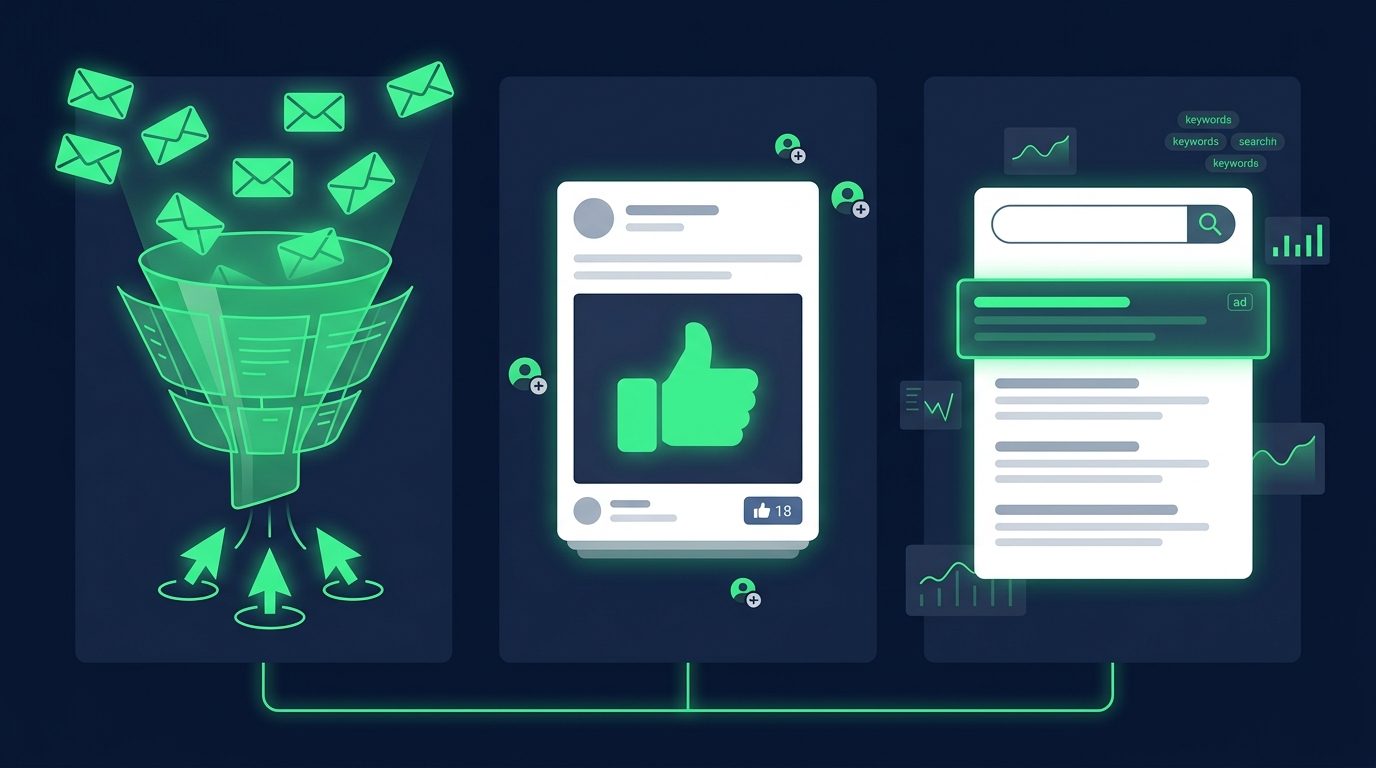
The model that works for most affiliate marketers: use solo ads to build the email list cheaply and quickly, then use Facebook to retarget the people who joined but didn't buy, and layer Google on top for the highest-intent buyer searches in your niche. Three sources, one funnel, one list.
For most readers of this site, the right starting point is solo ads. The learning curve is shorter, the risk is contained, and the payback timeline is days, not months.
Want Verified Traffic Without the Guesswork?
PulseTraffic screens every seller, filters bot clicks in real time, and shows you verified buyer traffic labels before you spend a dollar.