

Most businesses obsess over growing their email list as large as possible. More subscribers equals more sales, right? Not exactly. The real role of email list in business growth has far less to do with raw numbers and much more to do with who is on that list, how engaged they are, and how well you communicate with them. A list of 1,000 highly engaged subscribers routinely outperforms a bloated list of 50,000 disengaged contacts. This article breaks down why your email list is your most controllable growth asset, and how to build and use it with precision.
Table of Contents
- Key Takeaways
- The role of email list in business growth as an owned asset
- What actually makes an email list effective
- Strategic email practices that convert and retain customers
- Practical ways to build a high-quality list
- My take on nurturing versus just growing
- Accelerate your list growth with targeted solo ads
- FAQ
Key Takeaways
| Point | Details |
|---|---|
| Email is an owned channel | Unlike social media, your email list gives you direct, repeatable access to subscribers without algorithm interference. |
| Quality beats quantity | Engaged, opted-in subscribers convert at higher rates and protect your sender reputation. |
| Segmentation drives results | Segmenting by behavior or demographics can increase open rates by 14% and click rates by over 100%. |
| List decay is real | Email databases lose about 25% annually without active re-engagement and pruning. |
| Measure beyond opens | Tracking pipeline contribution and revenue influenced by email reveals the true business impact. |
The role of email list in business growth as an owned asset
Social media platforms change their algorithms without warning. Paid ad costs fluctuate with competition. But your email list belongs to you. That distinction matters more than most marketers realize.
Email marketing is a direct line of communication that businesses fully control, enabling repeatable customer nurturing without needing constant paid impressions. When you send an email, it goes to your subscriber's inbox. No algorithm decides whether 10% or 90% of your audience sees it based on engagement scores. You set the schedule, the message, and the frequency.
This is why email list growth is fundamentally a resilience strategy against fluctuating social media algorithms and paid reach limitations. Businesses that rely solely on Facebook pages or Instagram accounts have no real audience. They have rented access to one. If the platform changes its rules or shuts down, that audience disappears overnight.
Here is what makes an owned email audience so different from other channels:
- Direct reach: Your message lands in the inbox without competing for ad space.
- Repeatable contact: You can email the same list multiple times, building familiarity and trust over time.
- Cost efficiency: Email marketing delivers an average ROI of $36 for every $1 spent, which is difficult to match with paid ads.
- Portability: You can export your list and use it across different email service providers.
- Predictability: Unlike organic social reach, you can forecast your email reach with reasonable accuracy.
Building an email list is not just a marketing tactic. It is building an audience you own, and that ownership compounds in value every time you nurture it.
For business owners using email for business expansion, the list is the foundation everything else is built on. Without it, every growth effort depends on paying someone else for access to their audience.
What actually makes an email list effective
Here is where most businesses get it wrong. They treat all subscribers as equal. They focus on getting as many opt-ins as possible without thinking about quality, segmentation, or deliverability. The result is a large list that generates disappointing returns.
List quality comes first. Organic opt-in lists maintain a bounce rate below 1% and a complaint rate under 0.05%. Purchased lists perform far worse and damage your sender reputation heavily. A damaged sender reputation means your emails land in spam folders, reducing your real reach even on the subscribers who want to hear from you.
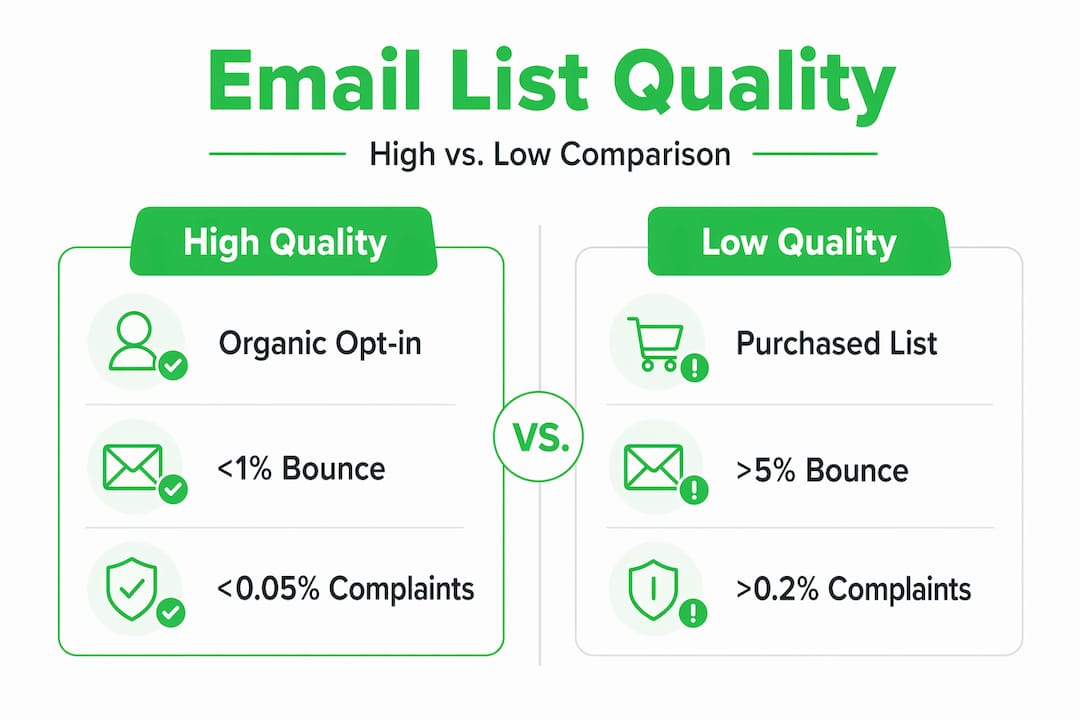
The table below shows the key differences between a high-quality list and a low-quality one:
| Factor | High-quality list | Low-quality list |
|---|---|---|
| Source | Organic opt-ins, lead magnets | Purchased or scraped contacts |
| Bounce rate | Below 1% | Often 5% or higher |
| Complaint rate | Under 0.05% | Frequently 0.1% or more |
| Open rate | 20% to 40% typical | Often under 10% |
| Deliverability | Strong inbox placement | Frequent spam folder placement |
| Revenue per subscriber | Higher over time | Consistently low |
Segmentation multiplies results. Sending the same message to every subscriber is one of the most common missed opportunities. Segmentation by behavior and demographics increases open rates by 14% and click rates by more than 100%. Think about what that means in practical terms. If your baseline click rate is 2%, segmenting could take that to 4% or higher across a well-divided list. That directly translates into more sales from the same audience.

Engagement metrics tell you who is paying attention. Track opens, clicks, and conversions by segment. When engagement drops in a segment, that is a signal to re-engage or clean those contacts out. Holding onto disengaged subscribers hurts deliverability and skews your data.
Pro Tip: Run a list hygiene pass every 90 days. Remove hard bounces immediately and flag subscribers who have not opened a single email in six months for a re-engagement sequence before deleting them.
Deliverability is the factor most marketers underestimate. A list of 20,000 subscribers where only 12,000 emails actually reach the inbox is not a 20,000-subscriber list in any meaningful sense. It is a 12,000-subscriber list with 8,000 contacts dragging down your sender score.
Strategic email practices that convert and retain customers
Having a quality list is only half the equation. What you do with it determines how well it drives sales and retains customers over time. Here is a step-by-step approach to using your email list strategically:
-
Start with a welcome sequence. Send three to five emails over the first two weeks after someone subscribes. Welcome emails that introduce your brand, set expectations, and deliver immediate value establish the relationship before you ever ask for a sale.
-
Build nurture tracks by funnel stage. A brand-new subscriber needs educational content about your category. A subscriber who clicked your pricing page needs a different message than someone who just downloaded a free resource. Match the email content to where the subscriber is in their decision process.
-
Automate lifecycle triggers. When a subscriber clicks a specific link or visits a product page, trigger an automated follow-up. Lifecycle automation converts a passive list into an active, revenue-driving system without requiring manual effort for every contact.
-
Run re-engagement campaigns to stop list decay. Email databases decay at about 25% per year. People change jobs, change email addresses, or simply lose interest. A re-engagement campaign, often called a win-back sequence, sends two or three targeted emails to inactive subscribers asking if they still want to hear from you. Those who do not respond get removed. This keeps your list healthy and your metrics accurate.
-
Track pipeline and revenue, not just opens. Measuring MQLs, SQLs, and closed deals that email influenced gives you the true picture of how email lists drive sales for your business. Open rate is a surface metric. Revenue attribution is the number that justifies investment.
-
Test and iterate. Subject lines, send times, content length, and call-to-action placement all affect performance. Run A/B tests on high-volume sends to learn what resonates with your specific audience, not what works generically.
Practical ways to build a high-quality list
Growing a list of engaged subscribers requires a different mindset than growing a list fast. Speed without quality creates the exact problems described above. Here are the tactics that consistently produce engaged opt-ins:
- Offer a lead magnet that solves a specific problem. A free checklist, template, mini-course, or report that addresses a real pain point your audience has will pull in far more motivated subscribers than a vague "subscribe for updates" prompt. The more specific the promise, the better the opt-in rate.
- Gate high-value content. Gated content and webinars are among the most effective methods for building an engaged list. A 60-minute training webinar, for example, attracts subscribers who are genuinely interested in your subject matter. That signals intent before they ever read your first email.
- Use simple, visible opt-in forms. Reducing friction matters. A form that asks for a first name and email address converts significantly better than one requiring phone number, company name, and job title. Get the email first. Collect more information later through segmentation surveys.
- Use double opt-in to confirm motivated subscribers. Double opt-in dramatically lowers complaint rates, which is one of the main reasons emails end up in spam folders. Yes, it reduces your raw opt-in count slightly, but the subscribers who confirm are meaningfully more engaged.
- Promote your list across every channel. Your social media bio, YouTube descriptions, podcast show notes, and website footer are all real estate for your email list signup. People who follow you on multiple platforms are your most likely list joiners.
Pro Tip: When promoting your list on social media, highlight what subscribers get in their first email. "Join 5,000 subscribers and get my free 10-step funnel template on day one" outperforms "subscribe to my newsletter" every time.
An email marketing ROI calculator can help you project the financial impact of your list growth efforts before you invest heavily in any single acquisition channel. Knowing your estimated cost per subscriber and expected revenue per subscriber turns list building into a measurable investment, not a guessing game.
My take on nurturing versus just growing
I have reviewed hundreds of email marketing setups over the years, and the single most common problem I see is not a list that is too small. It is a list that is being ignored between promotional sends.
Most business owners put serious effort into growing their list and almost no effort into what happens next. They send a promotional email when they have something to sell and go quiet for weeks in between. That pattern trains subscribers to tune you out. When you do send, your open rates tank, your clicks disappear, and you wonder why your large list is not converting.
What I have found actually works is treating your list like a relationship rather than a broadcast channel. Consistent value in emails is what keeps subscribers engaged and buying over time. That means sending content that is useful even when you have nothing to sell. Tips, case studies, short lessons, behind-the-scenes observations. These emails cost you almost nothing to produce, and they keep your sender reputation high and your audience warm.
The importance of email marketing is not realized through a single campaign. It compounds through consistency. The businesses I have seen get the best long-term results from their lists are the ones that show up regularly, deliver real value, and treat the sale as a natural next step rather than the only reason they write.
— Phil
Accelerate your list growth with targeted solo ads
Building a quality list from scratch takes time, but there is a way to speed up the process without sacrificing subscriber quality. Solo ads connect you with established email list owners in your niche who send your offer directly to their audience. When you work with verified, high-converting providers, you get real opted-in traffic to your squeeze page fast.
Soloadsguide specializes in helping marketers find exactly those providers. The platform features tested tier-1 traffic sources with documented conversion rates, so you avoid the vendors that deliver clicks with zero intent. If you are ready to grow your list with targeted traffic, explore the best solo ads providers reviewed and ranked by Soloadsguide, or visit the Solo Ads Guide to understand how to structure your campaigns for maximum opt-in rate.
FAQ
What is the role of an email list in business growth?
An email list gives businesses a direct, owned channel to communicate with potential and existing customers, enabling repeatable sales and customer retention without depending on paid platforms or social media algorithms.
How do email lists drive sales?
Email lists drive sales through targeted nurture sequences, lifecycle automation, and segmented promotions that move subscribers from awareness to purchase. Email marketing delivers $36 for every $1 spent on average.
Why are email lists considered business assets?
Email lists are owned assets because they are portable, controllable, and not subject to third-party platform rules. Unlike social media followers, your list stays with you regardless of algorithm changes or platform shutdowns.
How often should I clean my email list?
Run a list hygiene check every 90 days, removing hard bounces immediately and sending re-engagement sequences to subscribers who have been inactive for six months. This protects your deliverability and keeps your metrics accurate.
What is the best way to build an email list quickly?
Offering a specific lead magnet, using double opt-in, gating high-value content like webinars, and driving targeted traffic through solo ads from verified providers are the most reliable methods for building a quality list with speed.
Recommended
- How to Buy Solo Ads That Actually Convert (Step-by-Step)
- Solo Ads Blog, Tips, Guides & Reviews | SoloAdsGuide.com
- The Solo Ads Guide for Affiliate Marketers
- Best Solo Ads Providers in 2026 (Ranked & Reviewed)
Want Verified Traffic Without the Guesswork?
PulseTraffic screens every seller, filters bot clicks in real time, and shows you verified buyer traffic labels before you spend a dollar.