
Your email list is the primary revenue asset in any solo ad campaign. Solo ads are paid email broadcasts where you rent another marketer's subscriber list to drive clicks to your offer. The vendor sends one email to their audience with your link embedded, and you pay per unique click delivered. The role of email list in solo ads goes far beyond traffic generation. Without capturing those clicks into your own list and following up with a structured sequence, 60–70% of your potential revenue simply disappears. Tools like GetResponse, AWeber, and ActiveCampaign exist precisely to capture and nurture that traffic into paying customers.
How solo ads work without an owned email list
Solo ads charge you per unique click delivered, not per impression or email open. That distinction matters because you are paying for a specific action, and if that action does not lead to an opt-in, you have nothing to show for your spend.
The traffic arriving from a solo ad is cold. These subscribers do not know you, have not seen your offer before, and are not ready to buy on the first visit. Without a squeeze page capturing their email address, you lose them permanently the moment they leave your page.
The core mistake most solo ad buyers make is sending paid traffic directly to a sales page. Direct linking to sales pages instead of a squeeze page means losing the lead entirely, with zero follow-up revenue potential.
Here is what breaks down when you skip list building:
- No opt-in means no follow-up. You cannot email someone who never gave you their address.
- Cold traffic rarely converts on the first touch. A single exposure to an offer is almost never enough to generate a sale.
- You pay for clicks you cannot reuse. Every dollar spent on solo ads without list capture is a one-time transaction with no compounding return.
- Vendor lists do not belong to you. The vendor's subscribers are their asset. Your owned list is yours to market to indefinitely.
Running solo ads without email capture wastes the majority of your ad spend. The squeeze page is not optional. It is the mechanism that converts rented traffic into an owned asset.
Why follow-up emails drive most solo ad revenue
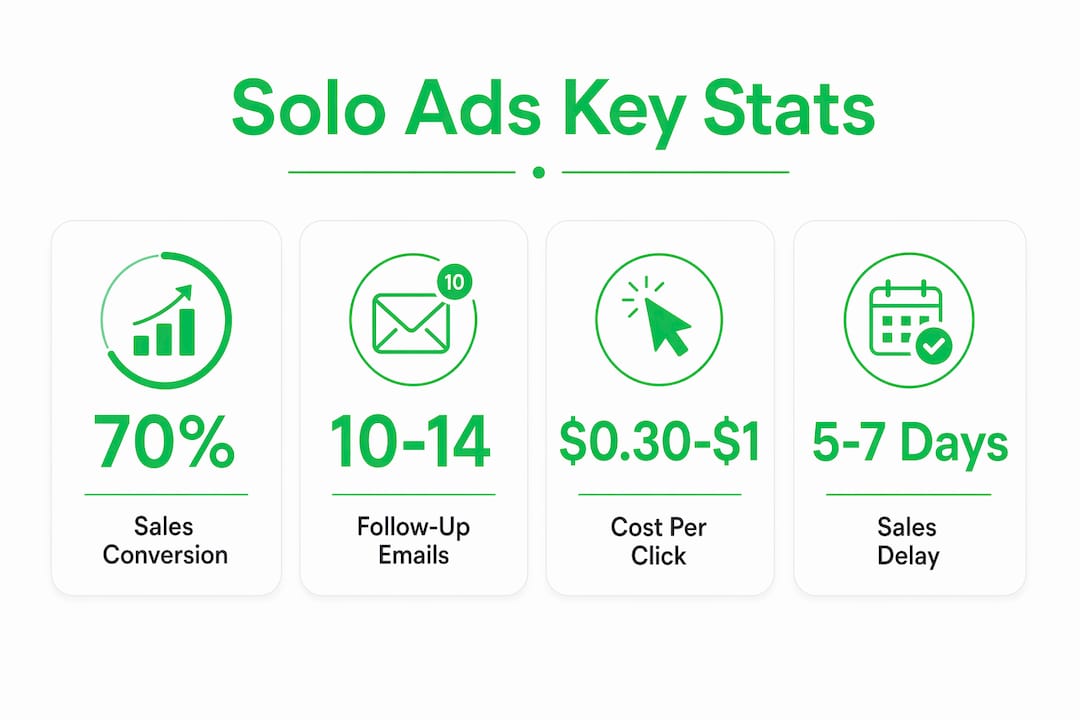
The follow-up email sequence is where solo ad campaigns actually make money. Sales commonly occur between email 5 and email 12 in a well-structured sequence. That means the subscriber who opted in on day one may not buy until day 8, day 11, or even day 14.
The role of follow-up emails in solo ads is to build trust, deliver value, and present your offer multiple times in different ways. A generic "buy now" reminder sent twice does not accomplish this. A stage-based sequence does.
Here is a proven structure for a 10-email welcome sequence:
- Email 1 (Day 0): Deliver the lead magnet or promised resource. Set expectations for what is coming.
- Email 2 (Day 1): Share a quick win or insight related to your niche. Build credibility.
- Email 3 (Day 2): Tell a short story that connects your subscriber's problem to your solution.
- Email 4 (Day 3): Provide social proof. Use a testimonial, case study, or result.
- Email 5 (Day 4): Handle the most common objection your audience has about your offer.
- Email 6 (Day 5): Soft pitch. Introduce the offer with context, not pressure.
- Email 7 (Day 6): Add urgency or a bonus. Give a reason to act now.
- Emails 8–10 (Days 7–12): Mix value content with direct offer reminders. Address remaining objections.
Buyers with 10–14 preloaded follow-up emails before running their first solo ad campaign consistently achieve the best return on investment. This is not a coincidence. The sequence does the selling so you do not have to.
Pro Tip: Build your follow-up sequence before you buy your first solo ad click. The sequence is the engine. The solo ad is just the fuel.
How email list quality shapes solo ad ROI
Not all email lists perform equally. List engagement quality affects conversion more than raw traffic volume. A vendor with 50,000 disengaged subscribers will deliver worse results than one with 15,000 highly responsive ones.

This dynamic shows up directly in pricing. Solo ad costs in 2026 range from $0.30 to $1.00 per click, with higher-quality lists commanding $0.50–$0.95 per click. Paying more per click for a better list often lowers your true cost per sale.
| List Quality Level | Typical CPC | Expected Opt-In Rate | Notes |
|---|---|---|---|
| Budget / Unverified | $0.30–$0.40 | 20–30% | Test carefully; high bot risk |
| Mid-Tier / Verified | $0.40–$0.60 | 35–45% | Good starting point for new campaigns |
| Premium / Tier-1 | $0.60–$0.95 | 45–55% | Best for scaling proven funnels |
Your own email list follows the same logic. As you build and nurture your subscriber base through solo ads, the quality of your list improves over time. Subscribers who have received 10 emails from you are far more likely to buy than someone who opted in yesterday. Capturing emails and following up over 7–30 days is how solo ad campaigns generate sustainable, recurring income rather than one-time spikes.
To measure your list quality accurately, track open rate, click-through rate, and revenue per subscriber. These three metrics tell you whether your follow-up sequence is working or needs adjustment.
Practical strategies for building your list with solo ads
Building a profitable email list through solo ads requires a specific funnel structure. Every element must serve one goal: capturing the subscriber's email address before presenting any offer.
The standard funnel flow looks like this:
- Solo ad email sends traffic to your squeeze page
- Squeeze page captures the email with a single opt-in form and a clear lead magnet offer
- Thank-you page delivers the lead magnet and introduces your core offer
- Autoresponder sequence (GetResponse, AWeber, or ActiveCampaign) delivers your follow-up emails automatically
Your squeeze page needs one job and one job only. Remove navigation links, sidebars, and any distraction. A headline that speaks directly to the subscriber's problem, a short benefit statement, and an opt-in form are all you need. Opt-in rates above 40% are achievable with a focused page.
Pro Tip: Add a retargeting pixel (Meta Pixel or Google Tag) to your squeeze page even if you are not running paid retargeting yet. You will build a custom audience automatically, which becomes valuable when you scale.
Here is a comparison of two common approaches to solo ad funnels:
| Approach | Squeeze Page First | Direct to Sales Page |
|---|---|---|
| Email captured | Yes | No |
| Follow-up possible | Yes | No |
| Revenue window | 7–30+ days | Single visit only |
| Cost per lead | Measurable | Unmeasurable |
| Long-term list value | High | Zero |
Tracking is non-negotiable. Use tools like ClickMagick or Voluum to monitor click quality, bot traffic, and conversion rates by vendor. Tracking solo ad traffic lets you identify which vendors deliver real buyers versus low-quality clicks that inflate your numbers without adding value.
Common pitfalls to avoid:
- Sending traffic to a sales page without a squeeze page
- Writing a follow-up sequence with only promotional emails and no value content
- Judging a campaign's ROI before 14 days of follow-up have passed
- Buying from vendors with no verified reviews or sales tracking data
Solo ads are best treated as cold traffic tests of your entire funnel. Significant sales may not appear until 14–21 days after the campaign ends. Early judgment is premature and leads to abandoning campaigns that would have been profitable with patience.
Key takeaways
Your email list is the asset that converts solo ad clicks into revenue, and without a structured follow-up sequence, most of that revenue is permanently lost.
| Point | Details |
|---|---|
| Email capture is mandatory | Always send solo ad traffic to a squeeze page, never directly to a sales page. |
| Follow-up drives most revenue | 60–70% of solo ad income comes from emails 5–12 in your follow-up sequence. |
| List quality beats list size | Higher-engagement lists convert better and lower your true cost per sale. |
| Build the sequence first | Load 10–14 follow-up emails before buying your first solo ad click. |
| Track everything | Use ClickMagick or Voluum to measure vendor quality and funnel performance by day. |
What i have learned after years of watching solo ad campaigns
Most affiliate marketers who fail with solo ads share one pattern: they treat the click as the finish line. They buy 200 clicks, check their sales dashboard 48 hours later, see one or two conversions, and declare the campaign a failure. They never built a follow-up sequence. They never gave the traffic time to convert.
The truth is that solo ads are a patience game disguised as a traffic channel. The follow-up sequence is the real product you are selling. The solo ad is just the introduction. I have seen campaigns that looked dead at day 3 produce their best sales on day 11 and day 14, simply because the email sequence was doing its job.
The other mistake I see constantly is obsessing over squeeze page design while ignoring the autoresponder. A plain text opt-in page with a strong headline will outperform a beautifully designed page with a weak sequence every single time. The money is in the list, and the list only pays you if you follow up.
My honest recommendation: before you spend a dollar on solo ads, open your autoresponder and write 10 emails. Make them useful. Make them personal. Make them specific to the problem your offer solves. Then buy your traffic. You will see a completely different result than marketers who skip this step.
Solo ads in 2026 work best as one piece of a diversified traffic strategy. Combine them with organic content, retargeting, and email list building from multiple sources. That combination builds a list that compounds in value over time, rather than one that depends entirely on paid traffic to stay alive.
— Phil
Start building your solo ad funnel the right way
If you are ready to put these strategies into practice, Soloadsguide has the resources to help you move fast and avoid costly mistakes.
Soloadsguide is built specifically for affiliate marketers who want to get real results from solo ad campaigns. You will find a full breakdown of how solo ads work for affiliate marketers, along with a curated list of top-rated solo ad providers ranked by traffic quality and verified buyer results. Whether you are setting up your first squeeze page or scaling a proven funnel, the guides and vendor reviews at Soloadsguide give you the clarity to spend smarter and build a list that actually converts.
FAQ
What is the role of an email list in solo ads?
Your email list is the asset that converts solo ad clicks into sales through follow-up. Without capturing opt-ins and sequencing follow-up emails, you lose the majority of your revenue potential from every campaign.
How many follow-up emails do i need before buying solo ads?
Load at least 10–14 follow-up emails into your autoresponder before running your first campaign. Research shows that solo ad buyers with this many preloaded emails achieve the best return on investment.
Why should i never send solo ad traffic directly to a sales page?
Direct linking skips the email capture step, which means you lose the lead permanently after one visit. A squeeze page collects the email address first, giving you the ability to follow up and generate revenue over days or weeks.
How much do solo ads cost per click in 2026?
Solo ad pricing ranges from $0.30 to $1.00 per click, with premium tier-1 lists priced between $0.50 and $0.95. Higher-priced clicks from quality vendors often produce a lower true cost per sale than cheaper, lower-quality traffic.
How long should i wait before judging a solo ad campaign's results?
Wait at least 14–21 days before evaluating ROI. Most sales from solo ad campaigns occur between email 5 and email 12 in the follow-up sequence, which means early results do not reflect the campaign's full performance.
Recommended
- Placeholder post: types-of-email-subscriber-lists-a-marketers-guide | SoloAdsGuide.com
- Solo Ads Blog, Tips, Guides & Reviews | SoloAdsGuide.com
- The Ultimate Guide to Solo Ads (2026) | SoloAdsGuide.com
- Types of Email Subscriber Lists: A Marketer's Guide (2026)
Want Verified Traffic Without the Guesswork?
PulseTraffic screens every seller, filters bot clicks in real time, and shows you verified buyer traffic labels before you spend a dollar.