

A solo ad traffic affiliate funnel is a paid email traffic system where you buy clicks from a vendor's subscriber list, send those visitors to a squeeze page, capture their email, and then promote affiliate offers through a structured follow-up sequence. This model gives affiliate marketers and small business owners a direct path to list-building without waiting months for organic traffic to materialize. Platforms like Udimi and tracking tools like ClickMagick make it possible to measure every click, opt-in, and conversion from day one. When the funnel is built correctly, solo ad traffic becomes one of the fastest ways to test an offer and generate affiliate commissions at a predictable cost.
What is a converting solo ad traffic affiliate funnel structure?
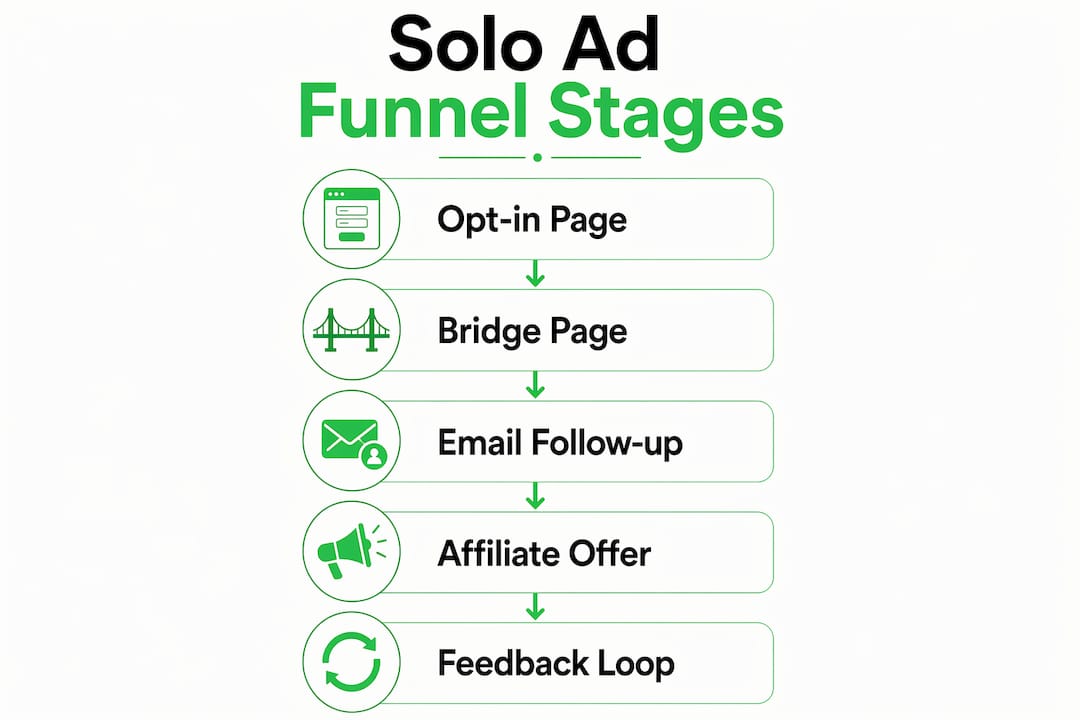
A converting affiliate funnel built for solo ad traffic follows four distinct stages: the opt-in page (also called a squeeze page), the bridge page, the affiliate offer, and the email follow-up sequence. Each stage has a specific job. The opt-in page captures the lead. The bridge page warms the visitor up and pre-sells the offer. The affiliate offer page closes the sale. The follow-up sequence monetizes the relationship over days and weeks.

Sending traffic directly to affiliate links wastes your ad spend and destroys your list-building opportunity. Cold traffic from a solo ad vendor has no prior relationship with you. Without a squeeze page in between, you get no email address, no second chance to convert, and no asset to show for your spend.
Here is how each stage works in practice:
- Opt-in page: A single-focus page with a headline, a brief benefit statement, and an email capture form. No navigation links, no distractions. A well-built opt-in page with solo ad traffic produces 25 to 45% opt-in rates, which means roughly one in three visitors becomes a lead.
- Bridge page: A short video or text page that introduces you, explains what the visitor will get, and transitions them toward the offer. This is where you build enough trust to make the affiliate link click feel like a natural next step.
- Affiliate offer: The vendor's sales page. Your job is done here. The offer must match the niche of the solo ad list, which is why make-money-online and business opportunity niches convert best with solo ad traffic.
- Email follow-up sequence: A 7-day email sequence that includes a welcome email, a story or insight email, an offer introduction, objection handling, and a call to action with urgency. This is where the majority of affiliate sales actually happen, not on the initial click.
Pro Tip: Write your email follow-up sequence before you buy a single click. If your autoresponder is not loaded and ready, you are paying for leads you cannot monetize.
Track opt-in rate, cost per lead, and click-to-sale conversion at every stage. These three numbers tell you exactly where your funnel is leaking.
How to select and vet solo ad providers for quality traffic
Choosing the wrong vendor is the fastest way to burn your budget on unresponsive clicks. Quality solo ad traffic comes from vendors with verified, engaged subscriber lists in your niche. The metrics that matter most are opt-in rate, cost per click, repeat buyer percentage, and vendor ratings from past buyers.
Udimi is the most widely used solo ad marketplace, offering click filtering, visible repeat buyer percentages, and verified seller ratings. Its built-in filtering removes bot clicks and low-quality traffic before they hit your funnel. For affiliate marketers starting out, Udimi is the safest place to make a first purchase because the transparency tools reduce the risk of buying from a fraudulent vendor. OptinWizard is another marketplace worth evaluating, particularly for marketers focused on the internet marketing and home business niches.
| Metric | What to look for |
|---|---|
| Opt-in rate | 30% or higher from vendor traffic |
| Repeat buyer rate | 20% or more signals list quality |
| Vendor rating | 4.5 stars or above on Udimi |
| Cost per click | $0.35 to $0.95 for tier-1 traffic |
| Negative reviews | Any pattern of complaints is a red flag |
Cheap traffic is almost always a false economy. A vendor selling clicks at $0.15 each is likely sending bot traffic or recycled, unresponsive leads. You will spend less per click and far more per actual conversion. Use ClickMagick to track click quality, filter out suspicious traffic, and measure your true cost per opt-in across vendors.
Before committing to a large order, read the vendor's recent reviews carefully. Look for comments that mention specific niches, opt-in rates, and sales. Generic five-star reviews with no detail are a warning sign. For a deeper look at evaluating vendors before spending, Soloadsguide has a dedicated resource on vetting solo ad sellers that covers the exact questions to ask.
Pro Tip: Always message a vendor before buying. Ask what niches perform best on their list and what opt-in rates their recent buyers have reported. A quality vendor answers quickly and specifically.
How to buy and manage solo ad traffic effectively
Buying solo ad traffic without a testing framework is guesswork. The standard approach is to start with 100 to 200 clicks on your first order. This gives you enough data to measure opt-in rate and cost per lead without risking a large budget on an unproven vendor or funnel.
Follow these steps when placing your first order:
- Set up ClickMagick or a comparable tracker before the campaign goes live.
- Choose a vendor on Udimi with at least 50 reviews and a repeat buyer rate above 20%.
- Order 100 clicks and specify your niche clearly in the order notes.
- Send traffic to your opt-in page, not directly to an affiliate link.
- Monitor opt-in rate in real time. A rate below 25% signals a problem with your squeeze page copy or headline.
- Check your email autoresponder to confirm new subscribers are entering the follow-up sequence correctly.
- After the campaign ends, calculate cost per lead and compare it against your expected revenue per subscriber.
Beyond the mechanics of placing an order, your email swipe copy matters more than most beginners expect. Solo ad vendors send your email to their list on your behalf. The subject line and opening sentence determine whether subscribers click through to your opt-in page. Write a subject line that creates curiosity without being misleading, and keep the email body to three to five sentences with a single call to action.
Common mistakes to avoid when managing campaigns:
- Scaling a campaign before confirming the funnel converts profitably
- Using the same swipe copy across multiple vendors without testing variations
- Ignoring the follow-up sequence and relying solely on front-end conversions
- Buying from vendors with no verifiable reviews or ratings
- Sending traffic to a slow-loading opt-in page (anything above three seconds kills conversions)
Understanding solo ad pricing before you commit to a budget helps you set realistic cost-per-lead targets and avoid overpaying for traffic that does not match your niche.
How to optimize and scale your affiliate funnel for better ROI
Optimization starts with data, not assumptions. Once your first 100 to 200 click test is complete, you have real numbers to work with. Conversion rates for quality solo ad campaigns range from 1% to above 5%, depending on funnel quality and targeting. A 1% conversion rate on a 200-click test means two sales. A 5% rate means ten. The difference between those outcomes is almost always the funnel, not the traffic.
Key areas to split-test before scaling:
- Opt-in page headline: Test two versions with the same traffic source. The headline is the single biggest lever on opt-in rate.
- Bridge page format: Video versus text. Video typically builds more trust but takes longer to produce.
- Email subject lines: Open rate directly affects how many subscribers see your offer.
- Offer positioning: Test different affiliate products in the same niche to find the highest-converting option.
The email follow-up sequence is where most of the funnel's profit comes from, not the initial click. A subscriber who does not buy on day one may buy on day four after receiving a story email or an objection-handling message. Extending your sequence from three emails to seven consistently increases backend revenue without any additional ad spend.
| Funnel stage | Metric to track | Optimization lever |
|---|---|---|
| Opt-in page | Opt-in rate (target: 30%+) | Headline, subheadline, form placement |
| Bridge page | Click-through rate | Video vs. text, call-to-action clarity |
| Affiliate offer | Conversion rate (1% to 5%+) | Offer match, pre-sell quality |
| Email sequence | Open rate, click rate | Subject lines, send timing, content mix |
Scale only when a vendor and funnel combination produces a positive or break-even return on ad spend. Scaling without data multiplies losses just as fast as it multiplies gains. When you find a vendor whose traffic converts at or above your target cost per lead, increase your order size by 50% at a time rather than doubling overnight. This protects you from sudden drops in list quality that can happen when a vendor's list gets fatigued.
Pro Tip: Track subscriber quality, not just quantity. A list of 500 engaged subscribers who open and click your emails is worth more than 2,000 cold leads who never respond. Use your email platform's engagement metrics to segment and prioritize your most active subscribers.
For a detailed breakdown of how affiliate commissions flow through a solo ad funnel, including recurring revenue structures, Soloadsguide covers the mechanics in depth.
Key takeaways
A solo ad traffic affiliate funnel only produces consistent returns when the funnel structure, vendor quality, and follow-up sequence are all working together.
| Point | Details |
|---|---|
| Build the funnel first | Set up your opt-in page, bridge page, and email sequence before buying any traffic. |
| Test before scaling | Start with 100 to 200 clicks and verify opt-in rate and cost per lead before increasing spend. |
| Vet your vendors | Use Udimi ratings, repeat buyer percentages, and ClickMagick data to filter out low-quality traffic. |
| Follow-up drives revenue | A 7-day email sequence generates more affiliate sales than the initial click alone. |
| Optimize with data | Split-test headlines, bridge pages, and email subject lines before committing to larger budgets. |
Why solo ads rewarded my patience more than my speed
The first time I ran a solo ad campaign, I made the classic mistake: I sent traffic straight to an affiliate offer page because the funnel "wasn't ready yet." I got clicks, zero opt-ins, and nothing to show for the spend. That experience taught me something no guide spelled out clearly at the time. Solo ads are not a shortcut. They are an accelerant, and they amplify whatever your funnel already does, good or bad.
What I have seen consistently is that marketers who struggle with solo ads are almost always fighting a funnel problem, not a traffic problem. They blame the vendor when the real issue is a weak headline or a mismatched offer. The traffic did its job. The funnel did not.
The other thing worth saying plainly: the money is in the follow-up, not the front end. I have had campaigns where the initial opt-in cost looked terrible on paper, but the 14-day email sequence turned those leads into a positive return. Beginners often abandon a list after three emails. That is leaving real revenue behind.
Solo ads fit best inside a broader traffic strategy that also includes organic content or retargeting. They are not a permanent replacement for owned traffic. But for testing a new funnel fast, getting real conversion data, and building a list from scratch, nothing moves as quickly. Use them with a plan, track everything, and resist the urge to scale before the numbers justify it.
— Phil
Start building your solo ad funnel with trusted resources
If you are ready to put this into practice, Soloadsguide is built specifically for affiliate marketers who want to skip the trial-and-error phase of finding quality vendors.
The Solo Ads Guide brings together verified tier-1 traffic sources, funnel setup guidance, and vendor reviews in one place. Whether you are placing your first 100-click test or looking to scale a campaign that is already converting, the platform gives you the vendor data and tracking frameworks to make informed decisions. Check the best solo ad providers list to find ranked and reviewed vendors matched to the make-money-online and business opportunity niches where solo ad traffic performs best.
FAQ
What is a solo ad traffic affiliate funnel?
A solo ad traffic affiliate funnel is a system where you buy email clicks from a vendor, capture leads on a squeeze page, and convert them into affiliate sales through a follow-up email sequence. It combines paid email traffic with structured list-building to generate affiliate commissions.
How many clicks should I buy for my first solo ad test?
Start with 100 to 200 clicks to gather enough data on opt-in rate and cost per lead without overcommitting your budget. Scale only after confirming the funnel converts profitably.
What opt-in rate should I expect from solo ad traffic?
A well-built opt-in page with solo ad traffic typically produces 25 to 45% opt-in rates. Rates below 25% usually point to a headline or page copy problem rather than a traffic quality issue.
Which niches work best with solo ad traffic?
Make-money-online, business opportunity, and digital marketing niches consistently produce the strongest conversion rates with solo ad traffic. These niches align with the subscriber lists most solo ad vendors have built.
How do I track whether my solo ad campaign is working?
Use a tracking tool like ClickMagick to monitor clicks, opt-ins, and conversions in real time. Tracking gives you the data to identify which vendors deliver quality traffic and which funnel stages need improvement.
Recommended
- The Solo Ads Guide for Affiliate Marketers
- The Ultimate Guide to Solo Ads (2026) | SoloAdsGuide.com
- Are Solo Ads Still Worth It in 2026? Honest Assessment
- Top 3 trafficdomination.rocks Alternatives for 2026
Want Verified Traffic Without the Guesswork?
PulseTraffic screens every seller, filters bot clicks in real time, and shows you verified buyer traffic labels before you spend a dollar.