
Solo ads affiliate commissions are earned when you pay an email list owner to send a promotional message to their subscribers, and those subscribers click your affiliate link and complete a qualifying purchase or conversion. This paid traffic model sits at the intersection of email marketing and affiliate marketing, making it one of the fastest ways to drive targeted visitors to an offer. Unlike SEO or social content, solo ads deliver traffic within hours of a campaign going live. To earn reliably, you need more than clicks. You need a properly structured funnel, a trackable affiliate link, and a clear understanding of how commissions are attributed.
How do solo ads generate affiliate commissions?
Solo ads work through a straightforward sequence, but each step must function correctly for commissions to appear in your account. Here is the process from purchase to payout:
- Buy clicks from a list owner. You find a vendor who manages an email list in your niche, typically through a marketplace like Udimi or through direct outreach. You pay for a set number of clicks, usually priced per click.
- The vendor sends a solo email. The list owner sends a dedicated email to their subscribers. That email contains your copy and your affiliate link or a link to your landing page. The message is the only promotion in that send, which is where the term "solo" comes from.
- Subscribers click and enter your funnel. Traffic lands on your squeeze page or opt-in page. A well-built funnel captures the visitor's email address before redirecting them to the affiliate offer. This step is where most beginners lose money by skipping it.
- The affiliate link fires and tracks the visit. When a subscriber clicks through to the merchant's site, your affiliate tracking link records the visit. If the visitor purchases within the attribution window, the sale is credited to your account.
- Follow-up emails close the gap. Most visitors do not buy on the first visit. Your email sequence, sent to the leads you captured at the opt-in stage, continues promoting the offer over days or weeks. This follow-up sequence is where a large portion of solo ads commissions actually come from.
Pro Tip: Build your squeeze page to capture leads before sending traffic to any affiliate offer. If the vendor's list does not convert immediately, your email sequence gives you multiple chances to earn the commission later.
The funnel structure is not optional. Traffic alone won't generate commissions without a landing page and follow-up sequence in place. Treating solo ads as a direct-to-offer traffic source is the most common and costly mistake in this model.

What key metrics determine solo ads profitability?
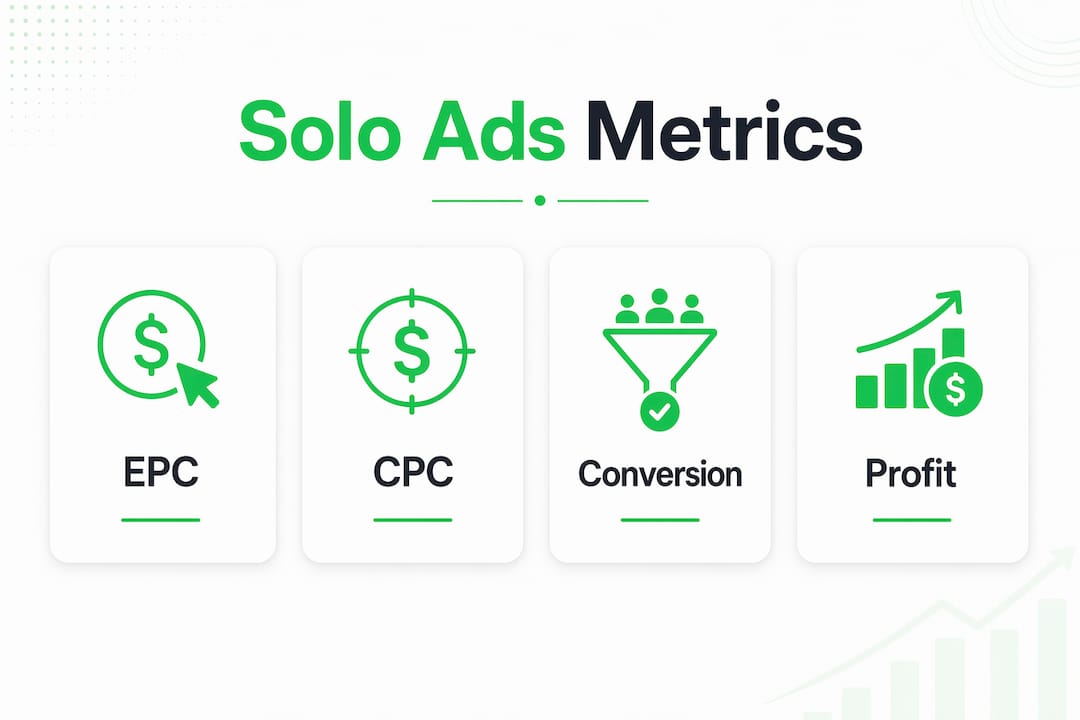
Understanding solo ads terminology explained through numbers is the fastest way to avoid wasting your budget. Two metrics control whether a solo ads campaign is profitable: Earnings Per Click (EPC) and Cost Per Click (CPC).
EPC is calculated by dividing total commissions earned by total clicks received. If you earned $120 from 300 clicks, your EPC is $0.40. EPC is the critical metric that tells you what each visitor is actually worth to your business.
CPC is what you pay the vendor per click. Your campaign breaks even when EPC equals CPC. Profit requires EPC to exceed CPC by a meaningful margin.
| Scenario | CPC Paid | EPC Earned | Result |
|---|---|---|---|
| Break-even | $0.40 | $0.40 | No profit, no loss |
| Profitable | $0.40 | $0.80 | 50% margin |
| Losing money | $0.40 | $0.20 | $0.20 loss per click |
| Strong campaign | $0.50 | $1.20 | 58% margin |
A high commission payout alone does not guarantee profit. A $200 affiliate commission means nothing if your EPC is $0.15 and you are paying $0.45 per click. The math must work at the click level, not just the offer level.
Niche list relevance also affects EPC significantly. Creator-led traffic generates roughly 3.7 times more revenue per follower compared to generic traffic sources, because trust and relevance drive higher conversion rates. This is why a targeted solo ads list in the make-money-online or health niche can outperform broad paid social traffic even at a higher CPC.
Pro Tip: Before buying any solo ads traffic, calculate your break-even CPC using your offer's known conversion rate and commission value. If your offer converts at 2% and pays $50, your maximum viable CPC is $1.00. Never enter a campaign without this number.
How does affiliate tracking affect your commission payouts?
Affiliate tracking is where commissions are won or lost without you ever knowing it. Every affiliate program assigns you a unique link containing parameters that identify your traffic and credit your account for conversions.
Key tracking concepts every solo ads affiliate marketer needs to understand:
- Click IDs and SubIDs. These parameters are appended to your affiliate link to identify the specific traffic source, campaign, or vendor. Tools like RedTrack pass click IDs using parameters such as "&affsub={clickid}` to ensure each conversion is matched back to the correct campaign.
- Attribution windows. Most affiliate programs define a window during which a referred visitor must complete a purchase for you to earn a commission. Some programs, such as Soloist, set attribution windows at 60 days, meaning a subscriber you referred must upgrade within that period for the commission to count.
- Upgrade timing and eligibility rules. Many programs pay commissions not just on the initial sale but on follow-on payments. Soloist, for example, covers commissions up to one year from the subscription date. Missing the upgrade window means losing that recurring revenue.
- Tracking link integrity. If your affiliate link is broken, redirected incorrectly, or stripped of its parameters by a landing page builder, the conversion will not be credited. Always test your full funnel from click to thank-you page before sending paid traffic.
- Bot traffic risk. Low-quality vendors sometimes deliver clicks from bots or inactive accounts. These clicks consume your budget, inflate your click count, and produce zero conversions. Using a tracking platform to filter suspicious traffic protects both your data and your spend.
Maintaining tracking parameter integrity end-to-end is non-negotiable. A single misconfigured redirect can silently erase an entire campaign's worth of commissions.
How do solo ads compare to other traffic sources?
Solo ads vs organic traffic is not a competition. They serve different functions in a marketing strategy, and understanding where solo ads fit helps you allocate budget correctly.
| Traffic Source | Speed | Cost | Conversion Quality | Best Use Case |
|---|---|---|---|---|
| Solo ads | Hours | Medium to high per click | High with niche lists | Fast testing, list building |
| SEO / organic | Months | Low ongoing | High with intent | Long-term authority |
| Facebook Ads | Days | Variable | Medium | Broad audience targeting |
| Google Ads | Hours | High | High with buyer intent | Direct offer promotion |
Solo ads deliver faster traffic than SEO or social content channels, but they require effective funnels with landing pages and follow-up sequences to convert clicks into commissions. You cannot simply buy 500 clicks and expect sales without a system behind the traffic.
The advantage solo ads hold over paid social platforms is list relevance. A vendor with 50,000 subscribers in the online business niche has built trust with that audience over time. When their email arrives in a subscriber's inbox, it carries more weight than a banner ad on a social feed. That trust translates directly into higher opt-in rates and better EPC. For a deeper comparison of how these channels stack up in 2026, Soloadsguide covers the full channel breakdown with data on funnel performance across platforms.
Solo ads are most appropriate when you need fast data on a new offer, when you want to build an email list quickly, or when you are testing funnel variations before committing to a larger paid campaign.
What strategies maximize affiliate commissions with solo ads?
Profitable solo ads campaigns follow a repeatable process. These are the practices that separate marketers who scale from those who burn through budget:
- Select offers with proven EPC data. Platforms like ClickBank and Warrior Plus display average EPC for each offer. Choose offers where the network-wide EPC already exceeds your expected CPC. This reduces the risk of testing an unproven offer with paid traffic.
- Use a tracking platform from day one. ClickMagick and RedTrack both allow you to monitor click quality, filter bot traffic, and pass SubIDs to your affiliate network. Without tracking, you cannot identify which vendors or landing pages are producing results.
- Plan your Udimi budget against offer economics. On Udimi, solo ads pricing is based on CPC. If your offer has an EPC of $2.00 and a 30% opt-in rate, your break-even CPC is $0.60. Buying clicks above that threshold requires a higher-converting funnel to stay profitable.
- Rotate landing pages. Test at least two squeeze page variants per campaign. Small changes to the headline or lead magnet can shift opt-in rates by 10 to 20 percentage points, which directly affects your EPC.
- Build a follow-up sequence of at least five emails. Most solo ads commissions come from the email sequence, not the initial click. Each email in the sequence should address a different objection or benefit of the affiliate offer.
Pro Tip: Start with a small test order of 100 to 200 clicks from any new vendor before scaling. This gives you enough data to calculate EPC and opt-in rate without risking your full budget on an unproven list.
Understanding the full marketing funnel mechanics behind solo ads traffic is what separates a one-time buyer from a marketer who builds a sustainable commission income.
Key takeaways
Solo ads generate affiliate commissions only when paid traffic flows through a properly built funnel, tracked with accurate attribution, and measured against EPC to confirm profitability.
| Point | Details |
|---|---|
| EPC is the profit filter | Calculate EPC before buying traffic to confirm your offer can cover the cost per click. |
| Funnels are required | Traffic sent directly to an offer without a squeeze page and follow-up sequence rarely produces commissions. |
| Tracking integrity matters | Broken or stripped affiliate link parameters silently erase commissions. Use RedTrack or ClickMagick. |
| Attribution windows are binding | Know your program's window (often 60 days) and ensure referred leads convert within that period. |
| Test before scaling | Start with 100 to 200 clicks per vendor to validate EPC and opt-in rate before increasing spend. |
What I've learned running solo ads for affiliate campaigns
Solo ads are one of the most misunderstood traffic sources in affiliate marketing, and most of the frustration I see comes from one root cause: marketers treat them like a vending machine. You put money in, commissions come out. That is not how it works.
The biggest mistake I made early on was sending traffic directly to an affiliate offer without capturing leads first. I spent real money on clicks, saw a handful of sales, and had nothing to show for it long-term because I built no list. The moment I added a squeeze page and a five-email follow-up sequence, my EPC nearly doubled on the same offer with the same traffic.
The second lesson was harder to learn: not all solo ads traffic is equal. A vendor with a large list is not automatically a good vendor. I have bought 500 clicks from a list of 200,000 subscribers and earned nothing, then bought 200 clicks from a tighter niche list and generated 12 sales. List relevance and engagement matter far more than raw size.
My honest advice is to treat solo ads as a testing and list-building tool, not a passive income switch. Use them to validate offers quickly, build your email list, and gather EPC data. Then use that data to decide whether to scale with solo ads, shift to paid social, or invest in SEO for the long term. Solo ads work best as one layer of a broader traffic strategy, not the entire foundation. For anyone serious about tracking solo ad traffic quality and filtering out low-quality clicks, that step alone can change your results dramatically.
— Phil
Start your solo ads journey with verified providers
If you are ready to put these principles into practice, the quality of your traffic source determines everything that follows.
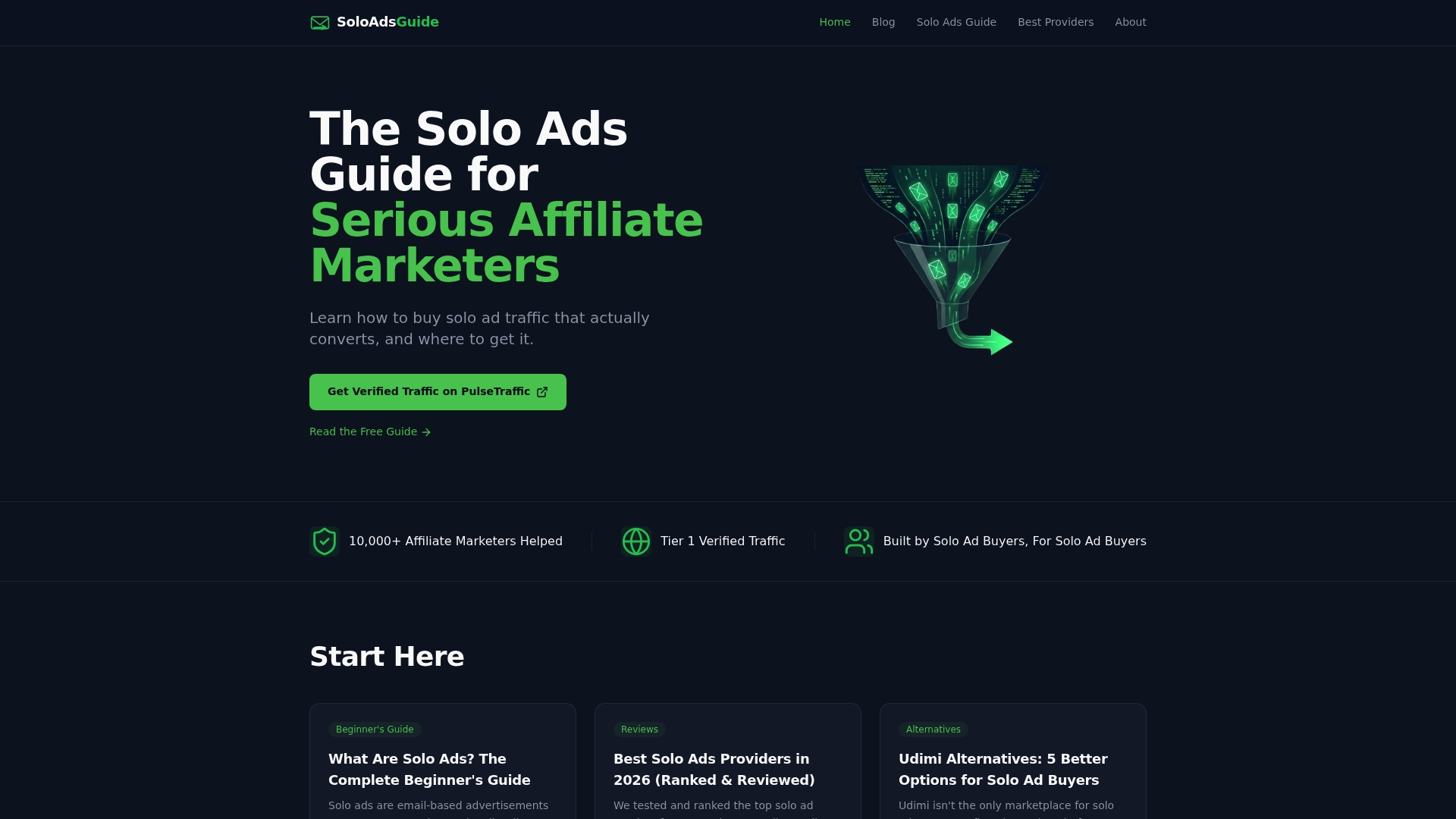
Soloadsguide is built specifically for affiliate marketers who want to skip the trial-and-error phase of finding reliable vendors. The platform features verified tier-1 traffic sources tested for conversion performance, along with a full breakdown of how to evaluate vendors before spending a dollar. Users have reported a 40% reduction in cost per lead after switching to vetted providers from the guide. Visit Soloadsguide to access the full resource library, or go directly to the ranked provider list to find traffic sources that match your niche and budget.
FAQ
What are solo ads in affiliate marketing?
Solo ads are paid email advertisements where you pay a list owner to send a promotional email containing your affiliate link to their subscribers. Commissions are earned when those subscribers click through and complete a qualifying purchase within the affiliate program's attribution window.
How is EPC calculated for solo ads?
EPC (Earnings Per Click) is calculated by dividing total commissions earned by total clicks received. Your campaign is profitable when EPC exceeds the CPC you paid the vendor.
Why am I not earning commissions from solo ads traffic?
The most common cause is sending traffic directly to an affiliate offer without a squeeze page or follow-up email sequence in place. Traffic without a funnel rarely converts into commissions because most visitors need multiple touchpoints before buying.
What is an attribution window in solo ads affiliate programs?
An attribution window is the time period during which a referred visitor must complete a purchase for you to earn a commission. Many programs set this at 60 days, meaning leads who convert after that window do not generate a payout.
How do I avoid bot traffic in solo ads campaigns?
Use a tracking platform like ClickMagick or RedTrack to monitor click quality metrics such as time-on-page, duplicate IPs, and conversion rates. Filtering bot traffic protects your budget and keeps your EPC data accurate.
Recommended
- The Solo Ads Guide for Affiliate Marketers
- Solo Ads vs Facebook vs Google Ads: Which Wins in 2026?
- Why Beginners Lose Money on Solo Ads (Real Reasons)
Want Verified Traffic Without the Guesswork?
PulseTraffic screens every seller, filters bot clicks in real time, and shows you verified buyer traffic labels before you spend a dollar.