

Most marketers think they understand business email campaigns. They set up a list, write a few messages, hit send, and wait. But that approach describes a broadcast, not a campaign. A business email campaign is a planned series of purposeful emails sent to a defined audience with a specific goal attached to each message. Whether you are trying to generate leads, convert prospects, or retain existing customers, understanding what is a business email campaign at a strategic level is what separates marketers who get results from those who get ignored. This guide breaks down the fundamentals clearly, so you can build campaigns that actually move the needle.
Table of Contents
- Key Takeaways
- What is a business email campaign, defined
- The real benefits of business email campaigns
- How to plan and run an email campaign
- Types of email campaigns and how to use them
- Measuring success and optimizing over time
- My take on what most businesses get wrong
- Expand your reach with solo ads
- FAQ
Key Takeaways
| Point | Details |
|---|---|
| Campaigns are planned sequences | A business email campaign is a coordinated series of emails with a defined goal, not a single broadcast. |
| Personalization multiplies results | Segmented campaigns can achieve 30% higher open rates compared to non-segmented bulk sends. |
| ROI is hard to beat | Email marketing returns $36 to $42 per dollar spent, making it one of the highest-performing channels available. |
| Measurement must go beyond opens | Clicks, conversions, and revenue per recipient are the metrics that reflect true campaign performance. |
| Campaign type shapes strategy | Newsletters, re-engagement sequences, and product launches each require different messaging, timing, and success metrics. |
What is a business email campaign, defined
A business email campaign is a coordinated set of emails sent to a specific group of recipients with a clear objective guiding every message. That objective might be promoting a new product, nurturing a lead through a sales funnel, re-engaging a dormant subscriber, or delivering onboarding content to a new customer. The word "campaign" is the operative term here. It implies intent, sequencing, and measurement.
Each individual email within the campaign serves a defined purpose. It moves the recipient one step closer to the desired outcome, whether that is booking a call, making a purchase, or downloading a resource. The audience is not random. Contacts are selected based on behavior, demographics, or their stage in the buyer's journey.
Here is what the core components look like in practice:
- Purpose: Every campaign has a business goal attached to it, such as lead generation, product promotion, customer education, or win-back outreach.
- Audience: Contacts are segmented by factors like past purchases, industry, geographic location, or engagement history.
- Sequence: A campaign typically involves multiple emails sent over days or weeks, with each message building on the previous one.
- Messaging: Content is relevant to the recipient's context, personalized where possible, and written with a single clear call to action.
Pro Tip: Before writing a single subject line, write out your campaign goal in one sentence. If you cannot define the goal of a specific email in six words or less, the message should not be sent. Clarity at the planning stage prevents vague messaging at the delivery stage.
Smart brands treat email campaigns the way engineers treat systems: every component has a defined job. When one part is unclear, the whole sequence underperforms.
The real benefits of business email campaigns
Email is not just a communication tool. It is a revenue channel. The average email ROI sits at $36 to $42 for every dollar spent, which outperforms paid social, display advertising, and most content marketing efforts on a cost-per-acquisition basis.
The table below shows how email campaigns compare to two other commonly used channels:
| Channel | Average ROI | Targeting precision | Measurement clarity |
|---|---|---|---|
| Business email campaigns | $36 to $42 per $1 spent | High (segmented lists) | High (clicks, revenue) |
| Paid social advertising | $2 to $5 per $1 spent | Medium (platform data) | Medium (attribution gaps) |
| Display advertising | $2 per $1 spent | Low (cookie-based) | Low (view-through only) |
Personalization is where the gap widens further. Segmented campaigns achieve 30% higher open rates compared to non-segmented broadcasts. Behavioral-triggered emails, which fire based on a recipient's action such as clicking a link or abandoning a cart, drive up to 4x more revenue than bulk sends. That is not a marginal improvement. It is a structural advantage.
The direct-reach aspect matters too. Social platforms control who sees your content. Email goes straight to the inbox of people who opted in. You own that relationship. No algorithm decides your reach. This is why treating email marketing as foundational infrastructure rather than a tactical add-on produces more consistent results over time.

How to plan and run an email campaign
Running an effective email campaign requires upfront planning more than it requires creative brilliance. Here is a practical step-by-step process:
- Define your goal. Start with a specific business objective. "Get more opens" is not a goal. "Book 20 discovery calls from our trial user segment this month" is a goal. Every decision that follows should serve that outcome.
- Segment your audience. Pull contacts from your CRM or email platform based on behavior, purchase history, engagement level, or firmographic data. Sending the same message to your entire list is one of the fastest ways to train subscribers to ignore you.
- Map the email sequence. Decide how many emails belong in the campaign, what each one will say, and when each will be sent. Modern brands have shifted from calendar-based batch sending to lifecycle journeys with measurable outcomes like pipeline contribution and deal velocity.
- Integrate your tools. Connect your email platform to your CRM and analytics stack. Integrating email platforms with CRM and analytics tools can reduce campaign setup time from a full day to around 45 minutes. That efficiency compounds over time.
- Write and design each email. Keep copy focused on one action per email. A clear subject line, one central message, and a single call to action perform better than multi-topic newsletters in campaign contexts.
- Test before you send. Send preview emails to yourself on mobile and desktop. Check all links. Review subject lines for spam triggers. Run A/B tests on subject lines when your list is large enough to produce statistically valid results.
- Monitor the right metrics. Track clicks, conversions, and revenue per recipient. Open rates are a vanity metric in isolation, especially with privacy protections making open rate data less reliable.
Pro Tip: Use your CRM data to build dynamic segments that update automatically based on behavior. A subscriber who clicks a pricing page link should move into a different sequence than one who only reads blog content. Automated segmentation makes your email tracking capabilities work harder without extra manual effort.
Types of email campaigns and how to use them
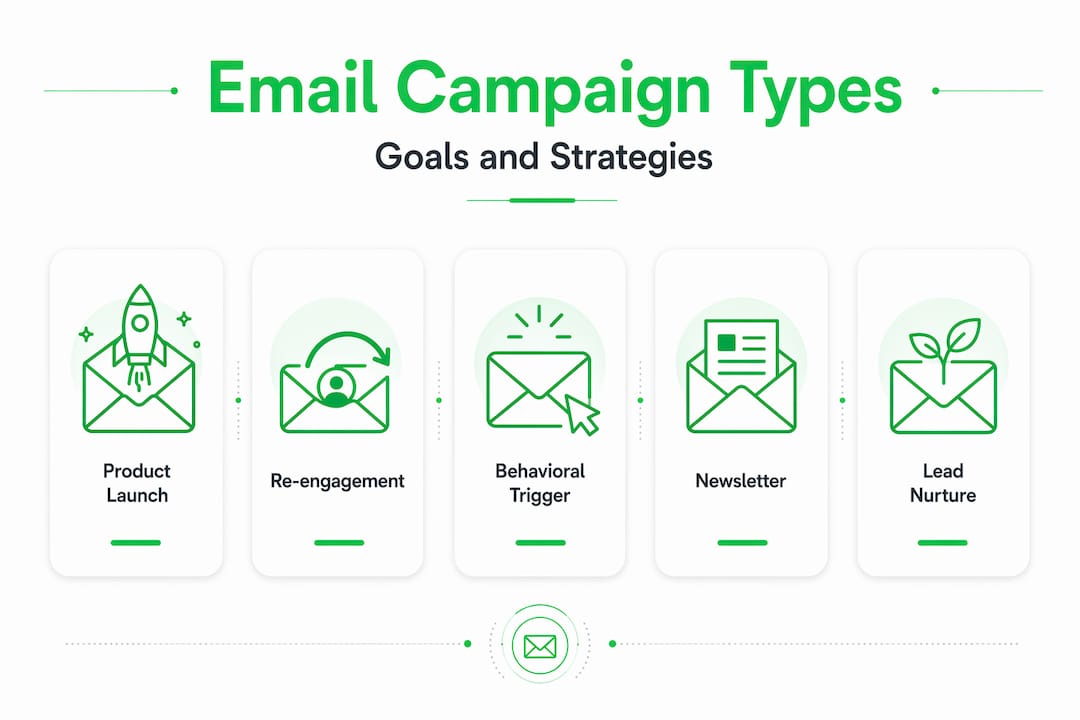
Not all campaigns serve the same purpose. Choosing the right campaign type is as important as the copy you write inside it. Here is a breakdown of the most common formats and what each is designed to accomplish:
| Campaign type | Primary goal | Key best practice |
|---|---|---|
| Product launch | Drive awareness and initial sales | Build a pre-launch teaser sequence before the main offer |
| Newsletter | Maintain engagement and authority | Deliver consistent value on a predictable schedule |
| Re-engagement | Win back inactive subscribers | Lead with a low-commitment offer or survey |
| Behavioral trigger | Convert high-intent users | Send within minutes of the triggering action |
| Transactional | Confirm actions and build trust | Include relevant cross-sell or next-step content |
Each type calls for a different tone and timing strategy. B2B email campaigns, for instance, require a strategic, informative approach targeting multiple decision-makers across longer sales cycles. A single email rarely closes a B2B deal. The campaign needs to deliver independent value at each touchpoint while advancing the relationship.
Re-engagement campaigns are one of the most underused opportunities in email marketing. Before purging inactive subscribers, send a three-email sequence. The first email acknowledges the gap. The second offers a reason to stay. The third sets a clear expectation: click to stay subscribed or be removed. This process cleans your list while recovering subscribers who simply got busy.
For behavioral triggers, speed matters. An abandoned-cart email sent within 30 minutes converts at significantly higher rates than one sent 24 hours later. Connecting your email platform directly to your website or e-commerce data makes these sequences possible without manual intervention.
Measuring success and optimizing over time
Measuring a business email campaign correctly is where most marketers fall short. They celebrate a 45% open rate without asking whether anyone converted. They panic over a 18% open rate without realizing the campaign generated three times the revenue of the previous quarter.
Here is what to actually track:
- Click-through rate (CTR): The percentage of recipients who clicked a link. This tells you whether your message and offer resonated.
- Conversion rate: The percentage of recipients who completed the desired action, whether that is a purchase, form submission, or call booking.
- Revenue per recipient: Total campaign revenue divided by total recipients. This is the clearest revenue-linked metric available.
- Unsubscribe rate: A spike here signals a relevance problem, not just a creative problem.
- List growth rate: Campaigns should contribute to net list growth. If you are losing subscribers faster than you gain them, the long-term channel is eroding.
Successful campaigns in 2026 aim for at least a 20% open rate and a 2.5% click-through rate, though these benchmarks shift significantly by industry. B2B software companies often see lower open rates but higher conversion values per click than e-commerce brands.
AI tools can support optimization by identifying which subject line patterns perform best, predicting optimal send times by segment, and flagging content that may trigger spam filters. However, AI tools require clear job definitions and iterative feedback. Accepting mediocre AI-generated drafts without review undermines campaign quality in ways that are hard to reverse once subscribers have seen subpar content.
Pro Tip: Run a monthly audit of your email list and segment health. A clean, well-segmented list of 5,000 engaged subscribers will consistently outperform a bloated list of 50,000 disengaged contacts. List quality is a performance variable, not just a hygiene task. For a detailed approach to understanding email marketing strategies, check out resources that go deep on segmentation and behavioral data.
My take on what most businesses get wrong
I have reviewed hundreds of email campaigns over the years. The single most common mistake I see is not poor design or weak copy. It is measuring the wrong things.
Most teams track open rates as if they were the scoreboard. In my experience, open rate tells you whether your subject line worked. Nothing more. The real question is whether the campaign contributed to revenue, shortened a sales cycle, or improved customer retention. Revenue attribution and deal velocity are better indicators of email campaign success. I have seen campaigns with 18% open rates that drove more pipeline than campaigns sitting at 40%.
The other trap I see consistently is what I call the "broadcast mindset." Teams design email campaigns the way they design press releases. One message, one direction, no differentiation by recipient behavior or stage. Effective email sequences should provide standalone value in every message, and that requires knowing who you are writing to before you write a word.
The operational piece matters too. When your email platform is not connected to your CRM or analytics stack, you are flying without instruments. You cannot personalize at scale if you do not know what a subscriber did last week. Fixing the integration layer is not glamorous work, but it is what separates teams that guess from teams that know.
My honest advice: treat your email program as infrastructure, not a campaign calendar. Build it once, build it correctly, and let the data tell you where to improve.
— Phil
Expand your reach with solo ads
If you have your email campaigns dialed in and want to grow your list faster, solo ads are worth understanding. A solo ad is a single email sent to another marketer's verified subscriber list on your behalf, with one call to action pointing to your opt-in page or offer.
Solo ads work as a lead generation tool that feeds directly into your existing email campaign sequences. You pay for clicks from real subscribers who are already interested in your niche. The key is finding vendors whose lists actually convert.
That is exactly what Soloadsguide is built for. The platform offers verified solo ads providers ranked by real conversion performance, not just click volume. If you are serious about building a high-quality email list without burning budget on low-grade traffic, the Solo Ads Guide is where to start.
FAQ
What is a business email campaign exactly?
A business email campaign is a planned series of emails sent to a specific audience segment with a defined business goal. It differs from a single email blast because it involves sequencing, personalization, and measurement across multiple messages.
How many emails should a business email campaign include?
There is no fixed number, but most campaigns run between three and seven emails depending on the goal and audience. B2B campaigns targeting longer sales cycles often use longer sequences with educational content at each stage.
What metrics matter most for email campaigns?
Click-through rate, conversion rate, and revenue per recipient are the most reliable indicators of performance. Open rates are becoming less reliable due to privacy tools that inflate tracking data automatically.
What is the ROI of a business email campaign?
Email marketing generates an average of $36 to $42 for every $1 spent, which consistently makes it the highest-performing owned marketing channel available to businesses.
What is the difference between a newsletter and an email campaign?
A newsletter is an ongoing, regularly scheduled email focused on content delivery and relationship maintenance. An email campaign is a time-bound sequence tied to a specific business goal, such as a product launch or a re-engagement effort.
Recommended
- Solo Ads Blog, Tips, Guides & Reviews | SoloAdsGuide.com
- The Ultimate Guide to Solo Ads (2026) | SoloAdsGuide.com
- What Are Solo Ads? The Complete Beginner's Guide (2026)
- How to Buy Solo Ads That Actually Convert (Step-by-Step)
Want Verified Traffic Without the Guesswork?
PulseTraffic screens every seller, filters bot clicks in real time, and shows you verified buyer traffic labels before you spend a dollar.