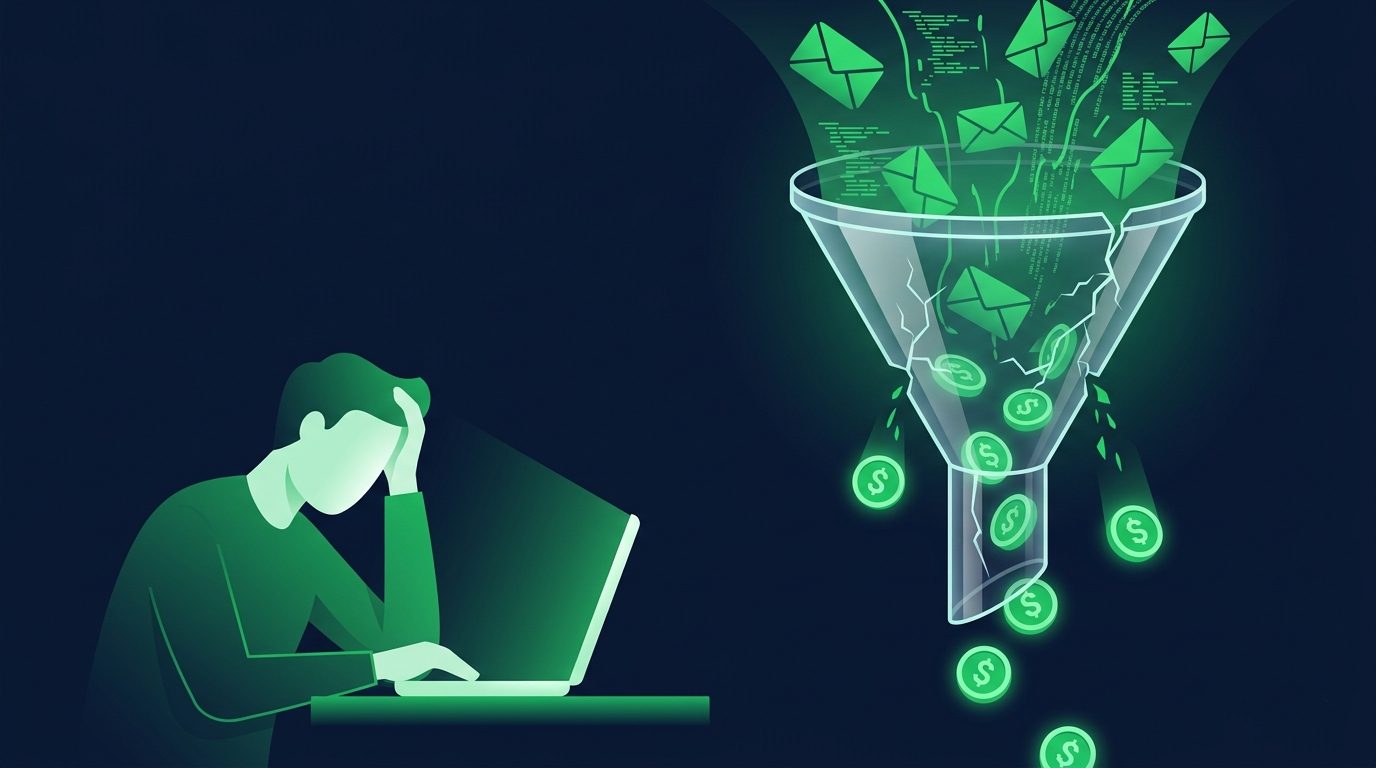
Solo ads look simple on the surface. You pay a vendor, they send an email to their list, and clicks land on your offer. But understanding why beginners lose money on solo ads goes much deeper than that surface picture. Most new affiliate marketers treat solo ads like a vending machine: put money in, get sales out. That framing is exactly what leads to budget losses, frustration, and the conclusion that solo ads don't work. They do work. But not the way beginners expect them to.
Key Takeaways
| Point | Details |
|---|---|
| Cost math matters first | Clicks cost $0.50–$5.00 with 1–5% conversion rates, so your commission must exceed your cost per acquisition. |
| Traffic quality beats volume | Vendor list quality and audience fit determine results more than how many clicks you buy. |
| Front-end profits are rare | Sustainable solo ad income comes from backend funnels and email follow-up, not immediate sales. |
| Campaigns need time | Cutting a campaign before 10–14 days creates data gaps and prevents accurate performance evaluation. |
| Vetting is non-negotiable | Vendors with over 50,000 engaged subscribers deliver significantly better conversion rates for beginners. |
Why Beginners Lose Money With Solo Ads
The financial math behind solo ads is where most beginners get blindsided. Solo ad clicks cost between $0.50 and $5.00, and conversion rates typically land between 1% and 5%. That means for every 100 clicks at $1.00 each, you spend $100 and might get one to five people to opt in or buy. If your affiliate commission is $20 per sale and your conversion rate is 2%, your cost per acquisition is $50. You lose $30 on every sale.
This is not a flaw in solo ads as a channel. It is a math problem that beginners rarely work out before spending money. The break-even point is the number where your commission equals your cost per acquisition. Profit only starts when your CPA drops below your commission, which requires testing and optimization over time.
The table below shows how different click costs and conversion rates affect your CPA at a fixed commission of $30:
| Cost per click | Conversion rate | Clicks to one sale | Total spend | Profit / Loss |
|---|---|---|---|---|
| $0.50 | 5% | 20 | $10.00 | +$20.00 |
| $1.00 | 3% | 33 | $33.00 | -$3.00 |
| $1.50 | 2% | 50 | $75.00 | -$45.00 |
| $2.00 | 1% | 100 | $200.00 | -$170.00 |
The numbers make it clear: even a small drop in conversion rate at a higher click cost turns a profitable scenario into a significant loss. Conversion rates from well-vetted solo ads can exceed 5% through testing and audience matching, but beginners rarely start there.
Pro tip: before you buy a single click, calculate your break-even CPA. Divide your commission by your expected conversion rate to see exactly how much you can afford to spend per click.
Common Mistakes That Drain Beginner Budgets
Knowing the math is one thing. Avoiding the behavioral mistakes is another. Most beginners fail with solo ads because of a predictable set of errors that compound each other.
- Buying cheap traffic without vetting the vendor. Low-cost clicks often come from recycled or scraped email lists. Traffic filled with bots and freebie seekers generates clicks that never convert, no matter how good your offer is.
- Sending traffic directly to a sales page. Without a squeeze page or opt-in funnel in between, you lose the ability to follow up. One email to a cold list rarely converts to a direct sale.
- Cutting campaigns too early. Many beginners pause after three days or fifty clicks and declare the campaign a failure. The recommended evaluation window is 10–14 days to collect enough data for meaningful conclusions.
- Ignoring the email follow-up sequence. Getting someone onto your list is step one. If you have no automated email sequence nurturing those leads, the traffic you paid for goes cold and never converts.
- Skipping landing page testing. Sending all your traffic to one untested page means you have no idea whether the page itself is the problem.
- Choosing offers with low commissions. If your affiliate offer pays $10 per sale and your CPA is $40, no amount of optimization will make that campaign profitable.
These are not random bad luck situations. They are predictable, avoidable patterns that show up consistently among beginners who are losing money on solo ads.
Pro tip: always use a dedicated squeeze page, not a direct sales page, as your landing destination for solo ad traffic. A 30–40% opt-in rate on a squeeze page gives you a list to follow up with, which is where the real money is made.
Want Verified Traffic Without the Guesswork?
PulseTraffic screens every seller, filters bot clicks in real time, and shows you verified buyer traffic labels before you spend a dollar.
Why Backend Funnels Change Everything
Here is the shift that separates struggling beginners from marketers who eventually profit from solo ads. Sustainable solo ad profit is almost always driven by backend funnels, not front-end sales. Expecting to profit on the first click is like expecting to profit on the first date. The relationship has to develop first.
A backend funnel works like this:
- A visitor clicks your solo ad link and lands on your squeeze page. They opt in with their email address in exchange for a lead magnet, such as a free guide, checklist, or mini-course.
- They are redirected to a one-time offer (OTO). This is a low-cost product, usually $7 to $27, that can offset some of your ad spend immediately.
- Your automated email sequence begins. Over the next 7 to 21 days, you send a series of emails that build trust, deliver value, and promote your core affiliate offer.
- Backend offers are introduced later in the sequence. Higher-ticket products, recurring subscriptions, or upsells generate revenue from the same leads you already paid to acquire.
- You track which emails and offers convert. That data tells you where to focus and what to scale.
The reason this matters for beginners is that solo ads are better seen as a testing tool than an instant profit machine. You are buying data about what your audience responds to. The email list you build is the asset. The backend sequence is where you recover your ad spend and eventually generate profit. Without that structure, you are paying for clicks that disappear with nothing to show for it.
Offer fit matters here too. If your vendor's list is built around general make-money-online content and your offer is a highly specific software tool for e-commerce store owners, the audience mismatch will tank your conversion rate regardless of how good your funnel is.
Practical Strategies to Reduce Risk
Reducing your risk as a beginner comes down to making deliberate decisions at each stage of the process rather than guessing and hoping. Here is how to approach solo ads more strategically.
Vet your vendors before spending. Vendors with over 50,000 subscribers and over 15% engagement deliver significantly better results. Ask for recent sales proof, check reviews, and look for vendors who specialize in your niche rather than general internet marketing lists. Our 6-point vetting checklist walks through this end to end.
Set a realistic budget and timeline. A minimum test run of 100 to 200 clicks over 10 to 14 days gives you enough data to evaluate performance. Spending $50 over two days tells you almost nothing. Pausing campaigns prematurely creates data signal gaps that prevent you from making accurate decisions.
Track everything from day one. Use a tracking tool to monitor click-through rates, opt-in rates, and sales conversions separately. You need to know if a poor result is caused by bad traffic, a weak landing page, or a poor email sequence. Without tracking, you cannot tell the difference. See our guide to tracking solo ad traffic for the exact setup, including how to catch low-quality clicks before they drain your budget.
The comparison below shows the difference between a structured approach and a common beginner approach:
| Approach | Vendor selection | Landing page | Follow-up | Tracking | Typical outcome |
|---|---|---|---|---|---|
| Beginner (unstructured) | Cheapest available | Direct sales page | None | None | Budget loss, no list built |
| Structured beginner | Vetted, niche-matched | Squeeze page tested | 7-day email sequence | Click and opt-in tracking | List built, data collected |
Diversify your traffic sources. Solo ads should be one channel in your marketing mix, not your only one. Combining solo ads with organic content, social traffic, or other paid channels reduces your dependency on any single vendor's list quality.
Pro tip: start with a small test order of 100 clicks from any new vendor before scaling. This limits your risk while giving you real performance data to evaluate before committing a larger budget.
My Honest Take on Why This Keeps Happening
I've watched the same pattern play out dozens of times. A beginner hears that solo ads are marketed as a quick path to profit, spends $200 on clicks, gets no sales, and concludes that solo ads are a scam. They are not a scam. But the way they are often sold does set beginners up for failure.
The uncomfortable truth I've learned is that success depends primarily on list quality and audience fit rather than on the offer alone. You have very little control over the email copy a vendor uses or the exact subscribers who open it. That means vendor selection is actually your most important decision, not your offer or your landing page.
What I've found actually works is treating solo ads as a precision data-gathering exercise. Experienced marketers use solo ads to test offers and audience intent, not to generate instant revenue. When you reframe the goal from "make sales today" to "learn what my audience responds to," your whole approach changes. You become patient, methodical, and far less likely to pull the plug too early.
The beginners who eventually succeed with solo ads are the ones who build a real email list, write a real follow-up sequence, and give campaigns enough time to produce meaningful data. They treat every dollar spent as tuition, not a gamble.
If you want to skip most of the trial-and-error on vendor selection, PulseTraffic pre-vets sellers for buyer-traffic quality and bot filtering, so you can focus your budget on funnel testing instead of seller research. Pair that with our best solo ads providers ranking and the full solo ads guide for the strategy context.
Want Verified Traffic Without the Guesswork?
PulseTraffic screens every seller, filters bot clicks in real time, and shows you verified buyer traffic labels before you spend a dollar.