

An email list is defined as a permission-based database of contacts who have opted in to receive direct communications from your business. Why building an email list matters comes down to one core fact: it is the only marketing channel you fully own. Social media platforms like Facebook and Instagram can change their algorithms overnight. Paid ad costs on Google Ads or Meta can spike without warning. Your email list sits outside all of that. Tools like Mailchimp and Klaviyo give you direct, unfiltered access to your audience, and email marketing delivers an average return of $36 for every $1 spent, far above what most digital channels produce.
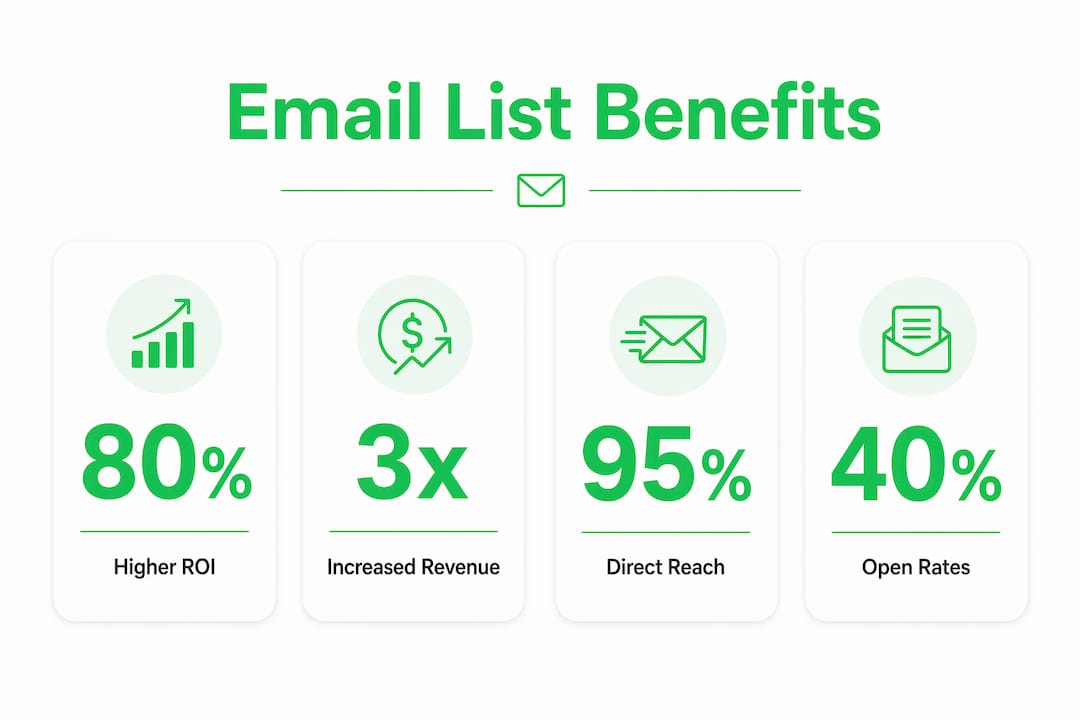
Why is an email list a critical marketing asset?
The foundational advantage of an email list is ownership. No third-party platform controls who sees your message. When Facebook reduces organic reach or Twitter changes its feed ranking, your email list is unaffected. That independence is not a minor convenience. It is a structural business advantage that compounds over time.

Email list independence from social platforms and paid ad fluctuations means your marketing budget goes further. Paid ads stop producing results the moment you stop paying. An email list keeps working because every subscriber represents a relationship you have already built.
The engagement numbers back this up. Email open rates average 20–40%, compared to organic social media reach of just 2–5%. That is a gap of roughly 10 to 20 times more visibility per message. For entrepreneurs running lean operations, that difference directly affects revenue.
"Email marketing significantly increases customer lifetime value by nurturing relationships through permission-based communication over time." — Soloadsguide research
Email also outperforms paid ads in cost stability. Ad platforms like Google Ads and Meta Ads operate on auction models, meaning your cost per lead rises as more advertisers compete. Your email list has no auction. You pay a flat monthly fee to platforms like Mailchimp or Klaviyo, and you can contact your entire list as often as your strategy calls for.
- Owned channel: No algorithm controls your reach.
- Compounding ROI: Each subscriber adds long-term value with every send.
- Higher engagement: Email open rates far exceed social media reach.
- Cost stability: Flat platform fees replace unpredictable ad spend.
- Privacy resilience: First-party email data stays compliant as third-party tracking declines.
How do segmentation and list hygiene improve results?
Segmentation is the practice of dividing your email list into smaller groups based on behavior, demographics, or purchase history. Segmented campaigns generate about 30% more opens and 50% more clicks than generic broadcasts. That performance gap exists because relevant messages get read, and irrelevant ones get ignored or flagged as spam.
Here is a practical approach to building a segmented, well-maintained list:
- Use double opt-in. Require subscribers to confirm their email address after signing up. This reduces fake signups and lowers spam complaints.
- Tag subscribers by behavior. Track who clicks on product links, who opens every email, and who has gone cold. Platforms like Klaviyo and Mailchimp handle this automatically.
- Run re-engagement campaigns. Before removing inactive subscribers, send a short sequence asking if they still want to hear from you. Some will re-engage. Those who do not should be removed.
- Remove invalid addresses regularly. Bounced emails damage your sender reputation with providers like Gmail and Outlook. Clean your list at least once per quarter.
- Automate lifecycle flows. Welcome sequences, abandoned cart emails, and post-purchase follow-ups run without manual effort. Lifecycle automation generates around 41% of total email revenue from just 5.3% of email sends.
Pro Tip: Set a calendar reminder every 90 days to audit your list. Remove addresses that have not opened a single email in six months. A smaller, cleaner list delivers better inbox placement and lower platform costs.
| Hygiene Action | Impact |
|---|---|
| Double opt-in | Reduces spam complaints, improves deliverability |
| Behavior tagging | Enables precise segmentation for higher click rates |
| Inactive removal | Protects sender reputation with Gmail and Outlook |
| Lifecycle automation | Drives 41% of revenue from 5.3% of sends |
Does list size matter more than engagement?
List size is a vanity metric when engagement is low. A small, highly engaged email list generates more revenue than a large, disinterested one. This is one of the most misunderstood facts in email marketing, and it costs entrepreneurs real money.
Consider two scenarios. A marketer with 10,000 subscribers and a 5% open rate reaches 500 people per send. A marketer with 1,000 subscribers and a 40% open rate reaches 400 people, but those 400 are far more likely to buy because they are genuinely interested. The second list also costs less to maintain on platforms like Mailchimp, which charges by subscriber count.
A large, unengaged list creates liabilities. Low open rates signal to Gmail and Outlook that your emails are unwanted. Over time, your messages get filtered into spam folders, reducing deliverability for your entire list, including the subscribers who do want to hear from you.
- Focus on alignment. Attract subscribers who match your offer, not just anyone willing to enter an email address.
- Use relevant lead magnets. A free checklist on affiliate marketing attracts a different subscriber than a generic discount code. Match the lead magnet to your core offer.
- Set expectations at signup. Tell new subscribers exactly what they will receive and how often. This reduces unsubscribes and increases engagement from day one.
Pro Tip: Track your list's revenue per subscriber, not just total revenue. Divide monthly email revenue by active subscriber count. This single metric tells you whether your list is growing in value or just growing in size.
What are the best strategies to build and grow your email list?
Building a high-quality email list starts with giving people a clear reason to subscribe. A lead magnet, which is a free resource offered in exchange for an email address, is the most reliable method. Effective lead magnets include PDF guides, discount codes, free courses, or exclusive content. The offer must match what your audience actually wants.
The micro yes approach increases opt-in quality by asking a low-commitment question before requesting an email address. For example, a pop-up that asks "Do you want 10% off your first order?" before showing the email field converts better than a direct email request. The subscriber has already said yes once, making the second step feel natural.
Here is a comparison of common list-building tools:
| Tool | Best For | Key Feature |
|---|---|---|
| Mailchimp | Beginners and small businesses | Free tier, drag-and-drop builder |
| Klaviyo | E-commerce brands | Deep Shopify integration, behavior tracking |
| Shopify Forms | Shopify store owners | Native opt-in forms, zero setup |
Avoid buying or scraping email lists. Cold emailing purchased lists increases spam complaints and damages your sender reputation. Inbox providers like Gmail track complaint rates, and a single bad campaign can get your domain flagged. The short-term volume gain is not worth the long-term deliverability damage.
Consistent, valuable content keeps your list engaged after signup. Marketers who send only promotional emails see higher unsubscribe rates. A mix of educational content, product updates, and occasional offers keeps subscribers opening. You can learn more about types of subscriber lists to understand how different segments respond to different content types.
Pro Tip: Place your opt-in form in at least three locations: your homepage header, a timed pop-up, and your blog sidebar or post footer. Each placement captures a different visitor behavior pattern.
For marketers who want to accelerate list growth, solo ads offer a direct path to new subscribers. A solo ad is a paid email sent to another marketer's list, directing their subscribers to your opt-in page. Understanding the role of email lists in solo ads helps you set up campaigns that convert traffic into real subscribers rather than one-time clicks.
Key Takeaways
Building an email list is the single highest-ROI marketing investment an entrepreneur or marketer can make, because it creates a direct, owned channel that compounds in value over time.
| Point | Details |
|---|---|
| Ownership beats reach | Email lists are immune to algorithm changes that reduce social media and paid ad performance. |
| ROI is unmatched | Email marketing returns $36 per $1 spent, far above other digital channels. |
| Segmentation drives results | Segmented campaigns produce 30% more opens and 50% more clicks than generic sends. |
| Engagement beats size | A small, active list generates more revenue and better deliverability than a large, cold one. |
| Automation multiplies output | Lifecycle flows generate 41% of email revenue from just 5.3% of total sends. |
The asset most marketers undervalue until it is too late
I have worked with hundreds of marketers who treated their email list as an afterthought. They focused on social followers, ad spend, and website traffic. Then a platform changed its algorithm, an ad account got suspended, or a traffic source dried up. The marketers who had built strong email lists recovered quickly. The ones who had not were starting from zero.
The compounding nature of email marketing is real, but it only works if you start early and stay consistent. A list you build over two years is worth far more than one you try to build in two months. Every subscriber you add today is a contact you can reach next year, the year after, and the year after that, without paying for access again.
The biggest mistake I see is chasing list size without caring about list quality. Marketers import cold contacts, skip double opt-in, and wonder why their open rates are below 10%. The answer is always the same: the list does not trust them yet, or never opted in at all.
Treat your email list like a customer ledger. Use subscriber behavior to understand what your audience wants. Track which emails drive purchases, which drive clicks, and which drive unsubscribes. That data is more useful than any third-party market research report.
Start building your list now, even if your business is small. The best time to build an email list was the day you launched. The second best time is today.
— Phil
How Soloadsguide helps you grow your list faster
Building an email list organically takes time. Solo ads give you a faster path by putting your opt-in offer in front of an already-engaged audience in your niche.
Soloadsguide reviews and ranks the top solo ads providers so you know which vendors deliver real, high-intent subscribers and which ones waste your budget. Every provider on the list has been tested for tier-1 traffic quality and conversion performance. If you are ready to scale your list with paid email traffic, the best solo ads providers for 2026 guide gives you a ranked, vetted shortlist to work from. No guesswork, no wasted spend on low-quality clicks.
FAQ
Why does building an email list matter more than social media?
Email lists give you direct, owned access to your audience without relying on platform algorithms. Email open rates average 20–40%, compared to 2–5% organic reach on social media.
What is a good email list open rate?
An open rate between 20–40% is considered strong across most industries. Segmented campaigns consistently outperform this baseline by targeting subscribers with relevant content.
How do I start building an email list from scratch?
Create a lead magnet that matches your core offer, set up an opt-in form using Mailchimp, Klaviyo, or Shopify Forms, and place it in at least three locations on your website.
Should I buy an email list to grow faster?
Buying email lists increases spam complaints and damages your sender reputation with providers like Gmail and Outlook. Permission-based list building always produces better long-term results.
How often should I clean my email list?
Remove invalid addresses and inactive subscribers at least once per quarter. Regular list hygiene improves deliverability and lowers your monthly platform costs.
Recommended
- Types of Email Subscriber Lists: A Marketer's Guide (2026)
- Email Traffic Lead Generation Benefits for Marketers
- Role of Email List in Solo Ads: 2026 Guide | SoloAdsGuide
- Types of Email Subscriber Lists: A Marketer's Guide
Want Verified Traffic Without the Guesswork?
PulseTraffic screens every seller, filters bot clicks in real time, and shows you verified buyer traffic labels before you spend a dollar.