

Buying email traffic is defined as paying a third party to send promotional emails to their subscriber list, directing clicks to your opt-in page or offer. This practice gives marketers immediate access to a targeted audience without waiting months to build an organic list from scratch. Platforms like Udimi connect buyers with solo ad sellers who own niche-specific lists, delivering hundreds of targeted clicks within 24 to 48 hours of purchase. Email marketing itself averages a $36 return per $1 invested, making it the highest-ROI channel in digital marketing. That combination of speed and return potential is the core reason why marketers buy email traffic as a campaign acceleration tool.
Why marketers buy email traffic for lead generation
Purchased email traffic fits into a specific role inside a marketing funnel. Marketers use it to fill the top of the funnel fast, capturing leads through opt-in pages rather than sending cold traffic directly to a sales page. This distinction matters because cold traffic rarely converts on a first visit to a product page. An opt-in page with a strong lead magnet, such as a free checklist, mini-course, or PDF guide, converts that cold click into a subscriber you can follow up with repeatedly.

The email traffic lead generation benefits extend beyond the first click. Once a visitor opts in, they enter your email sequence, where the real conversion work happens. A well-structured welcome sequence of 3 to 5 automated emails is the mechanism that turns a cold purchased lead into an engaged subscriber and eventually a buyer.
Here is how purchased traffic typically moves through a funnel:
- Traffic source: Solo ad seller or bulk list provider sends clicks to your URL
- Landing page: A squeeze page collects the visitor's email in exchange for a lead magnet
- Welcome sequence: Automated emails deliver the lead magnet, build trust, and introduce your offer
- Conversion point: A sales page, webinar, or call booking converts the warmed subscriber
Solo ads and bulk list campaigns serve different funnel roles. Solo ads deliver niche-targeted clicks from a single list owner's audience, making them better suited for affiliate marketing and digital product funnels. Bulk purchased lists offer volume at scale but require more filtering and segmentation before use.
Pro Tip: Send purchased traffic to a dedicated squeeze page, not your homepage or a product page. A focused opt-in page with one clear call to action consistently outperforms general pages for cold traffic.
Solo ads vs. bulk purchased email lists: which works better?
Marketers who buy email traffic have two primary options: solo ads and bulk purchased email lists. Each has a distinct performance profile, and choosing the wrong one for your funnel can waste your entire budget.
Solo ads are a single promotional email sent by a list owner to their subscribers on your behalf. The list owner has an existing relationship with their audience, which means the traffic arrives pre-qualified by niche relevance. You pay per click, and most reputable sellers guarantee a minimum click volume. The downside is that quality varies significantly between vendors, and guaranteed clicks do not guarantee conversions. Your funnel and follow-up sequence determine whether those clicks become leads and sales.
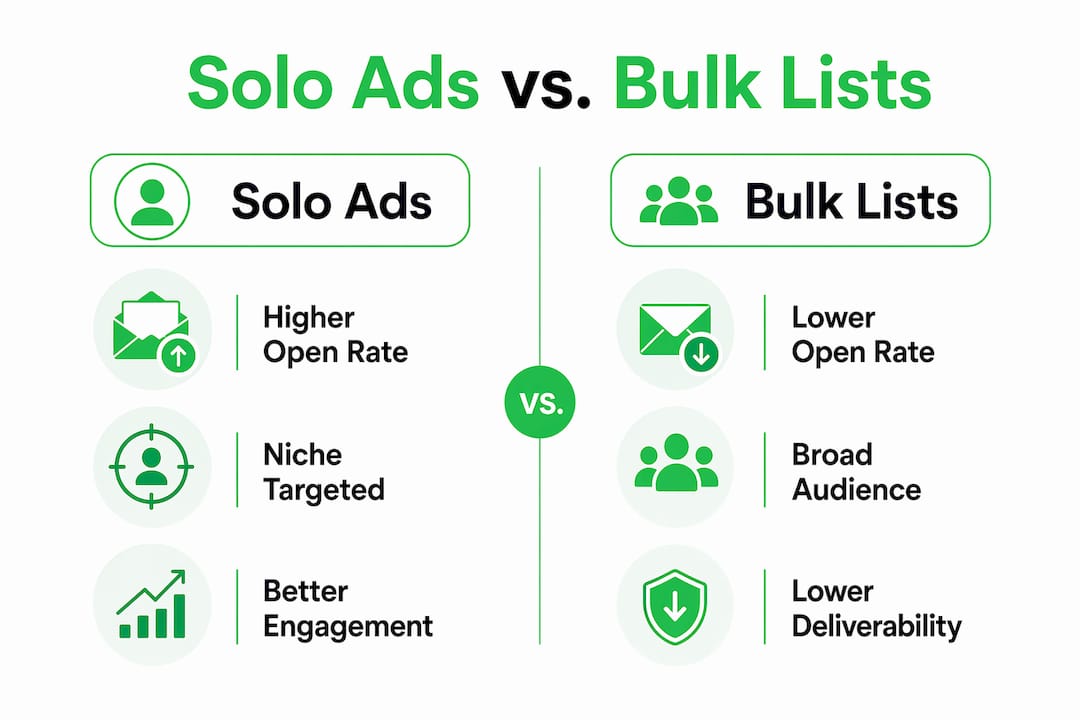
Bulk purchased email lists give you a database of contacts you email directly using your own sending infrastructure. They offer speed and scale, but purchased lists typically generate open rates under 5% compared to 18 to 35% for organically built lists. Low engagement signals hurt sender reputation and increase the risk of landing in spam folders.
| Metric | Solo ads | Bulk purchased lists |
|---|---|---|
| Open rate | 10%–20% (varies by vendor) | 2%–8% |
| Cost per lead | $1–$5 on average | Lower upfront, higher per conversion |
| Targeting | Niche-specific | Broad demographic |
| Deliverability risk | Low to moderate | Moderate to high |
| Best use case | Affiliate and digital product funnels | B2B outreach with verified data |
The table above shows that solo ads carry a meaningful deliverability and engagement advantage over bulk lists for most digital marketing funnels. Bulk lists can work in B2B contexts when the data is verified and intent-based, but they require careful list hygiene and separate sending infrastructure to protect your primary domain.
Pro Tip: When evaluating solo ad vendors, ask for a recent traffic report showing opt-in rates and the percentage of tier-1 traffic (US, UK, Canada, Australia). Vendors who share this data openly are far more reliable than those who only quote click guarantees.
For a detailed breakdown of list types and their reputational risks, the types of email subscriber lists guide from Soloadsguide covers the key differences marketers need to understand before buying.
Key advantages and risks of buying email traffic
The benefits of buying email traffic are real, but so are the risks. Understanding both sides helps you make smarter decisions about when and how to use purchased traffic in your campaigns.
Advantages:
- Speed: Organic list building takes months. Purchased traffic delivers clicks within 24 to 48 hours, letting you test offers and validate funnels without a long runway.
- Scalability: You can increase click volume by purchasing from multiple vendors simultaneously, scaling a winning funnel faster than SEO or social media allows.
- Targeting: Solo ad sellers maintain niche-specific lists, so your offer reaches people already interested in your topic area. This is a meaningful advantage over broad social media targeting.
- ROI potential: With email marketing averaging a 36x return on investment, even moderate conversion rates on purchased traffic can produce a positive return when your funnel is optimized.
Risks:
- Lead quality: Not all purchased clicks come from genuinely interested subscribers. Some vendors use low-quality or recycled lists that produce clicks but no opt-ins or sales.
- Deliverability damage: Sending to bulk purchased lists from your primary domain can trigger spam filters and damage your sender reputation across your entire email program.
- Compliance exposure: Emailing contacts who have not opted in to receive communications from you specifically creates legal risk under CAN-SPAM, GDPR, and similar regulations.
Purchased email traffic is best used as a channel acceleration tool, not a primary long-term strategy. Experts recommend treating bought lists as supplements to organic growth, not replacements for it. (The Starr Conspiracy)
The smartest approach is to maintain separate sending infrastructure when testing bulk purchased lists. Use a subdomain and a separate IP address so that any deliverability issues do not affect your core email program. This single operational decision protects months of sender reputation you have built with your organic list.
Best practices for buying and converting email traffic effectively
Buying email traffic produces results when you follow a structured process. Marketers who treat it as a plug-and-play solution consistently underperform those who test methodically and optimize their funnels before scaling.
-
Start with a small test budget. Purchase 100 to 200 clicks from a new vendor before committing to a larger order. This lets you evaluate traffic quality, opt-in rates, and lead behavior without significant financial exposure.
-
Vet vendors by niche and recency. A vendor who sold health and wellness traffic two years ago may not be the right fit for a business opportunity offer today. Check recent testimonials, ask for a traffic breakdown by geography, and confirm the list was built in your niche.
-
Optimize your opt-in page before buying traffic. A squeeze page with a clear headline, a specific lead magnet promise, and a single call to action should convert at 30% to 50% for warm traffic. If your page converts below 25% on cold traffic, fix the page before spending more on clicks.
-
Build a 3 to 5 email welcome sequence. Deliver the lead magnet immediately in the first email, then send value-building content over the next four emails before making a direct offer. This sequence converts cold purchased leads into subscribers who recognize and trust your brand.
-
Track the right metrics. Clicks and opt-in rates are traffic metrics. Cost per lead, email open rates, and revenue per subscriber are business metrics. Separate the two and judge vendor performance by cost per lead, not raw click volume.
Pro Tip: Use a dedicated tracking link for each vendor purchase so you can compare opt-in rates and lead quality across sources. Tools like ClickMagick or Voluum make this straightforward and give you the data to make confident scaling decisions.
For a step-by-step walkthrough of the full buying process, the how to buy solo ads guide from Soloadsguide covers vendor selection, page setup, and follow-up sequencing in detail.
Key takeaways
Marketers buy email traffic because it delivers immediate, niche-targeted clicks that accelerate lead generation and funnel testing far faster than organic methods, but conversions depend entirely on funnel quality and vendor selection.
| Point | Details |
|---|---|
| Speed is the primary driver | Purchased traffic delivers targeted clicks within 24 to 48 hours, bypassing months of organic growth. |
| Funnel quality determines ROI | Clicks alone do not produce revenue. A strong opt-in page and a 3 to 5 email welcome sequence convert cold traffic into buyers. |
| Solo ads outperform bulk lists | Solo ads deliver niche-targeted traffic with better open rates and lower deliverability risk than bulk purchased lists. |
| Infrastructure separation protects reputation | Use a separate domain and IP when testing bulk lists to prevent deliverability damage to your primary email program. |
| Test before scaling | Start with 100 to 200 clicks per vendor and measure cost per lead before increasing spend. |
Buying email traffic: what I've learned after years of testing
Marketers often come to purchased email traffic expecting it to solve a traffic problem. What they discover is that traffic was never really the problem. The funnel was.
I have seen campaigns with excellent solo ad vendors produce zero sales because the opt-in page was generic, the lead magnet was weak, and the welcome sequence was a single "thanks for subscribing" email. The vendor delivered exactly what was promised. The funnel failed. This is the most common and most expensive mistake in the space.
The best ROI from email marketing comes from combining quality traffic with strong first-party data practices and personalized follow-up sequences. Purchased traffic accelerates the process of building that first-party data, but it does not replace the work of nurturing it.
My honest recommendation is to treat buying email traffic the way you would treat paid search. You would not run Google Ads to a broken landing page. Apply the same standard here. Get your funnel converting on organic or referral traffic first, then use purchased traffic to scale what already works.
The other caution I would offer is about over-reliance. Marketers who build their entire list through purchased traffic often find themselves on a treadmill. The moment they stop buying, lead flow stops. Sustainable growth requires a mix of purchased traffic for speed and organic channels like content, SEO, and referrals for compounding returns over time. Purchased traffic is a powerful accelerator. It is not a foundation.
— Phil
Find the right solo ad providers with Soloadsguide
If you are ready to buy email traffic and want to skip the trial-and-error phase of finding reliable vendors, Soloadsguide has done the vetting work for you.
Soloadsguide maintains a curated ranking of the best solo ads providers for 2026, each tested for tier-1 traffic quality and conversion performance. The platform is built specifically for affiliate marketers and digital product sellers who need targeted clicks without the risk of wasting budget on low-quality sources. Whether you are running your first solo ad campaign or looking to scale a proven funnel, Soloadsguide gives you the vendor data and buying guidance to make confident decisions from day one.
FAQ
What does buying email traffic mean?
Buying email traffic means paying a list owner or traffic provider to send promotional emails to their subscribers, directing clicks to your opt-in page or offer. It is a paid method of accessing an existing audience rather than building one organically.
Why do marketers buy email traffic instead of building a list?
Marketers buy email traffic because it delivers targeted clicks within 24 to 48 hours, compared to the months required to grow an organic list through content or SEO. It is used primarily to accelerate lead generation and test funnel performance quickly.
Are solo ads better than buying bulk email lists?
Solo ads generally outperform bulk purchased lists for digital marketing funnels because they deliver niche-targeted traffic with higher open rates and lower deliverability risk. Bulk lists can work for B2B outreach when the data is verified and intent-based, but they require separate sending infrastructure to protect your sender reputation.
Do guaranteed clicks from solo ads guarantee sales?
No. Guaranteed solo ad clicks cover the volume of traffic delivered, not the downstream conversions or revenue generated. Sales depend on the quality of your opt-in page, lead magnet, and follow-up email sequence.
How much ROI can marketers expect from email traffic?
Email marketing as a channel averages a 36x return on investment, but results from purchased traffic vary based on vendor quality, funnel optimization, and offer relevance. Marketers who test systematically and optimize their funnels consistently achieve better returns than those who scale without testing first.
Recommended
- Email Traffic Lead Generation Benefits for Marketers
- Placeholder post: types-of-email-subscriber-lists-a-marketers-guide | SoloAdsGuide.com
- Types of Email Subscriber Lists: A Marketer's Guide (2026)
- What Is a Business Email Campaign? A 2026 Guide
Want Verified Traffic Without the Guesswork?
PulseTraffic screens every seller, filters bot clicks in real time, and shows you verified buyer traffic labels before you spend a dollar.