
CPC works best when you need clicks, small budgets protect against waste, or your creative is still unproven. CPM works best when reach itself is the goal, retargeting a warm audience, or you already know your creative converts. The metric that settles the argument for any specific campaign is effective CPC, and search platforms like Google Ads default to CPC while display and video inventory often runs on CPM or vCPM.
TL;DR:
- Small budgets and unproven creative typically perform better on CPC, which caps risk since you only pay when someone clicks.
- Warm retargeting audiences often favor CPM due to higher CTRs, which significantly reduce effective CPC compared to cold prospecting.
- Effective CPC should be calculated regularly, using verified CTR and impression data, before reallocating budgets between models.
- Seasonal fluctuations can raise CPM costs by 30 to 50 percent, especially during holiday periods, so budget adjustments during these times are essential.
- Always vet third-party traffic sources thoroughly and confirm tracking data to avoid misleading numbers that could distort cost calculations.
Table of Contents
- CPC vs CPM Pricing: Formulas and Quick Reference
- How Do You Decide Between CPC and CPM?
- What Are Typical CPC and CPM Rates by Platform?
- How Should You Allocate Budget Across CPC and CPM?
- Worked Examples: Turning CPM Into Effective CPC
- Vetting Traffic Sources Before You Scale Either Model
- Run the Math Before You Reallocate
- Verify Your Traffic Before You Trust the Math
- Sources
- FAQ
CPC vs CPM Pricing: Formulas and Quick Reference
Both models charge for different things, and that difference drives everything else about how you plan and budget a campaign.
CPC (cost per click) charges you only when someone clicks your ad. The formula is simple: CPC = total spend ÷ clicks. If you spend $200 and get 50 clicks, your CPC is $4. Google Ads treats CPC as a performance-based pricing model, where your Quality Score and competing bids determine what you actually pay per click, not just what you bid.
CPM (cost per mille, or cost per thousand impressions) charges you for exposure, regardless of clicks. The formula: CPM = (total spend ÷ impressions) × 1000. Spend $500 to get 100,000 impressions, and your CPM is $5. CPM has long served as both a pricing model and a benchmarking metric across traditional and digital media.
The bridge between them is effective CPC: Effective CPC = (CPM ÷ 1000) ÷ CTR. This converts a CPM buy into what you're really paying per click, so you can compare it directly against a CPC bid.
| Factor | CPC | CPM |
|---|---|---|
| Billing trigger | Per click | Per 1,000 impressions |
| Risk profile | Lower, pay only for action | Higher, pay regardless of engagement |
| Predictability | Cost scales with response | Cost is fixed upfront |
| Best use case | Traffic, leads, sales | Awareness, reach, retargeting |
| Common platforms | Search ads, solo ad clicks | Display, video, social feeds |
A few things worth remembering when you're scanning these numbers:
- CPC shifts the financial risk toward the platform since you don't pay for impressions that go nowhere.
- CPM shifts the risk toward you, the advertiser, since impressions don't guarantee action.
- Neither model is inherently cheaper. It depends entirely on your CTR and what a click is worth to you downstream.
How Do You Decide Between CPC and CPM?
Pick a model by walking through three questions in order, not by gut feeling or whichever number looks smaller on the dashboard.
- Confirm the objective. Are you trying to generate clicks, leads, or sales (action) or are you trying to build reach and recall (awareness)? Action goals lean CPC. Awareness goals lean CPM.
- Check your data. Do you have CTR and conversion-rate history for this specific creative and audience combination? Without it, you're guessing, and guessing on a CPM buy is more expensive than guessing on CPC because you pay whether or not anyone responds.
- Run the math. Take the CPM you're quoted, divide by 1,000, then divide by your estimated or historical CTR. That's your effective CPC. Compare it against what you'd pay bidding CPC directly for the same audience.
If effective CPC comes in lower than your CPC bid, the CPM buy is the better deal. If it comes in higher, stick with CPC.
A few rules of thumb make this faster in practice. Small budgets should almost always start on CPC, since the downside of a bad click is capped and known. Retargeting and warm audiences often favor CPM, because click-through rates on warm lists frequently run 2 to 5%, which drives effective CPC down sharply even when the CPM itself looks pricier than average. And whenever you're not sure, run a short test rather than committing a full month's budget to either model.
Pro Tip: Don't trust the CTR a vendor or platform preview promises you. Pull your own tracking data after 48 to 72 hours of real spend before you plug numbers into the effective CPC formula, or you're just computing a fantasy figure.
What Are Typical CPC and CPM Rates by Platform?
Google Ads runs search campaigns on CPC by default, while display and video inventory frequently defaults to CPM or viewable CPM, and Smart Bidding can override a manual CPC setting entirely to chase conversions instead of clicks, according to Google's own bidding documentation.
Rates vary enormously by vertical, format, and season. Rough 2026 reference points:
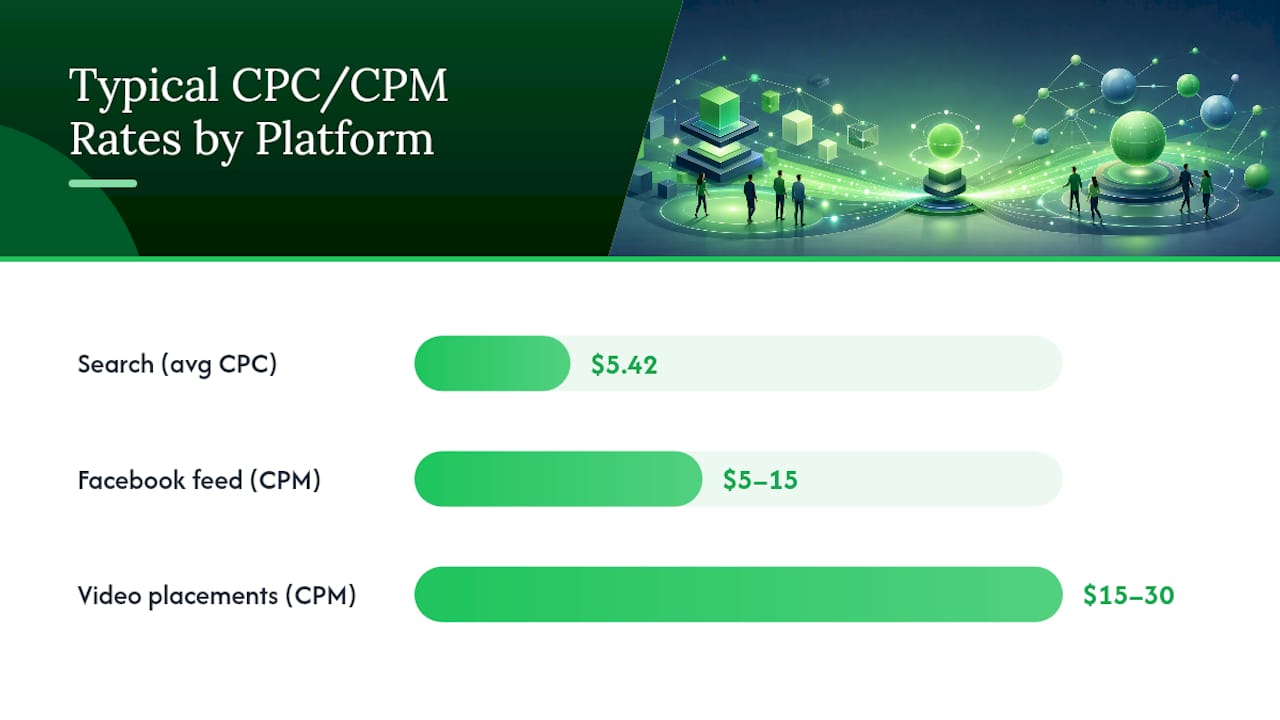
- Average search CPC across industries sits around $5.42, though this masks huge spread. Legal and insurance keywords routinely run several times higher than retail or entertainment terms.
- Facebook feed CPMs commonly fall between $5 and $15, while video placements often run $15 to $30.
- Medians tend to be lower than averages in most benchmark reports, reflecting that expensive verticals pull the averages upward.
Seasonality matters too. Fourth-quarter demand from holiday advertisers can push CPMs up 30 to 50% as more brands compete for the same inventory. If your campaign runs November through December, budget for that spike rather than getting blind sided by it.
How Should You Allocate Budget Across CPC and CPM?
Most campaigns don't need to pick one model forever. They need a sequence.
Manual CPC bidding gives you the most control when you're new to an audience and want to cap risk while you gather data. Automated bidding, including CPA targets, makes sense once you have enough conversion history for the platform's algorithm to optimize against, generally a few dozen conversions at minimum.
A practical funnel timeline looks like this:
- Days 1 through 5: Launch on CPM to build reach and gather CTR data cheaply, since you're not paying a premium for clicks you haven't proven yet.
- Day 5 checkpoint: Calculate effective CPC from the CPM data. Compare it to what direct CPC bidding would cost for the same audience.
- Days 6 onward: Shift underperforming segments to CPC or CPA, and let strong CTR segments continue running on CPM if the effective CPC is beating your CPC alternative.
Watch four signals throughout: CTR, effective CPC, conversion rate, and ROAS. If CPC starts climbing mid-campaign, the fix usually isn't a bigger bid. It's often a stale creative, a landing page that no longer matches the ad's promise, or audience fatigue setting in. Improving landing-page quality frequently beats renegotiating media rates because conversion rate multiplies every dollar you're already spending on clicks.
Pro Tip: If your CPC spikes but your CPM hasn't moved, the problem is almost never the platform. It's your CTR dropping, which mechanically raises effective CPC even when the underlying inventory price is flat.
Worked Examples: Turning CPM Into Effective CPC
Numbers settle arguments that opinions can't. Here are three scenarios that show how the same formula plays out differently depending on CTR.
- Cold prospecting: A $10 CPM with a 1.0% CTR gives you an effective CPC of ($10 ÷ 1,000) ÷ 0.01 = $1.00. That's competitive with many CPC campaigns, but only because the CTR held up.
- Warm retargeting: An $8 CPM with a 3% CTR gives you ($8 ÷ 1,000) ÷ 0.03 = $0.27 effective CPC, far cheaper than most direct CPC bids on the same audience. This is why retargeting so often favors CPM.
- Small-budget test: With only $50 to spend and no CTR history, CPC protects you better than CPM. A bad CPM buy at 0.2% CTR would produce an effective CPC north of $5, quietly burning through your entire budget before you learn anything useful.
| Scenario | CPM | CTR | Effective CPC |
|---|---|---|---|
| Cold prospecting | $10 | 1.0% | $1.00 |
| Warm retargeting | $8 | 2 to 5% | $0.27 |
| Poor CTR test | $10 | 0.2% | $5 to $15 |
If you want to model your own campaign numbers, Soloadsguide's cost-per-click optimization guide walks through similar calculations for solo ad and traffic-buying scenarios specifically.
Vetting Traffic Sources Before You Scale Either Model
Every formula above assumes the CTR and impression numbers you're working with are real. That assumption breaks down fast when you're buying traffic from a vendor rather than bidding directly on a platform like Google or Meta, where the reporting is at least standardized.
Before committing real budget to any CPC or CPM buy from a third-party source, run through a short checklist:
- Require a working tracking link before you send payment, not after.
- Ask for raw click logs or impression logs, not just a summary screenshot.
- Start with a small test batch instead of a full budget commitment.
- Confirm your landing page's actual conversion rate matches what the traffic quality would predict.
Inflated click or impression counts distort effective CPC in one direction only: they make a bad buy look cheap on paper.
Run the Math Before You Reallocate
Test small, track everything yourself, and calculate effective CPC before you commit real budget to either model. The formula only protects you if the numbers feeding it are verified, not vendor-promised.
— Philip Coble
Verify Your Traffic Before You Trust the Math
Every effective CPC calculation in this article assumes your click and impression data is accurate. In solo ad buying, that assumption fails more often than most marketers expect. Soloadsguide exists specifically to close that gap: the 21-question vendor vetting framework walks you through exactly what to ask a traffic seller before you send payment, and the site's tracking guides show you how to confirm the CTR and conversion numbers you're plugging into your own formulas.

If you're weighing a CPC or CPM buy and want to know whether the traffic behind it is legitimate, start with Soloadsguide's vetting checklist before you commit budget. It's a five-minute read that can save you from calculating effective CPC on numbers that were never real in the first place. Visit Soloadsguide to get the framework and start vetting your next traffic source properly.
Sources
- About bidding strategies and pricing (Google Ads support)
- Cost per click (CPC) — Investopedia
- Cost per thousand impressions — Wikipedia
- Google Ads CPC Too High? Benchmarks + How to Lower It (2026) — SuperScale
FAQ
Is CPC Better Than CPM?
Neither is universally better. CPC tends to protect small budgets and untested creative, while CPM often wins for awareness campaigns and warm retargeting audiences where CTR is already strong.
How Much Does CPM Cost Per 1,000 Views?
Costs vary widely by platform and format. Facebook feed placements often run $5 to $15 per 1,000 impressions, while video placements frequently run $15 to $30, and seasonal demand in the fourth quarter can push these figures 30 to 50% higher.
Why Is My CPC So High on Facebook?
A rising CPC usually points to a falling CTR, increased competition for your audience, creative fatigue, or a landing page that no longer matches what the ad promises. Check effective CPC against your CTR trend before assuming the platform simply got more expensive.
Is Google Ads CPC or CPM?
Google Ads runs search campaigns on CPC by default, while display and video inventory frequently prices on CPM or viewable CPM, and Smart Bidding can override manual CPC settings to optimize toward conversions instead of clicks.
Recommended
- Cost Per Click Optimization for Solo Ad Affiliates
- What Is Cost Per Acquisition Explained for Solo-Ad Buyers
- Vendor Traffic Source Quality Indicators: 2026 Guide
- Affiliate Traffic Source Comparison: 2026 Guide
Want Verified Traffic Without the Guesswork?
PulseTraffic screens every seller, filters bot clicks in real time, and shows you verified buyer traffic labels before you spend a dollar.