

Cost per acquisition (CPA) is the average amount you spend on advertising to produce one defined conversion. For solo-ad buyers, that definition hinges on a choice you must make before you measure anything: what counts as an acquisition?
The term itself carries a built-in ambiguity. CPA can mean either "Cost Per Acquisition" or "Cost Per Action," and the two are often used interchangeably in marketing reports. This article uses Cost Per Acquisition throughout, meaning the cost to produce one specific conversion event you define in advance.
The formula is straightforward:
Two quick facts to anchor your expectations:
- Industry averages show wide variation in CPA across different verticals, with some sectors much cheaper and others much more expensive. It is context, not a target.
- Your first job before buying a single click is to define your acquisition event. Everything else follows from that decision.
Table of Contents
- What counts as an acquisition in your solo-ad campaign?
- How to calculate CPA with real solo-ad numbers
- How to judge whether your CPA is sustainable
- How to verify that your solo-ad CPA is real
- Which KPIs matter when comparing solo-ad vendors?
- Red flags that distort your CPA measurement
- Key Takeaways
- The metric most solo-ad buyers measure too late
- Soloadsguide helps you vet vendors before you spend
- Sources used in this article
What counts as an acquisition in your solo-ad campaign?
The acquisition event you choose is the single most consequential input in your CPA calculation. Change the event, and you change the number entirely.

Solo-ad campaigns typically serve two different goals, and each demands a different conversion definition.
List-building campaigns count a confirmed email opt-in as the acquisition. Your squeeze page collects the lead, your autoresponder confirms the address, and that confirmation is the event. CPA here is really cost per lead (CPL), and it tends to run lower because you are not asking for money yet.
Affiliate sale campaigns count a completed purchase as the acquisition. The bar is higher, the conversion rate is lower, and the CPA will be significantly larger. Comparing a list-building CPA to a sale-based CPA across two vendors tells you nothing useful.
Defining your acquisition event is not a formality. It is the only way to make CPA figures from different vendors or campaigns mean the same thing.
Other events worth considering: a tripwire purchase (a low-cost front-end offer), a free trial sign-up, or a webinar registration. Each produces a different CPA and a different downstream value. Choose the event that matches your funnel's actual goal, and hold every vendor to that same definition.
Pro Tip: For list-building campaigns, use the opt-in as your primary acquisition event, but track the micro-conversion rate from opt-in to first email open. A vendor delivering cheap opt-ins from disengaged subscribers will show a low CPA that evaporates the moment you look at open rates.
How to calculate CPA with real solo-ad numbers
The formula is simple. Applying it correctly takes a few deliberate choices.
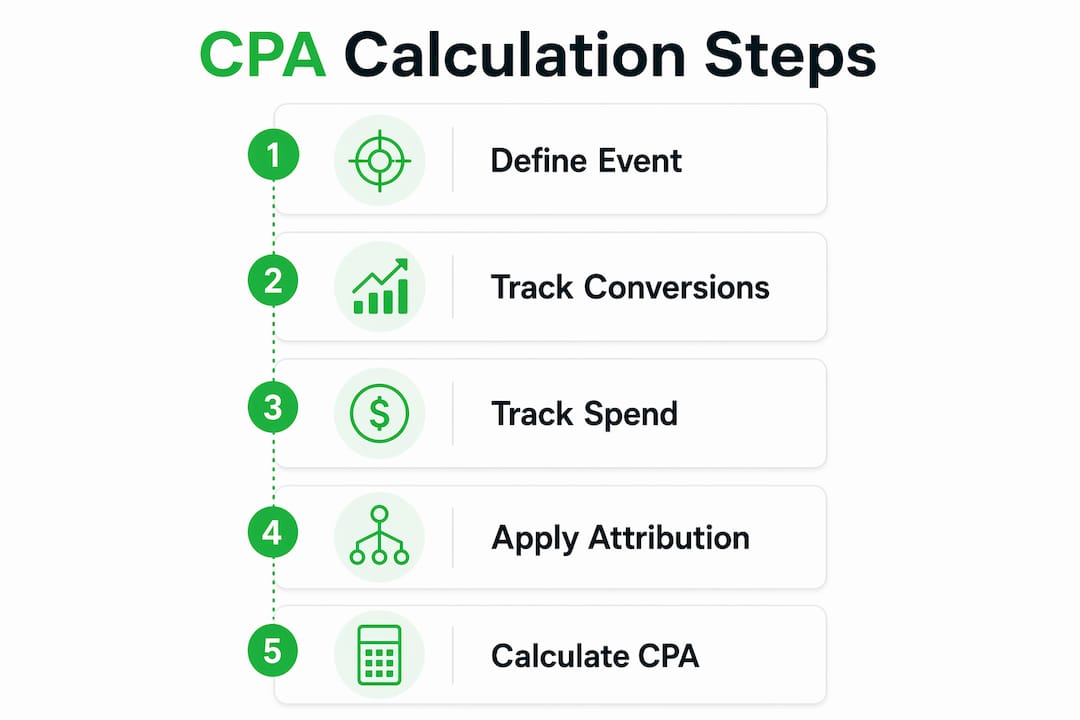
What to include in "total ad spend": For a media-level CPA, include only what you paid the vendor for clicks. Exclude your autoresponder fees, landing page tools, and creative costs. That keeps the number comparable across vendors. If you want a fully loaded view, add those costs in, but label it clearly so you are not mixing metrics.
Here are three worked examples using numbers typical for solo-ad campaigns:
- List opt-in example. You pay $200 for 200 clicks. Your squeeze page converts at 40%, giving you 80 opt-ins. CPA = $200 ÷ 80 = a low cost per opt-in.
- Affiliate sale example. Same $200 spend, same 80 opt-ins. Your email sequence converts 4% of those leads to a $47 sale, producing 3 buyers. CPA = $200 ÷ 3 = a substantially higher cost per sale.
- Blended campaign example. You run two vendors simultaneously, spending $400 total and generating 7 buyers. Blended CPA = $400 ÷ 7 = an average CPA in the mid-range. That blended figure hides the fact that one vendor produced 5 buyers and the other produced 2. Always segment by vendor before drawing conclusions.
Attribution window matters. Solo-ad traffic rarely converts the same day. A subscriber who opts in on Monday may buy on day 12 after your nurture sequence warms them up. A same-day attribution window will make your CPA look terrible. A 30-day window is a reasonable starting point for most affiliate funnels; 90 days is appropriate if your sequence is long.
How to judge whether your CPA is sustainable
A CPA number means nothing without context from your own unit economics. There is no universal "good" CPA; the right number depends on your average order value (AOV), gross margin, and lifetime value (LTV).
Break-even CPA = AOV × Gross Margin. For example, if your product sells for a moderate price and your margin is decent, your break-even CPA is the product of those two values. Spending more than that on a single acquisition loses money on the first transaction.
Target CPA = LTV × % of LTV you are willing to spend. For example, if a customer is worth a certain amount over their lifetime, you may choose a target CPA as a fraction of that value.
Industry averages sit below typical break-even points in some examples, but averages are built from thousands of verticals with very different economics. Use them as a sanity check, not a goal.
One more number to keep in mind: fully loaded customer acquisition cost (CAC) typically runs multiple times higher than your platform-reported CPA once you add tools, email software, and time. CPA is a media-efficiency metric. CAC is the business-level truth.
| Metric | Reference Figure | Source |
|---|---|---|
| 2025 average CPA (all industries) | $53.52 | ConversionStudio |
| Fully loaded CAC vs. platform CPA | 2–4x higher | AdSights |
| Suggested max CPA as % of LTV | Up to 30% | BigCommerce guidance |
How to verify that your solo-ad CPA is real
Vendor-reported conversions are not proof. You need your own tracking in place before you send a dollar.
- Create a unique tracking link for every vendor. Never reuse the same link across two sources. Tools like ClickMagick or Voluum let you generate per-vendor links that log every click with a timestamp.
- Add UTM parameters to every link so your analytics platform (Google Analytics 4 or equivalent) records source, medium, and campaign separately.
- Install a conversion pixel on your thank-you page. This fires when a visitor completes the acquisition event and ties the conversion back to the originating click.
- Match conversion timestamps to vendor send times. If a vendor claims they sent your email at 2 PM EST and your pixel shows conversions starting at 11 AM, something is wrong. Timestamp matching is one of the most reliable fraud-detection steps available.
- Check deliverability signals. Low open rates on a confirmed opt-in list, unusually high bounce rates, or a sudden drop in engagement after the first email all suggest the traffic quality is poor regardless of what the CPA looks like.
- Request sample proof. Before scaling, ask the vendor for a sample of 20–30 leads with timestamps, IP addresses, and opt-in confirmation data. Legitimate vendors provide this without hesitation.
Pro Tip: Run a small validation test of 100–200 clicks before committing to a larger order. Calculate your CPA from that test, check the timestamps, and verify at least 10 opt-ins manually before scaling. A $50–$100 test is cheap insurance against a $500 mistake.
Which KPIs matter when comparing solo-ad vendors?
CPA is one input in a larger decision. Relying on it alone will get you burned.
The KPIs that actually matter for vendor comparison are:
- Verified conversion rate: clicks to opt-ins, confirmed by your own pixel, not the vendor's dashboard.
- Click-to-open rate on your follow-up sequence: a proxy for list quality that CPA does not capture.
- Deliverability rate: what percentage of your emails reach the inbox after the vendor sends traffic.
- Refund and complaint rate: high refund rates on tripwire purchases signal low buyer intent in the list.
- List overlap: if you are buying from multiple vendors, duplicate subscribers inflate your opt-in count and deflate your real CPA.
Before paying any vendor, request three things: a sample of previous campaign stats (opt-in rate, not just click volume), audience demographic data, and at least one reference from a buyer in your niche. CPA becomes meaningful only after you have confirmed the traffic is real.
The 21-Question Vendor Vetting Framework at Soloadsguide covers every one of these checkpoints systematically. CPA fits into that framework as one data point among many, not the deciding factor.
Red flags that distort your CPA measurement
Several common mistakes make CPA look better than it is, and some vendor behaviors are designed to exploit them.
A CPA that looks too good is almost always measuring the wrong thing, measuring it too early, or measuring traffic that was never real.
Watch for these pitfalls:
- Blended CPAs hiding bad vendors. If you average two vendors together and one is performing well, the combined CPA masks the underperformer. Always segment.
- Mismatched conversion events. A vendor quoting you a $3 CPA is measuring opt-ins. You are measuring sales. Those numbers are not comparable.
- Ignoring attribution lag. Cutting a vendor after 48 hours because you see zero sales is premature. Give your nurture sequence time to work before judging.
- Unverifiable screenshots. A vendor showing you a screenshot of their dashboard as conversion proof is not evidence. Your pixel is evidence.
- Unusually low CPAs with vague definitions. If a vendor cannot tell you exactly what action triggered their reported conversion, assume it is not the action you care about.
Pro Tip: If a vendor's reported CPA is more than 50% below your own tracked CPA for the same event, pause the campaign immediately and run a 100-click confirmation test with fresh tracking links before spending more.
Key Takeaways
CPA only becomes a useful decision tool when you define the acquisition event, track it yourself, and compare it against your own unit economics rather than industry averages.
| Point | Details |
|---|---|
| Define the event first | Choose opt-in, sale, or trial before measuring CPA — mixing event types makes vendor comparisons meaningless. |
| Use the formula correctly | CPA = Total Ad Spend ÷ Acquisitions; include only media spend for campaign-level comparisons. |
| $53.52 is context, not a target | The 2025 industry average spans a 20x range; base your target CPA on your AOV, margin, and LTV instead. |
| CAC runs 2–4x platform CPA | Fully loaded acquisition cost is always higher than the media metric; calculate both before scaling. |
| Soloadsguide vetting framework | Use the 21-Question Vendor Vetting Framework to verify traffic quality before CPA figures mean anything. |
The metric most solo-ad buyers measure too late
Most buyers calculate CPA after a campaign ends and use it to decide whether to repeat. That is the wrong sequence. The conversion event, the attribution window, and the tracking setup all need to be in place before the first click arrives. A CPA calculated after the fact, without your own pixel data, is just the vendor's story about what happened.
The other thing buyers consistently underweight is the gap between platform CPA and fully loaded CAC. A $40 CPA on a $97 product looks profitable until you add your autoresponder, your landing page tool, and the two hours you spent writing the email sequence. That $40 becomes $70 fast. Build the full cost picture before you decide a vendor is worth scaling.
CPA is genuinely useful. It gives you a per-unit cost to compare across vendors and campaigns, and it forces you to think about conversion events in concrete terms. But it only works as a tool when the measurement is yours, not the vendor's.
Soloadsguide helps you vet vendors before you spend
Knowing your CPA formula is the easy part. The harder part is confirming that the traffic behind your numbers is real, the vendor is transparent, and your tracking is set up correctly before money changes hands.

Soloadsguide was built specifically for buyers in that position. The site's 21-Question Vendor Vetting Framework walks you through every checkpoint, from requesting sample campaign data to verifying deliverability and spotting bot traffic. The tracking guides cover unique link setup, UTM configuration, and pixel verification in plain language, without the hype that most solo-ad content relies on.
If you are buying solo ads to grow your email list or drive affiliate sales, start with the vendor vetting checklist at Soloadsguide.com before placing your first order. It takes 20 minutes and can save you from a $300 mistake on your first campaign.
Sources used in this article
- Cost per acquisition, Wikipedia — definition and CPA vs. Cost Per Action terminology clarification.
- ConversionStudio CPA Guide — 2025 average CPA of $53.52 and the 20x vertical variability caveat.
- How to Calculate Cost Per Acquisition, AdLibrary — CPA formula, acquisition event definition, and segmentation guidance.
- What is Cost Per Acquisition, BigCommerce — unit economics framework and the principle that no universal CPA benchmark exists.
- Cost Per Acquisition, AdSights — CPA vs. CAC distinction and the 2–4x fully loaded CAC multiplier.
- What is CPA and How to Calculate It, Salesforce — practical tracking techniques including timestamp matching and UTM parameters.
- SoloAdsGuide.com — 21-Question Vendor Vetting Framework and buyer-focused educational resources.
Recommended
- Why Solo Ads Reduce Customer Acquisition Costs
- Cost Per Click Optimization for Solo Ad Affiliates
- How Much Do Solo Ads Cost in 2026? Pricing Breakdown
- What Are Solo Ads? The Complete Beginner's Guide (2026)
Want Verified Traffic Without the Guesswork?
PulseTraffic screens every seller, filters bot clicks in real time, and shows you verified buyer traffic labels before you spend a dollar.