
Solo ads are a paid traffic method where you buy email clicks from an established list owner, and they reduce customer acquisition costs by delivering warm, pre-engaged subscribers directly to your offer. This cost-per-click (CPC) model, the industry standard term for what solo ad buyers actually purchase, removes bidding wars and ad platform complexity. The result is predictable spending, faster campaign feedback, and a lower cost per acquisition (CPA) than most cold traffic channels. Compliance with the FTC's CAN-SPAM Act also protects your sender reputation and keeps traffic quality high from the start.
Why solo ads reduce customer acquisition costs compared to other paid channels
Solo ads deliver warm traffic from email lists, meaning the subscribers receiving your offer already trust the list owner who sent it. That pre-existing trust shortens the decision cycle and raises conversion rates compared to cold display or social audiences who have never heard of you.
The pricing model reinforces this advantage. With solo ads, you pay a fixed rate per click, not a variable auction price. Paid social and search platforms use real-time bidding, so your CPC can spike based on competitor budgets, seasonality, or algorithm changes. Solo ads remove that variable entirely.

Setup speed is another cost driver that solo ads address directly. Solo ads deliver traffic within 1–3 days, with no creative approval process, no audience build-out, and no minimum spend threshold. Less time spent on setup means lower overhead per campaign.
That said, vendor quality varies significantly. Not every list owner maintains an engaged, responsive subscriber base. Key factors to evaluate before buying include:
- Niche alignment: The list must match your offer category, such as online business, health, or finance.
- Tier-1 traffic percentage: Clicks from the US, UK, Canada, and Australia convert at higher rates.
- Opt-in rate history: A vendor's average opt-in rate tells you how warm their list actually is.
- Verified reviews: Third-party testimonials from buyers reduce the risk of low-quality traffic.
Skipping vendor vetting is the fastest way to turn a cost-effective channel into a money pit. Quality control at the vendor selection stage is where most of the CPA reduction actually happens.
How do solo ads improve funnel testing to lower acquisition costs?
Rapid funnel testing is one of the clearest ways solo ads cut long-term acquisition costs. When you can drive traffic to a new offer within 48 hours, you get real conversion data before committing to a larger budget.
Marketers can start test campaigns for $50–$100, gaining direct feedback on opt-in rates, click-through rates, and front-end conversion performance. That data tells you whether your funnel is ready to scale or needs adjustment. Spending $75 to learn a landing page converts at 12% instead of 25% saves thousands in wasted spend later.
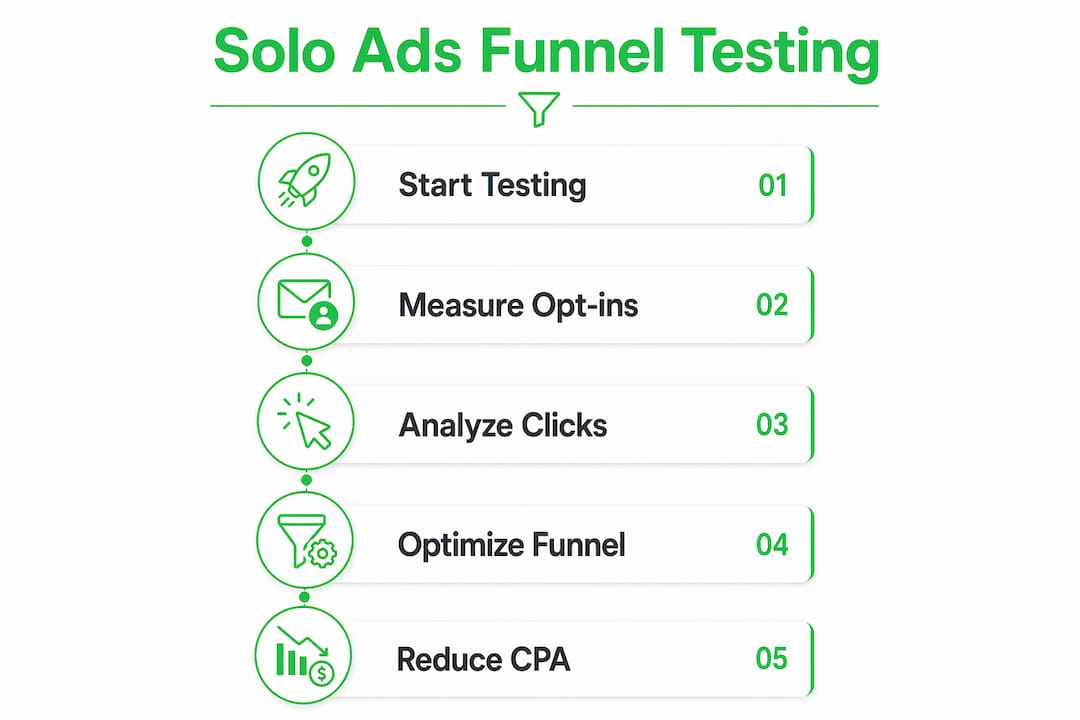
The "fail fast" principle applies directly here. Solo ads provide immediate funnel data that lets you avoid pouring budget into unproven offers. Each small test either confirms your funnel works or reveals the specific step that needs fixing.
Here is a practical four-step testing process that keeps costs low:
- Send 100–200 clicks to a squeeze page. Measure the opt-in rate. Anything below 30% signals a headline or offer mismatch.
- Track front-end sales conversions. If your offer converts below your target CPA, adjust the price point or the lead magnet before scaling.
- Analyze email open rates from new subscribers. Low open rates in the first 48 hours indicate a weak welcome sequence.
- Run a second test with one change at a time. Changing multiple variables simultaneously makes it impossible to identify what moved the numbers.
Pro Tip: Track your cost per lead (CPL) separately from your CPA. A high CPL with a strong back-end sequence can still produce a profitable CPA. Conflating the two leads to cutting campaigns that would have been profitable with a better follow-up.
Why building an email list from solo ads lowers long-term acquisition costs
The squeeze page approach is the mechanism that turns solo ad traffic into a reusable asset. Instead of sending clicks directly to a sales page, you send them to a short opt-in page that captures the subscriber's email address first. That subscriber now belongs to your list, not just the vendor's.
This matters because the email follow-up sequence generates recurring revenue beyond the initial conversion. A subscriber who does not buy on day one may buy on day seven, day fourteen, or after your fifth follow-up email. Each of those conversions costs you nothing additional in ad spend.
The math on this is compelling. One documented campaign example shows an immediate ROI of -52% on the front end, meaning the initial ad spend exceeded direct sales revenue. After email follow-up sequences ran over subsequent weeks, total campaign ROI turned positive at +53%. That swing from loss to profit came entirely from the list asset, not from additional ad spend.
| Metric | Front-end only | With email follow-up |
|---|---|---|
| Initial ad spend | $200 | $200 |
| Front-end revenue | $96 (ROI: -52%) | $96 |
| Follow-up revenue | $0 | $306 |
| Total ROI | -52% | +53% |
The contrast is stark. Marketers who treat solo ads as a direct-response channel only will almost always see negative returns. Marketers who treat solo ads as a list-building tool see compounding returns over time.
Pro Tip: Write at least a 7-email follow-up sequence before you buy your first solo ad click. Subscribers who do not convert immediately are not lost. They are warm leads waiting for the right message at the right time.
The lifetime value of an email subscriber consistently exceeds the cost of acquiring that subscriber through solo ads when the follow-up system is in place. This is why solo ads for lead generation produce better long-term economics than most paid traffic sources.
How does landing page optimization multiply solo ad cost savings?
Landing page conversion rate is the single largest lever for reducing CPA, and it works independently of how much you spend on traffic. Improving conversion from 2% to 3% cuts CPA by 33% without touching your ad budget. A 2% conversion rate at $10 CPC produces a $500 CPA. A 3% rate at the same CPC drops CPA to $333.
Message match between the solo ad email copy and the landing page headline drives that conversion lift. When a subscriber clicks an email promising "a free guide to affiliate marketing for beginners" and lands on a page with that exact promise, trust carries over. When the page headline says something different, that trust breaks and the subscriber leaves.
Most teams achieve 20–30% CPA improvement by addressing landing page content for message match and usability alone. Ad-side changes have diminishing returns once a campaign matures. The page is where the untapped gains sit.
Better message alignment also improves Quality Score in paid search campaigns you may run alongside solo ads. Higher Quality Scores lower CPC across those channels, creating a compounding cost reduction effect.
| Optimization lever | CPA impact | Effort level |
|---|---|---|
| Landing page conversion rate | Up to 33% reduction | Medium |
| Message match (ad to page) | 20–30% improvement | Low |
| Email follow-up sequence | Turns negative ROI positive | Medium |
| Vendor quality selection | Prevents wasted spend | Low |
Conversion rate optimization on your landing page is not optional if you want solo ads to work at scale. A well-written squeeze page with a clear headline, a single opt-in form, and a specific lead magnet offer will consistently outperform a generic page regardless of traffic volume.
Strong calls to action also matter more than most marketers expect. Effective CTAs on your opt-in page directly raise the percentage of visitors who subscribe, which lowers your CPL and, by extension, your CPA.
Key Takeaways
Solo ads reduce customer acquisition costs by combining warm traffic, predictable CPC pricing, rapid funnel testing, email list building, and landing page optimization into a system where each element compounds the savings of the others.
| Point | Details |
|---|---|
| Warm traffic lowers CPA | Pre-engaged subscribers convert faster than cold audiences, reducing cost per acquisition from the first click. |
| Fixed CPC removes budget risk | Predictable pricing eliminates bidding volatility, making campaign budgeting accurate and controllable. |
| Email list building turns losses into profit | A follow-up sequence can flip a -52% front-end ROI to +53% total ROI without additional ad spend. |
| Landing page optimization cuts CPA by a third | Raising conversion rate from 2% to 3% reduces CPA by 33% at the same traffic cost. |
| Vendor quality determines baseline results | Tier-1 traffic from verified vendors is the foundation; poor vendor selection negates all other optimizations. |
Phil's take: why solo ads are misunderstood as a quick-win channel
Most marketers who try solo ads and quit did one thing wrong. They sent traffic directly to a sales page, measured immediate revenue, saw a loss, and called the channel broken. The channel was not broken. The strategy was.
Solo ads are most effective as a supplement to a broader marketing strategy, not as a standalone revenue machine. The real value is speed of data and list growth. No other paid channel gives you 200 targeted clicks within 48 hours for under $100. That speed is worth paying for when you use it to test, not just to sell.
I have seen affiliate marketers spend $500 on solo ads with zero front-end profit and then generate $800 in commissions over the following 30 days from the email list they built. They almost gave up after week one. The marketers who stick with it long enough to build a real follow-up sequence are the ones who report the cost per lead reductions that make this channel worth the effort.
Start small. Track everything. Build your list before you worry about immediate ROI.
— Phil
How Soloadsguide helps you find vendors that actually lower your costs
Choosing the wrong solo ad vendor is the fastest way to waste your budget. Soloadsguide maintains a ranked list of vetted providers tested specifically for tier-1 traffic quality and conversion performance, so you skip the trial-and-error phase that costs most marketers hundreds of dollars.
Soloadsguide users have reported up to a 40% reduction in cost per lead after switching to verified vendors from the guide's rankings. The platform covers both beginner-friendly providers and higher-volume options for experienced marketers ready to scale. Check the best solo ads providers rankings to find a vendor matched to your niche, budget, and traffic goals.
FAQ
What are solo ads and how do they reduce acquisition costs?
Solo ads are paid email traffic purchases from established list owners. They reduce acquisition costs by delivering warm, pre-engaged subscribers at a fixed CPC, removing bidding volatility and shortening conversion cycles.
How much does it cost to test a solo ad campaign?
Marketers can start a test campaign for $50–$100, which is enough to generate 100–200 clicks and measure opt-in and conversion rates before committing to larger spend.
Why does building an email list from solo ads lower long-term CPA?
Subscribers captured through a squeeze page can be monetized repeatedly through follow-up sequences. One documented example shows a campaign that started at -52% ROI reaching +53% total ROI after email follow-up revenue was counted.
How does landing page optimization work with solo ads to cut costs?
Raising landing page conversion rate from 2% to 3% cuts CPA by 33% at the same traffic cost. Message match between the solo ad email and the landing page headline is the most direct way to achieve that lift.
Are solo ads compliant with email marketing regulations?
Solo ads must comply with the FTC's CAN-SPAM Act. Compliance reduces spam complaints, protects sender reputation, and maintains the traffic quality that makes solo ads cost-effective.
Recommended
- Are Solo Ads Worth It for Affiliate Marketers in 2026?
- Solo Ads Blog, Tips, Guides & Reviews | SoloAdsGuide.com
- Why Beginners Lose Money on Solo Ads (Real Reasons)
- How Much Do Solo Ads Cost in 2026? Pricing Breakdown
Want Verified Traffic Without the Guesswork?
PulseTraffic screens every seller, filters bot clicks in real time, and shows you verified buyer traffic labels before you spend a dollar.