
Solo ads are paid email promotions delivered to a third-party list owner's subscribers, giving you direct access to a targeted audience without building your own list first. For affiliate marketers and small business owners asking whether solo ads are worth it, the honest answer is: yes, but only with the right funnel, vendor, and tracking in place. Conversion rates typically run 1–5%, and that range tells you everything. Solo ads can generate real leads fast, but they punish unprepared campaigns quickly.
What benefits do solo ads offer affiliate marketers?
Solo ads deliver one advantage no organic channel can match: speed. A single campaign can produce 100–500 targeted leads in 1–3 days, compared to weeks or months with SEO. That speed makes them especially useful for testing a new funnel, validating an offer, or filling a list before a product launch.
The benefits of solo ads go beyond raw speed. Here is what makes them practical for affiliate marketers and small business owners:
- Predictable cost-per-click pricing. You pay a fixed rate per click, so your budget is never a surprise. This makes solo ads easier to plan around than auction-based platforms.
- Warm, niche-targeted audiences. You are reaching subscribers who already opted into a related email list. That pre-existing interest raises the floor on engagement compared to cold display traffic.
- No ad account risk. Solo ads carry no account ban risk, unlike Facebook or Google Ads, where a policy violation can shut down your entire account overnight.
- Funnel testing at low cost. A small buy of 100–200 clicks gives you real conversion data on a squeeze page or lead magnet before you commit a larger budget.
- List building as a byproduct. Every opt-in from a solo ad campaign becomes your subscriber. You own that relationship going forward, which compounds the value of each campaign.
Solo ads also support email traffic lead generation in a way that paid social cannot. Social platforms rent you attention for a moment. A solo ad subscriber joins your list and stays there for follow-up.

What are the main risks and challenges of solo ads?
Solo ads carry real risks, and beginners absorb most of the damage. About 1 in 3 beginner campaigns fail to break even due to poor funnel setup or low-quality vendors. That failure rate is not a reason to avoid solo ads. It is a reason to prepare before spending.
The most common pitfalls fall into three categories:
- Low-quality traffic. Cheap solo ads frequently deliver bot clicks and recycled list members with low buyer intent. A $0.30 click that never converts costs more than a $0.60 click that opts in and buys.
- List churn. Vendors who sell to too many buyers repeatedly expose the same subscribers to offer after offer. Those subscribers become fatigued and stop engaging. Avoid vendors whose lists are heavily advertised to, because churn destroys deliverability and conversion rates.
- Inflated metrics. Bot traffic inflates click counts and open rates, making a bad campaign look acceptable until you check actual opt-ins and sales. Never judge a solo ad campaign by clicks alone.
Tracking is non-negotiable. You need to monitor earnings per click (EPC), cost per acquisition (CPA), and opt-in rate at minimum. Without those numbers, you cannot tell a profitable campaign from a money pit.
Pro Tip: Set a hard rule before any campaign: if your opt-in rate falls below 10% after 100 clicks, pause and fix the landing page before buying more traffic.
The reasons beginners lose money on solo ads almost always trace back to skipping this step. A weak squeeze page wastes every click, regardless of traffic quality.
How to evaluate and optimize solo ad campaigns for maximum ROI
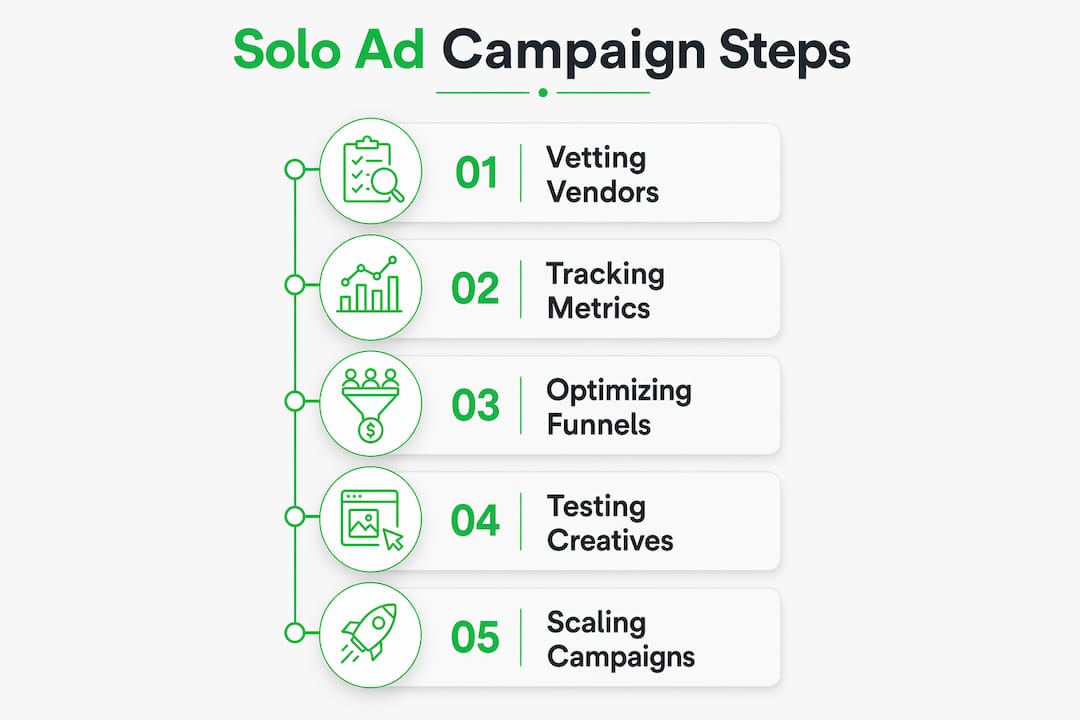
Solo ad effectiveness comes down to a repeatable process: vet the vendor, test small, track everything, and follow up aggressively. Here is how to execute that process step by step.
- Vet vendors before buying. Ask for click IDs and recent conversion data. A credible vendor can show you EPC averages and opt-in rates from past buyers. If they cannot, move on.
- Start with a small test buy. Testing 100–200 clicks before scaling lets you validate lead quality without risking your full budget. Treat this as tuition, not a loss.
- Track with dedicated tools. Voluum and RedTrack with subIDs let you filter bot traffic, identify which vendors produce buyers versus tire-kickers, and make scaling decisions based on real data.
- Set EPC and cost-per-lead benchmarks. Know your numbers before you buy. If your offer pays $40 per sale and converts at 2%, you need a cost per click well below $0.80 to stay profitable.
- Optimize your landing page. Target a minimum 10–20% opt-in rate on your squeeze page. Test headlines, lead magnets, and page layout. Traffic quality matters less when your page converts well.
- Build a 30–60 day follow-up sequence. Email follow-up sequences are essential to monetization. Most subscribers do not buy on day one. A well-structured autoresponder sequence turns a cold lead into a buyer over time.
- Measure lifetime subscriber value, not just CPC. Cost per lead and lifetime subscriber value are the metrics that determine whether a campaign was actually profitable. A subscriber worth $3 over 90 days justifies a higher cost per click than you might initially accept.
Pro Tip: Use a dedicated tracking domain for each vendor so you can compare performance side by side. One vendor producing $1.20 EPC versus another at $0.40 EPC tells you exactly where to reinvest.
For deeper guidance on cost per lead optimization, the math behind these benchmarks is worth studying before your first buy.
How do solo ads compare to other paid traffic sources in 2026?
Solo ads occupy a specific niche in the paid traffic ecosystem. They are not the best channel for every goal, but they outperform alternatives in specific situations.
| Factor | Solo ads | Paid social and search |
|---|---|---|
| Setup complexity | Low. No creative assets or audience targeting required. | High. Requires ad creative, audience research, and ongoing optimization. |
| Account ban risk | None. No platform account involved. | Real. Policy violations can suspend accounts without warning. |
| Traffic quality | Variable. Depends entirely on vendor list quality. | Generally higher intent, especially search traffic. |
| Scalability | Limited. Volume is capped by vendor list size. | High. Budget increases translate directly to more volume. |
| Minimum test budget | Low. A 100-click test can cost $40–$100. | Higher. Paid social typically requires larger budgets to exit the learning phase. |
| Best use case | List building, funnel testing, affiliate offers. | Brand awareness, e-commerce, high-ticket sales. |
Solo ads win on simplicity and speed. Paid social and search win on scalability and traffic intent. The right answer for most affiliate marketers is to use solo ads for diversifying traffic sources and list building, then layer in other channels as revenue grows.
The key limitation of solo ads is volume. A single vendor can only send so many clicks. Scaling solo ads means working with multiple vendors simultaneously, which multiplies the tracking and vetting workload.
Key Takeaways
Solo ads are worth it when you treat them as a media-buying strategy built on vendor vetting, rigorous tracking, and a long-term email follow-up sequence.
| Point | Details |
|---|---|
| Speed advantage is real | Solo ads deliver 100–500 leads in 1–3 days, far faster than organic channels. |
| Beginners face high failure rates | About 1 in 3 beginner campaigns fail to break even without proper funnel setup. |
| Cheap traffic is a false economy | Low-cost solo ads frequently deliver bots and fatigued subscribers that waste budget. |
| Track EPC and subscriber value | Cost per click alone does not measure profitability. Lifetime subscriber value does. |
| Follow-up sequences are mandatory | A 30–60 day email sequence converts leads into buyers and justifies the initial spend. |
Why I think most marketers misread solo ad results
Solo ads get a bad reputation because most people evaluate them wrong. They look at clicks, see a low opt-in rate, and conclude the channel does not work. The real problem is almost always the funnel, not the traffic.
I have watched marketers send 500 clicks to a generic squeeze page with no lead magnet and then declare solo ads a scam. That is like blaming the highway for a car that will not start. Solo ads are rented attention, not a magic button. If your funnel cannot convert warm traffic from a related email list, it will not convert anything.
The marketers I have seen succeed with solo ads treat the first few campaigns as paid education. They spend $100–$200 to learn what their opt-in rate actually is, what their EPC looks like with real traffic, and whether their follow-up sequence produces any sales. That data is worth more than the leads themselves.
The other mistake is chasing the lowest cost per click. Solo ads evolve into a media-buying and tracking challenge where list quality and backend funnel sophistication determine everything. A $0.70 click from a fresh, well-maintained list beats a $0.35 click from a burned-out list every time. Patience and data are the only antidotes to solo ad skepticism.
— Phil
Finding the right solo ad providers for your first campaign
Choosing the wrong vendor is the fastest way to waste a solo ad budget. The difference between a profitable campaign and a frustrating one often comes down to list quality, traffic tier, and whether the vendor can show you real conversion data from past buyers.
Soloadsguide has done the vetting work for you. The best solo ads providers for 2026 are ranked and reviewed based on verified tier-1 traffic, opt-in rates, and buyer feedback. Users of Soloadsguide have reported a 40% reduction in cost per lead by switching to vetted providers from the guide's recommendations. Start with a small test buy from a top-ranked vendor, apply the tracking and funnel practices covered here, and you will have real data to build on within days.
FAQ
What is a solo ad and how does it work?
A solo ad is a paid email promotion sent by a list owner to their subscribers on your behalf. You pay per click, and the list owner's audience sees your offer in a dedicated email with a single call to action.
Are solo ads worth it for beginners?
Solo ads can work for beginners, but about 1 in 3 beginner campaigns fail to break even without proper funnel setup. Starting with a small 100-click test and a well-optimized squeeze page reduces that risk significantly.
How much do solo ads typically cost?
Pricing varies by vendor and traffic quality, but a 100-click test generally costs $40–$100. Higher-quality, tier-1 traffic vendors charge more per click but typically deliver better opt-in rates and buyer intent.
What opt-in rate should I expect from solo ads?
A well-optimized squeeze page should achieve a 10–20% opt-in rate from solo ad traffic. Rates below 10% usually signal a landing page problem rather than a traffic quality issue.
Do solo ads work for affiliate marketing specifically?
Yes. Solo ads work well for affiliate marketing when paired with a lead magnet, a strong squeeze page, and a 30–60 day email follow-up sequence that nurtures subscribers toward a purchase decision.
Recommended
- Are Solo Ads Still Worth It in 2026? Honest Assessment
- Solo Ads Blog, Tips, Guides & Reviews | SoloAdsGuide.com
- Best Solo Ads Providers in 2026 (Ranked & Reviewed)
- Solo Ads Affiliate Commissions Explained for Marketers
Want Verified Traffic Without the Guesswork?
PulseTraffic screens every seller, filters bot clicks in real time, and shows you verified buyer traffic labels before you spend a dollar.