

Diversifying affiliate traffic sources means deliberately spreading your traffic acquisition across multiple independent channels so no single algorithm, policy change, or platform shutdown can collapse your income. Programs dependent on one or two sources risk exactly that kind of collapse when Google updates its ranking signals or Facebook revises its ad policies overnight. The six core channel categories available to affiliate marketers in 2026 are paid search, organic SEO, email, social and influencer, comparison and aggregator sites, and display and retargeting. Each carries a different cost structure, conversion pattern, and risk profile. Google Search Console, Google Analytics 4, and the FTC's revised 2026 disclosure framework are the three tools and rules shaping how you build, measure, and protect a diversified traffic portfolio right now.
How to diversify affiliate traffic sources across channels
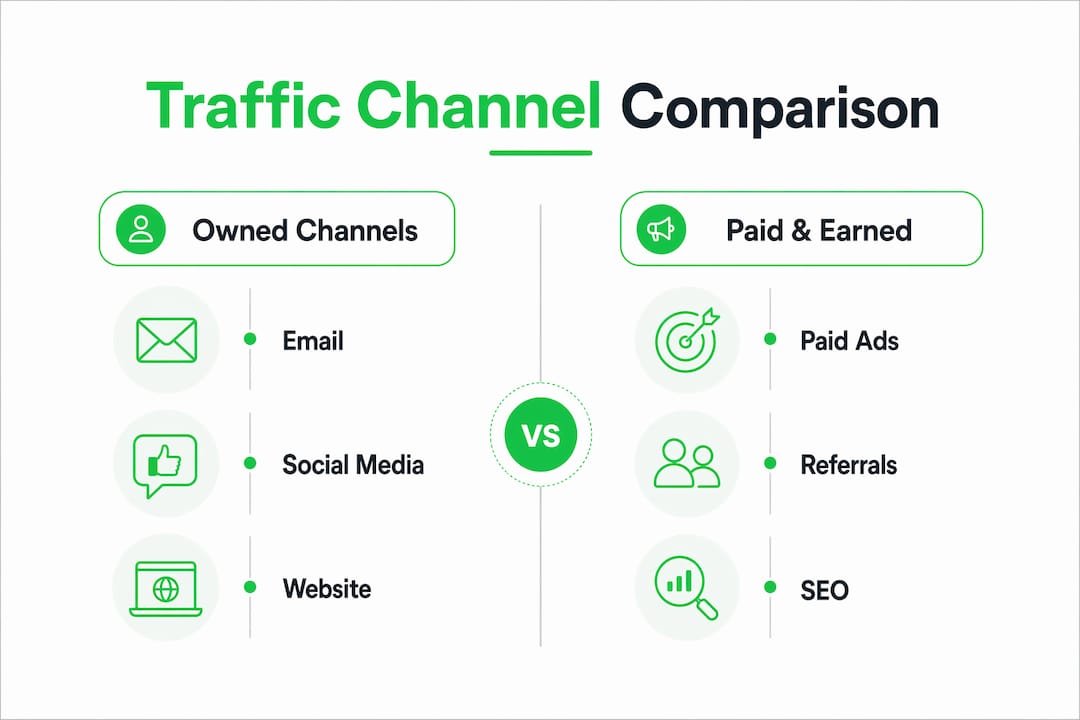
Meaningful traffic diversification requires volume from at least three distinct source types: owned channels like email and SMS, earned channels like organic search, and paid or partner channels. The distribution does not need to be equal. What matters is that no single channel accounts for more than 60% of your total clicks, because concentration above that threshold leaves your revenue exposed to one decision you did not make.
Here is how each major channel category performs in practice:
- Owned channels (email, SMS, communities): You control the list, the send schedule, and the message. Building this asset is slow, but email traffic for lead generation compounds over time and survives every algorithm update. Opt-in rates on a well-maintained list typically outperform cold paid traffic on cost per conversion.
- Organic SEO and content: Organic search delivers 60 to 80% of an affiliate site's long-term traffic when content is built systematically. This is the load-bearing channel. It compounds, it costs nothing per click at scale, and repurposing top articles into YouTube videos extends reach across two major search engines simultaneously.
- Paid traffic (Google Ads, Facebook Ads, solo ads): Paid channels are best used for testing funnels or scaling what already converts, not as primary volume drivers. A comparison of solo ads vs. Facebook and Google Ads shows each has a distinct cost-per-click range and audience intent level that suits different funnel stages.
- Social media and influencer marketing: Engagement-driven traffic from platforms like Instagram, TikTok, and YouTube can generate strong click-through rates, but reach is rented. Platform algorithm changes can cut organic reach by 50% or more with no warning.
- Referral and partner networks: Recruiting affiliates who themselves use distinct source types adds a distributed layer of resilience. If one partner's SEO traffic drops, others running email or paid campaigns keep your program active.
- AI-driven traffic discovery: In 2026, platforms like ChatGPT, Perplexity, and Bing AI are sending measurable referral traffic to affiliate content. This channel is growing and requires its own tracking setup, covered in the next section.
| Channel | Cost | Control | Conversion pattern |
|---|---|---|---|
| Email / owned list | Low per send | High | Consistent, relationship-driven |
| Organic SEO | Time investment | Medium | Slow build, high long-term ROI |
| Paid (Google, Facebook, solo ads) | Variable CPC/CPL | Low to medium | Fast, funnel-dependent |
| Social / influencer | Low to medium | Low | Engagement-driven, variable |
| Referral / partner networks | Revenue share | Medium | Distributed, resilient |
| AI-driven traffic | Near zero | Low | Emerging, growing fast |
Pro Tip: Start with two channels you can execute well before adding a third. Spreading across five channels with thin execution produces worse results than dominating two channels with depth.
How to measure and attribute traffic across diversified sources
Measurement quality determines whether your diversification strategy actually works or just looks busy. Last-click attribution misrepresents channel value in affiliate funnels with multiple touches, which leads to distorted ROI data and budget decisions that defund the channels doing the most early-funnel work. If your email sequence warms a lead and a paid ad closes the sale, last-click gives 100% of the credit to the paid ad. You end up cutting email spend and wondering why conversions drop.

Multi-touch attribution in Google Analytics 4 solves this directly. GA4's path exploration report shows every channel a user touched before converting, so you can see which channels initiate journeys and which ones close them. That distinction changes how you allocate budget across a diversified portfolio.
For organic traffic specifically, the Google Search Console Performance report shows clicks, impressions, click-through rate, and average position for every keyword driving traffic to your affiliate pages. This data comes directly from Google's systems, making it the most reliable signal for identifying ranking gaps and tracking which organic queries are sending conversion-linked traffic.
AI-sourced traffic requires its own measurement layer. Tracking AI search traffic accurately means building custom GA4 channel groups using referral regex patterns for domains like chatgpt.com and bing.com, then cross-referencing with GSC's AI overview metrics. Without this setup, AI referrals get misclassified as generic search or direct traffic, and you undercount one of the fastest-growing affiliate traffic sources in 2026.
Here is a practical measurement checklist for a diversified affiliate setup:
- Set up GA4 multi-touch attribution and review path exploration reports weekly
- Create custom channel groups in GA4 for AI referral sources
- Monitor GSC Performance report for keyword ranking opportunities beyond your primary targets
- Audit click-to-conversion gaps by channel monthly to detect crediting errors
- Use a solo ad traffic tracking tool to separate quality clicks from bot traffic in paid campaigns
Pro Tip: Connect GA4, Google Search Console, and your affiliate network dashboard into a single Looker Studio report. One view across all sources removes the blind spots that cause budget misallocation.
What compliance rules apply when diversifying affiliate traffic in 2026
Compliance is not optional, and in 2026 it is more specific than most affiliates realize. The FTC's revised 2026 disclosure framework requires clear, conspicuous disclosures placed before the first monetized affiliate link, not buried in a footer or a site-wide disclaimer page. This rule applies across every traffic channel you use.
The implications vary by channel:
- Email and push notifications: Disclosure must appear at the top of the message, before any affiliate link appears in the body.
- AI-assisted content: The FTC's 2026 guidance explicitly requires disclosure when AI tools were involved in creating affiliate content, in addition to the standard affiliate relationship disclosure.
- Video content: Early verbal disclosure is required, not just a text overlay at the end of the video.
- Deep landing pages: Disclosures buried in footers fail users who land directly on a product review page from a search result or social post. Inline placement adjacent to the first affiliate link is the only reliable approach.
Clear, pre-link disclosures do more than satisfy regulators. Users who see an honest disclosure before clicking an affiliate link convert at higher rates because trust is established before the decision point.
The FTC's 2026 disclosure changes also affect conversion performance directly. Affiliates who treat disclosure as a conversion obstacle get it backwards. Transparent disclosures placed near decision points build the credibility that turns a click into a sale.
Pro Tip: Audit every traffic source in your portfolio for disclosure placement. Create a simple checklist: email templates, landing page templates, video scripts, and AI-generated content drafts. Update each one before July 1 if you have not already.
How to build a diversified affiliate traffic portfolio step by step
Building a traffic portfolio that holds up over time requires a deliberate sequence, not a simultaneous launch across every channel.
- Identify your current traffic concentration. Pull your GA4 source and medium report. If one channel drives more than 60% of sessions, that is your single point of failure. Name it, then plan around it.
- Build one owned asset before scaling paid. An email list, a private community, or an SMS subscriber base gives you a channel you control. Owned channels are the only traffic marketers truly control. Algorithmic channels add volume but carry platform risk.
- Establish organic SEO as your load-bearing channel. Publish content systematically around buyer-intent keywords. Organic search compounds over time in a way paid traffic cannot. Use GSC to find ranking opportunities adjacent to your existing content.
- Repurpose top-performing content across media. A high-converting product review article becomes a YouTube video, a short-form social post, and an email sequence. Repurposing content into videos ranks across multiple platforms and multiplies reach without multiplying production cost.
- Use paid traffic for testing and scaling, not primary volume. Run Google Ads, Facebook Ads, or solo ads to validate a funnel before committing to organic content production. Once a funnel converts profitably, paid traffic scales it faster. Review solo ad budget allocation strategies to avoid overspending during the testing phase.
- Recruit affiliates with distinct traffic profiles. If your program currently relies on SEO-driven affiliates, actively recruit partners who run email lists, paid media, or social audiences. Program-level diversification mirrors site-level diversification.
- Avoid the common pitfall of spreading too thin. Adding five new channels in 90 days produces shallow execution across all of them. Add one new channel per quarter, measure it for 60 days, then decide whether to scale or cut it.
The goal is a portfolio where organic SEO provides stable baseline traffic, owned channels provide direct-access traffic, and paid or partner channels provide scalable volume when a funnel is ready for it. That three-layer structure is what makes a traffic portfolio genuinely resilient.
Key takeaways
Effective affiliate traffic diversification requires owned channels for control, organic SEO for compounding reach, and paid or partner channels for scalable volume, measured with multi-touch attribution and protected by FTC-compliant disclosures.
| Point | Details |
|---|---|
| Diversify across three channel types | Combine owned, earned, and paid sources so no single channel exceeds 60% of total traffic. |
| Use multi-touch attribution | GA4 path exploration reveals which channels initiate and close conversions, preventing budget misallocation. |
| Track AI traffic separately | Custom GA4 channel groups and GSC AI signals prevent AI referrals from being misclassified as direct traffic. |
| Place FTC disclosures pre-link | Inline disclosures before the first monetized link are required in 2026 and improve conversion trust. |
| Build owned assets first | An email list or community gives you traffic you control, independent of algorithm changes. |
Why measurement and compliance are the real levers in traffic diversification
Most affiliates treat diversification as a traffic acquisition problem. Add more channels, get more clicks. That framing misses the two factors that actually determine whether diversification pays off: measurement accuracy and compliance.
I have seen campaigns where an affiliate added three new traffic sources, watched overall clicks increase, and concluded the strategy was working. But when we pulled GA4 path data, the new channels were generating early-funnel sessions that last-click attribution was assigning zero credit to. The affiliate was about to cut the channels that were warming every lead. That is the measurement trap, and it is more common than most people admit.
On compliance, the FTC's 2026 updates are not a bureaucratic inconvenience. I have tested disclosure placement directly on landing pages, and pre-link disclosures consistently outperform footer-only disclosures on conversion rate. Users who know they are reading an affiliate recommendation before they click convert better than users who feel surprised by it after the fact. Transparency is a conversion tactic, not just a legal obligation.
My honest advice: start with two channels, measure them properly with GA4 multi-touch attribution and Google Search Console, get your disclosures right, and then add a third channel. Depth in a few channels beats shallow presence across many. AI-driven traffic is worth tracking now even if the volume is small, because it is growing fast and the affiliates who build tracking infrastructure early will have a data advantage when it scales.
— Phil
How Soloadsguide helps you add paid traffic to your mix
If you are building out the paid layer of your traffic portfolio, solo ads are one of the fastest ways to drive targeted email traffic to a squeeze page or lead magnet without waiting for SEO to compound.
Soloadsguide is built specifically for affiliate marketers who want to use solo ads without wasting budget on low-quality vendors. The platform features verified tier-1 traffic sources tested for conversion performance, with user results including a 40% reduction in cost per lead. Whether you are new to paid traffic or looking to replace underperforming vendors, the Solo Ads Guide for affiliate marketers gives you the vendor rankings and buying frameworks to make solo ads a reliable part of your diversified traffic strategy. You can also review the best solo ads providers in 2026 to find ranked and tested options that fit your niche and budget.
FAQ
What does it mean to diversify affiliate traffic sources?
Diversifying affiliate traffic sources means acquiring visitors from at least three independent channel types, such as organic search, email, and paid ads, so that no single platform change can eliminate your income. Programs dependent on one or two sources are the most vulnerable to algorithm updates and policy changes.
How many traffic sources should an affiliate marketer use?
Start with two channels you can execute well, then add a third after 60 days of measurement. Spreading across too many channels too quickly produces shallow results across all of them.
Why is last-click attribution a problem for diversified traffic?
Last-click attribution misrepresents channel value by giving 100% of conversion credit to the final touchpoint, which causes affiliates to defund early-funnel channels like email and organic content that are actually driving most of the lead warming.
Do FTC disclosure rules apply to every traffic channel?
Yes. The FTC's 2026 disclosure rules require clear, pre-link disclosures across email, video, AI-generated content, and web pages, placed before the first monetized link regardless of the traffic source sending visitors to that content.
How do you track AI-sourced affiliate traffic in 2026?
Build custom GA4 channel groups using referral regex patterns for AI platforms like chatgpt.com and bing.com, then cross-reference with Google Search Console AI overview metrics to avoid misclassifying AI sessions as generic search or direct traffic.
Recommended
- Solo Ads vs Facebook vs Google Ads: Which Wins in 2026?
- Udimi Alternatives: 5 Better Options for Buyers (2026)
- Email Traffic Lead Generation Benefits for Marketers
- Solo Ads Recurring Income Explained for Affiliate Marketers
Want Verified Traffic Without the Guesswork?
PulseTraffic screens every seller, filters bot clicks in real time, and shows you verified buyer traffic labels before you spend a dollar.