

Solo ads budget allocation is the strategic process of distributing your ad spend across vendors, test phases, and scaling stages to generate quality clicks and opt-ins at a profitable cost per acquisition. Most affiliates and small business owners enter this channel without a clear spending framework, which leads to wasted money on unproven vendors and underperforming funnels. Solo ad traffic costs between $0.30 and $1.00 per click, with quality Tier-1 traffic sitting in the $0.50 to $0.95 range. That pricing context shapes every budget decision you make, from your first test order to a scaled monthly spend.
What is solo ads budget allocation and why does it matter?
Solo ads budget allocation, also called paid email traffic budgeting, is how you divide your marketing dollars across vendor tests, funnel validation, and campaign scaling to control your cost per lead. Without a defined allocation strategy, you are essentially guessing. The result is either under-spending on a vendor who could have delivered strong results, or over-committing to one who delivers low-quality clicks.
The stakes are real. A poorly structured budget exposes you to two specific risks: spending too much before you have conversion data, and spending too little to gather statistically meaningful results. Both errors cost you money and time.

Getting this right from the start separates marketers who build profitable email lists from those who write off solo ads as ineffective. The channel works. The budget process is what determines whether it works for you.
How to determine the right initial solo ads budget for testing
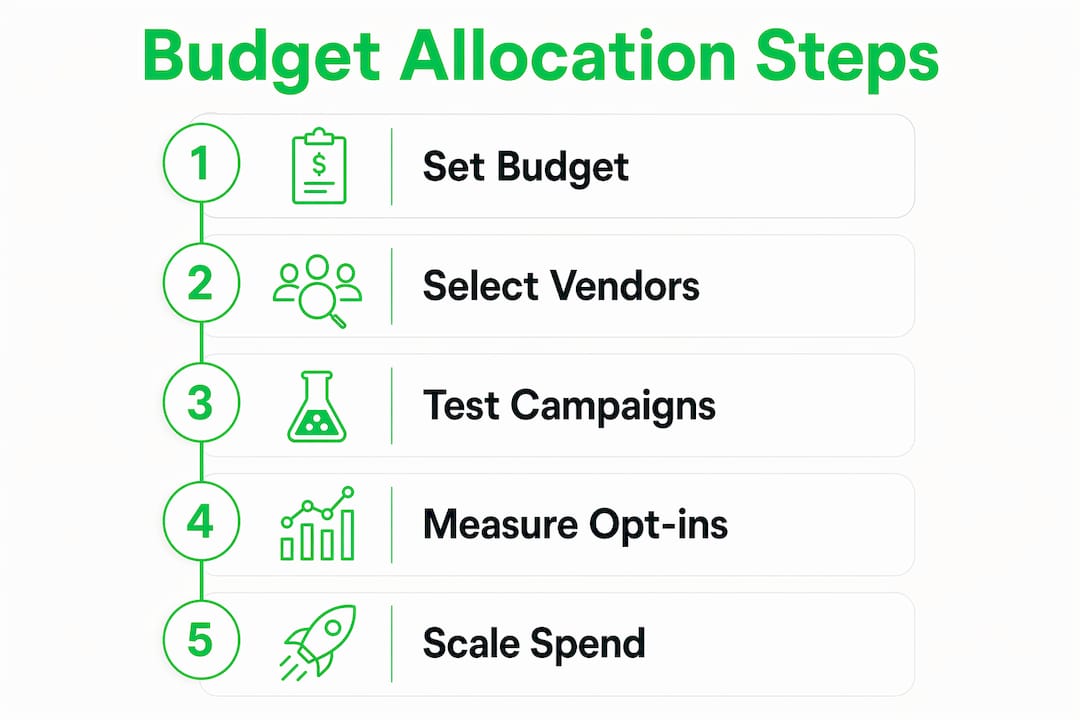
The right starting budget for solo ads treats your first purchase as market research, not list building. Initial solo ad purchases of 100 to 200 clicks give you enough data to evaluate vendor traffic quality and landing page conversion without risking a large sum. This is your learning budget, and it should be treated as a sunk cost you are willing to lose in exchange for real data.
Here is what a practical learning budget looks like in 2026:
- 100 clicks at $0.50/click: $50 total. Minimum viable test for a new vendor.
- 100 clicks at $0.70/click: $70 total. Mid-range Tier-1 traffic test.
- 200 clicks at $0.80/click: $160 total. Stronger data set for opt-in rate analysis.
A 30% opt-in rate on 200 clicks produces roughly 60 subscribers at approximately $2.33 per subscriber when you pay $0.70 per click. That per-subscriber cost only makes sense if your offer converts those subscribers into buyers at a value that exceeds $2.33. Running this math before you spend is not optional. It is the foundation of effective solo ad investment.
Starting with a modest learning budget of $50 to $100 lets you build confidence and make data-driven decisions without overcommitting. You are buying information, not just traffic.
Pro Tip: Focus on opt-in rate and lead quality during your first test, not raw click volume. A 40% opt-in rate from 100 clicks tells you far more than a 15% rate from 500 clicks.
Key factors to consider when allocating your solo ads budget
Effective budget allocation depends on more than just how much you spend. Four variables determine whether your dollars produce results or disappear.
Vendor reputation and list quality sit at the top of the list. A vendor charging $0.90 per click with a verified, responsive list in your niche will outperform a $0.40 vendor with a burned-out general list every time. Checking reviews on platforms like Udimi, reading testimonials, and asking vendors directly about their list demographics are non-negotiable steps before you commit any budget.
Landing page conversion rate is the second variable. Poor funnel readiness leads to wasted solo ad spend regardless of traffic quality. If your squeeze page converts at 10% when the industry benchmark sits closer to 30% to 40%, no vendor can save your campaign. Fix the funnel before you scale the budget.
Offer relevance determines whether subscribers stay engaged after opt-in. A list built around make-money-online offers will not respond well to a health supplement pitch. Mismatched offers inflate your cost per sale even when your cost per click looks reasonable.
The table below compares two common budget allocation strategies for new solo ad buyers:
| Strategy | Approach | Best for | Risk level |
|---|---|---|---|
| Multi-vendor testing | Split budget across 3 to 4 vendors at 100 clicks each | Finding the best vendor quickly | Medium: more data, more variables |
| Single-vendor validation | Commit full test budget to one vendor, then repeat | Deep funnel testing with one traffic source | Low: cleaner data, slower vendor comparison |
Pro Tip: Never allocate more than 20% of your monthly solo ads budget to a single vendor until you have at least two successful test campaigns with that vendor on record.
How to scale your solo ads budget after initial testing
Scaling your solo ads budget is a staged process, not a single decision. Gradual, incremental scaling maintains CPA in line with profitability goals and prevents the kind of large budget losses that come from over-investing in unproven traffic at volume. Here is a proven scaling sequence:
- Complete your 100-click test. Confirm opt-in rate, lead quality, and initial email engagement before spending another dollar with that vendor.
- Scale to 200 clicks with the same vendor. If your cost per lead and opt-in rate hold steady, the vendor's list is consistent. Inconsistency at this stage is a red flag.
- Introduce a second vendor at 100 clicks. Diversifying vendors reduces your dependency on any single traffic source and gives you comparative data.
- Scale your top performer to 500 clicks. At this stage, you have enough data to project CPA with reasonable confidence. Solo ads pricing for larger packages of 500 clicks holds in the $0.35 to $0.95 range, so per-click costs do not typically spike at volume.
- Set a hard CPA ceiling before each scaling step. Expert guidance from Working With Walter recommends keeping CPA below $50 and targeting at least 100% ROI on every dollar spent. If a scaling step breaks that ceiling, pause and diagnose before continuing.
The most common mistake at this stage is scaling spend without scaling your email follow-up sequence. More leads entering a weak nurture sequence produces the same poor conversion rate at higher cost. Treat your autoresponder as a budget variable, not an afterthought.
How does solo ads budget compare to Facebook and Google Ads?
Solo ads require smaller initial budgets than most PPC channels and offer niche list-based targeting that Facebook and Google Ads cannot replicate. Solo ads typically require smaller initial budgets and deliver traffic to a pre-segmented email audience, which is a structural advantage for affiliate marketers promoting specific offers.
The table below illustrates how the three channels compare for a new affiliate marketer with a $300 monthly budget:
| Channel | Minimum actionable spend | Targeting method | Learning curve | Best use case |
|---|---|---|---|---|
| Solo ads | $50 to $100 per test | Vendor's niche email list | Low | Affiliate offers, email list building |
| Facebook Ads | $150 to $300 per campaign | Interest and behavior targeting | High | Brand awareness, broad audience reach |
| Google Ads | $200 to $500 per campaign | Keyword intent targeting | High | High-intent buyers, product searches |
The 70/20/10 marketing budget framework adapts well to solo ads spending. Allocate 70% of your solo ads budget to vendors with a proven track record, 20% to vendors you are actively testing, and 10% to new vendors or experimental offers. This structure keeps your core spend protected while still generating new data.
Solo ads are most effective when your goal is building a targeted email list quickly and at a predictable cost per lead. For direct sales to cold traffic, Google Ads and Facebook Ads offer stronger intent signals. The right channel depends on your funnel stage, not just your budget size.
Key takeaways
Effective solo ads budget allocation requires staged testing, funnel readiness, and a clear CPA ceiling before any scaling decision.
| Point | Details |
|---|---|
| Start with a learning budget | Spend $50 to $160 on 100 to 200 clicks to gather vendor and funnel data before committing more. |
| Fix your funnel first | A poorly converting squeeze page wastes budget regardless of traffic quality. |
| Scale in stages | Move from 100 to 200 to 500 clicks incrementally, monitoring CPA at each step. |
| Diversify vendors | Split budget across multiple vendors to reduce risk and generate comparative performance data. |
| Use the 70/20/10 rule | Allocate 70% to proven vendors, 20% to active tests, and 10% to new experiments. |
Why most solo ads budgets fail before they get a fair chance
I have reviewed hundreds of solo ad campaigns over the years, and the pattern is almost always the same. The budget is not the problem. The sequence is. Marketers spend money on traffic before they have a tested opt-in page, a working lead magnet, or a follow-up sequence that actually sells. Then they blame the vendor.
The honest reality is that solo ads should never compensate for poor funnel design. Traffic is a multiplier. If your funnel converts at 10%, more traffic just multiplies that 10% at higher cost. The marketers I have seen get real results from solo ads treat their first $100 as a diagnostic tool. They are not trying to profit from it. They are trying to learn from it.
The other mistake I see constantly is abandoning a vendor after one test. One 100-click order is not enough to judge a vendor's list. Engagement rates vary by day, by offer, and by email subject line. Two or three tests with the same vendor, using the same landing page, give you data you can actually act on.
My advice is simple: build your funnel, set your CPA ceiling, and track your solo ad traffic from click to conversion before you spend a dollar on scaling. The budget strategy follows the data. The data comes from disciplined testing.
— Phil
Ready to allocate your solo ads budget with confidence?
Knowing the theory behind solo ads budget allocation is a strong start. Applying it with the right vendors makes the difference between a profitable list and a wasted spend.
Soloadsguide provides verified Tier-1 traffic sources tested specifically for high conversion rates, along with detailed vendor reviews that help you skip the guesswork. Marketers using the guide have reported up to a 40% reduction in cost per lead by choosing vendors from the ranked provider list rather than testing blindly. Whether you are allocating your first $50 or scaling past $1,000 per month, the Solo Ads Guide gives you the data and vendor intelligence to spend smarter from day one.
FAQ
What is a good starting budget for solo ads?
A starting budget of $50 to $160 covers 100 to 200 clicks, which is enough to evaluate vendor traffic quality and test your opt-in page conversion rate before committing to larger orders.
How do I calculate cost per lead from solo ads?
Divide your total spend by the number of opt-ins generated. At $0.70 per click with a 30% opt-in rate, 200 clicks produce 60 leads at roughly $2.33 per subscriber.
When should I scale my solo ads budget?
Scale only after two or more test campaigns with the same vendor show consistent opt-in rates and a CPA that stays within your profitability ceiling. Stepwise scaling from 100 to 200 to 500 clicks is the standard approach.
How does solo ads budgeting differ from Facebook Ads budgeting?
Solo ads require a lower minimum spend per test ($50 to $100 versus $150 to $300 for Facebook) and target pre-segmented email lists rather than broad interest audiences, making them more accessible for affiliates with limited budgets.
How do I avoid wasting my solo ads budget on bad vendors?
Check vendor reviews, request traffic source details, and optimize your cost per lead before scaling. Never allocate more than 20% of your monthly budget to a single untested vendor.
Recommended
- Solo Ads Affiliate Commissions Explained for Marketers
- Solo Ads Recurring Income Explained for Affiliate Marketers
- Solo Ads vs Facebook vs Google Ads: Which Wins in 2026?
- Placeholder post: solo-ad-cost-per-lead-optimization-that-works | SoloAdsGuide.com
Want Verified Traffic Without the Guesswork?
PulseTraffic screens every seller, filters bot clicks in real time, and shows you verified buyer traffic labels before you spend a dollar.