
Solo ads recurring income explained simply: a solo ad is a paid, dedicated email blast sent to another marketer's subscriber list, and when paired with recurring affiliate programs and a well-built email funnel, it becomes one of the fastest ways to generate compounding monthly revenue. Unlike organic traffic strategies that take months to gain traction, solo ads deliver hundreds of targeted visitors within 24 to 48 hours of purchase. The real income potential is not in the click itself. It lives in what happens after the click: your opt-in page, your welcome sequence, and the affiliate programs you promote. Platforms like Udimi, tools like King Content Agency's email frameworks, and affiliate networks offering recurring commissions are the three pillars that turn a single ad buy into a long-term income stream.
What are solo ads and how do they accelerate list building?
Solo ads are pay-per-click email promotions where you pay a vendor to send your offer to their existing subscriber list. You are not renting ad space on a website or bidding in an auction. You are paying for direct access to a warm, pre-built audience that has already opted in to receive emails on a specific topic, most commonly online business, health, or personal finance.
Typical costs run between $0.35 and $0.95 per click, depending on vendor reputation, niche, and traffic tier. That means 500 clicks could cost anywhere from $175 to $475. That range matters because your cost per subscriber, not your cost per click, is the number that determines profitability.
The core benefits of solo ads for list building come down to three factors:
- Speed: Traffic arrives within 24 to 48 hours, not weeks or months.
- Targeting: Vendors specialize by niche, so you reach people already interested in your category.
- Scalability: Once a funnel converts profitably, you can increase click volume with the same vendor or test new ones.
Solo ads work best when your opt-in funnel is already tested and converting. Sending cold traffic to an unoptimized squeeze page wastes budget. The ad is the accelerator. Your funnel is the engine.
Pro Tip: Before buying your first solo ad, run at least 50 clicks of paid social traffic to your opt-in page to confirm your conversion rate sits above 30%. If it does not, fix the page first.
Marketplaces like Udimi let you filter vendors by niche, review ratings, and verified sales percentages. This reduces the guesswork significantly, especially for marketers who are new to the channel.
How do welcome email sequences convert solo ad leads?
A welcome sequence is an automated series of emails triggered the moment someone opts in to your list. For solo ad traffic specifically, this sequence is your single most important conversion asset. Cold subscribers who found you through a vendor's list have no prior relationship with you. The welcome sequence builds that relationship before you ask for a sale.
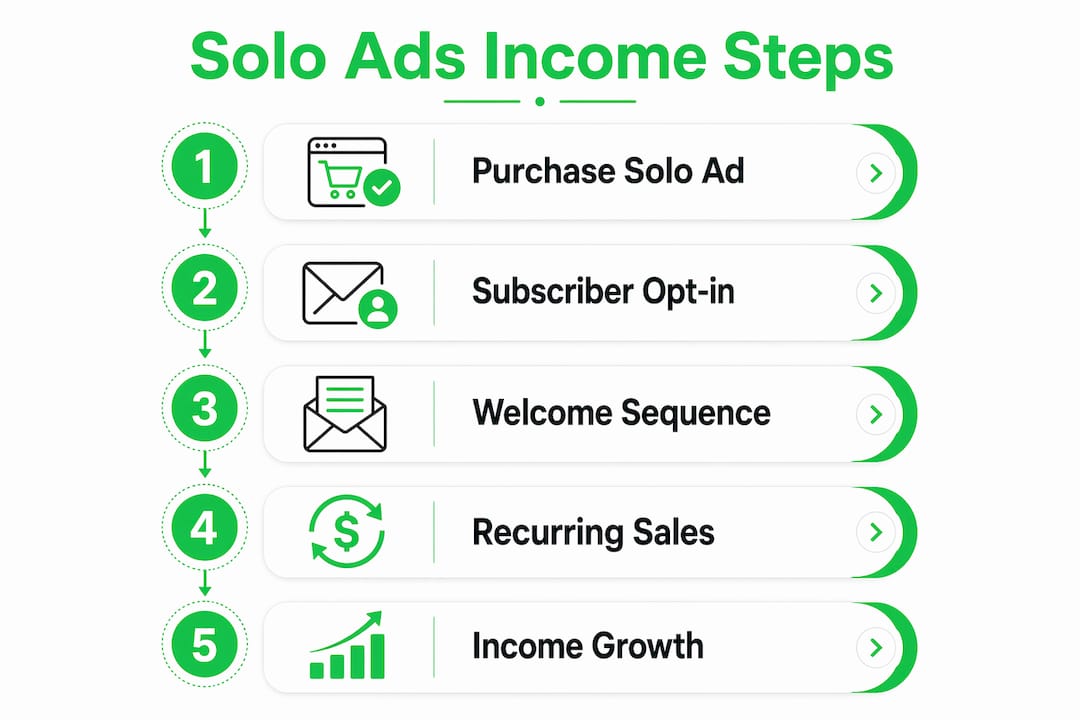
A well-designed welcome series generates 4x more opens and 5x more clicks than standard marketing emails. That performance gap exists because subscribers are most engaged in the first few days after joining a list.
The recommended structure for a solo ad welcome sequence looks like this:
- Email 1 (immediate): Deliver the lead magnet. Confirm the opt-in. Set expectations for what comes next.
- Email 2 (Day 2): Share a useful tip or insight related to your niche. No pitch. Build credibility.
- Email 3 (Day 4): Tell a short story or case study that connects to the problem your audience wants to solve.
- Email 4 (Day 6): Introduce your recommended tool or affiliate offer with context, not pressure.
- Email 5 (Day 7 to 8): Follow up on the offer with social proof, a FAQ, or a limited-time incentive.
The ideal sequence runs 4 to 7 emails, starting immediately after signup, with subsequent emails spaced across the first 7 to 8 days. This timing keeps you top of mind without overwhelming new subscribers.
Here is how sequence structure varies by business type:
| Business type | Sequence focus | Pitch timing |
|---|---|---|
| Affiliate marketer | Value content, then soft offer | Email 4 or 5 |
| Course creator | Authority building, testimonials | Email 3 or 4 |
| SaaS or tool vendor | Feature education, free trial | Email 2 or 3 |
| Coaching or consulting | Problem framing, discovery call | Email 5 or later |
Metrics to track across your sequence include open rate by email number, click-through rate on offer emails, and conversion rate from click to purchase. A drop in open rate after Email 2 usually signals a subject line problem. A drop in clicks on the offer email usually signals a weak call to action or a mismatch between the lead magnet promise and the offer.
Pro Tip: Use your email service provider's automation tags to segment subscribers who clicked the offer link but did not buy. Send them a separate follow-up sequence with a different angle or bonus.
Why recurring affiliate programs outperform one-time payouts
The financial math behind recurring affiliate commissions is the core of solo ads recurring income explained at a practical level. One-time payouts feel attractive because the upfront number looks bigger. Recurring commissions feel smaller per month but compound significantly over time.
Consider this comparison. A 30% recurring commission on a $19.99 per month subscription pays roughly $6 per month per customer. Over 12 months of retention, that is $72 per customer. A one-time 30% commission on a $99 annual plan pays $29.70 once. Recurring programs generate 3 to 5x more lifetime income than one-time payouts when customers retain for 4 or more months.
| Commission model | Monthly payout | 12-month total | Break-even vs. one-time |
|---|---|---|---|
| Recurring 30% on $19.99/mo | $6.00 | $72.00 | Month 5 |
| One-time 30% on $99/yr | $29.70 (once) | $29.70 | Never compounds |
The break-even point sits around month 5. After that, every retained customer is pure profit above what a one-time program would have paid. Recurring income builds a safety net that sustains revenue through low-traffic months, which is exactly the kind of stability solo ad campaigns need to justify ongoing spend.
Retention rate is the variable that matters most. Doubling average retention months doubles lifetime earnings from recurring commissions. This means your email sequence and ongoing engagement strategy directly impact your affiliate income, not just your conversion rate.
One-time payouts still make sense in specific situations:
- High-ticket offers where the upfront commission exceeds 6 months of recurring income.
- Products with notoriously high churn rates where retention past month 3 is unlikely.
- Campaigns where you need immediate cash flow to reinvest in more solo ad traffic.
A balanced affiliate portfolio combines both models. Use recurring programs as your income foundation and one-time programs to fund new traffic purchases.
How to optimize and scale solo ads campaigns for sustainable income
Scaling solo ads without testing first is how marketers waste significant budget. The right approach starts small, measures everything, and scales only what works.

Start with a test purchase of 100 to 200 clicks from a single vendor. Treat this as a research investment, not an income attempt. You are measuring three things: opt-in rate, cost per subscriber, and early email engagement.
Key metrics to evaluate after each test:
- Opt-in rate: Aim for 30% to 50% on a focused squeeze page. Below 30% means the page or the traffic source needs work.
- Cost per subscriber: Divide total spend by new subscribers. Compare this across vendors to find your most efficient source.
- Email open rate on Day 1: A healthy rate is 20% to 40% for cold solo ad traffic. Lower rates suggest the lead magnet or subject line missed the mark.
Use Udimi's verified vendor ratings and buyer reviews to shortlist vendors before purchasing. Verified sales percentages on vendor profiles indicate whether their list actually buys, not just clicks. That distinction separates list builders from income generators.
Funnel readiness checklist before scaling:
- Squeeze page with a single, clear opt-in offer.
- Lead magnet delivered automatically via your email service provider.
- Welcome sequence fully written and scheduled.
- Affiliate offer integrated into the sequence at the right email number.
- Tracking links in place to measure which vendor drives the best conversions.
Once a vendor produces a cost per subscriber below your target and your sequence converts at a profitable rate, you can scale by increasing click volume with that vendor or testing two to three similar vendors simultaneously. Soloadsguide covers cost per lead optimization in detail for marketers ready to push past the testing phase.
What are common challenges and misconceptions about solo ads income?
Solo ads traffic is rented. The moment you stop paying, the traffic stops. This is the most important structural reality to understand before building a recurring income model on this channel. Your email list is the asset you own. The solo ad is just the acquisition method.
Common pitfalls that kill recurring income potential:
- Expecting instant profits: Solo ads build lists. Lists build income over weeks and months, not days.
- Skipping funnel preparation: Sending paid traffic to an untested page wastes budget and produces low-quality subscribers.
- Ignoring churn: If subscribers cancel the affiliate product you promote within 1 to 2 months, the recurring model breaks down entirely. Onboarding sequences and continued email engagement are the primary tools for reducing early cancellations.
- Over-relying on a single vendor: Vendor list quality degrades over time. Rotating across multiple tested sources keeps traffic quality consistent.
- Promoting only one affiliate program: Diversifying across two to three recurring programs protects income if one program changes its commission structure or closes.
The marketers who generate sustainable recurring income from solo ads treat the channel as one part of a larger system. They invest in their email list, their sequences, and their affiliate relationships with the same discipline they apply to ad spend.
Key takeaways
Solo ads generate recurring income by accelerating list building, and that income compounds only when paired with a tested welcome sequence and recurring affiliate programs with strong retention.
| Point | Details |
|---|---|
| Solo ads as list accelerators | Traffic arrives in 24 to 48 hours, but income builds through your email funnel, not the click itself. |
| Welcome sequence structure | Run 4 to 7 emails starting immediately after opt-in to convert cold leads into buyers. |
| Recurring vs. one-time commissions | Recurring programs outperform one-time payouts by 3 to 5x when customer retention exceeds 4 months. |
| Test before scaling | Start with 100 to 200 clicks per vendor and measure opt-in rate and cost per subscriber before increasing spend. |
| Retention drives income | Doubling subscriber retention months doubles lifetime affiliate earnings from recurring programs. |
Why I think most marketers misuse solo ads
I have watched a lot of marketers buy solo ad traffic, see a modest opt-in rate, and then declare the channel does not work. What they are actually describing is a funnel problem, not a traffic problem. Solo ads are one of the most honest traffic sources available because the feedback is immediate and measurable. If your opt-in rate is 18%, the page needs work. If your sequence open rates drop after Email 2, the subject lines are weak. The traffic tells you exactly where the system breaks.
The recurring income angle is where I see the biggest missed opportunity. Most beginners promote one-time affiliate offers because the commission looks bigger on paper. But a subscriber who buys a $99 one-time product generates $29.70 once. That same subscriber on a $19.99 monthly tool generates $72 over a year if they stay. The math is not complicated, but it requires patience that most new marketers do not have.
My honest advice: build your welcome sequence before you spend a dollar on solo ads. Get your solo ads fundamentals right first. Then buy 100 clicks, measure everything, and treat the data as your roadmap. Recurring income from solo ads is real, but it is built in months, not days. The marketers who stick with the process and keep optimizing are the ones who end up with a list that pays them every single month.
— Phil
Start building your recurring income with vetted solo ad vendors
If you are ready to move from theory to practice, the right vendor makes all the difference between a profitable campaign and wasted spend.
Soloadsguide has ranked and reviewed the top solo ad providers for 2026, covering verified tier-1 traffic sources tested specifically for opt-in rates and conversion quality. You will find vendor comparisons, pricing breakdowns, and buyer reviews in one place, so you can make an informed decision before committing your budget. For deeper strategy on building your full funnel, the Solo Ads Guide covers everything from squeeze page setup to scaling recurring affiliate campaigns with step-by-step tutorials built for both beginners and experienced marketers.
FAQ
What is a solo ad in affiliate marketing?
A solo ad is a paid email promotion where you pay a vendor to send your offer to their subscriber list. You receive clicks to your opt-in page, and every new subscriber becomes a lead you can market to directly.
How long does it take to earn recurring income from solo ads?
Recurring income typically builds over 3 to 6 months as your email list grows and subscribers convert to recurring affiliate products. The break-even point for recurring commissions over one-time payouts occurs around month 5 of customer retention.
What opt-in rate should I expect from solo ad traffic?
A well-optimized squeeze page targeting the right niche should convert solo ad traffic at 30% to 50%. Rates below 30% usually indicate a mismatch between the vendor's audience and your offer, or a weak headline on the opt-in page.
Are solo ads worth it for building a recurring income stream?
Solo ads are worth it when your funnel is ready and you promote recurring affiliate programs. Verified vendors on Udimi reduce traffic quality risk, and the speed of list growth makes solo ads one of the most efficient paid channels for affiliate marketers starting without an organic audience.
How many emails should be in a welcome sequence for solo ad leads?
The optimal welcome sequence runs 4 to 7 emails, starting with immediate delivery of your lead magnet and spacing subsequent emails over the first 7 to 8 days to build trust before introducing affiliate offers.
Recommended
- Why Beginners Lose Money on Solo Ads (Real Reasons)
- Solo Ads vs Facebook vs Google Ads: Which Wins in 2026?
- Why Beginners Lose Money on Solo Ads (Real Reasons)
Want Verified Traffic Without the Guesswork?
PulseTraffic screens every seller, filters bot clicks in real time, and shows you verified buyer traffic labels before you spend a dollar.