
Solo ads are paid email promotions where you purchase clicks from a list owner who sends your offer to their subscribers, paying only for unique clicks delivered. Whether solo ads work depends almost entirely on three factors: the quality of the vendor's list, the strength of your funnel, and how you measure results over time. Affiliate marketers and small business owners who treat solo ads as a list-building channel, track performance over 30 days, and optimize their funnels consistently report positive ROI. Those who expect instant front-end profits without a tested funnel typically lose money fast.
Do solo ads work, and how does the buying process look?
Solo ads work by connecting you directly with a vendor who owns an email list in your niche. You pay for a set number of unique clicks, the vendor sends a dedicated email to their subscribers promoting your offer, and traffic lands on your squeeze page or landing page. No ad auction, no algorithm, no account ban risk.
The buying process follows a clear sequence:
- Find a vendor in your niche through marketplaces like Udimi or through direct outreach to list owners.
- Review their stats including opt-in rate history, niche focus, and buyer traffic percentage.
- Submit your swipe copy and landing page URL for the vendor to review and send.
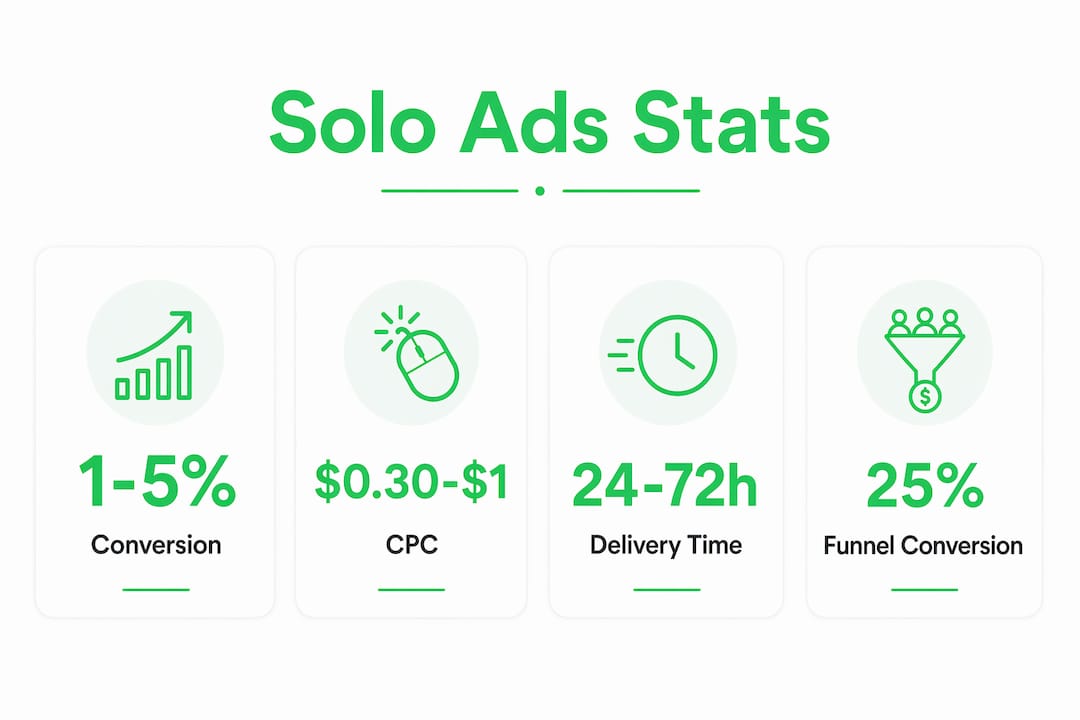
- Negotiate your click package. Solo ads typically cost between $0.30 and $1.00 per unique click in 2026, with beginners advised to start with packages of 100–500 clicks.
- Track delivery using a click-tracking tool like ClickMagick or Voluum to verify click counts and traffic quality.
- Follow up with your email sequence immediately after traffic hits your list.
Solo ads deliver traffic fast, often within 24–72 hours of campaign launch. That speed makes them useful for testing funnel performance without waiting weeks for organic traffic to build.
Pro Tip: Ask vendors for a traffic breakdown showing the percentage of tier-1 clicks from the US, UK, Canada, and Australia. Tier-1 traffic converts at higher rates for most English-language offers.

What factors determine if solo ads work for you?
Solo ads amplify whatever funnel you already have. A strong funnel gets stronger results. A weak funnel loses money faster. Experienced marketers agree the funnel is the bottleneck in solo ad campaigns, not the traffic source.
The key factors that determine your results:
- Vendor list quality. The vendor's list must match your niche. A make-money-online offer sent to a health and wellness list will convert poorly regardless of click volume.
- Landing page conversion rate. A landing page converting under 25% signals a funnel problem that solo ads will make worse, not better. Aim for 35–50% opt-in rates on a well-targeted squeeze page.
- Email follow-up sequence. Most leads do not buy on day one. Your autoresponder sequence over the following weeks determines how much revenue you actually recover from each subscriber.
- Cost per subscriber (CPS). A sustainable solo ad strategy targets a CPS below $2.00. A CPS above $4.00 signals a funnel or traffic quality problem that needs fixing before you spend more.
- 30-day revenue window. Measuring ROI only on front-end sales leads to premature judgments. Most revenue arrives during the 30 days following the campaign, not on day one.
Pro Tip: Build a simple tracking spreadsheet with columns for clicks purchased, opt-ins, CPS, front-end sales, and 30-day revenue. Review it after every campaign before buying more traffic.
Conversion rates from solo ads typically range from 1–5%, with some campaigns exceeding 5% when list quality, audience relevance, and funnel strength align. That range means a 200-click test at $0.40 per click ($80 total) might generate 4–10 subscribers at a CPS of $8–$20 if your funnel is weak, or 70–100 subscribers at a CPS of $0.80–$1.14 if your funnel is strong. The traffic cost is the same. The funnel makes all the difference.
How do solo ads compare to Facebook Ads and Google Ads?
Solo ads occupy a specific niche in the paid traffic ecosystem. They are not better or worse than Facebook Ads or Google Ads in absolute terms. They serve different goals and carry different risks.
Solo ads offer predictable cost per click, fast delivery, and no risk of ad account suspension or complex compliance reviews. Facebook Ads and Google Ads use auction-based pricing, which means costs fluctuate and accounts can be restricted without warning, especially for affiliate offers.
| Factor | Solo Ads | Facebook Ads | Google Ads |
|---|---|---|---|
| Pricing model | Fixed CPC ($0.30–$1.00) | Auction-based CPM/CPC | Auction-based CPC |
| Traffic warmth | Warm (email subscribers) | Cold to warm | Intent-based |
| Account ban risk | None | High for affiliate offers | Moderate |
| Targeting control | Low (vendor's list) | Very high | High |
| Setup complexity | Low | Moderate to high | High |
| Best use case | List building, email offers | Brand awareness, retargeting | Search intent, product sales |
Solo ads work best for email-friendly offers: lead magnets, free courses, webinar registrations, and affiliate offers in the make-money-online, health, or personal development niches. Google Ads works better for product searches with clear buyer intent. Facebook Ads works better for visual products and retargeting campaigns.
The key advantage solo ads hold over both platforms is simplicity. You do not need a pixel, a creative team, or a compliance review. You need a working squeeze page and a follow-up sequence.
How to maximize ROI and avoid common mistakes
Most beginners lose money on solo ads due to poor funnel design, lack of testing, and misunderstanding traffic quality. Experienced marketers treat solo ads as list-building tools, not instant profit machines. That mindset shift changes everything about how you run campaigns.
The metrics you must track on every campaign:
- Click-through rate (CTR) from the vendor's email to your landing page
- Opt-in rate on your squeeze page (target: 35–50%)
- Cost per subscriber (CPS) (target: below $2.00)
- Front-end conversion rate on your offer page
- 30-day revenue per subscriber from your email sequence
Follow these practices to protect your budget and build a profitable list:
- Test before scaling. Start with 100–200 clicks from a new vendor. Analyze CPS and opt-in rate before ordering 500 or 1,000 clicks.
- Use a bridge page. Optimized funnels often include a bridge page between the opt-in and the main offer to build authority and warm up the lead before the pitch.
- Split-test your squeeze page. Run two versions with different headlines or lead magnets. Even a 10-percentage-point improvement in opt-in rate cuts your CPS significantly.
- Nurture your list. Send value-driven emails for 5–7 days before pushing a hard offer. Subscribers who trust you buy more and stay subscribed longer.
- Verify traffic quality. Buy only from vendors with transparent traffic verification, including geo splits and timestamp tracking. Bulk clicks without verification often include bot traffic or recycled leads.
Pro Tip: Use ClickMagick's bot filtering feature to flag suspicious clicks in real time. If more than 10% of clicks from a vendor are flagged, request a refund or avoid that vendor in the future.
Treating solo ads solely as direct sales campaigns is the most common mistake. The real payoff comes from building a responsive email list that you can monetize repeatedly over months, not from a single campaign's front-end revenue.
Key Takeaways
Solo ads work when you pair quality vendor traffic with an optimized funnel, track performance over 30 days, and treat list building as the primary goal rather than immediate sales.
| Point | Details |
|---|---|
| Funnel quality drives results | A landing page converting below 25% will cause solo ads to amplify losses, not profits. |
| Target CPS below $2.00 | A cost per subscriber above $4.00 signals a funnel or traffic quality problem to fix immediately. |
| Track over 30 days | Most revenue from solo ad campaigns arrives in the 30 days after launch, not on day one. |
| Start small and test | Begin with 100–500 clicks per vendor to verify list quality before scaling spend. |
| Use bridge pages and sequences | A bridge page plus a 7-day email sequence consistently improves conversion rates and subscriber value. |
Why I think most marketers misread solo ad results
Solo ads get a bad reputation because most marketers measure them wrong. They buy 200 clicks, check front-end sales after 48 hours, see zero profit, and declare the channel dead. That is like planting seeds and digging them up after two days to see if they grew.
The marketers I have seen succeed with solo ads share one habit: they measure subscriber lifetime value, not campaign-day revenue. A subscriber who costs $1.50 to acquire and generates $6.00 in revenue over 60 days through a backend email sequence is a profitable subscriber, even if they never bought anything on day one. That math works at scale.
The other thing most guides skip is the funnel audit before the first click is purchased. You should know your squeeze page opt-in rate, your bridge page click-through rate, and your email open rate before you spend a dollar on traffic. If you do not know those numbers, solo ads will just show you how broken your funnel is, faster and more expensively than organic traffic would.
My recommended framework: audit your funnel first, set a CPS target below $2.00, buy a 200-click test, track for 30 days, and only scale what the data confirms. That process removes emotion from the decision and makes solo ads a repeatable, measurable channel. Check out Soloadsguide's solo ad funnel guide if you want a step-by-step breakdown of building that funnel before your first campaign.
— Phil
Finding the right solo ads providers for your campaigns
Choosing the wrong vendor is the fastest way to waste your budget on solo ads. The provider you pick determines traffic quality, list relevance, and ultimately whether your CPS stays below that $2.00 target.
Soloadsguide has ranked and reviewed the top solo ads providers for 2026, evaluating each one on list quality, tier-1 traffic percentage, pricing transparency, and verified buyer traffic. The best solo ads providers list gives you a shortlist of vetted vendors so you can skip the trial-and-error phase that costs most beginners hundreds of dollars. Whether you are running your first 100-click test or scaling a proven funnel, starting with a verified vendor list cuts your risk significantly and puts your budget toward traffic that actually converts.
FAQ
What are solo ads in affiliate marketing?
Solo ads are paid email promotions where you buy a set number of unique clicks from a vendor who sends your offer to their email list. You pay per click, and traffic goes directly to your landing page or squeeze page.
Do solo ads convert for affiliate offers?
Conversion rates from solo ads typically range from 1–5%, depending on list quality, audience relevance, and funnel strength. Offers in the make-money-online, health, and personal development niches tend to convert best.
How much do solo ads cost in 2026?
Solo ads typically cost between $0.30 and $1.00 per unique click. Beginners should start with small packages of 100–500 clicks to test vendor quality before scaling.
How do I track solo ads performance?
Use a click-tracking tool like ClickMagick or Voluum to monitor click delivery, opt-in rates, and traffic quality. Track cost per subscriber and 30-day revenue, not just front-end sales, for an accurate ROI picture.
Are solo ads worth it for building an email list?
Solo ads are worth it when your funnel converts at 35% or better and your cost per subscriber stays below $2.00. They are one of the fastest ways to build a targeted email list in competitive niches without relying on ad platforms.
Recommended
- Are Solo Ads Still Worth It in 2026? Honest Assessment
- Solo Ads Blog, Tips, Guides & Reviews | SoloAdsGuide.com
- The Ultimate Guide to Solo Ads (2026) | SoloAdsGuide.com
- Best Solo Ads Providers in 2026 (Ranked & Reviewed)
Want Verified Traffic Without the Guesswork?
PulseTraffic screens every seller, filters bot clicks in real time, and shows you verified buyer traffic labels before you spend a dollar.