

Email segmentation is defined as the practice of dividing your subscriber list into distinct groups based on shared traits, behaviors, or lifecycle stages to send more relevant messages. The role of email segmentation in campaigns is to replace one-size-fits-all blasts with targeted communication that matches what each group actually needs. Lifecycle email flows generate 41% of total email revenue while accounting for only 5.3% of sends. That ratio proves that relevance, not volume, drives email revenue. This guide covers the benefits, segmentation types, implementation steps, and common mistakes to avoid.
What are the key benefits of email segmentation in campaigns?
Segmented campaigns consistently outperform generic email blasts on every measurable metric. Segmented campaigns frequently double click-through rates compared to non-segmented sends, with relevance as the primary driver. That means the same list, split and targeted correctly, can produce twice the traffic without adding a single new subscriber.
The revenue impact is equally significant. Targeted campaigns reach people with offers they are already predisposed to accept, which shortens the path from open to purchase. Emails sent to targeted segments get three times better engagement than emails sent to a full list. Higher engagement directly protects your sender reputation, which keeps your messages landing in the inbox rather than the spam folder.

Deliverability is the hidden benefit most marketers underestimate. When subscribers consistently open and click your emails, inbox providers like Gmail and Outlook treat your domain as trustworthy. Higher relevance emails protect inbox placement and reduce spam complaints. A damaged sender reputation can take months to repair, so segmentation functions as preventive maintenance for your entire email program.
Key performance gains from segmentation include:
- Open rates: Targeted subject lines matched to segment interests produce measurably higher open rates than generic subject lines.
- Click-through rates: Relevant content gives subscribers a reason to act, which doubles clicks compared to non-segmented sends.
- Conversion rates: Offers aligned with purchase history or browsing behavior convert at a higher rate than untargeted promotions.
- Unsubscribe rates: Relevant emails reduce list fatigue, keeping your list healthier and your deliverability intact.
Understanding the benefits of email segmentation goes beyond open rates. Segmentation is the foundation that makes every other email marketing strategy work better.
Which segmentation types deliver the best results?
Not all segmentation approaches carry equal weight. The most effective types share one trait: they use real subscriber behavior or data, not assumptions.
| Segmentation type | Best use case | Example trigger |
|---|---|---|
| Lifecycle stage | Onboarding and retention | New subscriber, first purchase, 90-day lapse |
| Engagement recency | Re-engagement and list hygiene | Opened in last 30 days vs. 90+ days inactive |
| Behavioral | Product recommendations | Browsed category, abandoned cart, repeat buyer |
| Value-based | VIP and loyalty programs | Top 10% by spend, high purchase frequency |
| Preference-based | Content personalization | Form selections, topic interests, format choices |
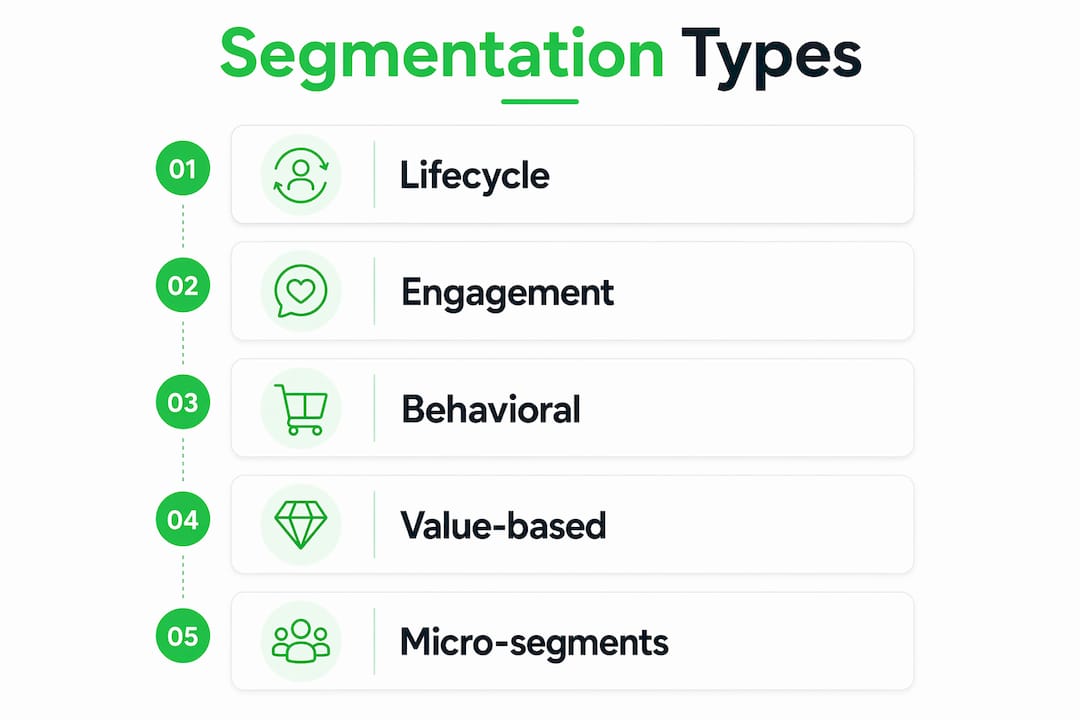
Lifecycle segmentation divides subscribers by where they are in their relationship with your brand. New subscribers need onboarding content. Repeat buyers respond to loyalty rewards. Lapsed customers need a win-back sequence. Each group has a different goal, and sending the same message to all three wastes the opportunity each stage represents.
Engagement-based segmentation is the most practical starting point for small businesses. Sort your list by who opened or clicked in the last 30 days versus those who have been inactive for 60 or more days. Active subscribers get your standard campaigns. Inactive subscribers enter a re-engagement flow. This single split immediately improves your average open rate and protects deliverability.
Behavioral segmentation uses purchase history, browsing data, and cart activity to predict what a subscriber wants next. A customer who bought running shoes is a strong candidate for a running gear promotion. A subscriber who browsed your pricing page but never purchased is a candidate for a trial offer or testimonial sequence.
Pro Tip: Layer two or three segmentation criteria together to create micro-segments. A subscriber who is both a repeat buyer and recently active is your highest-value audience. Send them your best offer first.
Value-based segmentation identifies your top spenders and treats them differently. VIP segments respond well to early access, exclusive discounts, and personalized outreach. Knowing how to segment email lists by value lets you allocate your best content and offers where they generate the most return.
How can marketers implement segmentation effectively?
Effective implementation starts with connecting your data sources before you build a single segment. Your email platform needs to pull from your CRM, your store or booking system, and your engagement history. Without that integration, successful segmentation depends more on data quality than on the number of segments you create. Clean, connected data produces segments that actually reflect subscriber behavior.
Follow these steps to build a working segmentation system:
- Audit your current data. Identify what subscriber data you already have: purchase history, form responses, open and click history, and geographic location. Build segments from data you can verify, not data you plan to collect later.
- Choose dynamic segments over static lists. Dynamic, real-time rule-based segments update automatically as subscriber behavior changes. A static list of "recent buyers" becomes outdated within days. A dynamic segment that updates in real time stays accurate without manual maintenance.
- Set up automated lifecycle flows. Build three core flows first: a welcome sequence for new subscribers, a win-back sequence for inactive subscribers, and a VIP flow for top spenders. These three automations cover the highest-value moments in the subscriber lifecycle.
- Start with simple triggers. Starting segmentation with simple automated triggers like link clicks or form preferences produces quick wins without complex data modeling. A subscriber who clicks a link about a specific product category has self-identified their interest.
- Document your segment logic. Write down the exact criteria for each segment, including what data field triggers inclusion and what removes a subscriber. Documentation keeps your team aligned and prevents segments from drifting over time.
- Measure ROI per segment. Track revenue, conversions, and unsubscribes for each segment separately. This tells you which segments justify the effort and which need to be simplified or retired.
Pro Tip: Focus on two to three revenue-tied segments before adding complexity. A welcome flow, an active buyer segment, and a re-engagement sequence cover most of the revenue opportunity in a typical email list.
For marketers running email traffic campaigns, segmentation also determines which traffic sources belong in which nurture flow. Subscribers from solo ads, for example, often need a different onboarding sequence than organic opt-ins because their awareness level differs.
You can also find practical email marketing tips that cover targeting and segmentation in more depth if you want to go further with audience-specific flows.
What common pitfalls should marketers avoid in email segmentation?
The most common mistake is building too many segments before you have the data to support them. Marketers often create 15 or 20 segments based on theoretical criteria, then find that most segments are too small to generate statistically meaningful results. Marketers should focus on two to three revenue-tied segments rather than overly complex permutations. Complexity without data support produces noise, not insight.
Other pitfalls to watch for:
- Stale static lists. A segment built manually in january becomes inaccurate by march. Subscribers who were "new" are now three months in, and their needs have changed. Static lists require constant manual updates that most teams cannot sustain.
- Ignoring inactive subscribers. Sending campaigns to long-inactive subscribers damages your sender reputation. A recommended win-back strategy is to run sequences for inactive subscribers after 60–90 days. If they do not re-engage, remove them from active sends.
- Segmenting without a goal. Every segment needs a defined business objective. "People who opened last month" is a description, not a goal. "People who opened last month and have not purchased" is a segment with a clear conversion objective.
- Skipping the sunset process. Subscribers who never engage after a win-back sequence should be removed from your list. Keeping them inflates your list size but drags down every performance metric and harms deliverability.
- Treating segmentation as a one-time setup. Subscriber behavior changes. A segment that performed well six months ago may need new criteria today. Review your segment logic quarterly and update it based on actual performance data.
Segmentation is the critical first step in the STP marketing framework, where segmentation enables targeting and positioning to work effectively. Skipping or shortcutting it means your targeting and positioning have no foundation to stand on.
Key Takeaways
Email segmentation is the single most effective way to increase revenue and engagement from an existing subscriber list without adding more sends.
| Point | Details |
|---|---|
| Segmentation doubles performance | Segmented campaigns frequently double click-through rates compared to non-segmented blasts. |
| Lifecycle flows drive revenue | Lifecycle email flows generate 41% of total email revenue while accounting for only 5.3% of sends. |
| Dynamic segments outperform static lists | Real-time rule-based segments stay accurate automatically; static lists go stale within days. |
| Start with two to three segments | Focus on welcome, active buyer, and re-engagement flows before adding complexity. |
| Data quality beats segment quantity | Clean, connected data from your CRM and store produces better results than dozens of poorly sourced segments. |
Why segmentation is now non-negotiable, not optional
I have worked with enough email lists to say this plainly: most marketers are sitting on a goldmine they are not mining. The list is there. The data is there. The problem is that they are sending the same email to everyone and wondering why results are flat.
Marketers must treat email strategy as critical infrastructure, defining clear goals for each segment before launching campaigns. That framing changed how I think about segmentation. It is not a feature you turn on. It is the architecture your entire email program runs on.
The shift I have seen work consistently is moving from list-based thinking to behavior-based thinking. Stop asking "who is on my list?" and start asking "what did they do last?" A subscriber who clicked a pricing link three days ago is a completely different conversation than someone who signed up six months ago and never opened again. Treating them the same is the real waste.
My practical advice: pick your three highest-value segments, build automated flows for each, and measure them for 60 days before touching anything else. The data will tell you exactly where to go next. Predictive segmentation tools like churn risk scoring require over 10,000 active subscribers to work reliably, so do not chase advanced tools before your fundamentals are solid.
Segmentation is not about sending less. It is about sending smarter. The marketers who figure that out early build lists that compound in value over time.
— Phil
Soloadsguide and targeted email campaigns
Segmentation makes every email campaign more effective, but it only works when your list contains the right subscribers in the first place. That is where traffic quality becomes the deciding factor.
Soloadsguide curates verified tier-1 solo ads providers specifically tested for high conversion rates. When you drive traffic from quality sources, your new subscribers enter your segmented flows with genuine interest, which means your welcome sequences, re-engagement flows, and VIP segments all perform as intended. Check out the best solo ads providers ranked and reviewed for 2026 to find traffic sources that match your audience and campaign goals.
FAQ
What is email segmentation?
Email segmentation is the practice of dividing a subscriber list into smaller groups based on shared traits, behaviors, or lifecycle stages to send more relevant messages to each group.
How does segmentation improve open rates?
Segmented campaigns match subject lines and content to subscriber interests, which increases the likelihood of opens. Targeted emails also generate fewer spam complaints, which protects inbox placement over time.
What is the easiest segmentation to start with?
Engagement-based segmentation is the simplest starting point. Split your list into active subscribers (opened in the last 30 days) and inactive subscribers (no opens in 60 or more days), then send different campaigns to each group.
How often should you update your segments?
Review segment criteria quarterly. Subscriber behavior changes, and segments built on outdated logic produce inaccurate targeting. Dynamic segments that update automatically reduce the manual review burden significantly.
When should you remove inactive subscribers?
Run a win-back sequence for subscribers inactive for 60–90 days. If they do not re-engage after that sequence, remove them from active sends to protect your sender reputation and deliverability.
Recommended
- What Is a Business Email Campaign? A 2026 Guide
- Email Traffic Lead Generation Benefits for Marketers
- Types of Email Subscriber Lists: A Marketer's Guide
- Types of Email Subscriber Lists: A Marketer's Guide (2026)
Want Verified Traffic Without the Guesswork?
PulseTraffic screens every seller, filters bot clicks in real time, and shows you verified buyer traffic labels before you spend a dollar.