
The fastest way to optimize solo ad sales funnel conversion is to build a focused six-page funnel, write a curiosity-driven email sequence first, and send traffic only through verified tier-1 vendors. Most affiliate marketers get this backwards. They buy clicks before the funnel is ready, skip the bridge page, and wonder why their opt-in rate is low.
Here is what a properly structured solo ad funnel looks like:
- Squeeze page: One headline, one email field, one button. Target a 35–50% opt-in rate on tier-1 traffic.
- Bridge page: Warms the subscriber before the offer. Skipping this collapses downstream conversions.
- Front-end offer: Low-ticket or affiliate offer. One job: convert subscribers into buyers.
- Order bump or upsell: Optional. Add only after the squeeze page converts consistently.
- Final confirmation page: Reassures new buyers and sets follow-up expectations.
- Email follow-up sequence: Where 60–70% of revenue from any solo ad campaign actually comes from.
The email sequence is not a finishing touch. Build it first, then build the pages around it. Track key metrics from day one. Split-test one element at a time, starting with the headline. Segment your list by engagement as it grows so your follow-ups stay relevant.
Table of Contents
- How does a bridge page improve your funnel conversions?
- Building email sequences that turn subscribers into buyers
- Common solo ad funnel mistakes that kill your conversions
- How to choose and verify solo ad vendors
- How to keep leads engaged after the email sequence ends
- Key Takeaways
How does a bridge page improve your funnel conversions?
The bridge page has one job: warm the subscriber before they see your offer. Most beginners skip it entirely, sending cold traffic straight from the squeeze page to a third-party sales page. The subscriber arrives with no context, no trust, and no reason to buy. Conversion rates collapse.
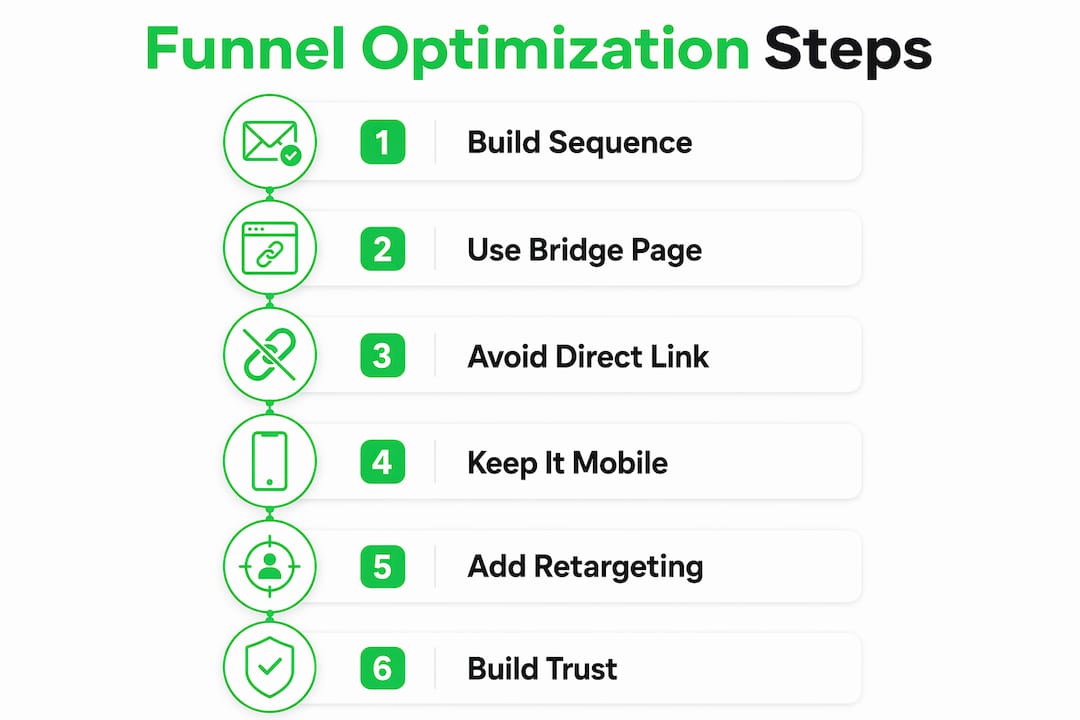
A bridge page can increase downstream conversion rates by 2–4x over direct linking. That lift comes from one thing: the subscriber now knows who is recommending the offer and why.
Keep the page minimal. No navigation links, no competing offers, no video autoplay. The messaging must match the email copy that drove the original click. If the ad promised "a simple system for daily leads," the bridge page should speak to that exact promise.
- Confirm the lead magnet delivery immediately
- Introduce yourself in two to three sentences, not a full bio
- Use one clear call-to-action button pointing to the offer
- Remove all outbound links except the offer link and a privacy policy
Building email sequences that turn subscribers into buyers
Design the email sequence before you build any funnel page. Experts consistently point to the follow-up sequence as the primary revenue driver in solo ad campaigns, not the front-end offer. A 5–7 day welcome sequence is the standard starting point.

Each email has one goal: generate curiosity and drive a single click. Solo ad copy that tries to sell too many things at once loses the reader before the call-to-action. Keep the body short, lead with a hook, hint at the solution, and close with one link.
The sequence structure that works:
- Day 1: Deliver the lead magnet. Set expectations for what is coming next.
- Day 2: Share a relatable problem your subscriber likely faces.
- Day 3: Introduce a solution without hard-selling it.
- Day 4: Provide a value-focused tip or case study.
- Day 5: Soft offer with a curiosity-driven subject line.
- Day 6: Address a common objection.
- Day 7: Stronger call-to-action with urgency or a specific outcome.
Emotional triggers drive clicks more reliably than logic. Fear of missing out, curiosity about a hidden method, and desire for a quick result all outperform feature-heavy descriptions. Keep the tone conversational, not corporate.
Pro Tip: Segment your list after the welcome sequence ends. Subscribers who clicked at least once during the seven days are warm. Send them a separate follow-up track with stronger offers. Subscribers who never clicked need a re-engagement email before you promote anything.
After the welcome sequence, shift to a regular broadcast schedule. Share case studies, introduce affiliate tools, and promote back-end offers. The email list you build from solo ad traffic is a long-term asset. Treat it that way.
Common solo ad funnel mistakes that kill your conversions
Mistake 1: Direct linking from squeeze page to affiliate offer. Subscribers expect a follow-up email, not an instant pitch. This approach damages both your conversion rate and your future open rates.
Mistake 2: Long sales copy on the squeeze page. Solo ad traffic scans and decides in seconds. A 1,000-word squeeze page loses visitors before they reach the opt-in form. Save long copy for the front-end offer page.
Mistake 3: Multiple offers on one page. Presenting several options overwhelms cold traffic. Confused visitors do not buy. One offer per page, always.
Mistake 4: Ignoring mobile. Over 70% of solo ad clicks land on mobile in 2026. If your email field is not visible without scrolling on a phone, you are losing opt-ins before they happen. Test every page in mobile incognito before buying traffic.
Mistake 5: No tracking or retargeting pixel. Install a retargeting pixel on your squeeze page from day one, even if you do not plan to run retargeting campaigns immediately. The audience data you collect now has real value six months later.
Mistake 6: Pushing hard sales before building trust. Sending promotional offers to a brand-new list before delivering value drops open rates fast. Let the welcome sequence do its job first.
How to choose and verify solo ad vendors
Vendor quality determines everything upstream of your funnel. Bad traffic produces low opt-in rates regardless of how well your pages are built. The criteria that matter most are tier-1 traffic sourcing, verified conversion data, and a track record you can check independently.
Start every new vendor relationship with a micro-campaign. Testing with a small number of clicks before scaling gives you real data on opt-in rate, EPC, and conversion consistency without risking your full budget. If the opt-in rate comes in below 30% on a clean squeeze page, the traffic quality is the problem, not your page.
Metrics to track for every vendor run:
- Opt-in rate: 35–50% is the target on tier-1 traffic
- Earnings per click (EPC): Tells you the revenue value of each visitor
- Cost per lead: Compare across vendors to find your most efficient source
- Conversion consistency: One good run means little. Look for repeatable results across two or three orders.
Avoid vendors selling clicks at unusually low prices. Cheap traffic almost always means low-quality lists with subscribers who have been over-mailed and rarely engage. The cost savings disappear quickly when your cost per lead triples.
Soloadsguide tests vendors against tier-1 traffic standards before recommending them. Marketers who switch to verified sources report a 40% reduction in cost per lead, which reflects the difference between targeted, engaged subscribers and bulk filler traffic. You can review ranked solo ad providers to find vendors that have already been vetted for conversion performance.
Some vendors also offer squeeze page review services. If your opt-in rate is underperforming, that consultation can identify page-level issues before you spend more on traffic.
How to keep leads engaged after the email sequence ends
The welcome sequence ends after seven days, but the relationship with your subscriber does not. Long-term engagement is what separates a profitable list from one that goes cold within a month.
Send regular broadcasts on a consistent schedule, whether that is twice a week or every other day. Consistency matters more than frequency. Subscribers who hear from you regularly are far more likely to open your emails than those who receive a burst of messages followed by silence.
Mix content types across your broadcasts. Value-focused emails, such as tips, tools, and short tutorials, build credibility. Soft promotional emails introduce offers without pressure. Stronger promotional emails with urgency or limited-time framing close sales. A rough ratio of two value emails for every one promotional email keeps your list engaged without burning it out.
Re-engagement campaigns are worth running every 60–90 days. Identify subscribers who have not opened an email in that window and send a direct, honest message asking if they still want to hear from you. Those who re-engage are worth keeping. Those who do not should be removed to protect your deliverability. A clean, responsive list consistently outperforms a large, disengaged one.
Key Takeaways
A solo ad funnel converts best when the email sequence is built first, the bridge page warms every subscriber before the offer, and traffic comes only from verified tier-1 vendors.
| Point | Details |
|---|---|
| Build email sequence first | The follow-up sequence drives most of the revenue; write it before building any funnel page. |
| Bridge page lifts conversions | A bridge page increases downstream conversion rates by 2–4x compared to direct linking. |
| Test vendors at small scale | Start with 100–200 clicks per vendor to evaluate opt-in rate, EPC, and consistency before scaling. |
| One offer, one field, one button | Multiple offers or form fields on a single page reduce conversions from cold solo ad traffic. |
| Verified vendors cut costs | Switching to tier-1 verified sources produces a 40% reduction in cost per lead. |
Recommended
- Solo Ad Traffic Affiliate Funnel: A 2026 Guide
- Solo Ad Traffic Affiliate Funnel: A 2026 Guide
- Why Your Solo Ads Are Failing (2026 Fixes That Scale)
- How to Buy Solo Ads That Actually Convert (Step-by-Step)
Want Verified Traffic Without the Guesswork?
PulseTraffic screens every seller, filters bot clicks in real time, and shows you verified buyer traffic labels before you spend a dollar.