
Solo ads and email marketing are two distinct lead generation strategies: solo ads are paid broadcasts sent to someone else's existing subscriber list, while email marketing means communicating directly with your own opt-in audience. Understanding the solo ad vs email marketing difference is the first decision every affiliate marketer faces when building a traffic strategy. Solo ads, commonly bought through platforms like Udimi, deliver fast results with no list required. Email marketing tools like Mailchimp and Klaviyo power long-term relationship building with subscribers you own. Each approach has a specific role, and the smartest marketers use both.
What are solo ads and how do they work in practice?
A solo ad is a paid email broadcast where you purchase a set number of clicks from a list owner who sends your promotional message to their subscribers. You pay per click, not per impression or per send. The list owner writes or approves the email, their audience receives it, and your squeeze page captures the leads. You never touch their list directly.
Solo ads cost between $0.30 and $1.00 per click in 2026, compared to $1.20–$8.00 on social platforms like Facebook or Google Ads. That cost gap makes solo ads attractive for affiliate marketers working with budgets between $100 and $2,000 per month. Setup typically takes 24–72 hours versus one to four weeks for a social ad campaign to get approved and optimized.
Solo ads also sidestep a problem that frustrates many affiliate marketers on paid social. iOS 14+ tracking restrictions cause social platforms to lose roughly 40% of attribution data. Solo ads are unaffected because the traffic flows through email, not a pixel-tracked browser session. Affiliates promoting make-money-online, business opportunity, or crypto offers also benefit because solo ad vendors do not enforce the same content restrictions as Facebook or Google.
Key factors that determine solo ad quality include:
- List freshness: Subscribers who joined recently respond at higher rates than those on over-mailed lists.
- Niche relevance: A list built around online business opportunities converts better for MMO offers than a general marketing list.
- Vendor reputation: Check sales pages, testimonials, and third-party reviews on platforms like Udimi before buying.
- Traffic source rotation: Vendors who rotate traffic across multiple lists maintain higher engagement rates.
Opt-in conversion rates for solo ads average 30–45%, compared to 8–22% on Facebook or Google Ads. That gap reflects the intent level of email subscribers versus cold social audiences.
Pro Tip: Before placing your first order, request a vendor's recent sales page and ask how often they mail their list. A vendor mailing more than once daily is a red flag for list fatigue.
What is email marketing and how does owning your list change the game?
Owned email marketing is defined as sending messages to subscribers who explicitly opted into your list. You control the data, the timing, the content, and the relationship. No platform can ban your list or change the algorithm overnight.
Email marketing requires explicit opt-in and compliance with CAN-SPAM laws in the United States and GDPR in Europe. This compliance requirement is what separates permission-based email marketing from spam. The four core email types are newsletters, promotional emails, transactional emails, and automated lifecycle sequences. Each serves a different function in a complete marketing strategy.
The financial case for building your own list is strong. Email marketing ROI averages $36 for every $1 spent, outperforming paid search's roughly $2 return. That figure reflects the compounding value of a list you own and can mail repeatedly at near-zero marginal cost. Platforms like Mailchimp charge based on list size, not per send, so your cost per message drops as your list grows.
Automation is where owned email marketing generates outsized returns. Automated lifecycle flows generate 41% of total email revenue from just 5.3% of sends. A well-built welcome sequence, abandoned cart flow, or re-engagement campaign runs without daily input and converts leads while you sleep.
Building a list takes time. Typical strategies include:
- Lead magnets: Free guides, checklists, or mini-courses that give subscribers a reason to opt in.
- Landing pages: Dedicated squeeze pages with a single call to action and no distractions.
- Content marketing: Blog posts and YouTube videos that drive organic traffic to opt-in forms.
- Segmentation: Tagging subscribers by interest or behavior so you send relevant messages to the right people.
Pro Tip: Send a three-part welcome sequence to every new subscriber within the first 72 hours. Engagement rates are highest immediately after opt-in, and that window sets the tone for the entire relationship.
Solo ads vs email marketing: cost, speed, and long-term value
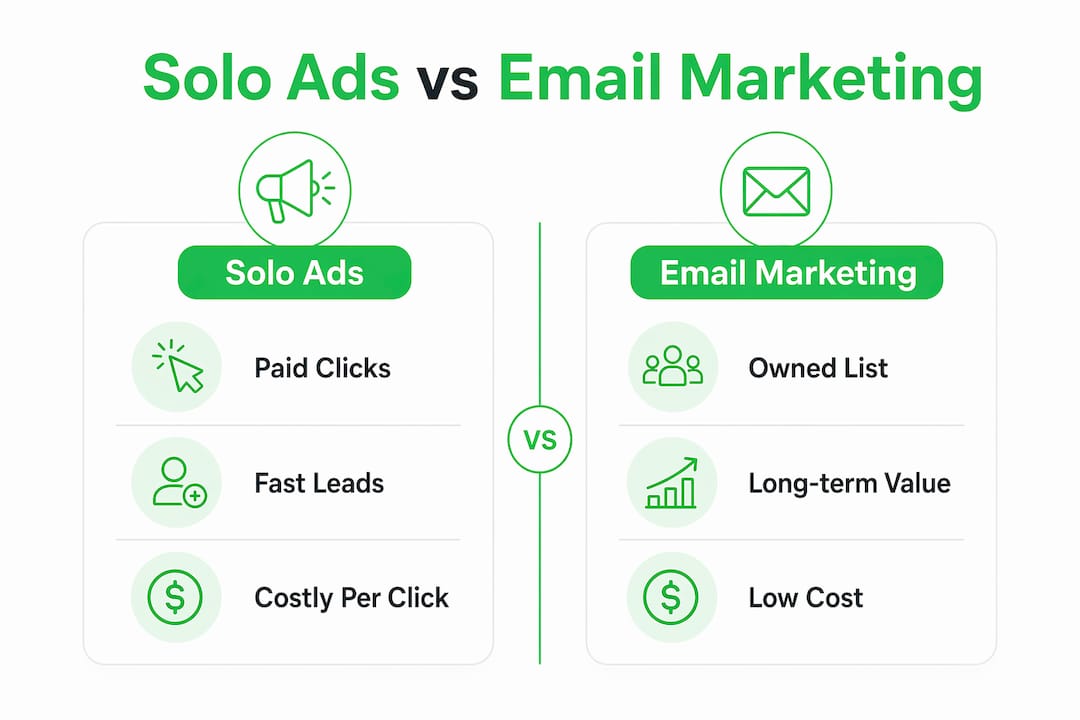
The core trade-off between solo ads and owned email marketing comes down to speed versus ownership. Solo ads deliver traffic today. Your own list delivers compounding returns over months and years.

| Factor | Solo ads | Owned email marketing |
|---|---|---|
| Average cost per click | $0.30–$1.00 | Near zero (platform fees only) |
| Opt-in conversion rate | 30–45% | Varies by traffic source |
| Setup time | 24–72 hours | Weeks to months to build |
| Affiliate offer restrictions | Low | Low (self-governed) |
| Risk of account ban | None | None |
| Data ownership | None (vendor's list) | Full ownership |
| ROI potential | Fast, short-term | High, long-term ($36 per $1) |
Solo ads work best when you need leads fast, have a proven squeeze page, and are promoting offers in niches like MMO, biz opp, or online education. Affiliates in these niches with monthly budgets of $100–$2,000 see the most predictable returns from solo ad campaigns.
Owned email marketing wins on long-term asset value. Once you have 5,000 engaged subscribers, you can promote new offers at almost no cost. You can also segment by behavior, purchase history, or interest level in ways that solo ad vendors cannot replicate.
Scaling solo ads requires buying from multiple vendors rather than increasing spend with a single source. A single vendor's list has a ceiling. Ordering from five vendors simultaneously multiplies your reach without exhausting any one list.
Pro Tip: Run solo ads to a squeeze page that feeds directly into your email automation. Every lead you capture becomes a long-term asset you own, regardless of whether you ever buy solo ads again.
The most effective approach combines both channels. Solo ads seed your list quickly. Your email sequences then nurture those leads into buyers. Effective marketers combine solo ads for fast acquisition with owned email marketing to maximize monetization over time.
How to run your first solo ad campaign and connect it to email marketing
Running a solo ad campaign that feeds into your email list is a five-step process. Each step builds on the previous one, and skipping any step reduces your results.
-
Select a reputable vendor. Use Udimi or check the Soloadsguide vendor directory to find sellers with verified sales and positive ratings. Filter for vendors in your niche and review their recent testimonials.
-
Build a dedicated squeeze page. Your landing page should have one headline, one opt-in form, and zero navigation links. Tools like ClickFunnels, Leadpages, or Kartra make this straightforward. Aim for a 35–45% opt-in rate as your baseline target.
-
Set up link tracking. Use a tracking tool like ClickMagick or Voluum to monitor clicks, opt-ins, and sales separately. Never send solo ad traffic to a page without tracking. Clean attribution tells you which vendors deliver quality leads versus empty clicks.
-
Purchase your solo ad order. Start with 100–200 clicks from a single vendor. Specify your niche, confirm the send date, and provide your swipe copy or let the vendor write it. Most vendors deliver within 24–72 hours.
-
Activate your email follow-up sequence. Every new opt-in should immediately enter a welcome series of at least five emails. The first email delivers your lead magnet or promised content. Emails two through five build trust, share value, and introduce your affiliate offer.
| Step | Tool options | Goal |
|---|---|---|
| Vendor selection | Udimi, Soloadsguide directory | Find verified, niche-relevant sellers |
| Squeeze page | ClickFunnels, Leadpages, Kartra | 35–45% opt-in rate |
| Link tracking | ClickMagick, Voluum | Clean attribution per vendor |
| Email automation | Mailchimp, Klaviyo, GetResponse | Automated nurture sequence |
| Performance review | Tracking dashboard | Optimize based on cost per lead |
Common mistakes that kill solo ad and email marketing results
Most solo ad campaigns underperform not because solo ads do not work, but because marketers make avoidable errors. Knowing these pitfalls before you spend a dollar saves real money.
- Treating solo ads as a standalone channel. Real profit from solo ads comes from the follow-up email sequences, not the initial clicks. Sending traffic to a page without an automated sequence wastes most of your budget.
- Ignoring list quality. Busy or over-promoted lists produce lower quality leads. Always ask vendors how frequently they mail and whether they rotate traffic sources.
- Skipping compliance. CAN-SPAM requires a physical mailing address and an unsubscribe link in every email. GDPR applies if any of your subscribers are in the European Union. Non-compliance exposes you to fines and deliverability problems.
- Mailing too frequently. Sending promotional emails daily burns out your list fast. A sustainable cadence for most affiliate lists is three to five emails per week, mixing value content with offers.
- Neglecting deliverability. Use a dedicated sending domain, warm it up gradually, and monitor your spam score with tools like Mail-Tester or GlockApps.
"The marketers who win with solo ads are the ones who treat every click as the start of a relationship, not the end of a transaction."
Successful email marketing in 2026 treats email as critical infrastructure, not a broadcast tool. Retention, segmentation, and lifecycle mapping separate high-performing lists from stagnant ones.
Key takeaways
Solo ads deliver fast, paid access to someone else's email audience, while owned email marketing builds a long-term asset you control completely.
| Point | Details |
|---|---|
| Core difference | Solo ads rent access to a list; email marketing means you own and control your subscribers. |
| Cost comparison | Solo ads cost $0.30–$1.00 per click; owned email marketing costs near zero per send after setup. |
| Speed vs. ownership | Solo ads generate leads in 24–72 hours; building your own list takes weeks but compounds over time. |
| Integration is key | Combining solo ads for acquisition with email automation for nurturing maximizes ROI for both channels. |
| List quality matters | Busy or over-promoted solo ad lists reduce lead quality; always vet vendors before buying. |
Why the follow-up is where the real money lives
I have bought solo ads from dozens of vendors over the years, and the pattern is always the same. The marketers who complain that solo ads do not work are the ones who sent traffic to a page and waited. The ones who built a five-email welcome sequence, tested their subject lines, and tracked cost per lead at the vendor level are the ones who scaled.
My honest view is that solo ads get unfairly criticized because most people use them wrong. They are not a magic traffic source. They are a fast way to seed a list that you then own and nurture. The click is just the beginning. I have seen campaigns where the initial solo ad broke even on day one and then generated three to five times the spend in affiliate commissions over the following 30 days, purely from email follow-up.
The other thing I would push back on is the idea that you have to choose between solo ads and owned email marketing. They are not competing strategies. Solo ads are a list-building tool. Email marketing is what you do with the list after you build it. Use email list integration as the connective tissue between the two, and you have a system that pays you repeatedly from a single traffic investment.
Test one vendor at a time, track every click, and let the data tell you what works. The marketers who measure consistently are the ones who improve consistently.
— Phil
Start your solo ad strategy with Soloadsguide
If you are ready to put this into practice, Soloadsguide is built specifically for affiliate marketers who want to buy solo ads without wasting budget on low-quality vendors.
The Solo Ads Guide for Affiliate Marketers gives you access to a verified vendor directory, pricing benchmarks, and campaign checklists tested across real affiliate funnels. Whether you are buying your first 100 clicks or scaling to $2,000 per month, the guide covers vendor selection, squeeze page setup, and email sequence strategy in one place. Start with a small test order, track your cost per lead, and use the resources at Soloadsguide to make every dollar count.
FAQ
What is the main difference between solo ads and email marketing?
Solo ads are paid broadcasts sent to someone else's subscriber list, while email marketing means sending messages to your own opt-in audience. The key distinction is ownership: solo ads give you temporary access to another person's list, while email marketing builds a long-term asset you control.
How much do solo ads cost compared to email marketing?
Solo ads cost $0.30–$1.00 per click, while email marketing costs are primarily platform fees with near-zero cost per send. Email marketing ROI averages $36 per $1 spent over time, making it more cost-effective at scale.
Can I use solo ads and email marketing together?
Yes, and combining them is the most effective approach. Use solo ads to build your list quickly, then nurture those leads with automated email sequences. This turns a one-time traffic purchase into a long-term revenue asset.
What opt-in rates should I expect from solo ads?
Solo ads achieve opt-in rates of 30–45% on a well-optimized squeeze page, compared to 8–22% on Facebook or Google Ads. List quality and niche relevance are the two biggest factors affecting your actual rate.
Are solo ads safe for affiliate marketing offers?
Solo ads carry no risk of platform bans and are unaffected by iOS tracking restrictions, making them a reliable channel for affiliate offers in niches like MMO, biz opp, and online education. Always verify vendor reputation and list freshness before purchasing to protect your budget.
Recommended
- Email Traffic Lead Generation Benefits for Marketers
- Types of Email Subscriber Lists: A Marketer's Guide
- Role of Email List in Solo Ads: 2026 Guide | SoloAdsGuide
- Why Marketers Buy Email Traffic: A 2026 Guide
Want Verified Traffic Without the Guesswork?
PulseTraffic screens every seller, filters bot clicks in real time, and shows you verified buyer traffic labels before you spend a dollar.