
Solo ads are paid email promotions where you buy clicks from an established list owner, and that single email drives traffic directly to your squeeze page or offer. For small business owners who need leads fast, solo ads represent one of the few paid channels that put your message in front of a pre-built, buyer-intent audience without requiring months of SEO or a large ad budget. The core mechanic is simple: you pay per click, the list owner sends your email to their subscribers, and you capture leads through a dedicated landing page. A realistic starting budget runs $200 to $500 to gather enough data before scaling. Done right, solo ads small business lead generation can produce measurable results within 48 hours of launching a campaign.
What do you need before launching a solo ads campaign?
Three things must be in place before you spend a dollar on solo ad traffic: a targeted landing page, an email follow-up sequence, and a clear budget plan. Skipping any one of these turns a paid campaign into a money drain.
Your landing page is the make-or-break element. Premium Tier-1 traffic produces opt-in rates of 30%–45%, while cheaper lists deliver 15%–25%. That gap is entirely determined by how well your landing page matches the audience's expectations. A strong squeeze page has one headline, one benefit statement, and one opt-in form. No navigation links, no distractions.

Your email follow-up sequence is equally critical. First-click leads rarely convert immediately without a nurturing sequence in place. A sequence of 5–7 emails sent over 10–14 days keeps your offer in front of new subscribers and builds the trust needed to close a sale. Without it, your cost per lead climbs and your ROI collapses.
Essential tools for a solo ads campaign:
- Landing page builder: Leadpages, ClickFunnels, or Kartra for building high-converting squeeze pages
- Email marketing platform: GetResponse, AWeber, or ActiveCampaign for automated follow-up sequences
- Link tracker: ClickMagick or Voluum to measure click quality, opt-in rates, and traffic sources
- Analytics: Google Analytics or your platform's built-in dashboard to track conversions
Budget planning at a glance:
| Item | Estimated Cost |
|---|---|
| Cost per click (standard) | $0.30–$1.00 |
| Cost per click (Tier-1 traffic) | $0.45–$0.70 |
| Recommended test budget | $200–$500 |
| Target opt-in rate (premium traffic) | 30%–45% |
Pro Tip: Build your email sequence before you buy a single click. If a subscriber joins your list and hears nothing for three days, they forget who you are. Your first follow-up email should arrive within one hour of opt-in.
How do you find and vet reliable solo ad vendors?
Vendor quality is the single biggest variable in any solo ads campaign. A great landing page cannot save you from a vendor with a burned-out, unresponsive list.
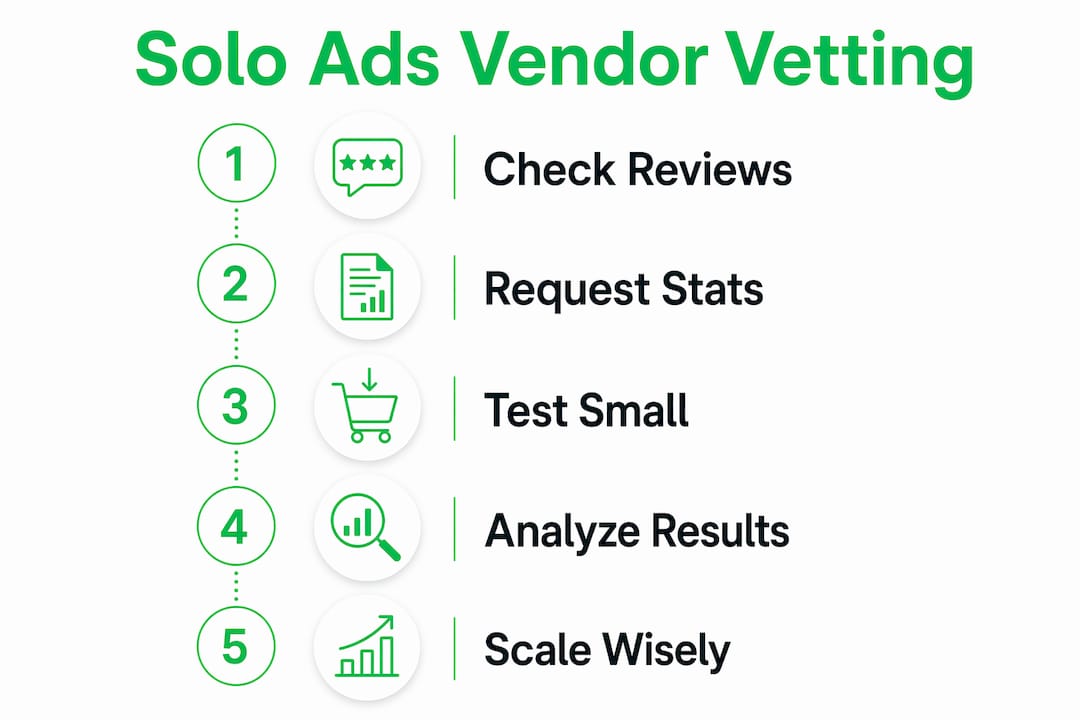
Start by checking vendor credibility through testimonials, case studies, and third-party reviews on platforms like Udimi. Udimi is a solo ad marketplace that displays verified buyer ratings, sales counts, and opt-in percentages for each seller. Those public metrics give you a baseline before you contact anyone.
Reliable vendors should provide open rates above 20%, click-through rates over 2%, and list segmentation data that shows what niches their subscribers belong to. If a vendor cannot answer basic questions about their list demographics, move on. Transparency is the minimum standard.
Red flags to watch for:
- Vendors who guarantee sales rather than clicks
- Lists described as "general" or "all niches" with no segmentation
- Prices below $0.30 per click with no explanation of traffic source
- No verifiable testimonials or third-party reviews
Steps to vet a vendor before a full order:
- Request a small test order of 100 clicks to evaluate traffic quality
- Check opt-in rates on your landing page within 48 hours
- Review the geographic breakdown of clicks in your tracker
- Confirm that Tier-1 countries (US, UK, Canada, Australia) make up the majority of traffic
- Ask the vendor directly about their list's primary niche and how subscribers were acquired
Pro Tip: Ask vendors for their most recent traffic statistics, not their best-ever results. A list that converted well two years ago may be cold today. Fresh data tells you what you are actually buying.
Understanding list quality and vendor vetting before you commit to a large order protects your budget and your campaign timeline.
How do you run and optimize a solo ads campaign step by step?
The biggest mistake new buyers make is going all-in on a large first order. Start with 100–200 clicks to test traffic quality and funnel fit. That small order gives you real data without risking your full budget.
Campaign execution steps:
- Place a test order of 100–200 clicks with a vetted vendor
- Track results for 48–72 hours after the campaign goes live
- Measure your opt-in rate. If it exceeds 25%, the traffic and funnel are working
- Scale cautiously to 300–500 clicks with the same vendor if results are positive
- Test a second vendor at the 300-click level to compare traffic quality
- Scale to 1,000+ clicks only after two or more successful test campaigns confirm consistent results
- Rotate your email copy and landing page every 3–4 campaigns to prevent list fatigue
Key metrics to track on every campaign:
| Metric | What to measure | Benchmark |
|---|---|---|
| Opt-in rate | Leads divided by clicks | 30%–45% (premium traffic) |
| Cost per lead | Total spend divided by leads | Depends on niche and offer |
| Open rate (follow-up) | Emails opened divided by delivered | 20%+ |
| Click-through rate | Clicks on links in follow-up emails | 2%+ |
Continuous testing separates profitable campaigns from wasted spend. Test one variable at a time: your headline, your lead magnet, or your call to action. Changing multiple elements at once makes it impossible to know what moved the needle.
Pro Tip: Use ClickMagick's bot filtering feature on every campaign. Some vendors send low-quality automated clicks that inflate your numbers without producing real leads. Filtering bots gives you accurate data and protects your budget.
For a deeper look at cost per lead reduction, Soloadsguide covers specific tactics that experienced buyers use to bring their acquisition costs down over time.
Which small businesses benefit from solo ads, and which should avoid them?
Solo ads work for a specific type of business. Knowing whether your business fits that profile before spending money is the most practical decision you can make.
Solo ads perform best in digital buyer-intent niches: make-money-online, affiliate marketing, crypto education, personal development, and business opportunity offers. These niches align with the subscriber base that most solo ad vendors have built. Products priced in the $27–$97 range with a clear digital delivery model convert well through this channel.
Local businesses should avoid solo ads entirely because purchased email lists are global and cannot be filtered by zip code or city. A plumber in Denver gains nothing from clicks sent by subscribers in London or Manila. For local service businesses, Google Business Profile, local SEO, and geo-targeted Google Ads produce far better results.
Solo ads fit vs. avoid comparison:
| Business type | Solo ads fit? | Better alternative |
|---|---|---|
| Make-money-online offers | Yes | Scale with solo ads |
| Affiliate marketing funnels | Yes | Scale with solo ads |
| Personal development courses | Yes | Scale with solo ads |
| Local plumber or electrician | No | Google Maps, local SEO |
| B2B SaaS product | No | LinkedIn Ads, content marketing |
| Physical product e-commerce | No | Facebook Ads, Google Shopping |
Niches where solo ads consistently underperform:
- Retail stores with local-only customer bases
- Professional services tied to specific geographic areas
- Physical product brands that require visual advertising
- B2B companies selling to procurement teams or enterprise buyers
The comparison between solo ads and other ad formats shows clearly that channel fit matters more than execution quality. Even a perfectly run solo ads campaign fails when the business model does not match the audience.
Key Takeaways
Solo ads small business lead generation works when you match the right niche, vet vendors carefully, and follow up every lead with a structured email sequence.
| Point | Details |
|---|---|
| Budget before you buy | Start with $200–$500 in test spend before scaling any solo ads campaign. |
| Landing page conversion target | Aim for 30%–45% opt-in rates using premium Tier-1 traffic sources. |
| Vendor vetting is non-negotiable | Require open rates above 20% and click-through rates over 2% from any vendor. |
| Scale in stages | Move from 100–200 clicks to 300–500, then 1,000+ only after confirmed results. |
| Local businesses should skip solo ads | Global email lists cannot be geo-targeted; use local SEO or Google Ads instead. |
What I've learned after watching hundreds of solo ad campaigns
Most small business owners who fail with solo ads make the same mistake. They treat their first order like a lottery ticket. They spend $300, get 200 clicks, see a 15% opt-in rate, and declare that solo ads do not work. What they actually proved is that their landing page needs work, or their vendor was the wrong fit.
Successful solo ad buyers treat every campaign as a data-collection exercise. They test small, measure everything, and only scale what is already working. That mindset shift is the difference between a profitable channel and a wasted budget.
The follow-up sequence is the part most beginners skip because it feels like extra work. It is not optional. The money in solo ads comes from the relationship you build after the click, not from the click itself. A 7-email sequence that delivers real value will consistently outperform any landing page tweak you make.
My honest advice: give yourself three to five test campaigns before drawing any conclusions. Set a realistic budget, pick one niche-aligned vendor, and measure your opt-in rate and email open rates obsessively. Solo ads reward patience and process, not impulse spending.
— Phil
Trusted resources for finding the best solo ad vendors
Finding the right vendor is the hardest part of getting started with solo ads. Most new buyers waste their first few hundred dollars on vendors with unresponsive lists before they find one that actually delivers.
Soloadsguide maintains a ranked list of vetted providers specifically reviewed for conversion quality and Tier-1 traffic reliability. Each vendor on the list has been evaluated for opt-in rates, traffic transparency, and buyer feedback. Starting with a reviewed provider cuts the trial-and-error phase significantly. If you are ready to place your first test order, that list is the most practical starting point available.
FAQ
What are solo ads in simple terms?
Solo ads are paid email promotions where you buy a set number of clicks from a list owner who sends your message to their subscribers. You pay per click, and traffic goes directly to your landing page or offer.
How much should a small business spend on solo ads to start?
A test budget of $200–$500 gives you enough data to evaluate traffic quality and funnel performance before committing to larger orders. Start with 100–200 clicks from a single vetted vendor.
Why do local businesses fail with solo ads?
Solo ad email lists are global and cannot be filtered by location. A local service business in one city will receive clicks from subscribers worldwide, making the traffic irrelevant and the spend wasted.
What opt-in rate should I expect from solo ads?
Premium Tier-1 traffic produces opt-in rates of 30%–45% on a well-built squeeze page. Cheaper or lower-quality traffic typically delivers 15%–25%. Your landing page quality also directly affects where you land in that range.
Do I need an email follow-up sequence for solo ads to work?
Yes. Solo ad leads rarely buy on the first click. A structured follow-up sequence of 5–7 emails sent over 10–14 days is what converts new subscribers into paying customers over time.
Recommended
- How to Buy Solo Ads That Actually Convert (Step-by-Step)
- The Solo Ads Guide for Affiliate Marketers
- Solo Ads Recurring Income Explained for Affiliate Marketers
Want Verified Traffic Without the Guesswork?
PulseTraffic screens every seller, filters bot clicks in real time, and shows you verified buyer traffic labels before you spend a dollar.