

The four best Tapper.ai alternatives for solo ad buyers are ClickCease, ClickGUARD, TrafficGuard, and CHEQ Essentials. Tapper.ai itself remains a solid baseline with shared threat intelligence and campaign-level fraud breakdowns, but these alternatives cover gaps depending on your budget and technical skill.
- ClickCease — fastest path to automated IP exclusion; best for buyers who want simple setup without touching code
- ClickGUARD — rule-based blocking with campaign and keyword diagnostics; best for marketers who want to reallocate spend based on data
- TrafficGuard — enterprise real-time validation across channels; best for high-volume buyers or agencies running parallel campaigns
- CHEQ Essentials — modular bot-and-farm detection; best for buyers who need mixed defenses and want to scale detection as spend grows
If you're new to fraud tools and working with a modest budget, start with ClickCease. It's the lowest-friction entry point. Technical buyers running larger lists should look at ClickGUARD or TrafficGuard first.
Pro Tip: Set your blocking thresholds conservatively on day one. Use the tool to collect evidence, not to auto-block everything. That evidence is what gets you refunds from vendors and builds your blacklist over time.
Table of Contents
- How do these Tapper.ai alternatives compare side by side?
- How does bot detection differ from click-farm detection for solo ads?
- What kind of support can you expect from these tools?
- What do real solo ad buyers say about these tools?
- Soloadsguide's 21-Question Vendor Vetting Framework pairs with any fraud tool
- Key Takeaways
How do these Tapper.ai alternatives compare side by side?
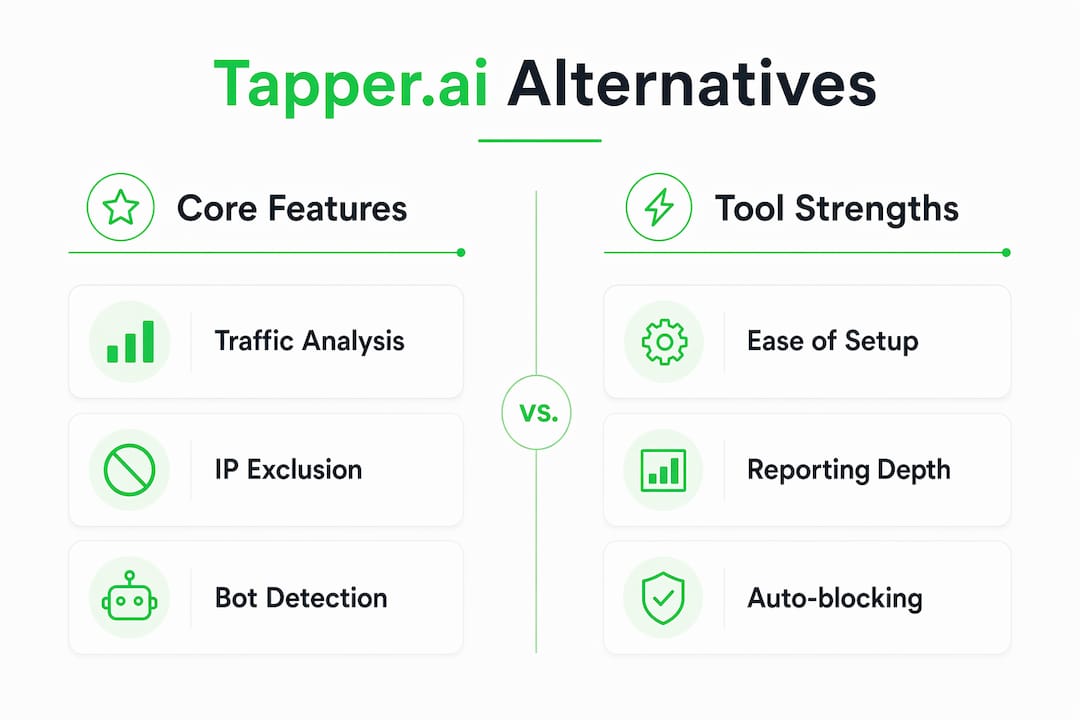
The top alternatives to Tapper share a core feature set: real-time traffic analysis, automated IP exclusion, and bot detection. Where they diverge is in detection depth, analytics granularity, and how much manual control you get.
| Tool | Best for | Detection focus | Key features | Auto-blocking | Reporting depth | Pricing / trial | Setup difficulty |
|---|---|---|---|---|---|---|---|
| Tapper.ai | Combined farm + bot defense | Mixed (bots + farms) | Real-time blocking, fingerprinting, shared threat intel, campaign breakdowns | Auto + manual | Campaign/keyword/device | Subscription; trial available | Low–Medium |
| ClickCease | Simple IP exclusion, small–mid campaigns | Bots + competitor clicks | Automated IP exclusion, real-time analysis, basic analytics | Primarily auto | Standard reports | Subscription; free trial | Low |
| ClickGUARD | Granular campaign analytics, spend reallocation | Bots + invalid clicks | Rule-based blocking, keyword-level diagnostics, campaign insights | Auto + rule-based | Detailed campaign/keyword | Subscription; trial available | Medium |
| TrafficGuard | High-volume, cross-channel enforcement | Mixed, enterprise-grade | Real-time validation, cross-platform exclusions, fast propagation | Auto | Enterprise-level | Subscription; demo available | Medium–High |
| CHEQ Essentials | Mixed bot + farm defenses, modular scaling | Mixed (bots + farms) | Modular detection, fingerprinting, programmatic/social coverage | Auto + manual | Modular reporting | Subscription; tiered modules | Medium |
ClickCease is the go-to for affiliate marketers who want to install a tool and have it working within an hour. The UI is clean, the IP exclusion workflow is direct, and the learning curve is minimal. Pricing follows a subscription model with a free trial, making it easy to test before committing.

ClickGUARD suits buyers who want to understand why fraud is hitting specific keywords or ad groups. Its rule-based automation lets you build custom blocking logic, and the campaign diagnostics are detailed enough to inform budget reallocation decisions, not just blocking.
TrafficGuard is built for scale. If you're managing multiple solo ad campaigns simultaneously or running alongside paid social, its cross-channel enforcement and fast exclusion propagation reduce the window where fraudulent clicks still cost you money. The setup requires more technical comfort.
CHEQ Essentials takes a modular approach, which is useful if you want to start with basic bot detection and add farm-detection modules as your spend increases. It covers programmatic and social placements well.
One important limitation applies to all of these tools, including Tapper: click fraud tools flag bad traffic but cannot verify a solo ad vendor's list quality. A clean fraud report does not mean the vendor's subscribers are engaged buyers. That gap is where structured vendor vetting becomes necessary.
Some market estimates suggest blocking invalid traffic can reduce Google Ads spend waste by roughly 15–20% monthly, illustrating the potential ROI of fraud detection tools. Run a small tracked test buy first to establish your baseline before scaling.
How does bot detection differ from click-farm detection for solo ads?
The distinction matters more for solo ad buyers than for most advertisers. Bots are automated scripts running on servers. Click farms use real humans on consumer devices. Bot defenses look for non-human behavioral signals, which farm workers simply don't exhibit. Farm detection requires behavioral and hardware fingerprinting to catch patterns that look human but cluster suspiciously by device, timestamp, or IP subnet.
For solo ads specifically, the threat is usually click farms and low-quality human traffic, not pure bots. A tool that only catches bots will show you a clean report while a vendor sends you recycled or unengaged subscribers.
Stat to know: Tapper's Meta Ads documentation cites that up to 40% of online traffic can come from bots, and that figure doesn't account for human-operated farm traffic layered on top.
Here's a practical setup checklist for verifying solo ad delivery:
- Install your chosen tool and place the tracking pixel on your squeeze page and thank-you page.
- Set up UTM parameters for each vendor so traffic is segmented by source.
- Run a small test buy (100–200 clicks minimum) before committing to a larger order.
- After delivery, check campaign/keyword/device breakdowns and look for timestamp clustering or device-type anomalies.
- Compare opt-in rate and conversion rate per source against your baseline.
- Export flagged IPs and add them to your exclusion list or blacklist for future buys from that vendor.
Pro Tip: Start with conservative sensitivity settings. Aggressive thresholds can block real users on VPNs or shared networks. Collect two to three weeks of baseline data before tightening rules.
On compliance: if your squeeze page collects email addresses from EU visitors, GDPR applies regardless of where you're based. For U.S.-based buyers, CCPA governs California residents' data. Most major fraud tools include consent-compatible pixel options, but confirm with the vendor before deploying.
What kind of support can you expect from these tools?
Support quality varies significantly and matters most when a campaign is running and something breaks. ClickCease and ClickGUARD both offer live chat and email support with response times that most users report as adequate for non-urgent issues. TrafficGuard, given its enterprise positioning, typically provides dedicated account management for higher-tier clients. CHEQ Essentials offers support scaled to plan level, with more hands-on help available at higher tiers.
For solo ad buyers, the practical question is whether you can get a human response within a few hours when a test buy is live. Check each vendor's support tier before signing up, and look for whether onboarding assistance is included in the trial period.
What do real solo ad buyers say about these tools?
Published user feedback on platforms like G2 and Capterra points to a consistent pattern: buyers who use fraud tools primarily for evidence collection get more value than those who rely on auto-blocking alone. ClickCease users frequently mention its straightforward IP exclusion as the feature they use most. ClickGUARD users highlight the keyword-level reporting as the differentiator that helped them identify which vendors were sending low-quality traffic to specific ad groups.
TrafficGuard's reviews skew toward agency and enterprise users, with less direct feedback from solo ad buyers specifically. CHEQ Essentials receives positive marks for its modular flexibility, though some users note the initial configuration takes longer than simpler tools.
The consistent takeaway across reviews: fraud tools work best as evidence-gathering instruments that support manual optimization and refund requests, not as passive protection layers.
Soloadsguide's 21-Question Vendor Vetting Framework pairs with any fraud tool
Install a fraud tool first. Then run Soloadsguide's 21-Question Vendor Vetting Framework before you scale spend with any vendor. The framework covers the questions fraud tools can't answer: Does the vendor disclose their traffic sources? Can they provide sample reports? What's their refund policy for high bot rates? Do they allow third-party tracking?
Use your fraud tool's output as evidence when working through the checklist. A vendor who refuses to discuss a flagged report is a vendor to avoid. One who engages with the data and offers a partial refund is worth a second, larger test. That's the buyer-first workflow Soloadsguide is built around: track solo ad traffic first, vet the vendor second, scale only when both checks pass.
Key Takeaways
The most effective approach to verifying solo ad traffic is pairing a fraud detection tool with a structured vendor vetting framework before scaling any spend.
| Point | Details |
|---|---|
| Start with the right tool | ClickCease suits beginners; ClickGUARD and TrafficGuard fit technical or high-volume buyers. |
| Bot vs. farm detection | Farm detection requires behavioral and hardware fingerprinting; bot-only tools miss most solo ad fraud. |
| Tools have limits | Fraud tools flag bad traffic but cannot verify a vendor's list quality on their own. |
| Use data as evidence | Export flagged IPs and fraud reports to support refund requests and build vendor blacklists. |
| Soloadsguide's framework | The 21-Question Vendor Vetting Framework at Soloadsguide completes what fraud tools can't cover. |
Recommended
- Top 6 Sources for Solo Ad Providers with Buyer Traffic 2026
- Best Solo Ads Providers in 2026 (Ranked & Reviewed)
- Udimi Alternatives: 5 Better Options for Buyers (2026)
Want Verified Traffic Without the Guesswork?
PulseTraffic screens every seller, filters bot clicks in real time, and shows you verified buyer traffic labels before you spend a dollar.