

Affiliate marketing traffic is defined as the flow of visitors arriving at an affiliate offer through specific marketing channels, where each click is tracked and tied directly to potential commissions. Understanding affiliate marketing traffic explained in full means knowing not just where visitors come from, but whether they are likely to convert. Sources range from Google Search and YouTube to Instagram, email campaigns, and solo ads. Tools like Google Analytics and affiliate network dashboards measure this flow and connect it to revenue. The quality of your traffic determines your earnings far more than raw volume ever will.
What are the main traffic sources for affiliate marketing?
Affiliate marketing traffic sources fall into two broad categories: paid and free. Paid traffic offers faster scale but higher costs, while free traffic builds more slowly and tends to produce more durable results over time. Knowing which sources fit your offer and skill set is the foundation of any working affiliate strategy.
Here is a breakdown of the most common source types:
- Search engines: Google Ads and Bing Ads deliver paid traffic with strong purchase intent. Organic SEO through blog content targets the same audience at no cost per click.
- Social media: Instagram, TikTok, and YouTube work for both free content and paid placements. YouTube review videos, in particular, convert well because viewers are already researching a product.
- Email marketing: Sending offers to a subscriber list is one of the most direct and stable affiliate traffic sources available. You control the audience and the timing.
- Solo ads: A solo ad is a single promotional email sent to another marketer's list on your behalf. It delivers fast, targeted traffic to a squeeze page or lead magnet, making it a popular paid option for affiliate marketers in the make-money-online and health niches.
- Referral and content sites: Comparison sites, review aggregators, and niche blogs send pre-qualified readers who are already evaluating options.
| Traffic Source | Cost | Speed | Conversion Profile |
|---|---|---|---|
| Google Ads | High | Fast | High intent, competitive |
| SEO / Blog | Low | Slow | High trust, durable |
| YouTube | Low to medium | Medium | Research-stage buyers |
| Email / Solo Ads | Medium | Fast | Warm, list-dependent |
| Social Media (paid) | Medium | Fast | Broad, awareness-level |
| Comparison / Review Sites | Low | Slow | High intent, near-purchase |
A well-rounded affiliate program pulls from at least 4–5 different source types. That spread reduces dependence on any single platform and stabilizes revenue when algorithms shift.
How do cold, warm, and direct traffic differ?
Traffic temperature describes how familiar a visitor is with you or your offer before they arrive. This familiarity directly affects conversion rates, and ignoring it is one of the most common reasons affiliate campaigns underperform.

Cold traffic comes from visitors with no prior exposure to you or the product. Paid ads on Google, TikTok, and native ad networks are the primary cold traffic sources. Cold traffic converts at lower rates because there is no established trust. These visitors need more context before they act, which means your landing page and offer copy carry extra weight.
Warm traffic consists of returning visitors, email subscribers, and social media followers who already know your brand. Conversion rates are higher here because trust is already built. Email lists and YouTube subscribers are the clearest examples. When you send an offer to a list that has read your content for months, the click-to-sale gap shrinks considerably.
Direct traffic arrives when someone types your URL directly into a browser or uses a bookmark. This group is the most familiar with your brand and typically shows the highest engagement metrics.
Tips for converting cold traffic into warm traffic:
- Capture emails at the first touchpoint using a lead magnet, such as a free checklist or short video course.
- Retarget cold visitors on Facebook or Google Display with follow-up ads that build familiarity before presenting the offer.
- Use a nurture email sequence of 3–5 messages before sending a direct affiliate promotion.
Pro Tip: Never send cold paid traffic directly to a merchant's sales page. Route it through your own squeeze page first so you capture the lead and can follow up regardless of whether the sale happens.
What are the challenges with affiliate traffic quality and fraud?
Traffic quality is the single biggest threat to affiliate campaign profitability that most beginners overlook. Volume metrics look healthy on the surface while conversions stay flat, and the cause is often fraud or misaligned audiences.
Invalid or fraudulent traffic can account for more than 20% of affiliate clicks, putting roughly $37 billion in U.S. ad spend at risk annually. That figure means roughly one in five clicks you pay for may never have a real human behind it. The financial damage compounds quickly across a campaign.
Beyond outright fraud, low-quality traffic includes valid clicks from misaligned audiences who have no genuine interest in the offer. These visits inflate your click counts but produce poor downstream outcomes like low purchase rates and high refund rates.
Warning signs of fraudulent or low-quality traffic:
- High click volume with near-zero opt-in or purchase rates
- IP address clusters from unexpected geographic regions
- Abnormally fast click-through times, under two seconds from ad impression to landing page
- Sudden traffic spikes with no corresponding campaign change
Pro Tip: Set up a click-to-conversion ratio alert in your tracker. If clicks exceed conversions by a ratio of 500:1 or more with no sales, pause the traffic source and investigate before spending further.
Regular fraud detection using behavioral, geographic, and IP data is not a one-time setup. It is an ongoing discipline. Tools like ClickMagick and Voluum include built-in bot filtering and allow you to flag suspicious traffic patterns in real time. Pair these with your affiliate network's reporting dashboard to cross-reference click and conversion data.
How to select, test, and optimize traffic sources
Choosing the right traffic source is not about finding the best one in theory. It is about finding the one that matches your offer economics, your skills, and your available budget. Success comes from steady execution on chosen platforms aligned with your capacity, not from chasing every new channel.
Follow this process to evaluate and improve your traffic sources:
- Set up your measurement foundation. Connect Google Analytics to your landing pages and use your affiliate network's reporting to track clicks, opt-ins, and sales. Without this baseline, you are guessing.
- Test one traffic source at a time. Run a single channel for at least two to four weeks before drawing conclusions. Mixing sources during testing makes it impossible to know what is working.
- Optimize link placement on your content pages. Up to 15–20% of readers click an affiliate link before finishing an article. Place your first link in the opening section, not buried at the bottom.
- Match offer economics to traffic cost. A $7 tripwire offer cannot support $3-per-click Google Ads traffic. Higher-ticket offers or recurring commission products justify paid traffic spend.
- Nurture warm leads with follow-up sequences. Once someone opts in, a 5-email sequence that delivers value before pitching will consistently outperform a single promotional email.
- Review and rotate underperformers. Check your cost per lead and earnings per click monthly. Drop sources that consistently miss your targets and reallocate budget to what converts.
Pro Tip: Use UTM parameters on every affiliate link so Google Analytics can show you exactly which traffic source, campaign, and piece of content drives your conversions. This data is worth more than any course on affiliate marketing.
Free vs. paid affiliate marketing traffic: which should you use?
The free versus paid decision shapes your entire affiliate strategy. Neither option is universally better. The right choice depends on your timeline, budget, and the type of offer you are promoting.
Free traffic sources include SEO-optimized blog posts, YouTube review videos, organic Instagram and TikTok content, and email marketing to a list you already own. These channels take time to build but produce durable results. A well-ranked blog post can send consistent affiliate traffic for years without additional spend.
Paid traffic sources include Google Ads, native advertising networks, Facebook Ads, and solo ads. These deliver results immediately but stop the moment you stop paying. They work best when your offer has a proven conversion rate and a clear return on ad spend.
| Factor | Free Traffic | Paid Traffic |
|---|---|---|
| Startup Cost | Low | Medium to high |
| Time to Results | Weeks to months | Days |
| Durability | High | Low (stops with spend) |
| Scalability | Limited by content output | High with budget |
| Conversion Quality | High (trust-based) | Variable (intent-based) |
| Control | Low (algorithm-dependent) | High |
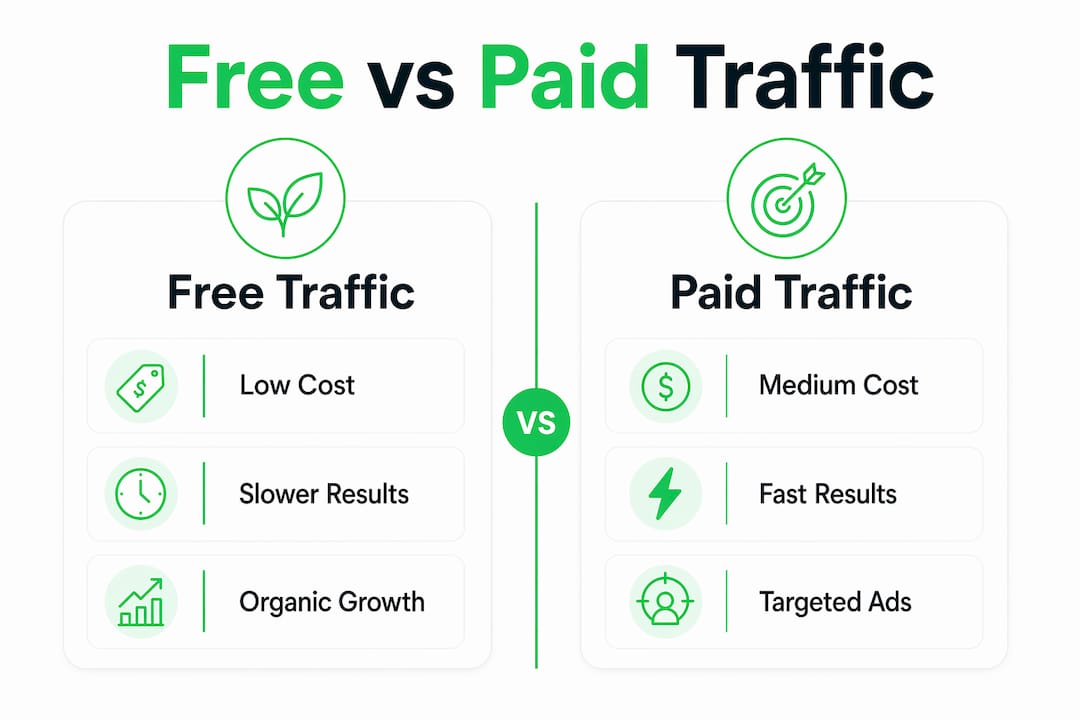
Programs relying on a single traffic source risk sudden collapse when an algorithm update or platform policy change hits. The practical answer for most affiliate marketers is a combination: use free content to build long-term authority and an email list, then use paid traffic to accelerate results on proven offers.
Email marketing sits in a unique middle ground. If you own the list, the marginal cost per send is near zero, but building that list requires either time or paid acquisition. That is exactly why solo ads, which let you rent access to another marketer's email list, are a popular shortcut for new affiliates who need warm traffic fast.
Key takeaways
Affiliate marketing traffic quality and source diversity determine campaign profitability more than total click volume.
| Point | Details |
|---|---|
| Define your traffic type | Know whether visitors are cold, warm, or direct before choosing your offer approach. |
| Diversify traffic sources | Use at least 4–5 source types to avoid revenue collapse from a single platform change. |
| Monitor fraud actively | Fraudulent clicks can exceed 20% of traffic; use ClickMagick or Voluum to filter bots. |
| Place links early in content | Up to 20% of readers click before finishing an article, so lead with your affiliate link. |
| Match traffic cost to offer value | Paid traffic only makes sense when your offer's commission covers the cost per click. |
What i've learned about affiliate traffic after years in the field
Most affiliate marketers I've spoken with spend the first year chasing traffic volume. They obsess over click counts and visitor numbers while ignoring the one metric that actually pays the bills: earnings per click. Once you shift your focus to that single number, your entire approach to traffic changes.
The attribution issue is something very few beginners account for. Last-click attribution dominates how most affiliate programs credit commissions. That means if you introduced a buyer through a YouTube video but they clicked a coupon site link right before purchasing, the coupon site gets the commission. You get nothing. Understanding this changes how you structure your funnels and which traffic sources you prioritize.
I have also seen marketers build entire campaigns on a single platform, only to watch their income disappear overnight when a Google algorithm update or a Facebook ad account ban hits. Diversification is not a nice-to-have. It is the only way to build income that survives platform volatility.
My honest recommendation: start with one free traffic channel and one paid channel. Master both before adding more. Track everything with affiliate tracking tools from day one, not after you have already spent money. And treat fraud detection as a monthly task, not a one-time setup. The marketers who build consistent income are not the ones with the most traffic. They are the ones who know exactly where their best traffic comes from and protect it.
— Phil
Solo ads: a fast lane to warm affiliate traffic
Solo ads are one of the fastest ways to get warm traffic to an affiliate offer without waiting months for SEO to kick in. A solo ad is a promotional email sent to a vendor's existing subscriber list on your behalf, with a single call to action pointing to your squeeze page or offer. Because the list is already engaged with email marketing content, opt-in rates tend to be higher than cold paid traffic from display networks.

The challenge is finding vendors whose lists actually convert for your niche. Soloadsguide solves that problem directly. The platform features verified tier-1 traffic sources tested specifically for affiliate marketing conversion rates, with real user results including a 40% reduction in cost per lead. Whether you are new to solo ads or looking to scale, Soloadsguide gives you the vendor data and guidance to spend smarter. You can also browse the best solo ads providers ranked and reviewed for 2026.
FAQ
What is affiliate marketing traffic?
Affiliate marketing traffic is the flow of visitors sent to an affiliate offer through tracked links across channels like search engines, email, social media, and solo ads. Each visit is recorded by an affiliate tracking system that connects clicks to conversions within a set attribution window.
How does affiliate tracking connect traffic to commissions?
Affiliate tracking works by storing a click ID or cookie when a user clicks an affiliate link, then matching that stored data to a conversion event within a window of 7–90 days. The affiliate whose click ID is recorded at conversion receives the commission credit.
What is the difference between cold and warm affiliate traffic?
Cold traffic comes from visitors with no prior relationship with you or the offer, typically from paid ads, and converts at lower rates. Warm traffic comes from email subscribers, social followers, or repeat visitors who already trust your recommendations.
How can i detect fraudulent affiliate traffic?
High click volume with near-zero conversions, geographic IP irregularities, and abnormally fast click times are the primary fraud indicators. Tools like ClickMagick and Voluum provide bot filtering and behavioral analysis to flag suspicious patterns before they drain your budget.
Is free or paid traffic better for affiliate marketing?
Neither is universally better. Free traffic through SEO and YouTube builds durable, long-term results, while paid traffic through Google Ads or solo ads delivers speed and scale. Most successful affiliate marketers use both, matching the traffic type to the offer's commission structure and conversion rate.
Recommended
- Affiliate Traffic Source Comparison: 2026 Guide
- Solo Ad Traffic Affiliate Funnel: A 2026 Guide
- The Solo Ads Guide for Affiliate Marketers
- Solo Ads Affiliate Commissions Explained for Marketers
Want Verified Traffic Without the Guesswork?
PulseTraffic screens every seller, filters bot clicks in real time, and shows you verified buyer traffic labels before you spend a dollar.