

Ad frequency is defined as total impressions divided by unique reach, and it directly determines whether your campaign builds purchase intent or destroys it. Every digital marketer running paid traffic on Meta, Google, or solo ad networks faces the same tension: show your ad too rarely and prospects forget you exist, show it too often and they start ignoring or resenting your brand. Understanding why ad frequency affects conversions is not optional for anyone managing real ad spend. Research from Omnicom Media, MHI Growth Engine, Rule1, and Count Technologies now gives marketers precise thresholds, early warning signals, and platform-specific caps to act on.
Why ad frequency affects conversions at every campaign stage
Ad frequency follows an inverted-U curve when plotted against conversion rate. Exposures in the low range build familiarity and recall, which lifts click-through rates and purchase intent. Past a certain threshold, the same audience stops responding and starts tuning out, and your cost per acquisition climbs while your return on ad spend falls.

Effectiveness typically peaks within a two-to-seven exposure range, though no universal optimal frequency exists since outcomes depend on campaign objectives and audience context. That range is narrower than most marketers assume, and the consequences of overshooting it are measurable within days on a live campaign.
The impact of ad frequency on your core metrics follows a predictable sequence. CTR starts falling first as the audience recognizes the creative and stops engaging. CPM rises because the algorithm detects declining relevance and charges more to serve the same impression. CPA then deteriorates as the shrinking pool of non-converters is increasingly composed of people who have already decided not to buy. Accounts with prospecting frequency above 4.5 see 35% higher CPA than those maintaining frequency below 3.0, according to MHI Growth Engine data.
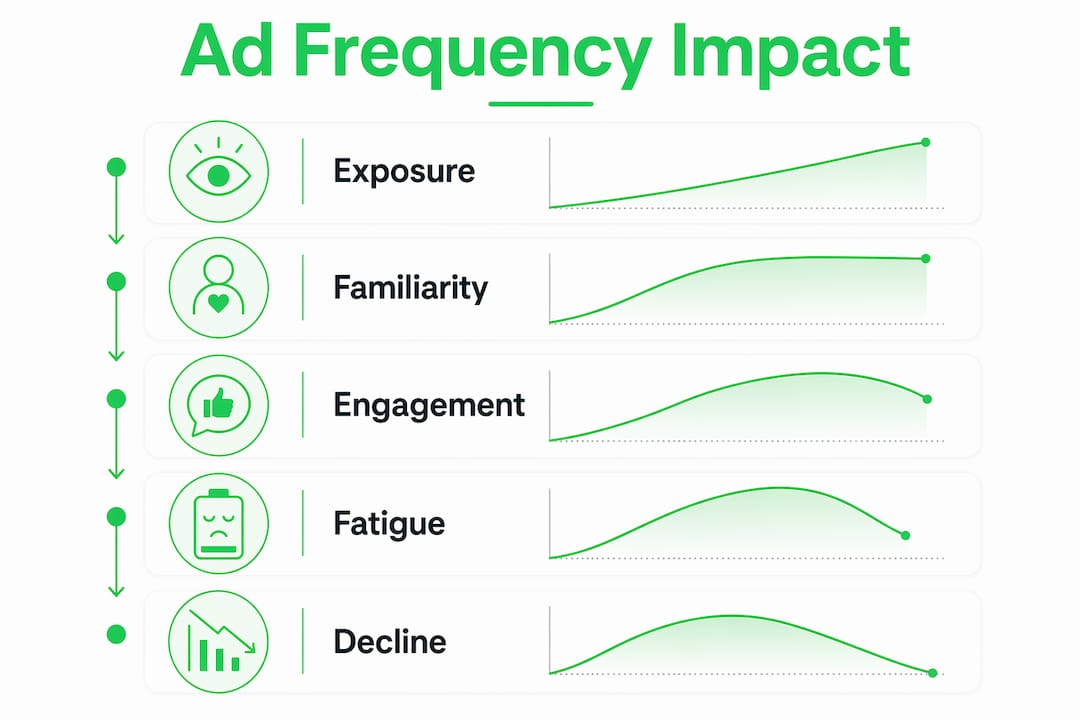
Omnicom Media's 2026 study introduced the term negative reach to describe what happens beyond the fatigue zone. Negative reach is not just wasted impressions. It is the point where repeated impressions frustrate consumers and actively harm brand perception. A prospect who sees your offer eight times without converting is not neutral toward your brand. They are increasingly annoyed by it, which creates a barrier that no future campaign can easily undo.
Key metrics to watch as frequency rises:
- CTR: First metric to decline; a drop of 15-20% signals early fatigue
- CPC: Rises as fewer users click despite the same number of impressions
- CPM: Increases when platform algorithms detect falling engagement
- CPA: Worsens last, but by then significant budget has already been wasted
- CVR: Falls because remaining non-converters are the least likely buyers in the audience
How audience fatigue and ad blindness cut into your results
Ad fatigue is the measurable decline in campaign performance caused by overexposure to the same creative. Creative fatigue is a subset of this, referring specifically to the exhaustion of a single ad variant rather than the audience segment as a whole. Both produce the same outcome: rising costs and falling conversions.
The psychological mechanism behind fatigue is habituation. When the brain encounters the same stimulus repeatedly, it reduces its attentional response to conserve cognitive resources. This is why a prospect who clicked your ad on the second impression may scroll past it entirely on the eighth. The mere-exposure effect, identified by psychologist Robert Zajonc, explains why early repeated exposures increase liking, but it has a ceiling. Past that ceiling, additional exposures produce indifference and then active avoidance.
Rule1's 2026 ad-fatigue framework identifies the specific signals that precede full conversion collapse:
- CTR drops 15-20% from baseline on unchanged creative
- CPC rises 20% or more without any bid changes
- CPM climbs steadily with a stable audience size
- ROAS begins declining even as spend holds constant
- CPA worsens, confirming that the fatigue has reached the conversion stage
Rule1 cautions that CTR and CPC changes are early indicators of frequency fatigue and should trigger action well before ROAS and CPA are affected. Waiting for CPA to worsen before responding means you have already burned budget on a saturated audience.
One counterintuitive finding from the Rule1 framework involves creative rotation. Many marketers rotate ads by swapping colors, fonts, or minor copy elements, assuming this resets fatigue. Weber's Law explains why this fails: the brain detects change only when the difference crosses a perceptible threshold. Minor visual tweaks fall below that threshold, so the audience continues to habituate as if the creative never changed. Effective rotation requires a genuinely different angle, hook, or format, not a cosmetic refresh.
Pro Tip: Set up a weekly creative audit using your ad platform's frequency report. If any ad set shows a frequency above 3.5 for cold audiences and CTR has dropped more than 15% from its launch-week baseline, pause that creative and replace it with a structurally different variant before CPA worsens.
How optimal ad frequency varies by audience and platform
The right frequency cap depends on where your audience sits in the funnel and which platform you are running on. Cold prospecting audiences have no prior relationship with your brand, so they fatigue faster. Retargeting audiences already know your offer and tolerate higher exposure before performance degrades.
Frequency caps for cold prospecting on Meta sit at 2-3 impressions per week, while retargeting audiences can sustain 5-7 per week before fatigue triggers. The reason retargeting audiences tolerate more exposure is that each impression carries more contextual relevance. A prospect who visited your squeeze page yesterday and sees your retargeting ad today is in a different psychological state than someone encountering your brand for the first time.
The table below summarizes recommended frequency caps by platform and campaign stage based on 2026 guidance:
| Platform | Campaign type | Recommended weekly frequency | Action threshold |
|---|---|---|---|
| Meta (Facebook/Instagram) | Cold prospecting | 2-3 | Act above 3.5 |
| Meta (Facebook/Instagram) | Retargeting | 5-7 | Act above 7 |
| Google Display Network | Prospecting | 3-5 | Act above 5 |
| Google Display Network | Remarketing | 7-10 | Act above 10 |
| Solo ads / email traffic | Cold list | 1-2 per send | Rotate list segments |
Rule1's early-2026 guidance links Meta cold audience fatigue to frequency thresholds around 2.5-3.5, with action required above approximately 3.5. That threshold is lower than many marketers expect, particularly those running always-on prospecting campaigns with small audience sizes.
Audience size and budget pacing interact with frequency in ways that catch many advertisers off guard. A $500 daily budget against an audience of 50,000 people will hit a frequency of 3.0 within days. The same budget against an audience of 500,000 will take weeks to reach the same frequency. If you are seeing rapid frequency accumulation, the fix is often audience expansion rather than a budget cut. Lookalike audiences, interest stacking, and broader geographic targeting all reduce frequency pressure without sacrificing reach.
Pro Tip: For platform-specific frequency management, check your ad set's frequency score every 48-72 hours during the first two weeks of a new campaign. Early frequency spikes on small audiences are the most common cause of wasted spend in the first month.
Best practices for managing frequency to protect conversion rates
Frequency management is an ongoing process, not a one-time setting. The marketers who maintain consistent conversion rates over long campaigns are the ones who treat frequency as a live metric rather than a background number.
Monitoring frequency correctly means tracking impressions divided by unique reach at the ad set level, not the campaign level. Campaign-level frequency averages can mask individual ad sets that are burning out while others are underdelivering. Count Technologies highlights that frequency measurement pitfalls can mislead marketers into increasing budgets for already-saturated users, which accelerates cost increases without improving results.
Creative rotation is the most effective long-term defense against fatigue. Top-performing accounts run 8-15 active creative variants rather than relying on 2-3 ads and frequency caps alone. Frequency caps buy time, but they do not solve the underlying problem. Fresh creative angles sourced weekly reset the audience's attentional response and extend the life of each campaign.
Here is a practical framework for frequency management across a live campaign:
- Week 1-2: Monitor frequency daily. Establish your CTR and CPC baseline from the first 72 hours.
- Week 2-3: If frequency exceeds 3.0 on cold audiences, introduce a new creative variant with a different hook or format.
- Week 3-4: If CTR has dropped 15% or more from baseline, pause the original creative entirely. Do not run it alongside the new variant.
- Ongoing: Expand your audience by 20-30% every 30 days to reduce frequency pressure. Use cohort-based lookback windows of 30-60 days to identify the exact frequency point where purchase rates flatten and media costs rise.
Budget pacing also affects frequency in ways that are easy to overlook. Accelerated delivery concentrates impressions on a smaller slice of your audience in a shorter window, which spikes frequency faster than standard pacing. Standard or even slightly throttled delivery spreads impressions more evenly across your audience, keeping frequency lower for longer and extending the productive life of each creative.
For solo ad campaigns, the cost per lead implications of frequency mismanagement are direct. Sending the same offer to the same list segment repeatedly without rotating your lead magnet or landing page angle produces the same fatigue dynamics as any other paid channel.
Pro Tip: Use the traffic quality tracking methods covered by Soloadsguide to monitor engagement drop-offs across repeated sends. A declining opt-in rate on the same list segment is the solo ads equivalent of a rising CPC on Meta.
Key takeaways
Ad frequency controls conversion rates by determining whether repeated exposure builds purchase intent or triggers audience fatigue and rising costs.
| Point | Details |
|---|---|
| Frequency follows an inverted-U curve | Conversions rise with early exposures then fall sharply past the fatigue threshold. |
| Negative reach causes brand damage | Omnicom's 2026 research shows overexposure creates emotional backlash, not just wasted impressions. |
| Cold vs. retargeting caps differ significantly | Cold audiences on Meta fatigue above 3.5 per week; retargeting audiences tolerate up to 7. |
| CTR and CPC are the earliest warning signals | Rule1 recommends acting on a 15-20% CTR drop or 20% CPC rise before CPA worsens. |
| Creative rotation beats frequency caps alone | Running 8-15 active variants outperforms relying on caps with 2-3 creatives. |
Frequency is the metric most marketers check last
I have reviewed hundreds of underperforming campaigns over the years, and the pattern is almost always the same. The marketer is watching CPA and ROAS. They are not watching frequency. By the time CPA has deteriorated enough to trigger concern, the audience has been saturated for two weeks and the damage to brand sentiment is already done.
The uncomfortable truth about ad frequency and sales is that the damage is not always visible in your dashboard. A prospect who saw your ad eleven times and never clicked is not just a missed conversion. They are now less likely to respond to your brand in any future campaign, on any channel. That is a cost that does not show up in your CPA column.
What I have found works in practice is treating frequency as a leading indicator rather than a lagging one. Set your frequency alerts before you launch, not after performance drops. Build your creative rotation calendar into your campaign setup, not as a reaction to fatigue. And expand your audience proactively every 30 days rather than waiting for CPM to spike.
Platform algorithms in 2026 are faster at detecting engagement decline than they were two years ago. Meta's delivery system will start deprioritizing your ad set within days of a sustained CTR drop, which compounds the cost increase. The marketers who understand this are the ones running cold versus retargeting audience strategies with separate frequency budgets and creative pools, not a single campaign trying to serve both.
Frequency management is not a technical detail. It is the difference between a campaign that scales and one that burns out in three weeks.
— Phil
Optimize your ad spend with Soloadsguide
Managing ad frequency effectively starts with understanding where your traffic comes from and how your audience responds to repeated exposure. Soloadsguide is built specifically for affiliate marketers who want to stop wasting budget on saturated audiences and low-quality clicks. The platform covers everything from buying solo ads that convert to identifying the vendors who deliver genuine tier-1 traffic. If you are comparing paid traffic channels and want to understand how frequency dynamics differ across platforms, the solo ads vs. paid social breakdown is a practical starting point. For a full overview of verified providers ranked for 2026, visit Soloadsguide and explore the best solo ads providers list.
FAQ
What is ad frequency and why does it matter for conversions?
Ad frequency is total impressions divided by unique reach, and it matters because conversion rates rise with early exposures then fall sharply once audiences become oversaturated. Count Technologies confirms that diminishing returns set in beyond the optimal frequency point, driving up CPA and reducing campaign efficiency.
What is the optimal ad frequency for Meta campaigns?
No single number applies to every campaign, but MHI Growth Engine and Rule1 both identify the 2-3 per week range for cold prospecting on Meta as the productive zone, with fatigue triggering above 3.5. Retargeting audiences tolerate 5-7 per week before performance deteriorates.
How do you know when ad frequency is too high?
The earliest signals are a CTR drop of 15-20% from your baseline and a CPC increase of 20% or more on unchanged creative. Rule1's framework treats these early fatigue signals as triggers for creative rotation or audience expansion, well before CPA worsens.
Does creative rotation actually fix ad fatigue?
Creative rotation fixes fatigue only when the new variant is structurally different from the original. Minor visual tweaks fail because they fall below the perceptible change threshold described by Weber's Law. Top-performing accounts run 8-15 active creative variants and refresh angles weekly rather than relying on frequency caps alone.
How does high ad frequency affect brand perception?
Omnicom Media's 2026 study defines negative reach as the point where repeated impressions frustrate consumers and harm brand perception, not just campaign metrics. This means overexposure creates lasting attitudinal damage that affects future campaigns across all channels.
Recommended
- Solo Ads vs Facebook vs Google Ads: Which Wins in 2026?
- How to Buy Solo Ads That Actually Convert (Step-by-Step)
- Email Traffic Lead Generation Benefits for Marketers
Want Verified Traffic Without the Guesswork?
PulseTraffic screens every seller, filters bot clicks in real time, and shows you verified buyer traffic labels before you spend a dollar.