

High-ticket offers require quality traffic because every lead consumes expensive sales resources — a discovery call, a demo, a consultant's time — and that investment is wasted the moment an unqualified prospect sits across from your closer. This is the core reason why traffic quality matters far more than volume when your offer is priced at $5,000 or above.
Two impacts hit immediately when you buy the wrong traffic:
- Cost per qualified lead balloons. A cheap click that never converts to a booked call costs more in real terms than a pricier, pre-qualified lead who shows up ready to buy.
- Sales time evaporates. Every unqualified call your team runs is time stolen from prospects who could actually close.
Before you spend a dollar on solo ads, run every vendor through Soloadsguide's 21-Question Vendor Vetting Framework. It is the fastest way to separate vendors who deliver real buyer traffic from those who sell volume with no substance.
Table of Contents
- Why low-quality traffic breaks high-ticket funnels
- The myths about traffic volume that cost you money
- What "quality traffic" actually looks like for $5K+ offers
- How to verify a solo ad vendor before you spend
- The metrics you must track for high-ticket solo ad tests
- A three-stage test-and-scale playbook
- Red flags and vendor tricks that kill lead quality
- Your pre-purchase checklist before every solo ad buy
- Key Takeaways
- The part most buyers get wrong
- What Soloadsguide gives you before you spend a dollar
- Useful sources
Why low-quality traffic breaks high-ticket funnels
Unqualified clicks do not just underperform — they break the entire economics of a high-ticket funnel. The causal chain is short and brutal: low-intent clicks produce low opt-in quality, which fills your pipeline with leads who were never going to pay $10K+ for anything. Those leads book discovery calls, your closer spends 45 minutes on each one, and your close rate collapses.
The metrics that matter shift completely at the high-ticket level. Cost per click and raw cost per lead become almost meaningless. What you need to watch is your qualified lead rate, your show-up rate, and your discovery-to-close rate. High-ticket lead generation analysis confirms that authority, credibility, and human-led qualification outperform volume-based automation for $10,000+ deals.
Scaling traffic without refining positioning amplifies funnel weaknesses and increases wasted spend. Traffic merely accelerates exposure to broken positioning rather than fixing it.
Salesforce's high-ticket sales guidance frames this precisely: treat every prospective high-ticket client like a major account. That means diagnosis before pitch, ROI framing before close, and qualification before the calendar invite goes out.
The myths about traffic volume that cost you money
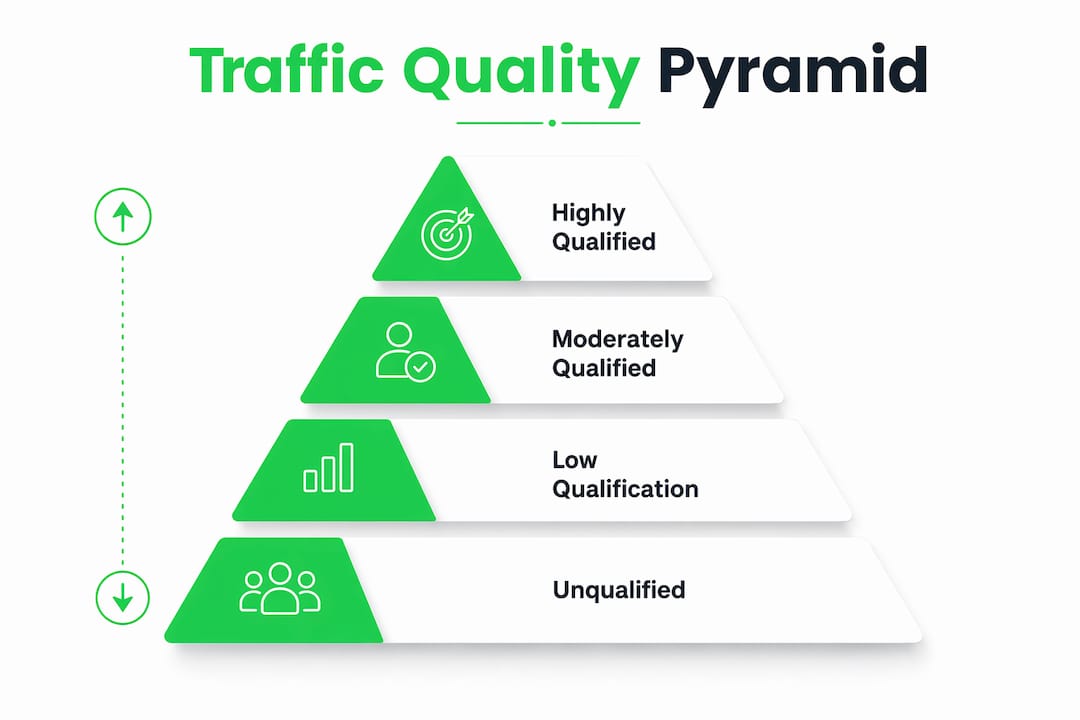
The most damaging misconception in high-ticket marketing is that more traffic fixes a broken funnel. It does not. Scaling traffic without fixing positioning simply wastes budget faster.
Four myths trip up buyers repeatedly:
- Myth 1: Volume fixes everything. More clicks expose your broken positioning to more people. Fix the message first.
- Myth 2: CPC optimization wins. Optimizing for cheap clicks attracts bargain hunters who never convert to premium buyers.
- Myth 3: Cold clicks go straight to booking pages. High-ticket buyers need trust assets — webinars, case studies, ROI calculators — before they book.
- Myth 4: Cost-per-lead is the right KPI. Without qualification, a low CPL is a vanity metric. Track cost per qualified lead instead.
The most common mistake is applying low-ticket logic to high-ticket buys. Volume-based funnels fail for $10K+ offers because authority and intent matter more than reach.
Pro Tip: Before increasing ad spend, invest in your positioning and pre-qualification assets. A tighter squeeze page headline and a qualification form above the booking link will do more for your close rate than doubling your click budget.
What "quality traffic" actually looks like for $5K+ offers

Quality traffic for a high-ticket offer means visitors who carry genuine buyer intent, match your demographic or firmographic profile, and arrive through a list with strong deliverability and hygiene. It is not a vague concept — it is a measurable set of attributes.
A practical quality framework combines behavioral, commercial, and attribution signals: time on page, scroll depth, pricing page visits, form starts, and return visit behavior. For solo ad buyers, that translates into a specific checklist:
- Vendor's list is niche-aligned to your offer category (business opportunity, health, finance, etc.)
- Opt-in rates on your squeeze page fall within expected ranges for the niche
- Leads engage with follow-up emails (opens, clicks) rather than going cold immediately
- Email deliverability is confirmed via seed list testing before the buy
- Demographic fit is verified (geography, income level, prior purchase behavior where available)
- No bot-like traffic spikes in click logs; consistent delivery over the agreed window
Quality also varies by offer type. A high-ticket coaching program needs leads who have already tried cheaper solutions. A B2B consulting offer needs decision-makers, not researchers. Align your buyer traffic signals to the specific transformation your offer delivers.
How to verify a solo ad vendor before you spend
Verify first, buy later. That sequence protects your budget and your sales team's time. Here is the verification order to run on every vendor:
- Request anonymized sample reports. Ask for recent click logs showing delivery windows, geography, and device breakdown. Refuse vendors who cannot produce them.
- Require click-tracking with UTMs and redirect landing pages. Use ClickMagick or a similar tracker to capture raw data independently of what the vendor reports.
- Run a seed deliverability test. Place seed email addresses on your list before the buy and confirm delivery, inbox placement, and timing.
- Buy a micro test. Start with 100–250 clicks routed through a tracked landing page. Measure opt-in rate, lead engagement, and booked-call rate before committing to scale.
- Validate lead quality before scaling. Check whether micro-test leads open follow-up emails, click links, and book calls at acceptable rates.
| Metric to record | What to capture |
|---|---|
| Total clicks delivered | Raw number from your tracker, not the vendor's report |
| Opt-in rate | Opt-ins ÷ clicks (target: 30–45% for a tight squeeze page) |
| Lead-to-call rate | Booked calls ÷ opt-ins |
| Email open rate (Day 3) | Opens on first follow-up sequence email |
| Geography breakdown | % of clicks from your target country |
Run every vendor through the 21-Question Vendor Vetting Framework before placing any order. Hyper-targeted traffic sources that yield consistent high-intent leads protect both budget and sales time far better than broad-reach buys.
The metrics you must track for high-ticket solo ad tests
Four metrics are non-negotiable: qualified lead rate, show/demo rate, cost per qualified lead, and discovery-to-close rate. Everything else is context.
| Metric | What it measures | Why it matters | Suggested threshold |
|---|---|---|---|
| Qualified lead rate | % of opt-ins who pass pre-call screening | Filters out unqualified volume | 20% of opt-ins |
| Show/demo rate | % of booked calls that actually show | Indicates lead intent and list quality | 60% of booked calls |
| Cost per qualified lead | Ad spend ÷ qualified leads | True acquisition cost for your funnel | Depends on offer price; set a ceiling |
| Discovery-to-close rate | Closes ÷ discovery calls held | Measures sales process and lead fit | 15–30% for most high-ticket offers |
If your show rate drops below 50%, the traffic source is the first place to look — not your closer. Low show rates almost always signal low-intent leads.
Industry playbooks consistently recommend tracking revenue-focused KPIs rather than CPC or raw lead volume. Scale when cost per qualified lead stays below your ceiling and show rate holds above your threshold. Stop and reassess when either metric misses by more than 20% across a full test window.
A three-stage test-and-scale playbook
Run a predictable three-stage sequence: micro test, validate conversion economics, then scale with controls.
- Stage 1 — Micro test (Days 1–7). Buy 100–250 clicks from a vetted vendor. Budget: $50–$150 depending on vendor CPM. Track opt-in rate, Day 3 email open rate, and lead-to-call rate. Go/no-go: opt-in rate above 30% and at least one booked call.
- Stage 2 — Validate (Days 8–14). If Stage 1 passes, buy 300–500 clicks. Measure qualified lead rate and show rate against the thresholds above. Budget: $150–$400. Go/no-go: qualified lead rate above 20% and show rate above 60%.
- Stage 3 — Scale (Days 15–21). If Stage 2 passes, negotiate a larger buy or recurring schedule with the same vendor. Maintain tracking on every order. Never remove UTMs or seed tests, even with a trusted vendor.
A simple budget example: cheaper unvetted clicks generate fewer qualified leads, while targeted, vetted clicks cost more but tend to produce more qualified leads. The test-and-learn approach favors precision over reach every time. For a broader view of which affiliate traffic channels hold up under this kind of scrutiny, Soloadsguide covers the current landscape in detail.
Red flags and vendor tricks that kill lead quality
The top red flag is a vendor who promises mass instant sales or guarantees a fixed cost per lead for high-ticket outcomes. No legitimate vendor can control your funnel's close rate. That promise is a sales tactic, not a service guarantee.
Watch for these specific issues:
- Bot traffic and click farms. Clicks arrive in unnatural bursts, geography is mismatched, and your tracker shows near-zero time on page.
- Recycled lists. The same subscribers have seen dozens of offers. Opt-in rates look acceptable but engagement collapses after Day 1.
- Inflated click reports. Vendor-reported clicks exceed your tracker's count. Always trust your own data.
- Fake testimonials. Screenshots with no verifiable names, dates, or offer context are worthless as social proof.
- Vague niche claims. "Make money online" is not a niche. Demand specifics: what offers has this list responded to, and when?
Pro Tip: Seed your opt-in form with two or three personal email addresses before any buy. If those addresses do not receive your lead magnet within the expected window, deliverability is broken — and you have proof before you scale.
For a deeper look at why solo ads fail and how to fix the most common problems, Soloadsguide covers the full troubleshooting list.
Your pre-purchase checklist before every solo ad buy
This checklist is the last gate before you click "buy." Run every item before committing budget.
- Click-tracking is live (UTMs set, redirect landing page confirmed)
- Seed deliverability test completed and inbox placement confirmed
- Vendor has answered all 21 vetting questions with verifiable responses
- Micro-test results meet minimum thresholds (opt-in rate, show rate, qualified lead rate)
- Vendor's niche alignment matches your offer category
- Refund or make-good policy is confirmed in writing before payment
- Results are logged in a vendor comparison file for future reference
Run this on every vendor, every time. Archive the results so you can compare vendors across multiple buys and spot patterns over time. Pre-call qualification using screening questions above your booking link is the final filter — budget, authority, need, and timeline should all be confirmed before a discovery call is ever scheduled.
Key Takeaways
High-ticket offers fail with low-quality traffic because each unqualified lead wastes expensive sales resources that volume-based funnels cannot afford.
| Point | Details |
|---|---|
| Quality beats volume | One qualified lead outperforms 20 cheap clicks that never book a call. |
| Verify before you buy | Run seed tests, require UTM tracking, and complete the 21-question vet on every vendor. |
| Track the right metrics | Qualified lead rate, show rate, and cost per qualified lead matter more than CPC. |
| Use a three-stage playbook | Micro test first, validate conversion economics, then scale with controls in place. |
| Soloadsguide's framework | The 21-Question Vendor Vetting Framework at Soloadsguide is the canonical tool for solo ad buyers. |
The part most buyers get wrong
Most buyers treat solo ad traffic as a commodity problem: find the cheapest clicks, send the most volume, and hope the funnel does the rest. After 11 years on the vendor side of this industry, Philip Coble's view is the opposite. The buyers who consistently build profitable lists for high-ticket offers are the ones who treat every traffic buy as a verification problem first.
The vendors worth working with are not the ones with the flashiest testimonial pages. They are the ones who hand over raw click logs without being asked, who tell you upfront when their list is not a fit for your niche, and who encourage small test buys before large commitments. Transparency is the signal. Any vendor who resists your tracking setup or pushes back on seed testing is telling you something important about what they are selling.
The 21-Question Vendor Vetting Framework exists precisely because most buyers skip the hard questions. Applying it consistently, even with vendors who come recommended, is what separates buyers who scale profitably from those who burn budget and blame the channel.
What Soloadsguide gives you before you spend a dollar
Soloadsguide is built for buyers who want to vet before they spend. The site gives you the tools to make that happen: the 21-Question Vendor Vetting Framework, a step-by-step click-tracking guide, and a test-buy checklist you can run on any solo ad vendor before committing real budget.
These are not generic checklists. They come from 11 years of vendor-side experience and are written specifically for affiliate marketers and online business owners buying solo ads for high-ticket list building. Every resource is free to use and designed to protect your budget, not sell you on a platform.
Visit Soloadsguide to download the vetting framework and start applying it to your next vendor evaluation today.
Useful sources
The claims in this article draw on a focused set of authoritative sources. For deeper reading on specific topics, the following are the most relevant starting points:
- Positioning before traffic — why scaling without fixing positioning wastes budget
- High-ticket sales guidance — consultative selling and qualification frameworks
- Quality traffic and source testing — hyper-targeted source selection and test-and-learn methodology
- Paid advertising for high-ticket clients — micro-test setup and trust asset architecture
- Lead generation for high-ticket services — authority and human-led qualification for $10K+ deals
- High-ticket sales qualification practices — pre-call screening and budget/authority/need filtering
- High ticket digital marketing mistakes — KPI selection and vanity metric traps
- What is quality web traffic and why it matters — behavioral and commercial signals for traffic quality assessment
- SoloAdsGuide home — 21-Question Vendor Vetting Framework, tracking guides, and test-buy checklists
Proprietary case studies and verified vendor testimonials will be added to this section as they are collected and confirmed. Placeholder for future client-specific outcome data.
Recommended
- What Does Buyer Traffic Mean in Solo Ads?
- Email Traffic Lead Generation Benefits for Marketers
- Why Your Solo Ads Are Failing (2026 Fixes That Scale)
- How to Buy Solo Ads That Actually Convert (Step-by-Step)
Want Verified Traffic Without the Guesswork?
PulseTraffic screens every seller, filters bot clicks in real time, and shows you verified buyer traffic labels before you spend a dollar.