

Solo ad vendors inflate click counts to fulfill volume-based contracts without delivering traffic that actually converts. This practice, formally known as invalid traffic or solo ad click fraud, is widespread enough to have reshaped how serious affiliate marketers evaluate campaign performance. Understanding why solo ad vendors inflate click counts protects your ad budget and gives you a clear picture of what real performance looks like. The 2026 AI-filtered inbox environment has made this problem worse, pushing more vendors toward artificial inflation just to stay in business.
Why solo ad vendors inflate click counts: the core mechanics
Click inflation in solo ads is a direct result of how the industry prices its product. Vendors sell clicks, not conversions. That single fact explains most of the manipulation you will encounter.
Vendors deliver promised clicks but fill those numbers with low-intent users, recycled traffic, and freebie hunters who have no interest in your offer. The business model rewards volume, not quality. A vendor who sends 500 clicks gets paid whether those clicks come from engaged buyers or disengaged subscribers who last opened an email six months ago.
The specific techniques vendors use to pad click counts include:
- Bot traffic: Automated scripts that simulate human clicks without any real person visiting your squeeze page.
- Click farms: Low-paid workers in bulk-clicking operations who generate real IP addresses but zero purchase intent.
- Incentivized clicks: Subscribers offered rewards for clicking links, producing traffic with no connection to your offer.
- Recycled lists: The same disengaged subscribers mailed repeatedly across multiple campaigns, generating clicks from habit rather than interest.
- Fake testimonials and cherry-picked stats: Screenshots and conversion stats presented without funnel context to create the illusion of strong performance.
Pro Tip: Ask any vendor for their average opt-in rate across the last 30 days, not just click-through rate. A vendor with strong clicks but a sub-5% opt-in rate is almost certainly sending low-quality or inflated traffic.
The motivation behind all of these tactics is simple. Vendors face growing pressure from AI-filtered inbox policies that reduce genuine inbox placement. When real clicks become harder to generate, some vendors manufacture them instead.
How inflated clicks damage your campaign metrics
The damage from click inflation goes far beyond a wasted budget line. It corrupts the data you rely on to make every future decision.

Average CTR on solo ad buys dropped from 38% to under 24% in 2026 due to AI-filtered inbox policies. That 14-percentage-point drop means the industry baseline for genuine engagement has fallen sharply, making inflated numbers even easier for vendors to hide behind.
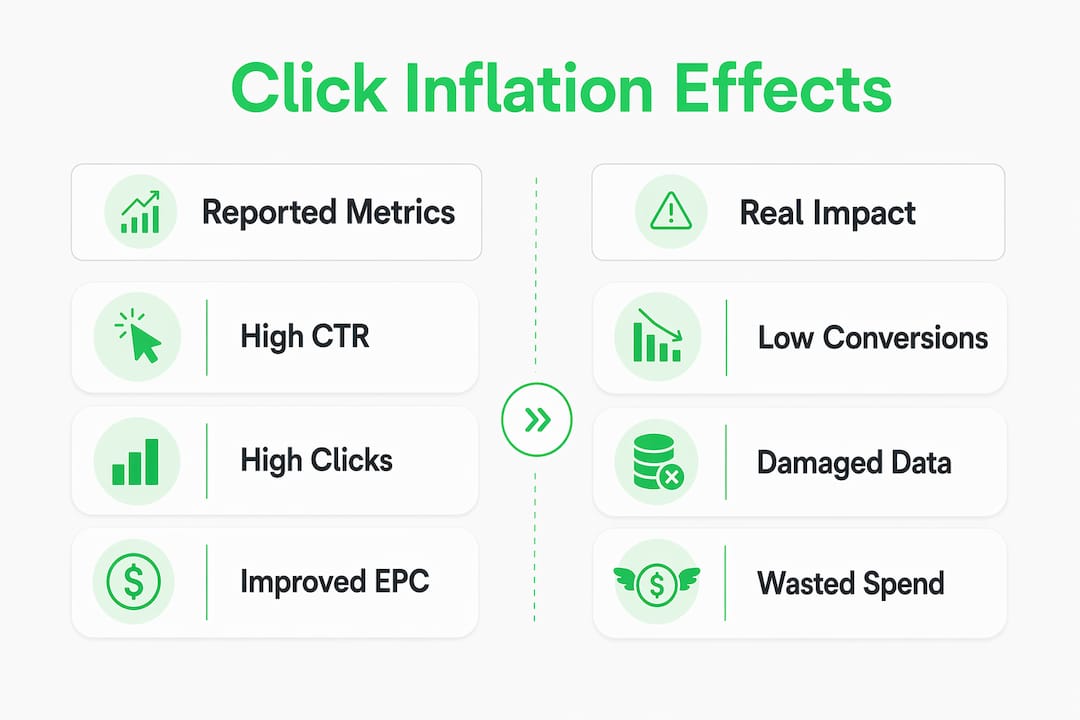
When your click count is padded, your earnings per click (EPC) collapses. You might see 500 clicks reported but only 8 opt-ins. That gives you an EPC that looks catastrophic when the real problem is not your funnel. It is the traffic quality. You then make the wrong fix, changing your headline or lead magnet, when the vendor is the actual variable.
The table below shows how inflated clicks distort the metrics that matter most:
| Metric | What inflated clicks report | What real performance shows |
|---|---|---|
| Click-through rate | High (vendor-reported) | Low (verified by your tracker) |
| Opt-in rate | Appears normal | Below 10% on a tested funnel |
| Earnings per click | Misleadingly low | Improves once traffic is cleaned |
| Retargeting audience quality | Large pool | Filled with bots and cold users |
Invalid traffic like bots and click farms corrupts campaign data, pollutes retargeting audiences, and weakens AI-driven smart bidding. This is the part most affiliate marketers miss. When fake clicks enter your pixel data, your ad platform's algorithm learns from garbage signals. Every future campaign you run using that audience or that conversion data performs worse as a result.
Why inflated click counts hurt your long-term ad spend
Wasted budget is the obvious cost. The hidden cost is what inflated clicks do to your marketing infrastructure over time.
Retargeting audiences built on fake clicks become useless. You pay to re-engage people who never had real intent in the first place. Your lookalike audiences, built from those same polluted pools, target the wrong people at scale. The more you spend, the worse the data gets.
The psychological damage is just as real. Seeing 500 clicks in your dashboard creates a false sense of progress. You assume the campaign is working and keep spending. The problem compounds before you realize the traffic was never real.
Here is what inflated clicks cost you beyond the immediate spend:
- Corrupted AI optimization: Smart bidding platforms like Google's Performance Max and Meta's Advantage+ learn from your conversion signals. Fake clicks teach them the wrong patterns.
- Polluted email lists: If any of those clicks result in opt-ins from bot-adjacent addresses, your sender reputation suffers when you mail them.
- Wasted split-test data: You cannot trust A/B test results when the traffic source is unreliable. You may kill a winning funnel based on fraudulent data.
- Delayed scaling: Every week you spend diagnosing a funnel that is not broken is a week you are not scaling a campaign that works.
Pro Tip: Run your solo ad traffic through a third-party click tracker like ClickMagick or Voluum before it hits your squeeze page. A sudden spike in clicks with zero time-on-page is a reliable signal of bot traffic.
Analytics-driven marketing consistently outperforms gut-feel decisions, but only when the underlying data is clean. Inflated clicks make clean data impossible.
How to detect signs of inflated click counts
Detection starts before you spend a dollar. The red flags are consistent across vendors who inflate their numbers.
- Click-to-opt-in mismatch: A healthy solo ad campaign delivers opt-in rates between 30% and 50% on a well-built squeeze page. If you are seeing 500 clicks and 15 opt-ins, the traffic is not what it was sold as.
- Unrealistic open rates: Vendors who refuse to share open rates and click-through rate data from their list are hiding something. Legitimate vendors track these numbers and share them willingly.
- Clicks with no engagement signals: Check your heatmap or session recording tool. Bot clicks produce no scroll depth, no mouse movement, and no time on page.
- Geographic anomalies: A vendor claiming tier-1 US traffic but delivering clicks from unexpected locations is a clear warning sign. Your tracker will show IP geolocation data.
- Suspiciously fast delivery: 500 clicks delivered in 45 minutes from a list of 10,000 subscribers is mathematically implausible for real human behavior.
You can also cross-reference vendor claims against opt-in rate benchmarks for 2026 to see whether what you are being promised is realistic. If a vendor guarantees numbers that exceed industry averages by a wide margin, treat that as a red flag, not a selling point.
Strategies to avoid paying for inflated clicks
Protecting your budget requires a systematic approach to vendor selection and campaign tracking. The following practices separate profitable solo ad buyers from those who keep losing money.
- Prioritize vendors with engagement-segmented sending. Sellers with verified domain age and DMARC enforcement maintain 72–80% inbox placement in 2026. Ask vendors directly whether they segment by engagement before mailing.
- Request backend conversion data. A vendor confident in their list will share opt-in rates and, in some cases, front-end conversion rates from recent campaigns. Refusal to provide this data is a disqualifier.
- Start with a small test. Buy 100–200 clicks before committing to a larger order. Track every metric: clicks, opt-ins, time on page, and email open rates from new subscribers.
- Use funnel continuity principles. Top affiliates track lifetime customer value and subscriber engagement beyond front-end clicks. Match your offer to the vendor's niche and audience temperature.
- Check the email marketing fundamentals. A vendor following email marketing best practices around list hygiene, authentication, and segmentation is far less likely to rely on inflated metrics.
- Monitor post-click behavior continuously. Do not evaluate a solo ad campaign by clicks alone. Track opt-in rate, email open rate from new leads, and any front-end sales within 72 hours of traffic delivery.
The best solo ad vendors in 2026 are transparent about deliverability, list age, and engagement history. If a vendor cannot answer basic questions about their list, move on.
Key Takeaways
Solo ad vendors inflate click counts because their business model rewards volume over quality, and the 2026 AI-filtered inbox environment has made genuine traffic harder to deliver.
| Point | Details |
|---|---|
| Core motivation | Vendors are paid per click, not per conversion, creating direct incentive to inflate numbers. |
| Detection method | Compare reported clicks against opt-in rate; below 10% on a tested funnel signals inflated traffic. |
| Data corruption risk | Fake clicks pollute retargeting audiences and corrupt AI bidding signals, harming future campaigns. |
| Vendor vetting standard | Require DMARC enforcement, engagement segmentation, and willingness to share opt-in rate data. |
| Testing protocol | Start with 100–200 clicks and track time-on-page, opt-ins, and email opens before scaling. |
What I have learned from years of watching this market
I have reviewed hundreds of solo ad campaigns, and the pattern is always the same. The vendor delivers the clicks. The affiliate blames the funnel. The real problem sits one step earlier in the chain.
The most dangerous vendors are not the obvious scammers. They are the ones who deliver real clicks from real people who have been mailed so many times that they click out of reflex, not interest. That traffic looks clean in a tracker. It produces terrible EPC. And it is nearly impossible to distinguish from quality traffic without backend data.
What changed my thinking was treating email lists as media assets rather than inventory. A quality list has a relationship with its subscribers. A vendor who has burned that relationship through over-mailing or irrelevant offers cannot restore it by sending you more volume. The clicks will come. The buyers will not.
The 2026 AI inbox filtering shift has accelerated this problem. Vendors who built their business on bulk sending are now watching inbox placement rates fall by 18 to 34 percentage points. Some adapt by improving list hygiene. Others adapt by inflating their reported numbers. Knowing which type of vendor you are dealing with is the most valuable skill you can develop as a solo ad buyer. If you want a shortcut, understanding why solo ads fail is the fastest way to stop repeating the same expensive mistakes.
— Phil
Soloadsguide makes finding honest vendors straightforward
Sorting through vendor claims on your own takes time and costs money in failed tests. Soloadsguide does that work for you.
The ranked and reviewed vendor list at Soloadsguide covers only providers with verified engagement metrics, confirmed tier-1 traffic, and transparent deliverability data. Every vendor on the list has been evaluated against the same standards this article describes: opt-in rates, inbox placement, list hygiene practices, and real conversion history. Soloadsguide also provides educational resources to help you track real solo ad performance and interpret the metrics that actually predict ROI. Whether you are placing your first order or auditing a vendor you have used for months, the guide gives you a clear, unbiased starting point.
FAQ
What is solo ad click fraud?
Solo ad click fraud is the practice of artificially inflating click counts through bots, click farms, or incentivized traffic to meet contractual delivery numbers without providing genuine buyer intent.
How do I know if a vendor is inflating my clicks?
Compare your reported click count against your opt-in rate. A well-built squeeze page should convert 30–50% of real visitors. Rates below 10% on tested funnels indicate inflated or low-quality traffic.
Why do solo ad vendors use disengaged lists?
Vendors are paid per click delivered, not per conversion generated. Disengaged lists still produce clicks, which fulfills the contract, even though those clicks rarely convert into leads or sales.
Does click inflation affect my ad platform's AI?
Yes. Invalid clicks corrupt the conversion signals that platforms like Meta and Google use for smart bidding. Polluted data causes AI optimization to target the wrong audiences in future campaigns.
What metrics should I track beyond click count?
Track opt-in rate, email open rate from new subscribers, time-on-page, and front-end conversion rate within 72 hours of traffic delivery. These metrics reveal whether clicks represent real human interest.
Recommended
- Why Your Solo Ads Are Failing (2026 Fixes That Scale)
- Top 4 Sources for 500 Clicks Solo Ads 2026
- How to Track Solo Ad Traffic (Catch Low-Quality Clicks)
- Solo Ads Blog, Tips, Guides & Reviews | SoloAdsGuide.com
Want Verified Traffic Without the Guesswork?
PulseTraffic screens every seller, filters bot clicks in real time, and shows you verified buyer traffic labels before you spend a dollar.