

The highest-converting solo ad niches are MMO/affiliate marketing, online business and digital courses, health and fitness supplements, personal development and coaching, finance and trading information, print-on-demand gifting, and crypto/trading signals. Run a 100–200 click test with a dedicated squeeze page and click-tracking postback before committing any real budget.
- MMO/affiliate marketing converts because subscribers already buy info products and tools; they are email-native buyers with a short decision cycle.
- Health and fitness supplements convert because buyers have recurring purchase intent and respond to free sample or low-ticket tripwire offers.
- Personal development and coaching converts because the audience is self-selected for action and responds to lead magnets that promise a fast, specific result.
- Finance and trading information converts because urgency and FOMO are built into the category; buyers act quickly when the offer is time-sensitive.
- Print-on-demand gifting converts because a single buyer often purchases multiple units, driving higher average order values on a single click.
Start with a 100–200 click test on one niche, one landing page, and one tracking postback. That is the minimum viable experiment.
Key Takeaways
The highest-converting solo ad niches share one trait: the list was built around the same buyer intent as the offer, and that match shows up immediately in opt-in rate and EPC.
| Point | Details |
|---|---|
| Top-converting niches | MMO/affiliate, online business, health supplements, personal development, and finance info consistently produce the strongest opt-in and sale CVR. |
| Test size before scaling | Run 100–200 clicks with a dedicated squeeze page and postback tracking before increasing spend with any vendor. |
| Vendor vetting is mandatory | Apply Soloadsguide's 21-question framework to every vendor; disqualify anyone who cannot answer list-source and tracking questions. |
| Scale and stop rules | Scale when opt-in rate exceeds 30% and EPC beats your cost per click; stop after 14 days with zero sales and a full follow-up sequence run. |
| Soloadsguide resources | The 21-question vetting framework, tracking setup guide, and niche benchmarks are available at soloadsguide.com. |
Table of Contents
- What actually moves the needle in solo ad conversions
- Why niche selection is the biggest driver of solo ad performance
- The best niches for solo ads: annotated examples and offer types
- What performance benchmarks should you actually expect?
- How do you match your offer to a seller's list?
- How Soloadsguide's 21-question framework and tracking setup protect your spend
- Which niches and offer types should you avoid with solo ads?
- A 7–14 day test plan you can run right now
- What 11 years in solo ads actually taught me about niche selection
- What Soloadsguide gives you before you spend a dollar
- Sources
What actually moves the needle in solo ad conversions
Before you pick a niche or spend a dollar, these five decisions determine whether your campaign breaks even or bleeds:
- List-offer fit beats list size. A 50,000-subscriber list in the MMO niche will outperform a 500,000-subscriber general list for an affiliate marketing offer. Alignment with buyer intent and email-list familiarity is the real lever.
- Traffic verification is non-negotiable. Always set up a postback URL before you buy a single click. If you cannot track which clicks converted, you cannot make a scale decision.
- Cold solo traffic needs a short, low-friction offer. A free lead magnet followed by a $7–$27 tripwire is the proven structure for cold email traffic. Direct-to-$497 offers rarely convert on first touch from a list you do not own.
- Test small, then scale. A 100–200 click test gives you enough data to read opt-in rate and early EPC without overcommitting budget. Scaling before you have that signal is the most common beginner mistake.
Pro Tip: Within the first 24–48 hours of a test, check your click timestamps. If a vendor delivers 200 clicks in 90 minutes at 2 AM, that is a bot-traffic red flag. Legitimate email broadcasts spread clicks over 4–12 hours as subscribers open at natural intervals.
Why niche selection is the biggest driver of solo ad performance
Niche selection determines whether the email list's intent matches your offer. That match, or lack of it, shows up immediately in click-through rate, opt-in rate, and downstream conversion to sale.
A subscriber who joined a list to learn affiliate marketing tactics is already primed to click an offer about traffic generation. A subscriber who joined to get a free recipe book is not. The gap between these two audiences is not a matter of copywriting or landing page design; it is a structural mismatch that no split test can fix.
Niche marketing examples from WebFX illustrate this clearly: Lefty's, a retail store selling exclusively left-handed products, converts at a high rate precisely because every visitor is a confirmed left-handed buyer. The audience and the offer are the same thing. Solo ads work the same way. When the list was built around a specific buyer persona and your offer serves that exact persona, conversion follows.
Three quick alignment checks before you buy:
- Audience intent: What did subscribers opt in for originally? A list built around "make money online" tips is a different buyer than one built around "personal finance budgeting."
- Offer fit: Does your offer type match what the list has historically responded to? Lead magnets work on most cold lists; direct-sale offers need a warm, engaged list.
- List engagement signals: Ask the vendor for recent open rates and click rates on past broadcasts. A list with a 10% open rate on a 30-day-old broadcast is healthier than one with a 2% rate on a 7-day-old one.
List age and send frequency also matter. A list that gets emailed twice a day by multiple vendors is fatigued. Segmented lists, where the vendor separates buyers from non-buyers, produce measurably better lead quality because the buyer segment has already demonstrated purchase intent.
The best niches for solo ads: annotated examples and offer types
These are the niches that consistently produce results for solo ad buyers. The table below gives you a quick reference across the dimensions that matter most for campaign planning.
MMO and affiliate marketing
This is the most reliable niche for solo ads because the audience was built specifically around buying traffic, tools, and training. Subscribers are email-native and have short decision cycles. The winning offer structure is a free checklist or short video training followed by a $7–$27 tripwire. Keep the squeeze page headline specific: "Get the 5-step traffic checklist affiliate marketers use to hit $100/day" outperforms "Free marketing guide" every time.
- Lead with a specific, numbered promise on the squeeze page.
- Use a two-step opt-in: email first, then name, to reduce friction.
- Follow up with the tripwire offer within 60 seconds of the opt-in confirmation.
Online business and digital courses
Course creators and coaches do well here because the audience is actively looking for systems and shortcuts. The sales cycle is slightly longer than MMO, so a free webinar or video training works better than a PDF alone. Pair it with a 3–5 email follow-up sequence before pitching the core offer.
Health and fitness supplements
Recurring purchase intent makes this niche valuable. A subscriber who buys a supplement once is likely to buy again, which means lifetime value is higher than the front-end conversion suggests. The risk is regulatory: never make disease-treatment claims in your ad copy or landing page. Stick to wellness and lifestyle framing.
Personalization drives conversion in this category too: one premium anti-aging brand routed cold paid traffic through a 12-step qualifying quiz and achieved a 9.8% quiz-to-purchase conversion rate with a 42.6% lift in average order value. A quiz funnel is worth testing for supplement offers where product fit depends on the buyer's specific situation.

Print-on-demand gifting
POD sub-niches like occupation shirts, pet portraits, and milestone apparel produce predictable conversion peaks around gifting windows: Christmas, Mother's Day, graduations, and bachelorette events. The group-purchase dynamic is the key mechanic: one buyer often orders multiple units for a group, which lifts AOV without any additional traffic cost. Personalization is a proven sales driver in this category, and POD lets you test niche offers without holding inventory.
- Target gifting windows 4–6 weeks in advance.
- Use a direct product offer or a short quiz funnel to match buyers to the right product.
- Occupation-specific and pet-specific sub-niches convert because the buyer identity is extremely clear.
Crypto and trading signals
High upside, high risk. List quality in this niche varies more than any other category. Fraud rates are elevated, vendor claims are frequently exaggerated, and the regulatory environment around financial advice is strict. If you test here, use 200+ clicks minimum, verify every click with a server-side postback, and apply the full 21-question vetting framework before spending anything.
What performance benchmarks should you actually expect?
Setting realistic expectations before your first test prevents two common errors: stopping a campaign that is actually working and scaling one that is not.
The metrics that matter are click-through rate (CTR) from the email to your landing page, opt-in rate on the squeeze page, lead-to-purchase conversion rate (CVR), earnings per click (EPC), and average order value (AOV). Each one tells you something different about where the funnel is leaking.
| Metric | Typical range | What drives variance | Caveat |
|---|---|---|---|
| Email CTR | 10–30% | List freshness, subject line, niche relevance | Vendor controls this; you see it as raw clicks |
| Squeeze page opt-in rate | 20–50% | Headline clarity, offer specificity, page speed | Below 20% usually means offer-list mismatch |
| Lead-to-purchase CVR | 1–5% | Offer price, funnel length, follow-up sequence | Measure over 7–14 days, not 24 hours |
| EPC (earnings per click) | $0.20–$1.00 | Niche, offer AOV, funnel quality | Compare against your CPC to assess profitability |
| AOV | $7–$497 | Offer type, upsell sequence, niche | Higher AOV niches need more clicks to reach significance |
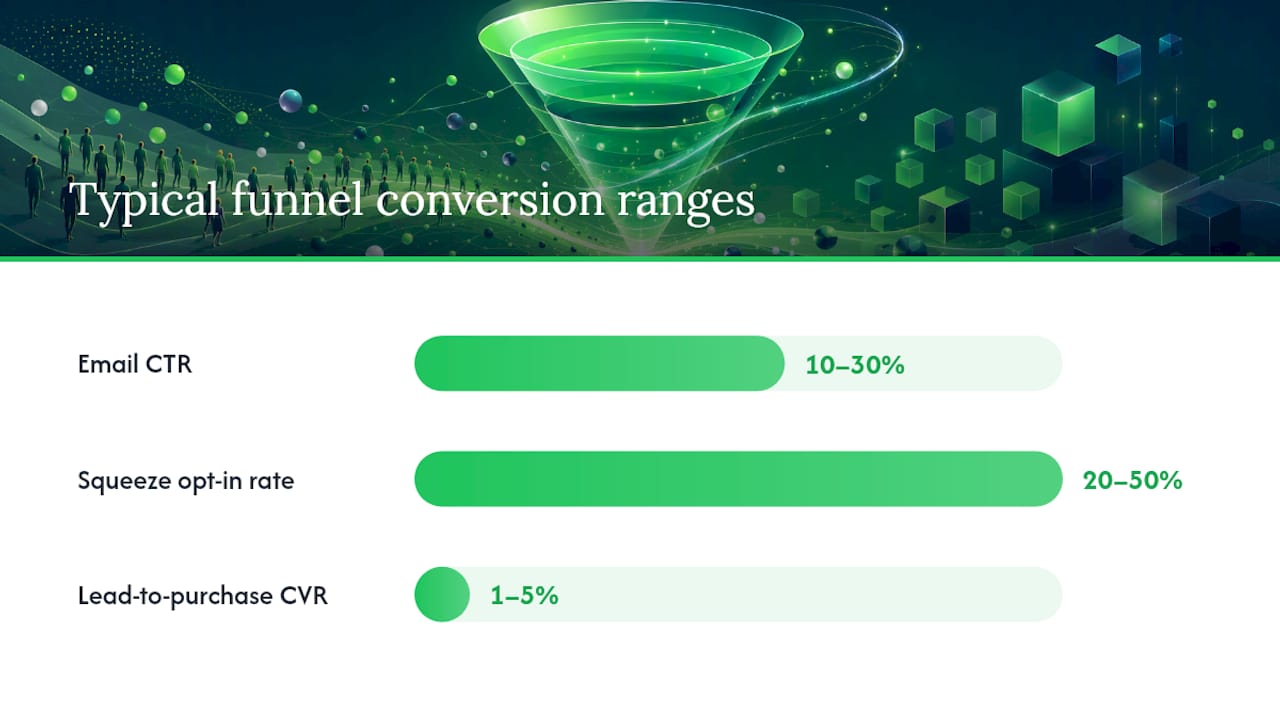
These are broad benchmarks, not guarantees. Soloadsguide's vendor conversion rate benchmarks guide breaks down realistic EPC ranges by niche and explains how to reconcile click-tracking data with merchant conversion events. The single most important caveat: 100–200 clicks is enough to read opt-in rate, but you need 300–500 clicks before lead-to-purchase CVR is statistically meaningful.
Geography also affects results. Always ask vendors to confirm the geographic breakdown of their list before buying.
How do you match your offer to a seller's list?
The primary filters are buyer-persona match, offer fit, and traffic verification. Apply them in that order before you ask about price.
Buyer-persona match checklist:
- What was the original opt-in incentive for this list? (A "free traffic course" list is different from a "make money with surveys" list.)
- What age range and income level does the list skew toward?
- Has the vendor sent offers in your specific sub-niche before? What were the results?
- Is the list segmented by buyers vs. non-buyers?
Offer fit checklist:
- Is your offer a lead magnet, a low-ticket product, or a high-ticket service? Match the offer complexity to the list's demonstrated purchase history.
- Does your landing page load in under 3 seconds on mobile? Most solo ad clicks come from mobile devices.
- Is your opt-in form above the fold with a single, specific call to action?
Vendor questions to ask before buying:
- Can you share open-rate and click-rate data from the last three broadcasts?
- What offers have performed best on your list in the last 90 days?
- Can you send me a sample broadcast so I can see your list's engagement style?
- What percentage of your list is US-based?
- Do you allow server-side postback tracking?
Red flags to walk away from:
- Vendor promises a specific conversion rate before seeing your offer.
- No tracking allowed or vendor discourages postback setup.
- Screenshots of results with no timestamps or verifiable data.
- Unusually fast delivery promises (all 500 clicks in under 2 hours).
- Vague answers about list source or original opt-in incentive.
The 500K solo pattern reinforces this: solo founders who succeed pick a narrow niche, run one repeatable lead magnet, and focus on a single acquisition channel until ROI stabilizes. Spreading across multiple niches and vendors simultaneously is a fast way to generate noise instead of data.
How Soloadsguide's 21-question framework and tracking setup protect your spend
The 21-question vendor-vetting framework published by Soloadsguide covers three categories: list quality verification, offer compatibility, and fraud detection. The questions are grouped so you can disqualify a vendor early without wasting time on a full negotiation.
List quality questions cover:
- Original opt-in source and incentive
- List age and last-cleaned date
- Send frequency and number of active advertisers per week
- Segmentation by buyer status and engagement tier
Offer compatibility questions cover:
- Historical performance of similar offer types
- Accepted niches and prohibited categories
- Funnel structure requirements (squeeze page only vs. full sales page)
- Geographic and device breakdown
Fraud detection questions cover:
- Tracking pixel and postback URL acceptance
- Referral and SubID field support in the click URL
- Delivery timeline expectations and bot-traffic policy
- Refund or make-good policy for low-quality traffic
Once a vendor passes the framework, set up tracking before you send a single dollar. The recommended setup uses a click-tracking tool (ClickMagick or Voluum are widely used for solo ad campaigns) with a server-side postback rather than a pixel. Pixels can be blocked by browsers and ad blockers; server-side postbacks fire regardless of the subscriber's browser settings.
Step-by-step tracking setup:
- Create a tracking link in your click-tracking tool with a unique SubID for each vendor.
- Add the postback URL to your offer's thank-you page or merchant platform.
- Validate that the SubID field passes correctly by running a test click before the campaign goes live.
- Set up a referral field to capture the vendor's identifier in every conversion event.
- After the campaign, reconcile your tracker's conversion count against the merchant's conversion count. A gap of more than 10–15% warrants investigation.
Example tracking URL structure:
https://yourtracker.com/click?vendor=vendorname&subid=test001&offer=leadmagnet
The SubID carries through to the postback so you can attribute each conversion to the exact vendor and campaign.
Common tracking failures and fixes:
- Postback fires but shows zero conversions: check that the merchant platform supports server-side postbacks and that the conversion event is mapped correctly.
- Click count in tracker is lower than vendor reports: confirm the tracking link is the one you sent to the vendor, not a direct link to your landing page.
- Conversion count inflated: check for duplicate postback fires on page refresh; add a deduplication token to the postback URL.
Pro Tip: *Request the vendor's raw click log after the campaign, including timestamps and IP addresses. Run the IPs through a fraud-detection tool like IPQualityScore.
Niche-focused tracking setup is also a direct ROI driver. One ecommerce case study showed that fixing tracking and feed structure before scaling spend produced 8.5x ROAS in 60 days, compared with near-zero returns when tracking was broken. The principle applies directly to solo ad campaigns: you cannot optimize what you cannot measure.
Which niches and offer types should you avoid with solo ads?
Some categories consistently underperform or carry risks that outweigh the potential upside. Knowing which ones to skip saves budget and keeps you out of legal trouble.
- Regulated medical claims. Any offer that implies treatment, cure, or diagnosis of a medical condition is a compliance liability. Solo ad vendors who accept these offers are themselves operating in a gray area, which is a signal about their overall list quality.
- Highly localized services. A plumber, dentist, or local real estate agent cannot convert national email traffic. Solo ad lists are geographically mixed even when a vendor claims "US only." Local service offers need hyper-local targeting that solo ads cannot reliably deliver.
- Long-cycle B2B offers. Enterprise software demos, consulting retainers, and B2B SaaS trials require multiple touchpoints and decision-maker buy-in. Cold email traffic from a solo ad list is not the right entry point for a 90-day sales cycle.
- Investment products without a clear track record. Offers that promise specific financial returns without verifiable performance data attract regulatory scrutiny and tend to attract low-quality vendors who specialize in financial-offer lists of dubious origin.
- High-friction checkout offers. Any offer that requires a phone call, a lengthy application, or multi-step verification before purchase will see conversion collapse on cold traffic. Solo ad buyers need to be able to complete the action in under 5 minutes.
Vendor-side red flags specific to these risky categories: vendors who actively solicit financial or medical offers, who promise "buyer lists" for regulated categories without documentation, or who cannot name the original opt-in source for their list are operating outside normal industry practice. Walk away.
A 7–14 day test plan you can run right now
This plan gives you a repeatable experiment for any niche on the shortlist. Follow it in order and do not skip the pre-test steps.
- Choose one niche and one offer. Pick the niche that best matches your existing offer or the one you can build a lead magnet for fastest. Do not test two niches simultaneously in your first run.
- Build a dedicated squeeze page. One headline, one opt-in form, no navigation links. The headline should name a specific result the subscriber gets. Page load time under 3 seconds on mobile.
- Set up click tracking with a postback. Use ClickMagick, Voluum, or a comparable tracker. Create a unique SubID for this vendor and campaign. Validate the postback with a test conversion before going live.
- Apply the 21-question vendor-vetting framework. Ask the vendor the list-quality, offer-compatibility, and fraud-detection questions before paying. Disqualify vendors who cannot answer the list-source and tracking questions.
- Buy 100–200 clicks as your test. Budget approximately $50–$150 for a 100-click test at typical solo ad rates of $0.40–$0.80 per click. For a direct-sale offer (no lead magnet), budget for 200 clicks minimum because the conversion event is further down the funnel.
- Check early signals at 50 clicks. If opt-in rate is below 15% at 50 clicks, pause and review the landing page headline and offer clarity before continuing. Do not wait for all 200 clicks if the early signal is clearly broken.
- Measure opt-in rate, EPC, and lead-to-purchase CVR over 7–14 days. Give the follow-up email sequence time to work. A subscriber who does not buy on day one may buy on day 5.
- Apply scale or stop rules:
- Scale: Opt-in rate above 30%, EPC above your cost per click, at least one sale from the test batch. Increase order size by 50–100% with the same vendor before testing a second vendor.
- Stop: Opt-in rate below 20% after 150 clicks, zero sales after 14 days and a full follow-up sequence, or fraud flags on more than 5% of IPs. Do not scale a campaign that has not cleared these thresholds.
Practical testing rhythms for solo founders consistently point to small test sizes, a single lead magnet, and single-channel focus early on as the pattern that produces reliable learning. Spreading budget across three vendors and two niches in your first month generates noise, not data.
For a lead magnet offer, a $50–$100 test budget is sufficient to read opt-in rate. For a direct-sale offer priced at $97 or above, budget $100–$200 minimum and extend the measurement window to 14 days to account for the longer decision cycle.
What 11 years in solo ads actually taught me about niche selection
Most buyers focus on the wrong variable. They spend hours comparing vendor prices and almost no time verifying whether the vendor's list was built around the same buyer intent as their offer. A $0.35-per-click vendor whose list was built on "free gift card" opt-ins will outperform a $0.75-per-click vendor with a genuine MMO buyer list? No. The opposite is almost always true.
The one tactical lesson worth applying in the next 24 hours: before you contact any vendor, find one offer in your niche that is already converting on solo ad traffic. Ask in a relevant Facebook group or forum, or check Udimi's marketplace for vendors who list recent results in your niche. Then contact only vendors who have demonstrably sent traffic to similar offers. That single filter eliminates the majority of wasted test spend.
The caution: do not let a good first test make you complacent. A vendor who delivers clean traffic on a 200-click test can deliver bot traffic on a 1,000-click order if they run out of genuine list inventory and backfill with purchased clicks. Verify every order independently using your tracker and the IP-check step, regardless of past results.
What Soloadsguide gives you before you spend a dollar
Buying solo ad traffic without a vetting process is the fastest way to lose your test budget with nothing to show for it. Soloadsguide exists to close that gap.
The site's 21-question vendor-vetting framework walks you through every question to ask a vendor before you pay, including the list-source questions most buyers never think to ask, the tracking setup steps that protect your data, and the red-flag signals that separate legitimate vendors from list recyclers. You also get conversion rate benchmarks by niche so you can set realistic test expectations and know when a campaign is actually working versus when it just looks like it is.
If you are ready to run your first test or tighten up an existing campaign, start with the vetting framework at Soloadsguide. It takes 20 minutes to apply and can save you hundreds of dollars in wasted clicks.
Sources
- Most profitable eCommerce niches and examples
- 9.8% quiz CVR, $691K in 90 days: anti-ageing case study - RevenueHunt
- 500K solo pattern case-study
- 9 Niche Marketing Examples To Inspire Your Strategy - WebFX
Recommended
- High-Ticket Offer Solo Ad Strategies That Actually Work
- Optimize Your Solo Ad Sales Funnel Conversion in 2026
- Landing Page Role in Solo Ad Campaigns: 2026 Guide
Want Verified Traffic Without the Guesswork?
PulseTraffic screens every seller, filters bot clicks in real time, and shows you verified buyer traffic labels before you spend a dollar.