

Solo ad red flags are common, but every one of them is checkable before you spend a dollar. The single move that catches most bad vendors: run a small test order of around 100 clicks through your own tracking link, and get written replacement terms before you scale. If a seller resists either request, treat that as your answer.
TL;DR:
- Vendors offering prices significantly lower than market rates for Tier-1 traffic likely use recycled clicks, bots, or mislabeled sources, indicating low quality.
- Delivery of traffic within minutes usually signals automated or fake clicks, whereas real subscribers open emails over 24 to 48 hours across different time zones.
- Geolocation discrepancies, such as a high percentage of clicks from countries not targeted, suggest list mislabeling or filler traffic, reducing conversion potential.
- Reject vendors who refuse to share full, timestamped screenshots, or who won't let you use your tracking link, as these are signs they want to hide their traffic quality.
- Always vet a vendor with a 100-click test, define measurable acceptance criteria beforehand, and insist on written replacement and refund terms to avoid scams and misinformation.
Table of Contents
- The Top Solo Ad Red Flags to Watch For
- How to Vet a Solo Ad Vendor: The Checklist and Questions to Ask
- Test Campaigns and Tracking: What to Measure
- Common Scam Patterns Buyers Report
- If You Get Burned: Recovery Steps
- Practitioner Perspective: The 21-Question Vetting Framework
- What Actually Separates Safe Buyers From Burned Ones
- Where to Start Vetting Your Next Solo Ad Vendor
- Primary Sources and Further Reading
- Sources
- FAQ
The Top Solo Ad Red Flags to Watch For
Some warning signs matter more than others, and knowing which ones to check first saves you from wasting a test budget on a vendor you should have skipped.
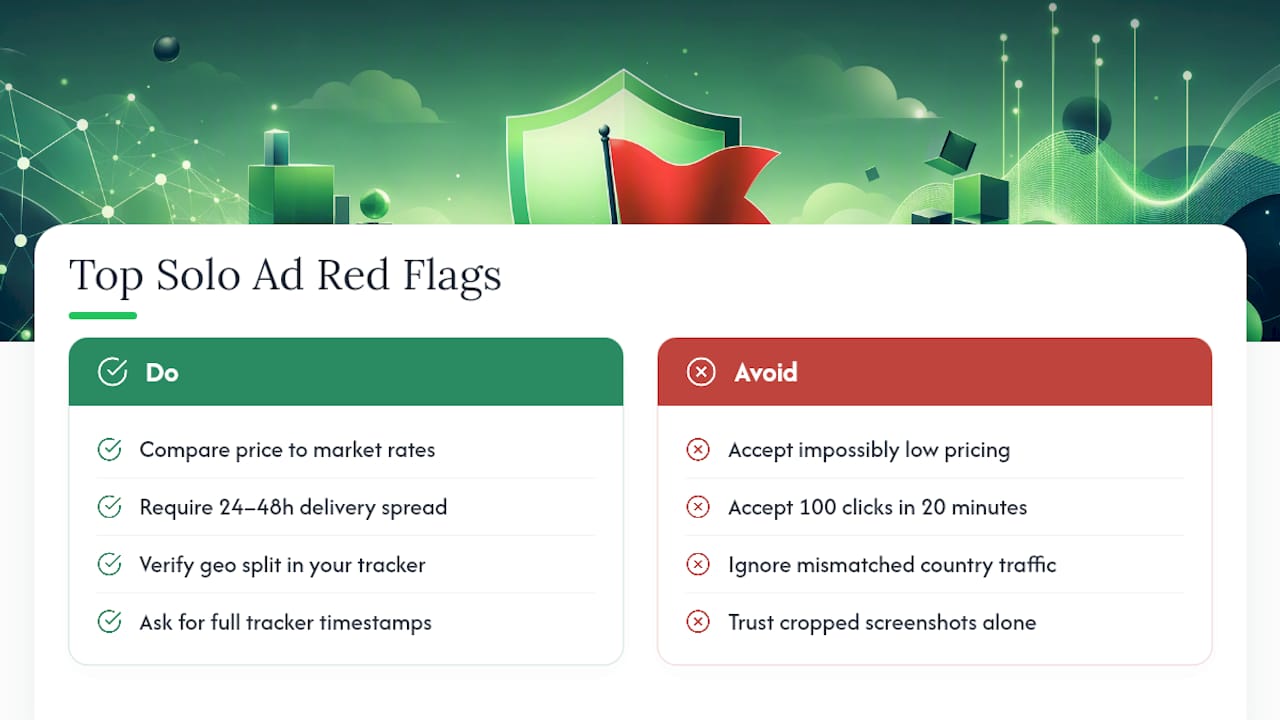
Impossible pricing tops the list. Tier-1 traffic (US, UK, Canada, Australia) carries real acquisition costs for any legitimate list owner. When a price sits far below what comparable sellers charge, that discount usually comes from somewhere: recycled clicks, non-Tier-1 traffic mislabeled as Tier-1, or bot manipulation. Cheap per-click pricing that defies market economics usually signals low-quality traffic, and it's one of the easiest red flags to catch because it doesn't require a single click to spot.
Delivery speed is the second tell. Real subscribers open email at different times of day, across different time zones, at a human pace. Healthy delivery behavior typically spreads clicks over 24 to 48 hours; a batch of 100 clicks landing in your tracker within 20 minutes almost always means automated traffic, not a real send.
Geo splits that don't match the promise are a related check. If you paid for US traffic and your tracker shows a third of clicks from countries you never targeted, the vendor either mislabeled their list or blended in cheaper filler traffic.
Unverifiable screenshots and generic testimonials deserve scrutiny too. Vendor-provided screenshots are useful only when they show full timestamps and the complete tracker URL and can be matched against your own dashboard. A cropped image with no name, date, or context proves nothing.
Guaranteed-sales claims without measurable terms are a classic overreach. No solo ad seller controls what happens after a click lands on your page. Anyone promising sales, not just clicks, is selling hype.
A seller who won't let you review the funnel or refuses your own tracking link is telling you something important. A vendor willing to look at your funnel and suggest changes signals a partner-oriented approach; one who never asks and never lets you track independently is treating the sale as a one-time transaction, not a relationship.
High opt-in rates with no data on replies or sales round out the list. This one trips up more buyers than any other red flag on this list, because it looks like good news.
A 40% opt-in rate can produce zero sales, while a lower opt-in rate from a more targeted list produces real buyers. Opt-ins measure curiosity, not intent.
Judge a vendor by replies and sales per 100 clicks, not the opt-in percentage alone.
How to Vet a Solo Ad Vendor: The Checklist and Questions to Ask
Vetting a vendor takes 15 minutes of messages before you spend anything. Here's the sequence that catches the most problems early.
- Ask for recent tracking screenshots and offer your own tracking link. A vendor with nothing to hide will let you track the order independently; one who insists you rely only on their reporting is asking you to trust rather than verify.
- Ask for sales conversion ranges from comparable offers, not just opt-in numbers. A seller who only quotes opt-in percentages is dodging the metric that actually predicts revenue. Reviewing conversion rate benchmarks beforehand gives you a realistic range to compare their answer against.
- Confirm how the list was built and whether it fits your niche. A list built for weight loss offers won't convert on a crypto trading pitch, no matter how clean the traffic is.
- Get replacement and refund terms in writing before you pay, including the delivery cadence and what counts as an acceptable delivery. Verbal promises evaporate the moment a delivery goes wrong.
- Start with a 100-click test order and define your acceptance criteria before the traffic runs, not after. Starting small and measuring opt-ins, replies, and sales per 100 clicks turns a subjective impression into a number you can compare across vendors.
Pro Tip: Write your acceptance criteria as a simple sentence before you order: "I expect at least X opt-ins, Y email replies, and delivery spread across 24 to 48 hours." Send that sentence to the vendor before you pay. If they balk at agreeing to it in writing, you have your answer without spending anything.
Save the vendor's answers to these questions. If a dispute comes up later, that written record becomes your evidence. For a longer version of this process, Soloadsguide's vetting guide breaks down each question with sample wording you can copy directly into outreach messages.
Test Campaigns and Tracking: What to Measure
Your own tracker is the only source of truth in this transaction. Set one up before you place a single order, and assign a unique sub-ID to every vendor so you can separate their traffic from anyone else's in your reports.
Five numbers matter more than anything a vendor tells you: total clicks, opt-ins, geo distribution, email replies, and sales per 100 clicks. Watch the delivery curve closely, too. A real human-driven send shows a slow wave over hours; a front-loaded burst within minutes is a pattern associated with bot or automated traffic.
| Metric | What healthy delivery looks like | What a red flag looks like |
|---|---|---|
| Delivery window | Spread over 24 to 48 hours | Nearly all clicks within 1 hour |
| Geo match | Matches the ordered Tier | Significant traffic from unordered countries |
| Opt-in rate alone | Treated as one signal among several | Vendor cites this as the only proof of quality |
| Sales/replies per 100 clicks | Nonzero, discussed openly | Vendor won't discuss or has no data |
Compare the vendor's self-reported numbers to your own tracker line by line. A mismatch of even 10 to 15 clicks between what they claim and what you logged is worth a direct conversation before you order again.
Before traffic arrives, have a five-email follow-up sequence loaded into your autoresponder leveraging AI tools for small businesses to automate and optimize your follow-up process. Sending traffic to a page you own and capturing leads to a list you control is the only way to keep the value of that click regardless of whether the first message converts. Every commercial email in that sequence needs to follow CAN-SPAM rules for U.S. senders, including a working unsubscribe link and accurate sender information.
Common Scam Patterns Buyers Report
Certain scam setups show up over and over in this industry, and once you've seen them named, they're easy to recognize.
- Bot-dump delivery: hundreds of clicks land in under an hour, all showing similar timestamps and near-identical browsing behavior.
- Recycled lists: the same subscribers get resold across multiple "solo ad" orders, so engagement quietly drops with every repeat buy from that seller.
- Incentivized clicks: traffic that looks organic but comes from reward apps or paid-to-click networks, producing clicks with no real buying intent.
- Fake guarantees: replacement promises with impossible claim windows (24 hours to report an issue on a purchase you can't fully analyze that fast) or buried clauses that void the guarantee.
- Cropped screenshots and stock-photo testimonials: images with no visible date, URL, or name, paired with reviews that could describe any product in any niche.
If You Get Burned: Recovery Steps
- Stop any pending orders immediately and preserve every log, screenshot, and message with timestamps intact.
- Request replacement clicks with tracking parity and a specific delivery window in writing.
- Open a dispute with the marketplace or payment processor, attaching your tracker data as evidence.
- Leave a specific, factual review naming the exact issue, not a vague complaint, to warn other buyers.
- Update your vetting checklist based on what you missed, and never scale spend with a vendor who showed even one inconsistency.
Practitioner Perspective: The 21-Question Vetting Framework
Screenshots and testimonials tell you what a vendor wants you to see. A structured question set tells you what they're avoiding. That's the reasoning behind treating vendor vetting as a repeatable framework rather than a gut check: questions about list-building methods, delivery history, and replacement terms expose inconsistencies that polished marketing never will. Vague answers to specific questions are, on their own, a red flag worth acting on.
What Actually Separates Safe Buyers From Burned Ones
Most advice on solo ads focuses on finding a "good" vendor, as if trustworthiness were a fixed trait. It isn't. Vendors who deliver clean traffic on one order have sent bot clicks on another, often because they resell inventory from sources they don't fully control themselves. That's why I've never trusted a testimonial over a tracker.
The conventional advice to "read reviews and pick someone reputable" undersells how much verification a buyer can do directly. You don't need someone else's opinion of a vendor when you can run your own 100-click test, log the results against your own criteria, and know within a week whether that seller is worth a second order.
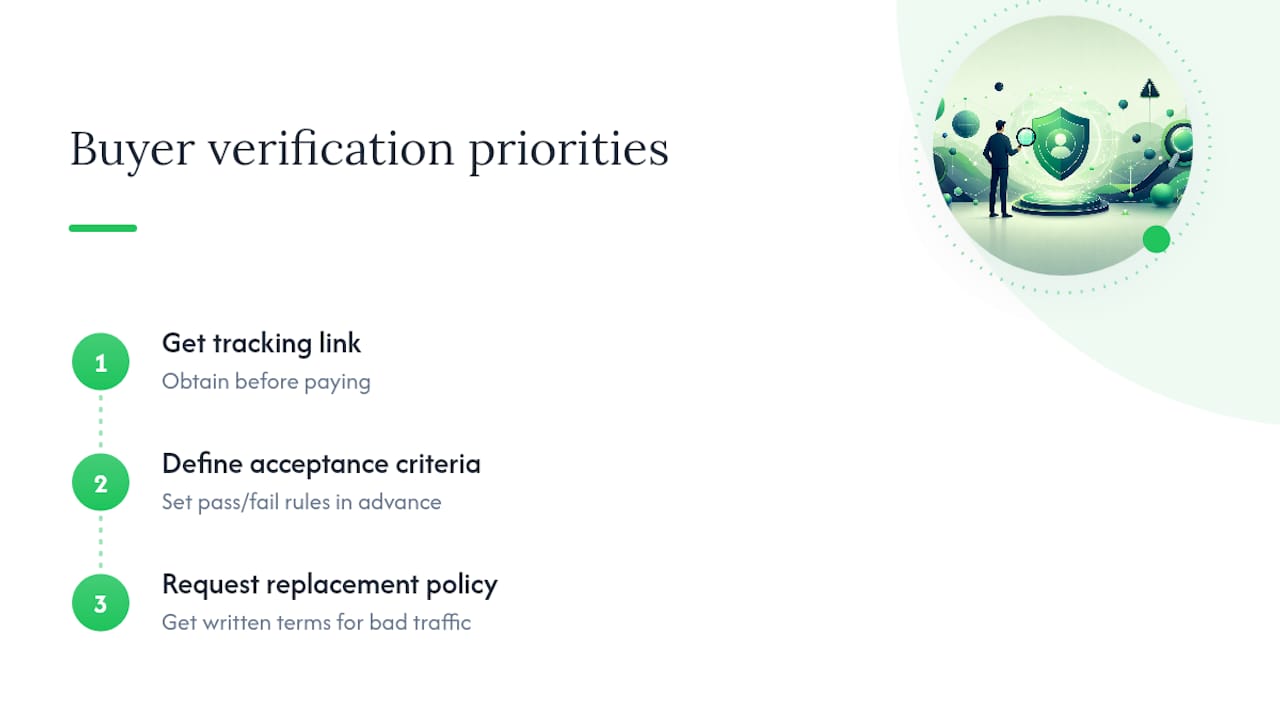
Prioritize this in order: get your own tracking link before you pay, define acceptance criteria before you order, then request the written replacement policy. Skip any of those three, and every other precaution is decoration.
— Philip Coble
Where to Start Vetting Your Next Solo Ad Vendor
Skipping vendor vetting costs more than the price of a bad order. It costs the follow-up sequence you built, the list-building momentum you lost, and the time you'll spend disputing a purchase instead of running your next test. This guide exists to replace guesswork with a repeatable process: a 21-question vetting framework, tracking setups you can build in an afternoon, and sample follow-up email sequences you can adapt to your own offer.
If you're about to place an order, download the vetting checklist and run your 100-click test before committing to a bigger buy. Start at the Soloadsguide home page for the full framework and the tracking guides that go with it.
Primary Sources and Further Reading
For deeper detail on the standards referenced in this guide, see RevBoost's guide to solo ads for CPA marketing, David Wood's breakdown of buying solo ads without getting burned, MK Authority's seller guide and red-flag checklist, and Ihsan Solo Ads' rundown of red flags in vendor behavior.
Sources
- Solo Ads for Network Marketing: How to Buy Traffic Without Getting Burned - Work With David Wood
- Solo Ads Seller Guide 2026 and How to Spot Good Traffic Quality
FAQ
What are the top solo ad red flags to check first?
Impossibly low pricing for Tier-1 traffic, delivery that arrives all at once instead of being spread over 24 to 48 hours, and a vendor who won't let you use your own tracking link top the list.
Are solo ads worth buying at all?
Solo ads can work when the vendor's list genuinely matches your niche and you send traffic to a funnel you control with a follow-up sequence ready to go; the risk sits almost entirely in vendor quality, not the traffic model itself.
What's the biggest red flag in a vendor's communication style?
A vendor who avoids specific questions about delivery cadence, replacement terms, or your own tracking link, and instead redirects to testimonials or urgency, is showing you the same evasiveness that shows up later in a bad delivery.
What red flags should I watch for on social media or forums when researching a vendor?
Look for accounts with only recent, generic praise and no history of engaging with complaints; a vendor with zero negative feedback across years of selling is more suspicious than one with a handful of resolved disputes on record.
How many clicks should I test before trusting a new vendor?
Start with roughly 100 clicks routed through your own tracker, and only place a larger order once replies and sales per 100 clicks meet the acceptance criteria you defined in writing beforehand.
Recommended
- How to Vet Solo Ad Sellers (Before You Spend a Dollar)
- How to Avoid Solo Ad Scams: 2026 Buyer's Guide
- Questions Before Buying Solo Ads: 2026 Buyer's Guide
- Advanced Solo Ad Vendor Vetting Checklist for 2026
Want Verified Traffic Without the Guesswork?
PulseTraffic screens every seller, filters bot clicks in real time, and shows you verified buyer traffic labels before you spend a dollar.