

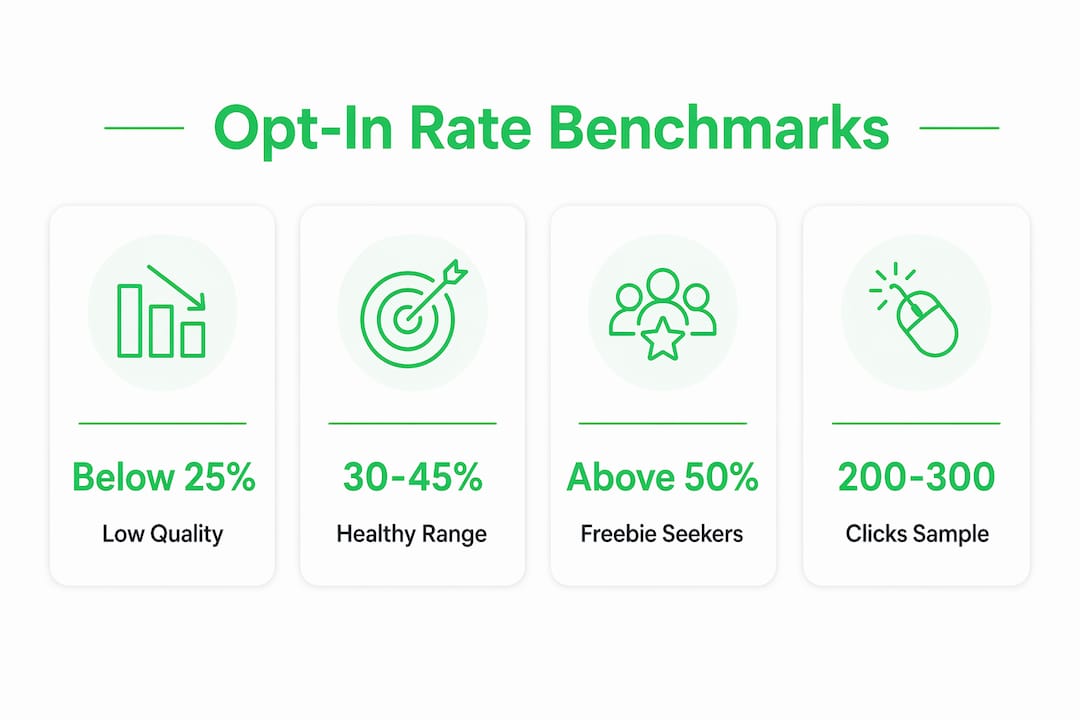
The solo ads opt-in rate is the percentage of unique clicks that convert into email subscribers after a visitor lands on your squeeze page. A healthy opt-in rate falls between 30% and 45% for legitimate traffic. Understanding this metric tells you whether your squeeze page, your offer, and your traffic source are working together. If any one of those three elements is weak, your rate will show it fast.
What is a good solo ads opt-in rate?
A 30%–45% opt-in rate is the standard benchmark for a healthy solo ad campaign. That range reflects a well-aligned offer, a clear squeeze page, and a reputable traffic source. Anything below 25% signals a real problem, whether that is a weak headline, a mismatched offer, or poor traffic quality.
A rate above 50% sounds like a win, but it often is not. Opt-in rates above 50% frequently indicate freebie-seeker traffic with low buyer intent. These subscribers join your list for a free download and never buy anything. Experienced marketers track cost per subscriber and 30-day revenue per subscriber rather than chasing the highest possible opt-in number.

The table below shows how to interpret different opt-in rate ranges and what each signals about your campaign.
| Opt-in rate | What it signals |
|---|---|
| Below 25% | Weak headline, poor offer alignment, or low-quality traffic |
| 25%–30% | Below average; squeeze page or offer needs improvement |
| 30%–45% | Healthy range; solid funnel and traffic alignment |
| 45%–50% | Strong performance; verify list quality before scaling |
| Above 50% | Possible freebie-seeker traffic; monitor buyer conversion |
The opt-in rate is a leading indicator, not the final measure of success. Revenue per subscriber is the metric that determines whether your campaign is actually profitable.
Key factors that affect interpretation:
- Cost per click (CPC): Solo ad CPC ranges from $0.30 to $5.00 depending on niche and vendor reputation. Higher CPC vendors often deliver cleaner traffic.
- Cost per lead (CPL): Divide your total spend by the number of opt-ins. A lower CPL with strong email engagement beats a high opt-in rate with no sales.
- Solo ads conversion rate: The overall conversion rate for solo ad campaigns typically runs between 1% and 5%, with top campaigns exceeding 5%.
Factors that influence solo ads opt-in rates
Your opt-in rate is not a fixed number. It shifts based on decisions you make before you ever buy a click. Solo ads amplify your existing funnel strengths or weaknesses rather than create conversion power from scratch. A poorly built squeeze page will fail with expensive traffic just as fast as it fails with cheap traffic.
The main factors you control:
- Squeeze page headline: The headline is the single biggest driver of opt-in decisions. A vague or generic headline kills conversions. Test specific, benefit-driven headlines against each other.
- Offer relevancy: Your lead magnet must match what the vendor's list actually wants. A make-money-online freebie sent to a health list will produce a low opt-in rate regardless of page quality.
- Swipe copy alignment: The email the vendor sends to their list sets expectations. If the swipe copy promises one thing and your page delivers another, visitors leave without opting in.
- Page load speed: A slow-loading squeeze page loses visitors before they read a word. Mobile load time matters especially, since a large share of solo ad traffic arrives on phones.
- Mobile responsiveness: A squeeze page that breaks on mobile devices will suppress your rate significantly. Test your page on multiple screen sizes before buying traffic.
- List quality and recency: Vendors with regularly maintained, opt-in confirmed lists produce better results. Always ask about the source and recency of a vendor's list before purchasing.
- Email follow-up sequence: Your opt-in rate measures entry into your funnel. A strong follow-up sequence determines whether those subscribers become buyers.
Pro Tip: Write your squeeze page headline before you design the page. If you cannot state the core benefit in one sentence, your offer is not clear enough to convert.
Solo ads work best when your funnel is already converting organic or paid traffic at a reasonable rate. Buying solo ad traffic to test an untested funnel is an expensive way to find problems you could have caught for free.
How to measure and track your solo ads opt-in rate
Accurate measurement starts with tracking unique clicks, not total clicks. Tracking unique clicks with tools like Voluum separates real visitors from duplicate hits and reveals low-quality or bot traffic. Without this distinction, your opt-in rate calculation is unreliable.
The formula is straightforward: divide the number of opt-ins by the number of unique clicks, then multiply by 100. If you received 200 unique clicks and 70 opt-ins, your opt-in rate is 35%.
Steps to track your campaign accurately:
- Set up a click tracker before buying traffic. Tools like Voluum record unique clicks, geographic data, and device type. This data shows you whether traffic matches what the vendor promised.
- Monitor unique versus duplicate clicks. Duplicate clicks can skew opt-in rates and mask poor traffic quality. A campaign showing 500 total clicks but only 200 unique clicks is delivering far less value than it appears.
- Check bounce rate and time on page. A high bounce rate combined with a low opt-in rate confirms your squeeze page is the problem. A high bounce rate with a decent opt-in rate suggests traffic quality issues.
- Track email engagement after opt-in. Open rates and click rates on your follow-up sequence reveal whether your new subscribers have genuine interest. Low email engagement from a high opt-in rate confirms freebie-seeker traffic.
- Calculate cost per lead for every campaign. Divide total spend by opt-ins. Compare this number across vendors and offers to identify what is actually working.
Pro Tip: Run at least 200–300 unique clicks before drawing conclusions about a vendor or offer. Smaller samples produce misleading opt-in rate data.
Tracking supporting metrics alongside your opt-in rate gives you a complete picture of campaign performance. The opt-in rate alone tells you one part of the story.
Practical strategies to improve your solo ads opt-in rate
Improving your solo ads conversion rate requires working on the funnel and the traffic source at the same time. Fixing only one side of the equation produces limited gains.
Squeeze page and offer optimization:
- Rewrite your headline to focus on a single, specific benefit. "Get 47 Email Subject Lines That Boosted Open Rates" outperforms "Free Email Marketing Guide" every time.
- Keep your squeeze page to one call to action. Remove navigation links, social icons, and anything that pulls attention away from the opt-in form.
- Match your lead magnet to the vendor's audience. Review the vendor's niche and past buyer testimonials before selecting which offer to promote.
- Test two headline variations before scaling any campaign. A/B testing with Unbounce or a simple split-test plugin on WordPress takes less than an hour to set up.
Vendor selection and traffic quality:
Choosing reputable vendors is the fastest way to raise your solo advertising results. Scaling without data leads to wasted spend and poor returns. Start with small test orders of 100–200 clicks before committing to larger purchases.
Ask vendors directly about their list source, how often they mail, and what niches perform best on their list. Vendors who cannot answer these questions clearly are worth avoiding.
Scaling based on data:
| Metric | Threshold to scale | Action if below threshold |
|---|---|---|
| Opt-in rate | 30% or above | Revise headline and offer before scaling |
| Cost per lead | Below your CPL target | Test a different vendor or offer |
| Email open rate | 20% or above | Improve follow-up sequence |
| 30-day revenue per subscriber | Positive ROI | Scale spend with the same vendor |
Pro Tip: Track 30-day revenue per subscriber for every vendor you test. A vendor delivering a 35% opt-in rate with strong buyer conversion is worth far more than one delivering a 50% rate with zero sales.
Avoiding excessive freebies is a counterintuitive but effective strategy. Offers that require a small commitment, such as a quiz, a short video series, or a mini-course, attract subscribers with higher intent than a simple PDF download. The opt-in rate may be slightly lower, but the list quality and backend revenue will be stronger.
Key takeaways
The solo ads opt-in rate is a critical campaign metric, but sustainable profitability depends on tracking cost per subscriber and 30-day revenue alongside it.
| Point | Details |
|---|---|
| Healthy benchmark range | A 30%–45% opt-in rate signals solid funnel and traffic alignment. |
| High rates need scrutiny | Rates above 50% often indicate freebie-seeker traffic with low buyer intent. |
| Funnel quality comes first | Solo ads amplify existing funnel strengths; fix your squeeze page before buying traffic. |
| Track unique clicks | Use tools like Voluum to separate real visitors from duplicate or bot traffic. |
| Measure revenue, not just opt-ins | Cost per lead and 30-day revenue per subscriber determine true campaign ROI. |
Why chasing opt-in rate alone is a trap
I have watched marketers spend months tweaking their squeeze pages to push opt-in rates above 45%, only to find their email lists full of people who never open a second message. The number looked great in the dashboard. The revenue told a different story.
The real mistake is treating opt-in rate as the goal rather than as a diagnostic tool. A 32% opt-in rate from a vendor whose list actually buys things will outperform a 48% rate from a list built on freebie offers. The difference shows up clearly when you track 30-day revenue per subscriber, which most marketers skip because it takes patience.
Vendor selection matters more than most guides admit. I have seen the same squeeze page produce a 28% opt-in rate with one vendor and a 41% rate with another. The page did not change. The list quality did. That is why asking vendors about list recency and mailing frequency before buying is not optional.
The other pattern I see repeatedly is marketers buying traffic before their funnel is ready. Solo ads will expose every weak point in your funnel within the first 200 clicks. That is actually useful information, but it is expensive information if you are buying 1,000 clicks at a time. Test small, read the data, fix the funnel, then scale.
— Phil
Top-rated solo ads providers for quality traffic in 2026
Finding vendors who consistently deliver traffic in the 30%–45% opt-in range is the hardest part of improving solo advertising results. Most marketers waste significant budget on vendors before finding ones that perform reliably.
Soloadsguide ranks and reviews verified solo ads providers tested specifically for tier-1 traffic and conversion performance. The best solo ads providers listed on the site are evaluated based on opt-in rates, traffic quality, and buyer intent, not just click volume. Marketers who have used the guide report measurable reductions in cost per lead by switching to vetted vendors. If you are ready to apply the optimization strategies covered here, starting with a quality vendor list removes the most expensive variable from your campaigns.
FAQ
What is a good solo ads opt-in rate?
A good opt-in rate falls between 30% and 45%. Rates below 25% signal funnel or traffic problems, while rates above 50% often indicate low-intent freebie-seeker traffic.
Why is my solo ads opt-in rate below 25%?
A rate below 25% typically points to a weak headline, a misaligned offer, or low-quality traffic. Audit your squeeze page headline and confirm your lead magnet matches the vendor's audience before buying more clicks.
How do I calculate my solo ads opt-in rate?
Divide the number of opt-ins by the number of unique clicks, then multiply by 100. For example, 70 opt-ins from 200 unique clicks equals a 35% opt-in rate.
Does a high opt-in rate mean my campaign is profitable?
Not necessarily. A high opt-in rate only measures list entry. Profitability depends on email engagement, sales conversions, and 30-day revenue per subscriber, not the opt-in rate alone.
What tools help track solo ads opt-in rates accurately?
Click trackers like Voluum record unique clicks, detect duplicate traffic, and give you the clean data needed to calculate a reliable opt-in rate. Pair click tracking with your email platform, such as Aweber, to monitor post-opt-in engagement.
Recommended
- Solo Ads Performance Benchmarks Explained (2026)
- Solo Ads vs Native Ads: Which Drives Better Results in 2026?
- Solo Ad Cost Per Lead Optimization That Works
- Solo Ads vs Facebook vs Google Ads: Which Wins in 2026?
Want Verified Traffic Without the Guesswork?
PulseTraffic screens every seller, filters bot clicks in real time, and shows you verified buyer traffic labels before you spend a dollar.