
Backend offers in solo ads are the follow-up products, upsells, and subscriptions presented to a subscriber after they respond to your initial front-end offer. Without them, you pay for a click once and earn from it once. With them, a single solo ad campaign can generate revenue for weeks or months through a well-built email funnel. The role of backend offers in solo ads is to convert cold traffic into repeat buyers by solving each subscriber's next logical problem. A 5–7 day automated email sequence is the industry standard for nurturing those leads. Mastering this structure is what separates profitable affiliate marketers from those who break even.
What is a backend offer in solo ads, and how does it differ from a front-end offer?
A front-end offer is the first thing a visitor sees after clicking your solo ad. It is typically low-friction and free or very low cost, such as a free report, a checklist, or a short video course. Its job is to get the click and capture the email address. Conversion is the only goal at this stage.
A backend offer is everything that comes after. It is presented through email follow-up sequences once trust has been established. Backend offers improve retention, deepen customer relationships, and increase profits by solving the subscriber's next problem rather than repeating the same pitch.
Common backend offer types include:
- Upsells: A paid upgrade to the free front-end product, offered immediately after opt-in
- Subscriptions: Monthly membership programs or software tools that generate recurring revenue
- Complementary digital products: Related courses, templates, or toolkits that extend the value of the front-end offer
- Higher-ticket affiliate offers: Premium programs introduced later in the email sequence, after trust is built
The key distinction is timing and intent. Front-end offers capture attention. Backend offers capture value. A solo ad funnel without backend offers leaves most of its revenue potential untouched.
Why are backend offers crucial for solo ad profitability?
Solo ad vendors typically charge $0.30 to $1.00+ per click, and that cost adds up fast. If your funnel only monetizes on the first interaction, your cost per acquisition stays high and your margins stay thin. Backend offers solve this problem by spreading revenue across multiple touchpoints.

The biggest mistake affiliate marketers make with solo ads is treating each campaign as a one-time transaction. Sending traffic directly to a CPA offer without capturing the email first wastes the long-term value of every click. The email list you build becomes a reusable asset. Every backend offer you send to that list costs you nothing in additional traffic spend.
Backend offers also build trust. A subscriber who receives a helpful email sequence before seeing a paid offer is far more likely to buy than one who gets a sales pitch on day one. The 5–7 day follow-up sequence is the proven structure for warming up cold solo ad traffic before presenting higher-value backend products.
Pro Tip: Never present a backend offer in your first email. Use the first two emails to deliver value from your lead magnet. Introduce the backend offer on day three or four, once the subscriber has already received something useful from you.
What are the best practices for integrating backend offers into solo ad funnels?
A well-built backend funnel follows a clear sequence. Skipping steps reduces conversion rates at every stage. Follow this structure:
-
Build a squeeze page. Send all solo ad traffic to an opt-in page, not directly to an offer. The squeeze page captures the email address before any selling begins. This is the foundation of your backend funnel.
-
Match your messaging. Consistent messaging across your solo ad, opt-in page, and email sequence reduces drop-off. If your ad promises a free guide on email marketing, your lead magnet must deliver exactly that. Your backend offer must extend that same topic.
-
Design your backend offer around the next logical problem. If your front-end offer teaches list building, your backend offer should teach traffic generation or email copywriting. The subscriber has solved problem one. Your backend offer solves problem two.
-
Automate a 5–7 day email sequence. Write emails that deliver value first and sell second. Day one delivers the lead magnet. Days two and three build credibility. Days four through seven introduce and reinforce the backend offer.
-
Avoid high-friction backend offers early in the sequence. High-ticket or complex offers underperform when presented too soon. Save premium offers for subscribers who have already engaged with your emails or purchased a lower-tier product.
Pro Tip: Use your email click data to segment subscribers. Anyone who clicked a link in your sequence but did not buy is a warm lead. Send them a separate follow-up specifically addressing the objection that likely stopped them.
For a deeper look at how this funnel structure works in practice, the solo ad affiliate funnel guide from Soloadsguide covers the full architecture from squeeze page to backend sequence.
Which types of backend offers perform best with solo ad traffic?
Solo ad traffic is cold traffic. These subscribers do not know you yet. That reality shapes which backend offers convert and which ones fall flat.
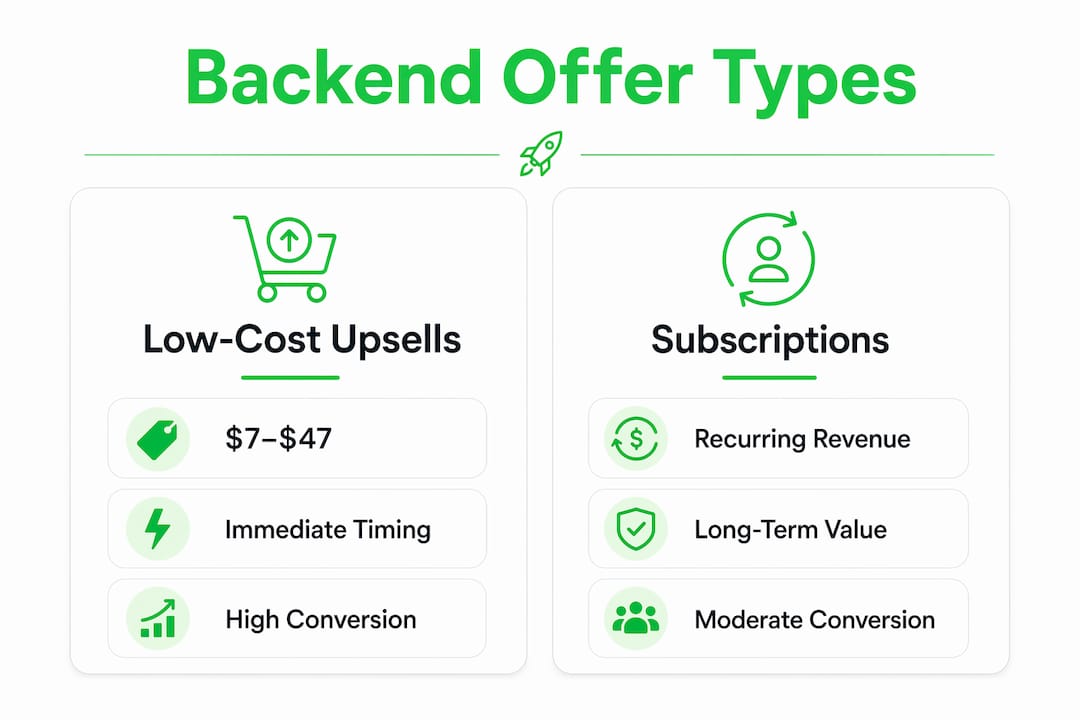
The best-performing backend offers for solo ad funnels share three traits. They are low-friction, closely related to the front-end offer, and priced at a level the subscriber can decide on quickly. A $27 or $47 digital product that directly extends the lead magnet converts far better than a $497 coaching program presented in the first week.
Here is how common backend offer types compare in practice:
| Offer type | Best timing in sequence | Conversion potential |
|---|---|---|
| Low-cost upsell ($7–$47) | Immediately after opt-in | High |
| Complementary digital product | Days 3–5 of email sequence | High |
| Monthly subscription | Days 4–6, after trust is built | Medium |
| High-ticket affiliate program | Day 7+, for engaged subscribers only | Low to medium |
Backend offers should feel like a natural next step, not a disruptive hard sell. When the offer solves the subscriber's next problem and arrives at the right moment, it reads as helpful rather than pushy. That distinction drives conversions.
Subscriptions deserve special attention. A recurring product, such as a monthly tool or membership, turns a single backend sale into ongoing revenue. One subscriber who buys a $29/month subscription generates more lifetime value than ten one-time buyers at the same price point.
How do you measure and optimize backend offer performance?
Tracking the right metrics tells you exactly where your funnel earns and where it leaks. Key metrics for backend offer performance include opt-in rate, cost per lead, backend conversion rate, and subscriber lifetime value.
- Opt-in rate: The percentage of solo ad clicks that become email subscribers. A healthy opt-in rate for a well-built squeeze page sits above 30%.
- Cost per lead: Total solo ad spend divided by total subscribers acquired. This number tells you how much each email address costs you.
- Backend conversion rate: The percentage of subscribers who purchase a backend offer. Even a 2–5% backend conversion rate can make a solo ad campaign profitable.
- Lifetime value (LTV): Total revenue generated per subscriber across all backend offers. LTV is the metric that determines how much you can afford to spend on solo ads.
Track these numbers for every campaign. When your backend conversion rate drops, test a different offer or adjust the timing in your sequence. When your opt-in rate drops, test a new headline or lead magnet. The email list you build from solo ads is a long-term asset, and its value compounds as you refine your backend offers over time.
Split testing is the fastest way to improve results. Run two versions of your backend offer email with different subject lines or different calls to action. The winning version becomes your control. Then test the next variable. Small improvements in each metric add up to significant gains in overall funnel profitability. For practical guidance on lead generation from email traffic, Soloadsguide covers how automated sequences support backend conversions at each stage.
Key Takeaways
Backend offers are the primary mechanism for turning solo ad traffic into sustainable affiliate income, and a 5–7 day email sequence is the proven structure for delivering them.
| Point | Details |
|---|---|
| Backend offers define profitability | Without backend offers, solo ad campaigns rarely cover their traffic costs long-term. |
| Email capture comes first | Always send solo ad traffic to a squeeze page before presenting any offer. |
| Message match reduces drop-off | Your ad, opt-in page, and email sequence must all address the same core promise. |
| Timing determines conversion | Low-cost offers convert early; high-ticket offers belong later in the sequence. |
| Track LTV, not just clicks | Lifetime value is the metric that tells you whether your backend funnel is working. |
Why most marketers underestimate backend offers until it's too late
I have reviewed hundreds of solo ad funnels over the years, and the pattern is almost always the same. A marketer buys 500 clicks, gets a decent opt-in rate, makes a handful of front-end sales, and then concludes that solo ads "don't work." What they actually built was a front-end funnel with no backend. That is like opening a restaurant and only charging for the appetizer.
The marketers who consistently profit from solo ads treat the front-end offer as a cost of acquisition, not a revenue event. They know their numbers. They know that if their backend sequence converts at 3% and their average backend sale is $47, they can afford to pay $0.70 per click and still come out ahead. That math only works when the backend is built and tested before the traffic is bought.
My honest recommendation: build your backend sequence before you spend a dollar on solo ads. Write all five to seven emails. Set up your automation. Test the sequence with a small list first. Then buy traffic. The affiliate commissions from backend offers compound over time in a way that front-end sales never will. Start small, but plan the full funnel from day one.
— Phil
How Soloadsguide helps you build profitable backend funnels
Soloadsguide gives affiliate marketers direct access to vetted solo ad providers who deliver tier-1 traffic tested for high opt-in rates and backend conversions.
Finding a reliable traffic source is only half the equation. Soloadsguide also provides funnel strategy resources that show you how to structure backend offers, write follow-up sequences, and track the metrics that matter. Marketers using Soloadsguide have reported a 40% reduction in cost per lead by pairing quality traffic with a properly built backend funnel. Browse the best solo ads providers ranked and reviewed for 2026, and build your backend funnel on a foundation of traffic that actually converts.
FAQ
What is the role of backend offers in solo ads?
Backend offers convert one-time solo ad clicks into repeat buyers by presenting follow-up products through an automated email sequence. They increase subscriber lifetime value and make solo ad campaigns profitable beyond the initial front-end sale.
How many emails should a solo ad backend sequence include?
A 5–7 day automated sequence is the recommended standard for solo ad funnels. This gives you enough touchpoints to build trust before presenting a backend offer.
Should I send solo ad traffic directly to a backend offer?
No. Sending traffic directly to an offer without capturing the email first eliminates your ability to follow up. Always use a squeeze page to collect the email address before presenting any offer.
What types of backend offers work best for solo ad traffic?
Low-cost digital products priced between $7 and $47 convert best early in the sequence. Subscriptions and higher-ticket offers perform better after the subscriber has engaged with several emails and received genuine value.
How do I know if my backend funnel is profitable?
Track your cost per lead, backend conversion rate, and subscriber lifetime value for every campaign. When your LTV exceeds your cost per lead, your funnel is profitable and ready to scale.
Recommended
- Role of Email List in Solo Ads: 2026 Guide | SoloAdsGuide
- Solo Ads Blog, Tips, Guides & Reviews | SoloAdsGuide.com
- The Ultimate Guide to Solo Ads (2026) | SoloAdsGuide.com
- Solo Ad vs Email Marketing Difference Explained
Want Verified Traffic Without the Guesswork?
PulseTraffic screens every seller, filters bot clicks in real time, and shows you verified buyer traffic labels before you spend a dollar.