

Click fraud is the deliberate act of generating fake clicks on pay-per-click ads to drain advertiser budgets, inflate publisher revenue, or sabotage competitor campaigns. It is not a minor nuisance. Automated bots drive nearly half of all internet traffic, and projected worldwide losses from click fraud are expected to reach $172 billion annually by 2028. That figure represents real money pulled from real marketing budgets, including yours. Understanding what click fraud means in digital ads is the first step toward protecting your campaigns from a threat that grows more sophisticated every year.
What does click fraud mean in digital ads?
Click fraud, also called PPC fraud or ad click fraud in industry terminology, is the intentional and unauthorized clicking of paid digital ads without any genuine interest in the advertiser's product or service. The goal is always manipulation: either depleting a competitor's budget, inflating a publisher's ad revenue, or generating fraudulent commissions.
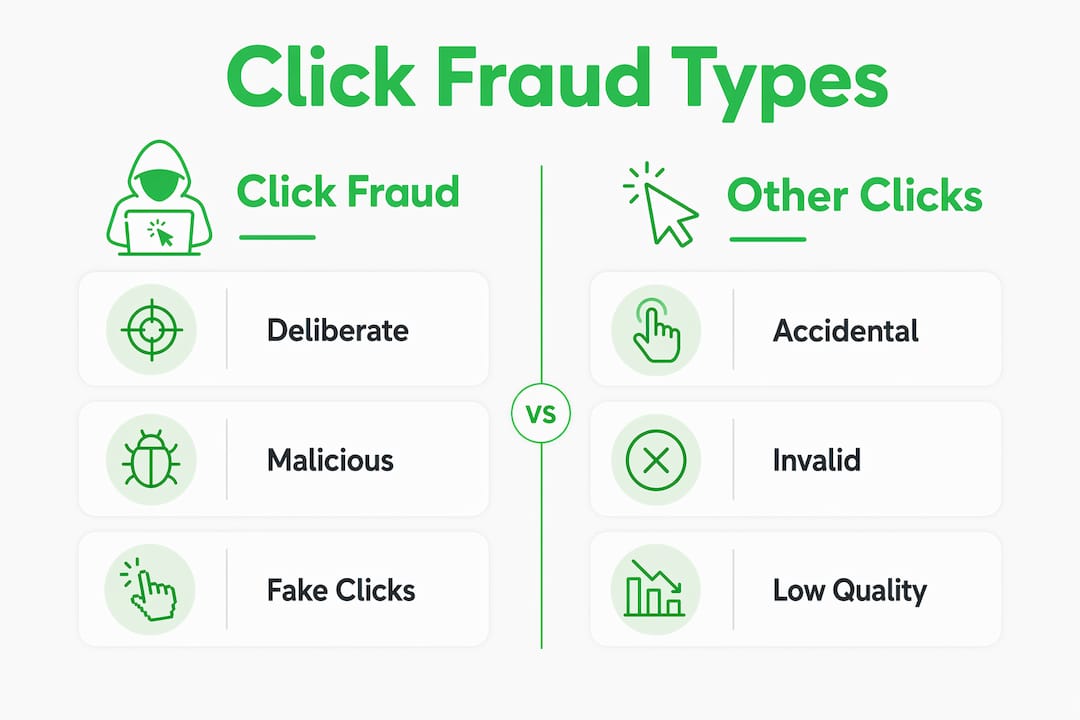
Click fraud is intentionally malicious and distinct from accidental or low-quality clicks. Three primary motives drive it. First, competitor sabotage: a rival clicks your Google Ads or Bing Ads campaigns repeatedly to exhaust your daily budget, forcing your ads offline. Second, publisher fraud: a website owner running display ads clicks their own inventory to inflate the commissions they earn from ad networks. Third, Made For Advertising (MFA) sites: scammers build content farms specifically to generate fraudulent engagement and monetize fake traffic at scale.

The definition of click fraud matters because pay-per-click advertising charges you for every click, regardless of whether that click came from a real person with buying intent. Every fraudulent click is a direct financial loss with zero chance of return.
How do fraudsters generate fake clicks?
Fraudsters use a range of methods, from simple scripts to sophisticated bot networks, to generate clicks that look real enough to pass platform detection.
Basic bots are automated programs that visit a URL and simulate a click. Early versions were easy to catch because they left obvious fingerprints: no mouse movement, no scroll depth, instant page exits. Modern bots have evolved well past that.
Sophisticated click fraud now uses rotating residential proxies, mouse movement emulation, and session mimicry to bypass detection and appear as legitimate human traffic. A residential proxy assigns the bot a real home IP address, making it nearly impossible to filter by IP range alone. Session mimicry means the bot browses the page, scrolls, and even hovers over elements before clicking, mimicking genuine user behavior.
Beyond bots, fraudsters also operate human click farms, where low-wage workers in countries like Bangladesh, India, or the Philippines are paid to click ads manually. These clicks are genuinely human, which means behavioral detection tools cannot flag them. AI and large language models are now being used to train bots to pass CAPTCHA challenges and adapt their behavior patterns to avoid detection algorithms.
Here is a breakdown of the main fraud methods you will encounter:
- Simple bots: Automated scripts that generate high click volumes quickly; easy to detect but still widely used in bulk attacks
- Residential proxy bots: Bots routed through real home IP addresses to evade IP-based blocking
- Behavioral mimicry bots: Advanced bots that simulate mouse movement, scroll depth, and dwell time to appear human
- Human click farms: Real people paid to click ads manually; undetectable by behavioral analysis
- MFA site networks: Publisher-side fraud where fake content sites attract bot traffic to inflate ad impressions and clicks
Pro Tip: If you are running solo ads and notice 80% of your clicks arriving within the first 90 minutes of a campaign, treat that as a red flag. Genuine email list traffic does not behave that way.
What is the financial and data impact of click fraud?
The financial damage from click fraud is direct and measurable. Fake clicks exhaust budgets and inflate CPC costs by distorting auction dynamics. When bots repeatedly click your ads, your daily budget depletes faster, your cost-per-click rises as the auction becomes more competitive, and your ads go offline before reaching real prospects.
"The biggest threat from click fraud is the long-term degradation of your campaign's data integrity, which can silently sabotage marketing ROI." — ClickFortify
That quote captures a damage layer most advertisers miss entirely. The financial loss is visible in your billing statement. The data corruption is invisible until your campaigns stop converting.
Bot clicks mislead platform optimization, creating what analysts call a "death spiral" effect. Here is how it works: Google Ads and Meta Ads both use machine learning to optimize delivery toward users most likely to convert. When bots generate clicks, the algorithm interprets those clicks as signals of interest and begins targeting more traffic that resembles those bot profiles. Your campaign then delivers ads to audiences that will never buy, your conversion rate drops, your Quality Score falls, and your CPC climbs further. The algorithm is doing exactly what it is designed to do. It is just working with corrupted data.
For solo ads specifically, this problem compounds quickly. You pay per click on a vendor's email list, and if a significant portion of those clicks come from bots or recycled traffic, your squeeze page opt-in rate tanks. You end up with inflated click counts, low subscriber numbers, and a cost per lead that makes the channel look unviable. Understanding solo ads pricing dynamics helps you set realistic benchmarks before you buy, so you can spot when numbers are off.
How does click fraud differ from invalid or accidental clicks?
Not every non-converting click is click fraud. Understanding the difference helps you prioritize where to focus your protection efforts.
| Click type | Definition | Intent | Platform response |
|---|---|---|---|
| Click fraud | Deliberate, systematic fake clicks by bots or malicious actors | Malicious | Limited refunds; requires proof |
| Invalid clicks | Accidental double-clicks, publisher self-clicks, or system errors | Unintentional | Google Ads filters and credits automatically |
| Accidental clicks | User clicks an ad by mistake and immediately bounces | None | Counted as valid; no credit issued |
| Bot traffic | Automated non-human traffic from crawlers or scripts | Varies | Partially filtered by platforms |
Click fraud is deliberate and systematic, which separates it legally and operationally from other invalid click types. Google Ads and Microsoft Advertising both run automated systems to filter invalid clicks before charging advertisers, and they issue credits for clicks they identify as fraudulent after the fact. However, platform detection is not comprehensive. Sophisticated fraud using residential proxies and behavioral mimicry regularly passes through undetected.
Accidental clicks are a natural part of PPC marketing and carry no malicious intent. A mobile user taps your ad by mistake and immediately hits the back button. That click costs you money, but it is not fraud. The distinction matters because your mitigation strategy differs: accidental clicks are reduced through better ad targeting and creative, while click fraud requires active monitoring and technical countermeasures.
Invalid clicks sit in the middle. Google defines them as clicks that do not represent genuine user interest, including double-clicks and automated traffic from known crawlers. The platform credits most of these automatically, which is why your billed clicks are typically lower than your raw click count in Google Analytics.
How to detect and prevent click fraud in your campaigns
Click fraud can be mitigated but not fully prevented through a single method. A layered defense combining monitoring, IP blocking, and independent analytics gives you the best protection available.
Follow these steps to build that defense:
-
Install independent tracking before you spend. Tools like ClickMagick give you click data that is separate from vendor dashboards. Vendor dashboards can be manipulated to hide bot traffic, so third-party verification is non-negotiable when buying solo ads or running display campaigns.
-
Analyze geographic click distribution. Legitimate email list traffic from a U.S.-focused solo ad vendor should show the majority of clicks originating from the U.S., Canada, the U.K., and Australia. If you see heavy traffic from Eastern Europe, Southeast Asia, or regions outside your target market, investigate immediately.
-
Monitor click timing patterns. Rapid delivery of clicks early in a campaign, such as 80% of clicks arriving within the first 90 minutes, signals fraudulent solo ad traffic. Real subscribers open emails throughout the day and across multiple time zones.
-
Set IP exclusions in Google Ads. When you identify suspicious IP addresses through your tracking tool, add them to your IP exclusion list in Google Ads campaign settings. This prevents those addresses from triggering your ads again.
-
Apply frequency caps on display campaigns. Capping how many times a single user sees your ad limits the damage a single bot or click farm operator can do to your budget in a short window.
-
Segment campaigns by device and placement. Mobile app placements and broad display network placements carry higher fraud rates than search campaigns. Segmenting lets you monitor and control each channel independently.
-
Track conversions, not just clicks. Professional marketers measure cost per subscriber or cost per sale, not cost per click. Clicks are easy to fake. Confirmed opt-ins and purchases are not.
Pro Tip: When evaluating a solo ad vendor, ask for a traffic breakdown by country and device type before you buy. A reputable vendor will provide this without hesitation. One who deflects or offers only aggregate click counts is worth avoiding.
Learning how to track solo ad traffic with independent tools is the single most effective step you can take to catch low-quality clicks before they drain your budget.
Key takeaways
Click fraud is the deliberate generation of fake ad clicks by bots or malicious actors, and it destroys both budget and campaign data integrity simultaneously.
| Point | Details |
|---|---|
| Click fraud definition | Intentional fake clicks on PPC ads by bots or malicious actors to drain budgets or inflate revenue. |
| Financial impact | Fake clicks deplete daily budgets, inflate CPC, and corrupt algorithm optimization toward bot traffic. |
| Fraud vs. invalid clicks | Click fraud is deliberate and systematic; invalid clicks are accidental and partially refunded by platforms. |
| Detection methods | Use independent tools like ClickMagick, monitor geo-data, and track click timing patterns for anomalies. |
| Prevention strategy | Layer IP exclusions, frequency caps, campaign segmentation, and conversion-focused metrics for best protection. |
Why click fraud is harder to catch than most marketers expect
I have reviewed hundreds of solo ad campaigns over the years, and the pattern I see most often is not the obvious fraud. It is the subtle kind. A vendor delivers 300 clicks, the geo-data looks clean, and the click timing seems reasonable. But the opt-in rate is 2% when the same offer converts at 35% on other traffic sources. That gap is the tell.
Most beginners focus on click volume because that is what vendors sell. Experienced marketers focus on what happens after the click. If your squeeze page is solid and your lead magnet is proven, a 2% opt-in rate on solo ad traffic is not a targeting problem. It is a traffic quality problem, and traffic quality problems are almost always rooted in some form of click fraud or list fatigue.
The uncomfortable truth is that even reputable vendors can unknowingly send you degraded traffic if their list has been monetized too aggressively or if they source traffic from sub-vendors you cannot vet. This is why I always recommend running a small test order with full independent tracking before scaling any solo ad buy. The comparison between solo ads and other paid channels also matters here: each platform has its own fraud profile, and understanding those differences shapes how you monitor and protect your spend.
Skepticism is not paranoia in this context. It is professional practice.
— Phil
Protect your ad spend with verified solo ad resources
If click fraud in solo ads is a concern for you, the most practical step is working with vendors who have already been vetted for traffic quality.

Soloadsguide was built specifically to solve this problem for affiliate marketers. The Solo Ads Guide for Affiliate Marketers covers how to evaluate vendors, what metrics to track, and how to structure test campaigns that reveal traffic quality before you commit serious budget. For marketers ready to buy, the best solo ads providers ranking lists verified tier-1 traffic sources tested for real conversion rates, not just click volume. Both resources give you a practical foundation for running solo ad campaigns with significantly lower fraud exposure.
FAQ
What is the simple definition of click fraud?
Click fraud is the deliberate clicking of pay-per-click ads by bots or malicious actors with no genuine interest in the advertised product. Its purpose is to drain advertiser budgets, inflate publisher commissions, or sabotage competitor campaigns.
How much money does click fraud cost advertisers?
Projected global losses from click fraud are expected to reach $172 billion annually by 2028, driven largely by automated bot traffic that accounts for nearly half of all internet activity.
How can I tell if my solo ad traffic includes click fraud?
Watch for click delivery where 80% or more of clicks arrive within the first 90 minutes, unusually low opt-in rates despite a proven offer, and geographic distributions that do not match your target market. Independent tracking tools like ClickMagick provide the data you need to spot these patterns.
Does Google Ads protect me from click fraud automatically?
Google Ads filters some invalid clicks automatically and issues credits for detected fraud, but sophisticated fraud using residential proxies and behavioral mimicry regularly bypasses platform detection. Independent monitoring is still required.
What is the difference between click fraud and invalid clicks?
Click fraud is intentional and systematic, carried out by bots or human click farms to cause deliberate harm. Invalid clicks are unintentional, such as accidental double-clicks or known crawler traffic, and platforms like Google Ads credit most of them back automatically.
Recommended
- How to Track Solo Ad Traffic (Catch Low-Quality Clicks)
- Why Ad Frequency Affects Conversions: 2026 Guide
- Solo Ads vs Facebook vs Google Ads: Which Wins in 2026?
- How to Buy Solo Ads That Actually Convert (Step-by-Step)
Want Verified Traffic Without the Guesswork?
PulseTraffic screens every seller, filters bot clicks in real time, and shows you verified buyer traffic labels before you spend a dollar.