

Paid solo-ad email traffic is worth testing for any small business or affiliate marketer who needs fast, targeted subscribers — provided you vet the vendor first, track independently, and treat the buy as a list-building investment rather than an instant-sale shortcut. Your two immediate next steps: run a small tracked test buy and work through the 21-Question Vendor Vetting Framework at Soloadsguide before you spend a dollar.
Quick read:
- Test if: You have a squeeze page, an autoresponder, and a follow-up sequence ready to go.
- Wait if: You have no funnel, no independent tracker, or no clear offer.
- Best first step: Download the Soloadsguide vetting checklist and set up third-party click tracking before contacting any vendor.
Table of Contents
- Core use cases for affiliate marketers and small online businesses
- How do you vet a solo-ad vendor before buying?
- What should your test-buy budget and expectations look like?
- Key Takeaways
- The part most buyers skip — and why it costs them
- What Soloadsguide gives you before your first buy
- Useful sources and tools
Core use cases for affiliate marketers and small online businesses
The strongest use cases share one trait: a clear, measurable subscriber goal tied to a follow-up sequence. List-building, niche testing, and rapid lead generation for time-limited offers are where solo ads consistently deliver.
Affiliate product launch: A marketer promoting a new digital product needs 500 opted-in subscribers before the launch window closes. A vetted vendor delivers targeted clicks to a squeeze page; subscribers enter a pre-launch sequence and receive the offer on Day 5. Revenue attribution is tracked by tagged links in the sequence.
Lead magnet growth: An online business owner offering a free checklist uses a solo ad to seed a new list in a sub-niche. The goal is cost per subscriber, not front-end sales. The follow-up sequence converts a share of those subscribers over 30 days.
Pre-launch list seeding: A startup with a new SaaS tool needs early adopters before a public launch. A small solo-ad buy builds a warm list that receives a beta invite sequence, generating feedback and early revenue before any paid search budget is committed.
Each scenario ties back to tagged leads, measurable opt-in rates, and a follow-up sequence that carries the revenue potential.
How do you vet a solo-ad vendor before buying?
Vendor transparency plus tracking parity is the baseline. Any vendor who refuses independent tracking or can't show recent, contextual client screenshots is a vendor to skip. The red flags that reveal a bad solo-ad vendor are consistent across the industry.
Key vetting questions to ask:
- Will you accept a third-party tracking link I control?
- How do you build your list, and what niche does it cover?
- What is your replacement policy for under-delivered clicks?
- Can you show recent screenshots with opt-in rates and context — not just click counts?
- Do you have repeat buyers or public mentions I can verify?
- What is the geo split, and what percentage is Tier 1 (US, UK, CA, AU)?
Top red flags:
- Refuses third-party tracking or insists on their own dashboard only.
- Delivers all clicks within the first few hours (instant dump pattern).
- Offers generic guarantees ("guaranteed sales") with no specifics.
- Can't show recent screenshots with niche context and opt-in data.
- No verifiable repeat buyers or public testimonials.
Pro Tip: Ask the vendor: "Can you send me a tracking link I set up myself before you start delivery?" A vendor who hesitates or redirects you to their own stats is telling you something. Demand parity within 10–15% between their reported clicks and your tracker's count — larger gaps require explanation.
Cherry-picked screenshots are one of the most common misleads in this industry. Repeat buyers and public mentions are far stronger credibility signals than any single polished result.
What should your test-buy budget and expectations look like?
Start with a small, tracked test sized to teach you — not to make you rich on day one. The goal of a first buy is vendor intelligence, not profit.
A practical test structure: order a modest baseline click package from one vendor at a time, measure opt-in rate and cost per subscriber, and wait the full 30 days before judging. Do not scale until you have at least two consistent runs from the same vendor. Evaluating vendors based on repeatable performance across multiple buys is what separates buyers who build lists from buyers who burn budgets.
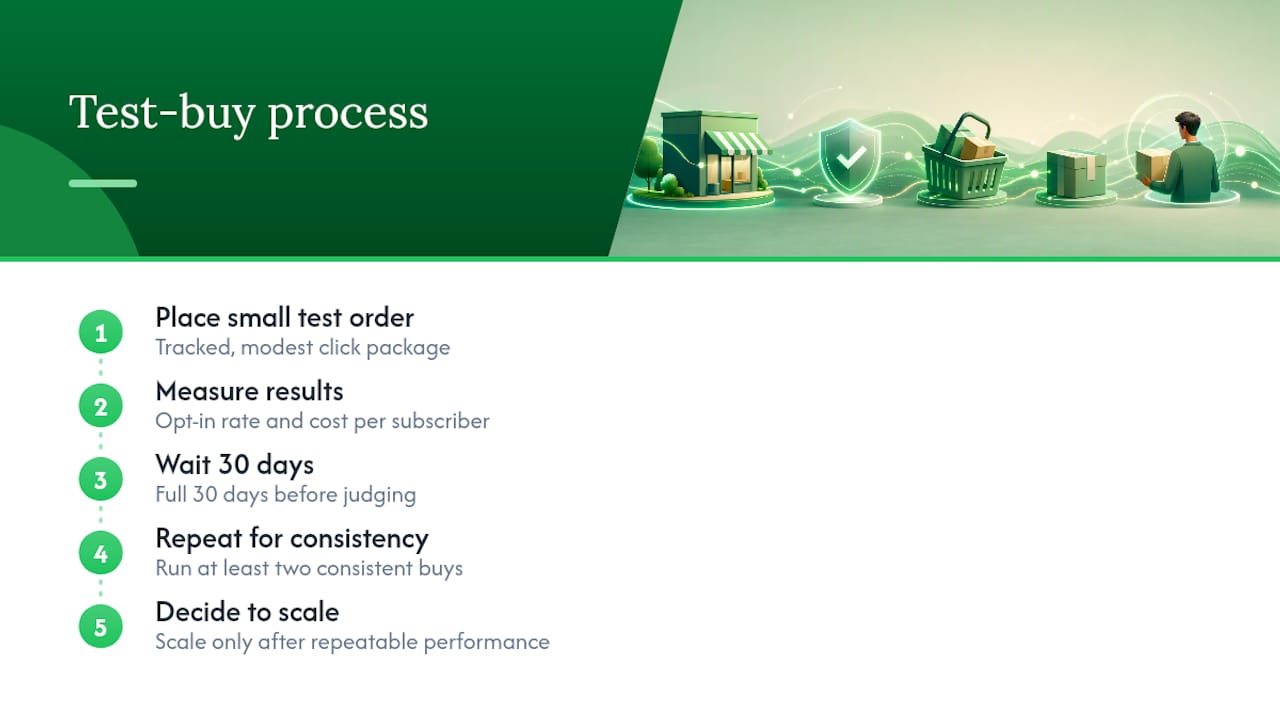
Treat the initial buy as a list-building investment. The front-end click cost rarely returns profit immediately. The value is in the subscribers who enter your follow-up sequence and convert over days or weeks. That long-term view is what makes solo ads a viable channel rather than a gamble.
Key Takeaways
Paid solo-ad email traffic works for small businesses when you vet vendors with a structured framework, track independently, test small, and evaluate results over a full 30-day window.
| Point | Details |
|---|---|
| Vet before you buy | Use the Soloadsguide 21-Question Vendor Vetting Framework before placing any order. |
| Track independently | Set up sub-IDs and bot filtering in a third-party tracker; never rely on vendor dashboards alone. |
| Test small first | Start with a baseline order; scale only after two consistent, verified runs from the same vendor. |
| Wait 30 days | Day-1 results are signals; final vendor judgment requires the full follow-up window. |
| Soloadsguide resources | The vetting checklist and tracking setup guides at Soloadsguide.com are the practical starting point. |
The part most buyers skip — and why it costs them
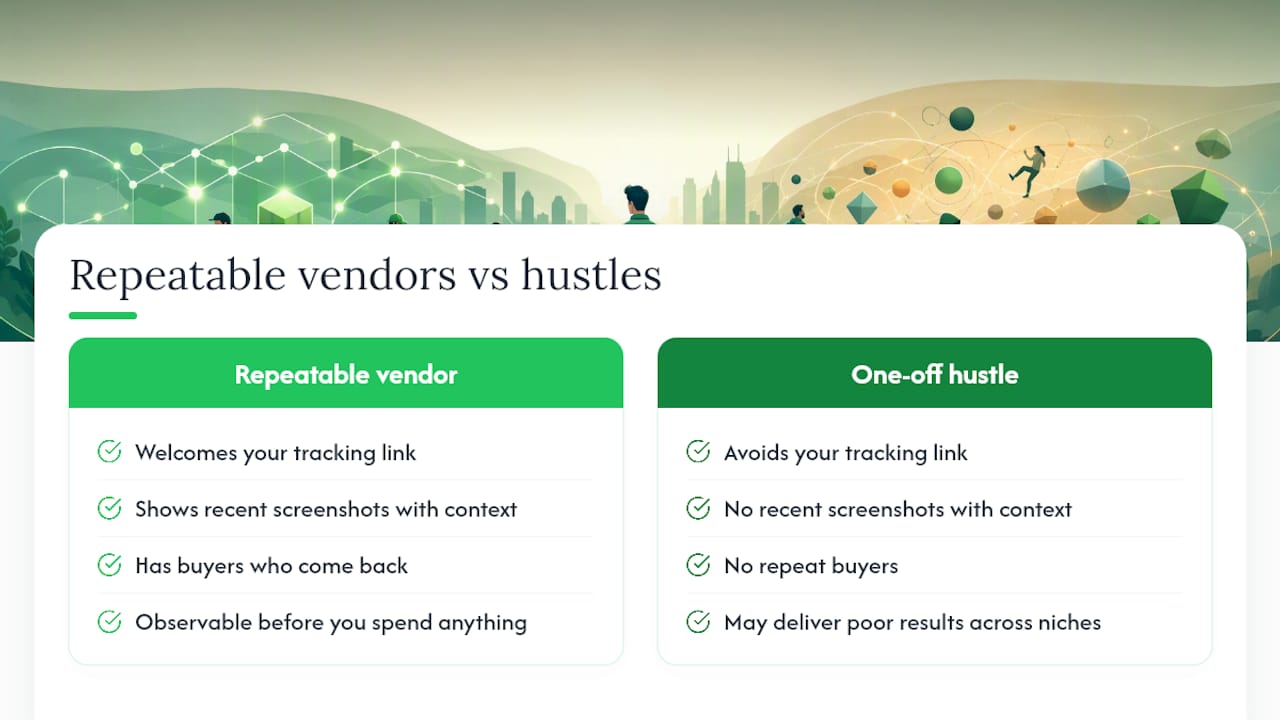
The solo-ad industry has a real problem with polished presentations and weak accountability. Buyers show up with a budget, find a vendor with a nice sales page, and place an order without asking a single hard question. Then they judge the whole channel by that one bad experience.
What actually separates repeatable vendors from one-off hustles is simple: they welcome your tracking link, they can show you recent screenshots with context, and they have buyers who come back. That pattern is observable before you spend anything. The 21-Question Vendor Vetting Framework exists because most buyers never ask more than two or three questions — and vendors know it.
One more thing worth saying plainly: results vary by niche. A vendor with a strong make-money-online list may deliver poor results for a health niche offer, and vice versa. Niche fit matters as much as vendor quality. No checklist eliminates variance, but it does eliminate the most avoidable losses.
What Soloadsguide gives you before your first buy
Soloadsguide gives you the vetting infrastructure most buyers skip entirely: a 21-question checklist, tracking setup guides, and vendor red-flag breakdowns written by Philip Coble from 11 years inside the industry.
The checklist walks you through every question to ask a vendor before placing an order, what answers to accept, and which responses should end the conversation. Pair it with the tracking setup guide and you go into your first buy with independent data from click one. If you also need help with your squeeze page or funnel design, Charles Choate Creative's marketing resources cover landing page fundamentals for small businesses.
No guaranteed outcomes here. Results depend on your funnel, your offer, and the vendor's list quality. What the checklist does is remove the most avoidable risks. Start at Soloadsguide.com and download the framework before you contact a single vendor.
Useful sources and tools
- 7 Red Flags That Reveal a Bad Solo Ad Vendor | Ihsan Solo Ads
- How to Track Solo Ad Clicks Like a Pro (Free Setup) | Ihsan Solo Ads
- Solo Ads for Affiliate Marketing Beginners — Where to Start | Ihsan Solo Ads
- Solo Ads Seller Guide 2026 and How to Spot Good Traffic Quality
- Solo Ad Stats: What to Check Before You Buy Traffic
Recommended
- Small Business Email List Building Tips for 2026
- Why Marketers Buy Email Traffic: A 2026 Guide
- What Is a Business Email Campaign? A 2026 Guide
- Email Traffic Lead Generation Benefits for Marketers
Want Verified Traffic Without the Guesswork?
PulseTraffic screens every seller, filters bot clicks in real time, and shows you verified buyer traffic labels before you spend a dollar.