
The moment a solo-ad click hits your list, your day-0 autoresponder message has to do three things: deliver the lead magnet instantly, set clear expectations for what comes next, and start tracking who actually opens and clicks. Treat your first buy as a 100-click test, verify sales per 100 clicks before you scale, and make sure your footer meets CAN-SPAM basics with a working reply address. Skip any of that and you're buying clicks with no way to know if they worked.
TL;DR:
- Verifying sales per 100 clicks and ensuring a strong initial engagement rate are essential before scaling a solo-ad campaign.
- Building a fully tracked, CAN-SPAM compliant funnel with a hosted capture page and immediate autoresponder ensures accurate measurement and deliverability.
- Setting clear expectations in the day-0 email and creating a follow-up sequence improves subscriber engagement and conversion rates within the first two weeks.
- Using your own tracking links and analyzing attribution windows helps identify genuine conversions rather than relying on vendor promises.
- Prior vetting vendors with proof of results, avoiding red flags like unverifiable screenshots, and maintaining strict list hygiene protect your investment.
Table of Contents
- How Solo Ads Work and Why Day-0 Matters So Much
- Step-by-Step Setup: What to Build Before You Buy Traffic
- What Your Day-0 Email Actually Needs to Say
- Building the Day 1–14 Follow-Up Sequence
- Tracking and Metrics That Prove a Solo Ad Was Worth It
- Vendor Vetting and Red Flags Before You Reorder
- CAN-SPAM and Deliverability Basics You Can't Skip
- Why Skeptical, Measurement-First Buying Wins
- Get the Full Vendor-Vetting Checklist From Soloadsguide
- Authoritative Reading to Verify These Claims
- Sources
- FAQ
How Solo Ads Work and Why Day-0 Matters So Much
A solo ad is a paid click model. A vendor mails their own list, links out to your capture page, and charges you per click delivered. You're not buying subscribers with intent to buy from you. You're buying attention from strangers who signed up for something else entirely, from someone else's promotion, months or years ago.
That's why the traffic runs cold. An opt-in on your page just means someone typed their email into a form. It says nothing about whether they'll ever buy. The only real lever you control is speed: how fast you follow up after that opt-in decides whether the relationship gets built or the contact goes stale.
Day-0 does double duty here:
- It delivers on the promise that got the click in the first place.
- It kicks off tracking so you can measure what this specific vendor's traffic actually does.
- It gives you an early deliverability checkpoint, since a burst of new sends can flag spam filters if your domain isn't ready.
Step-by-Step Setup: What to Build Before You Buy Traffic
Buying clicks before your infrastructure is ready wastes money. Build these pieces first, in this order.
- Build a capture page you own. Host it on your own domain, not a third-party builder with no tracking access. Pair it with a hosted lead magnet file and a thank-you page that confirms delivery in plain language.
- Configure your autoresponder for immediate send. The day-0 message needs to go out the second someone subscribes, not a few hours later. Verify the From and Reply-To addresses actually work, and add a CAN-SPAM compliant footer with your postal address and unsubscribe link.
- Install tracking before a single click arrives. Add UTM parameters to your solo-ad link, place a tracking pixel on the thank-you page, and if you can, add server-side tracking as a fallback for when browsers block client-side pixels.
- Run a full test yourself. Click your own link, subscribe with a test email, confirm the pixel fires, and check that the day-0 email lands in your inbox rather than spam.
This is the checklist stage where most beginners cut corners, usually because they're eager to get traffic flowing. Resources on how to grow your email list with solo ads quickly walk through this setup in more detail if you're building your first funnel from scratch.
Pro Tip: Test your own opt-in flow from a phone on mobile data, not just your office Wi-Fi. Mobile inbox providers and connection speeds can expose delivery problems your desktop test never catches.
What Your Day-0 Email Actually Needs to Say
Your day-0 message has one job: deliver, and set the tone for everything after it. A handful of elements are non-negotiable:
- A working delivery link to the lead magnet, front and center.
- A one-line statement of the value the reader is about to get.
- A heads-up that another email is coming, and roughly when.
- A simple reply prompt, like asking a question the reader can answer.
- An unsubscribe link and your postal address, per CAN-SPAM.
Keep the format plain. A simple text-based layout, or lightly styled HTML, tends to land better than a heavily designed template, and subject lines heavy on urgency words or dollar signs trip spam filters more often than they earn opens.
Here's a template you can adapt:
Subject: Here's your [lead magnet name]
Hey [First Name], here's your download: [link]. Inside, you'll find [one-line benefit]. Tomorrow I'll send you [next email topic], so keep an eye out. Hit reply and tell me what you're working on. Talk soon.

Mailchimp's own welcome series data shows that a short sequence built around a first message like this consistently drives higher combined open rates than a single one-off email.
Building the Day 1–14 Follow-Up Sequence
One email isn't a strategy. A short sequence gives cold clicks a real chance to become engaged subscribers, and Mailchimp's automation research finds that automations averaging around three messages tend to outperform single sends for first-purchase conversions.
A workable structure looks like this:
- Day 0: Deliver the lead magnet and set expectations.
- Day 1: Introduce yourself and add one piece of standalone value, no pitch.
- Day 3: Go deeper, or share proof that what you teach or sell actually works.
- Day 7: Make a targeted offer, segmented based on what the subscriber has already engaged with.
- Day 14: Re-engage anyone who hasn't opened, or present a secondary offer to non-buyers.
Only push offers to people who haven't already bought. Basic segmentation, even something as simple as tagging buyers versus non-buyers, keeps you from insulting someone who already paid.
Watch two numbers closely in this window: opens within the first 48 hours, and reply rate. Both are early signals of whether the list you just paid for is made of real, engaged humans or dead weight.
Tracking and Metrics That Prove a Solo Ad Was Worth It
Vendor claims mean nothing without your own numbers behind them. The metrics that actually tell you whether to reorder or walk away:
- Delivered clicks (what the vendor promised versus what your tracker recorded).
- Opt-in rate on your capture page.
- Reply rate on your day-0 and day-1 emails.
- Sales per 100 clicks, the single number that matters most.
- Delivery speed, meaning how long it took from your order going live to clicks actually arriving.
Set up UTM parameters on every link you send to a vendor, and combine pixel tracking on your thank-you page with server-side tracking as backup, since pixel blockers and privacy settings routinely undercount conversions.
Pay attention to attribution windows too. A 7-day click window captures buyers who take a few days to decide. A 1-day view window only shows what happened immediately after the click. If you're only measuring same-day activity, you're missing the slower buyers who convert on day four or five, and you'll undercount what the traffic actually produced.
Vendor Vetting and Red Flags Before You Reorder
Most solo-ad problems trace back to one thing: buyers trusting a seller's word instead of demanding proof. Soloadsguide built its 21-question vendor vetting framework around exactly this gap, and the core of it comes down to a few non-negotiable demands before you send money.
Ask for proof of clicks that isn't just a screenshot you can't verify independently. Insist on using your own tracking links, not the vendor's. Confirm the refund policy in writing, and ask directly whether the vendor's list matches your niche.
Watch for these red flags:
- Screenshots of "results" with no way to verify the source.
- Refusal to let you use your own tracking link.
- Opt-in rates that look too good, paired with zero sales.
- Delivery windows that slip well past what was promised.
Run the same test every time: buy 100 clicks, record opt-ins, replies, and sales, then calculate sales per 100 clicks. That number, tracked across multiple vendors, becomes your actual purchasing history, not their sales page.
Pro Tip: Keep a simple spreadsheet with vendor name, date, clicks bought, opt-ins, replies, and sales per 100 clicks. After three or four buys, patterns show up that no single order would reveal.
CAN-SPAM and Deliverability Basics You Can't Skip
The FTC's CAN-SPAM guidance requires commercial email to identify itself as an ad when appropriate, include a valid postal address, and offer a working unsubscribe. Honor opt-outs promptly, since ignoring them creates real legal exposure.
On deliverability, warm your sending domain before a big push, authenticate with SPF and DKIM, and stay away from purchased lists, which risk harvested addresses and opt-out violations under FTC business guidance. If a vendor's traffic tanks your sender reputation, pause buying and fix list hygiene and authentication before you send another dime toward that vendor.
Why Skeptical, Measurement-First Buying Wins
Solo ads are fuel, not the engine. Your funnel and follow-up sequence do the actual work of turning a click into a customer, and no amount of vendor hype changes that math.
Expect to lose a little money on your early tests. That's not failure, it's the cost of finding vendors whose traffic actually converts. The goal isn't one lucky batch of opt-ins, it's a repeatable number you can trust. Document sales per 100 clicks and how the vendor behaves under scrutiny. That combination, not their promises, is what should decide your next order.
— Philip Coble
Get the Full Vendor-Vetting Checklist From Soloadsguide
Soloadsguide is the alternative to trusting a solo-ad vendor's word: a free, buyer-first checklist that makes vendors prove their claims before you spend a dollar. The site walks through the same 21-question vendor vetting framework referenced above, plus autoresponder templates and tracking guides built specifically for running a 100-click test the right way.
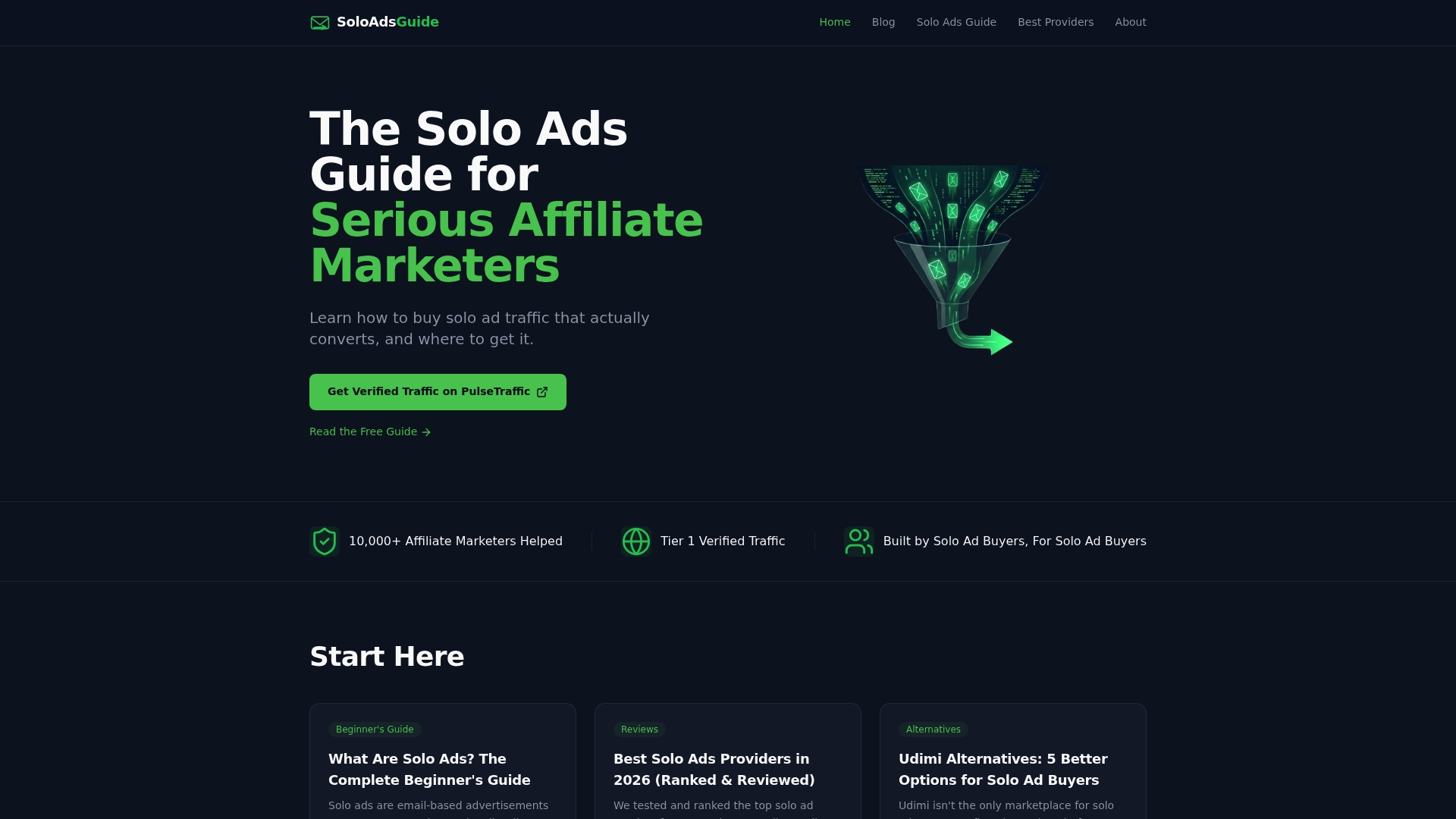
None of this is guru talk or income promises. It's a practical checklist you run before every purchase, built from watching how the solo-ads industry actually operates, including where it goes wrong. If you want the full checklist and editable templates, visit the Soloadsguide landing page and run through it before your next solo-ad order. For more on setting up the funnel that receives your traffic, Soloadsguide's guide on optimizing solo-ad funnel conversion and this partner breakdown on boosting ROAS with retargeting both pair well with the tracking setup covered here.
Authoritative Reading to Verify These Claims
Check Mailchimp's own data on welcome series performance before building your sequence. Read the FTC's CAN-SPAM compliance guide for the legal minimums. And for a practitioner's firsthand account of testing solo-ad vendors, the step-by-step campaign guide at MarketerRakib walks through timing and metrics in practical detail.
Sources
- A winning welcome email series | Mailchimp
- CAN‑SPAM Act implementation and guidance (FTC)
- How to Launch a Solo Ad Campaign: Step-by-Step Guide (2026) - MarketerRakib
FAQ
What does "solo ads" mean?
A solo ad is paid traffic where a vendor emails their own list on your behalf, sending clicks to your link in exchange for a per-click fee. You're buying attention, not guaranteed buyers, which is why tracking and a solid autoresponder sequence matter so much.
What does 7-day click, 1-day view attribution mean?
A 7-day click window credits a sale to a click if the purchase happens within seven days of that click. A 1-day view window only captures activity that occurred within a day, which means slower buyers get missed if you're only watching same-day numbers.
What is the 3-2-2 method for Facebook ads?
That framework is specific to paid social campaign structure, not solo-ad email traffic, and it isn't something this guide's testing protocol covers. If you're running solo ads, the more relevant benchmark is the 100-click test described above.
Is email marketing still worth it in 2026?
Yes. Automated sequences continue to outperform one-off sends, and Mailchimp's data shows welcome series driving meaningfully higher combined open rates than single welcome emails. The channel works when the list is built and followed up on correctly, which is exactly what a day-0 autoresponder setup is designed to do.
How much does Soloadsguide's vetting checklist cost?
Current pricing and access details for the checklist and templates are listed directly on the Soloadsguide site, not repeated here to avoid outdated figures.
Recommended
- 100 Click Test: Solo Ad Open Rate Benchmarks Buyers Can Verify
- Solo Ad Buyers: 50–200 Click Test and 21 Questions to Verify Leads
- Solo Ad Buyers: Test Single vs Double Opt-In with a 2-Week A/B Split
- Protect Your Budget: 21 Question Solo Ad Red Flags for Buyers
Want Verified Traffic Without the Guesswork?
PulseTraffic screens every seller, filters bot clicks in real time, and shows you verified buyer traffic labels before you spend a dollar.