
Solo ads work for coaches, but only under specific conditions: you need a high-ticket or high-margin offer, a funnel you own, and a willingness to test small before spending real money. If your coaching offer sells for under $200 or serves a local market, skip solo ads entirely and put your budget elsewhere.
Here's the rationale in plain terms. Solo ads deliver cold traffic, meaning people who have never heard of you, straight to your opt-in page. That traffic converts best on offers with room to absorb a customer acquisition cost, which is why conversion rates for coaching and information products tend to run in the 1% to 5% range. A $47 mini-course can't survive that math. A $2,000 coaching package usually can, if the follow-up sequence does its job.
Your immediate next step: build a capture page and a 5-email follow-up sequence, then buy a 100 to 200 click test from one vetted vendor. Don't skip the vetting. Don't skip the tracking link. And don't scale until the numbers from that first test actually justify it.
- Verdict: Solo ads suit coaches with offers priced high enough to cover a real cost-per-lead, not impulse-buy price points.
- Credibility anchors to use before buying: a structured vendor-vetting framework (21 questions), realistic conversion benchmarks (1% to 5%), and a small starter test size (100 to 200 clicks).
- Biggest mistake to avoid: sending traffic to a page you don't own, or skipping the test phase because a vendor's screenshots look impressive.
Key Takeaways
Solo ads work for coaches with high-ticket offers and a tested funnel, but only when paired with vendor vetting, tracking links, and a small test buy before scaling.
| Point | Details |
|---|---|
| Match offer to traffic type | Solo ads suit high-ticket or high-margin coaching, not low-price or local-only services. |
| Own your funnel | Send traffic to a landing page on your own domain, never a replicated vendor funnel. |
| Vet before buying | Run every vendor through a structured checklist covering niche fit, tracking policy, and list hygiene. |
| Track the right metrics | Sales-per-click and reply rates matter more than opt-in rate alone. |
| Start with Soloadsguide's tools | Use the 21-question vetting framework and tracking guides at Soloadsguide before your first test buy. |
Table of Contents
- What Are Solo Ads for Coaching, and How Do They Work?
- When Do Solo Ads Work Best for Coaching Businesses?
- What Does a Solo Ad Campaign Flow Look Like for Coaches?
- How Do You Vet a Solo Ad Vendor Before Buying?
- Which Metrics Actually Tell You If a Campaign Worked?
- What Makes a Landing Page and Lead Magnet Convert for Coaches?
- How Much Do Solo Ads Cost, and What Should a Test Budget Look Like?
- How Do You Test and Scale a Solo Ad Campaign Safely?
- When Should You Choose an Alternative to Solo Ads?
- What's the Bottom Line for Coaches Considering Solo Ads?
- What Legal Rules Apply to Solo Ad Email Marketing?
- Author Perspective: A Vendor-Aware, Buyer-First Take
- How Soloadsguide Helps You Buy Solo Ads Without Getting Burned
- Sources
What Are Solo Ads for Coaching, and How Do They Work?
A solo ad is a dedicated email a list owner sends to their subscribers, promoting your offer exclusively. No other product competes for attention in that email, which is the entire appeal: solo advertising for coaches means renting someone else's audience for one message, one call to action, one shot at a click.
Vendors typically charge two ways. Per-click pricing means you pay for a set number of clicks delivered to your link, and it's the more common and safer model because you only pay for traffic that actually shows up. Flat-fee packages promise a certain send volume or click count for one price, which shifts more risk onto you if the vendor under-delivers or sends low-quality traffic.
A "click" in this context means someone on the vendor's list clicked your link inside their email. It does not mean that person is interested in coaching, has money to spend, or will ever open another email from you. That's why tracking links matter so much. Without a third-party tracking link, you have no independent way to confirm how many clicks were delivered, where they came from, or whether the vendor's own dashboard numbers match reality.
- A solo ad is one dedicated email sent to a vendor's list promoting your offer alone.
- Per-click pricing is the standard model; flat-fee packages carry more risk.
- Tracking links are non-negotiable. If a vendor won't let you use one, that's a red flag, not a policy quirk.
- Prices and click quality vary enormously between vendors selling into the same niche.
When Do Solo Ads Work Best for Coaching Businesses?
Solo ads fit a narrow but real set of coaching scenarios. They work best when your offer targets a well-defined niche, when you have an evergreen lead magnet that doesn't need seasonal updates, and when your pricing can absorb a cost per lead that might run anywhere from a few dollars to $20 or more depending on your niche and vendor quality.
They tend to fail in three predictable situations. Low-margin offers can't cover acquisition costs once you factor in the vendor's fee, your tracking tool, and your email platform. Local-only services, think in-person life coaching in one city, waste most of the traffic because solo ad lists are rarely geo-targeted to a metro area. And any coach without a follow-up sequence is buying clicks that evaporate the moment the visitor closes the tab.
Ideal fit looks like this:
- High-ticket or high-margin coaching (career coaching, executive coaching, business coaching priced above roughly $500)
- A tightly defined target market the vendor's list can actually match, since list-market alignment is what separates a converting run from a wasted one
- An evergreen lead magnet already built and tested
- A follow-up email sequence ready to fire the moment someone opts in
Red flags that mean walk away:
- The vendor can't confirm their list contains subscribers interested in coaching, personal development, or your specific niche
- The seller forbids or discourages the use of independent tracking links
- The vendor only advertises "biz-opp" or make-money traffic with no coaching or personal-development segment
- You have no landing page of your own and would be sending traffic to a replicated affiliate funnel
What Does a Solo Ad Campaign Flow Look Like for Coaches?
Buying traffic before your funnel exists is the single most common way coaches waste money on solo ads. The traffic has to land somewhere that converts, and that "somewhere" needs to already be built and tested before you spend a dollar.
Here's the sequence, in order:
- Vet the vendor. Run them through a vetting checklist before any money changes hands.
- Prepare your ad copy. Some vendors write it for you; others require you to submit copy that matches their list's tone and past open rates.
- Vendor sends the email. This is the one piece of the process you don't control. The vendor owns the list, the send schedule, and the exact subject line unless you negotiate otherwise.
- Traffic hits your tracking link first. This is where you measure delivered clicks, unique visitors, and click timing before anyone reaches your page.
- Visitor lands on your opt-in page. This page lives on a domain you own, not a vendor-hosted redirect or a replicated company funnel.
- Opt-in triggers a thank-you page. This is where you can introduce a tripwire offer or simply confirm the lead magnet delivery.
- A 5 to 7 email sequence begins. Cold solo-ad traffic responds best to a structured follow-up sequence rather than a single pitch email, since almost no one buys coaching services from a first touch.
- The coaching offer is presented. This can be a call booking, an application, or a direct sales page depending on your funnel.
You own the domain, the landing page, the email list, and the follow-up sequence. The vendor owns exactly one thing: the send. That's an important line to draw, because it defines what happens to your lead the moment they click. If you're sending to a page you control, that lead is yours forever. If you're sending to a replicated funnel, the lead technically belongs to whatever platform hosts that page, and you may never see their email address again.
How Do You Vet a Solo Ad Vendor Before Buying?
Vetting is the difference between buying targeted solo ads and setting money on fire. A structured vetting process, like Soloadsguide's 21-question vendor vetting framework, forces a vendor to answer specifics instead of hiding behind testimonials and screenshots.
The questions worth asking cover several categories:
- Niche fit: Does the list actually contain coaching, personal development, or business-opportunity subscribers who'd respond to your specific offer?
- Traffic geography: What percentage of the list is Tier-1 (US, UK, Canada, Australia)? Vendors frequently advertise country-targeted or "100% USA" traffic, but that claim should come with a way to verify it, not just a promise.
- Tracking link policy: Will they allow your independent tracking link, or do they insist on their own reporting only?
- Send frequency: How often is this list emailed? A list hit five times a day by different sellers will convert worse than one emailed sparingly.
- List hygiene: When was the list last scrubbed for inactive or fake subscribers?
- Make-up click policy: What happens if delivered clicks fall short of what you paid for?
- References: Can they provide names of other buyers you can actually contact, not just posted testimonials?
Red flags to watch for during this process: a vendor who refuses tracking links outright, screenshots of "results" that are old, cropped, or impossible to verify, guarantees of a specific number of sales (no one can promise that from cold traffic), and vendors who push you toward sending traffic to a replicated company funnel instead of your own capture page. If Soloadsguide's full vetting checklist surfaces even two of these red flags on one vendor, move on. There are enough sellers in this space that you don't need to gamble on one who fails basic transparency tests.
Pro Tip: Ask a vendor what their opt-in rate has looked like on similar coaching offers over their last five sends, not their all-time best result. A vendor who only quotes their single best campaign is showing you an outlier, not a baseline.
Which Metrics Actually Tell You If a Campaign Worked?
Most coaches obsess over opt-in rate and ignore the metric that actually pays the bills: sales per click. A campaign can produce a fantastic opt-in rate and still lose money if nobody on that list ever buys anything, which is why a case study on coaching lead magnets specifically warns that high opt-ins don't guarantee sales.
Here's the full metric set worth tracking, and what each one tells you:
| Metric | What it measures | Why it matters |
|---|---|---|
| Unique clicks | Distinct visitors who clicked your tracking link | Confirms real delivered traffic, not inflated vendor numbers |
| Opt-in rate | Percentage of clicks that become email subscribers | Cold traffic benchmarks commonly fall in a rough 20% to 40% range |
| Cost per lead | Total spend divided by opt-ins | Tells you what each new subscriber actually cost |
| Conversion to sale | Percentage of leads who become paying clients | The number that determines profitability, not vanity metrics |
| Earnings per click (EPC) | Total revenue divided by total clicks | The cleanest single number for comparing vendors head to head |
A quick worked example: say you buy 200 clicks at $0.45 each, spending $90 total. Even accounting for tools and time, that's a workable return, but it only shows up if you measure over a full window.
Evaluate results over 7 to 30 days, not 24 hours. Sales-per-click is the metric that matters, not opt-ins alone, and coaching sales cycles often need the full 30-day window to show their real conversion number since prospects rarely buy a high-ticket program from the first or second email. Tools built for measuring sales conversion rate can help you standardize this math across every vendor you test.
What Makes a Landing Page and Lead Magnet Convert for Coaches?
Message match is the single biggest factor separating a profitable run from a wasted one. The promise made in the vendor's email has to match the headline on your landing page, which has to match what your lead magnet actually delivers. Break that chain anywhere and your opt-in rate collapses, no matter how good the traffic is.
Practical lead magnet ideas that work for coaching niches:
- A worksheet that solves one narrow, specific problem (a "5-minute morning clarity worksheet" for a life coach)
- A quick-win checklist tied directly to the outcome your coaching program produces
- A mini-audit or self-assessment quiz that ends with a personalized result
- A 7-day challenge delivered via email, which doubles as your follow-up sequence
Your copy checklist before launching any landing page:
- Headline repeats the exact promise made in the vendor's email, word for word if possible
- Three benefit bullets that describe the outcome, not the process
- One single call to action, never two competing buttons
- Mobile-first design, since the majority of cold email clicks happen on a phone
Subject-line angles that tend to perform well for coaching lead magnets lean on specificity and curiosity rather than hype: "The 3-question audit that shows why clients aren't booking calls" beats "Free coaching resource" every time. Specific outperforms vague, in subject lines and in headlines alike.
How Much Do Solo Ads Cost, and What Should a Test Budget Look Like?
Pricing swings widely based on list quality, niche, and geography. Tier-1 traffic (US, UK, Canada, Australia) commands a premium over broader international lists, and coaching-specific or personal-development-targeted lists typically cost more than generic biz-opp traffic because the subscribers are pre-qualified for the topic.
| Traffic tier | Typical use case | Relative cost |
|---|---|---|
| Tier-1 targeted (coaching/personal development) | Higher-intent coaching offers, best conversion potential | Highest per-click cost |
| Tier-1 general (biz-opp/make-money) | Broader online business offers, weaker niche match | Mid-range per-click cost |
| Mixed or international lists | Lower-budget tests, list-building at volume | Lowest per-click cost, weaker buyer intent |
Your first buy should always be a probe, not a profit campaign. A 100 to 200 click test from a single vendor is enough to see real opt-in behavior and, more importantly, whether anyone from that list actually replies to your follow-up emails or engages with human outreach. If subscribers never respond to a single email in your sequence, scaling that vendor won't fix the underlying problem: replies and early engagement are the leading indicators of whether the list has real buyers on it, not the raw click count.
Scaling rules worth setting in stone before you start:
- Only reinvest with a vendor after a completed test shows a positive or break-even sales-per-click number
- Double your next buy, don't 10x it, even after a strong first test
- Blacklist a seller immediately if delivered clicks come in far below what you paid for, or if engagement is near zero across the full sequence
How Do You Test and Scale a Solo Ad Campaign Safely?
Treat every new vendor relationship as an experiment with a defined start and end point, not an open-ended spend. Here's the repeatable plan:
- Run a 100 to 200 click test with one vendor whose niche and geography match your offer.
- Hold the results for 7 to 30 days before judging the campaign, since coaching sales cycles are slower than impulse-buy products.
- Measure opt-ins, replies, and sales, not just clicks. A list that opts in well but never replies is a warning sign, not a win.
- A/B test one variable at a time, starting with the email swipe copy the vendor sends, then your landing page headline, then your lead magnet offer.
- Tag every source in your email platform so you know exactly which vendor produced which subscribers, which matters enormously once you're running multiple tests at once.
- Build a whitelist and a blacklist as results come in. A vendor who delivers real engagement earns repeat buys; one who doesn't gets crossed off permanently.
- Reinvest only profit, never your original testing budget, into scaled buys from a proven vendor.
- Watch refund and complaint rates on your own coaching offer as volume increases. A spike here usually means the traffic quality dropped, not that your offer suddenly got worse.
This isn't a one-time process. Even a vendor who performs well on your first three buys can send you a stale segment of their list on the fourth, which is exactly why the tagging and tracking discipline has to stay in place permanently, not just during the initial testing phase.
When Should You Choose an Alternative to Solo Ads?
Solo ads aren't the only lever, and for some coaches they're the wrong one entirely. Here's how they stack up against other common channels:
- Paid social (Facebook, Instagram, LinkedIn ads): Better targeting controls and retargeting options, but a steeper learning curve and typically higher upfront cost to find a winning ad.
- SEO and organic content: Slower to produce results, often six months or more before meaningful traffic, but compounds over time and costs no per-click fee.
- Partnerships and joint ventures: Can produce highly qualified leads fast, but depend entirely on relationships you may not have built yet.
- Referral marketing: Extremely high trust and conversion, but capped by the size of your existing client base.
Solo ads make the most sense when you need cold-start speed, meaning you have zero list and need subscribers fast, and you already have a tested funnel that can absorb cold traffic without leaking money. Avoid them when your margins are too thin to cover a real cost per lead, or when your service is inherently local and most of the list will never be in your service area.
A hybrid approach often works best in practice: use solo ads purely for list-building volume, then lean on organic content and email nurturing (see lead warming strategies for service-based offers) to convert and retain those leads over the following months. That combination gets you speed on the front end and lower long-term acquisition costs on the back end.
What's the Bottom Line for Coaches Considering Solo Ads?
Solo ads make sense for coaches with a high-ticket or high-margin offer, a niche the vendor's list can actually match, and a funnel already built to receive cold traffic. They don't make sense for low-price offers, local-only services, or anyone without a follow-up sequence ready to go.
Your three-step checklist to get started:
- Build your capture page and 5-email follow-up sequence on a domain you own, before you spend a single dollar on traffic.
- Buy a 100 to 200 click test from one vetted vendor, using an independent tracking link from the start.
- Measure opt-ins, replies, and sales-per-click over a 7 to 30 day window before deciding whether to scale or blacklist that vendor.
The most common mistake coaches make isn't picking a bad vendor. It's skipping the funnel-building step and buying traffic before there's anywhere good for it to land.
What Legal Rules Apply to Solo Ad Email Marketing?
Solo ads run entirely through email, which means both you and your vendor operate under email marketing law, not general advertising rules. In the United States, the CAN-SPAM Act requires every commercial email to include a working unsubscribe mechanism, an honest subject line, a physical postal address, and clear identification that the message is an advertisement. This applies to the vendor's send and to every email in your own follow-up sequence once a lead opts in.
If any portion of your list or your coaching business touches subscribers in the European Union or UK, GDPR adds another layer: you need a documented lawful basis for holding someone's email address, a clear way for them to withdraw consent, and limits on how long you retain their data. A solo ad opt-in from an EU-based subscriber isn't automatically consent to your ongoing marketing under GDPR the way it might be treated under CAN-SPAM, so review how your opt-in language and email provider handle EU-based leads.
This is general information, not legal advice. Confirm current requirements with your email service provider's compliance documentation or a qualified attorney before running campaigns at volume. This is especially important if your list spans multiple countries.
Author Perspective: A Vendor-Aware, Buyer-First Take
Most solo ad advice online comes from one of two places: an affiliate trying to sell you a vendor relationship, or a vendor trying to sell you clicks. Neither has much incentive to tell you when solo ads are the wrong move for your coaching business. That gap is exactly why a vetting framework matters more than any single tactic in this article. Vendors aren't lying to you as often as they're simply not volunteering the information that would talk you out of a purchase.
The mindset shift that actually changes outcomes: treat your first purchase from any new vendor as tuition, not revenue. You're paying to learn whether that specific list responds to your specific offer, whether people reply to your emails, and whether the vendor's claims about their traffic hold up under a tracking link. Coaches who expect their first solo ad buy to produce net profit usually quit after one disappointing run. Coaches who expect their first buy to produce data tend to stick around long enough to find a vendor that actually works.
Pro Tip: If a vendor's entire pitch leans on testimonials and screenshots rather than answering direct questions about list hygiene and send frequency, that's information too. The sellers most confident in their traffic are usually the ones most willing to let you verify it.
How Soloadsguide Helps You Buy Solo Ads Without Getting Burned
Soloadsguide exists because most coaches lose money on their first few solo ad buys not from bad luck, but from skipping the vetting step entirely. The site gives you the tools to fix that before you spend a dollar: the 21-question vendor vetting framework, step-by-step tracking link guides, and templates for structuring your first test buy so you're measuring the right numbers from day one.
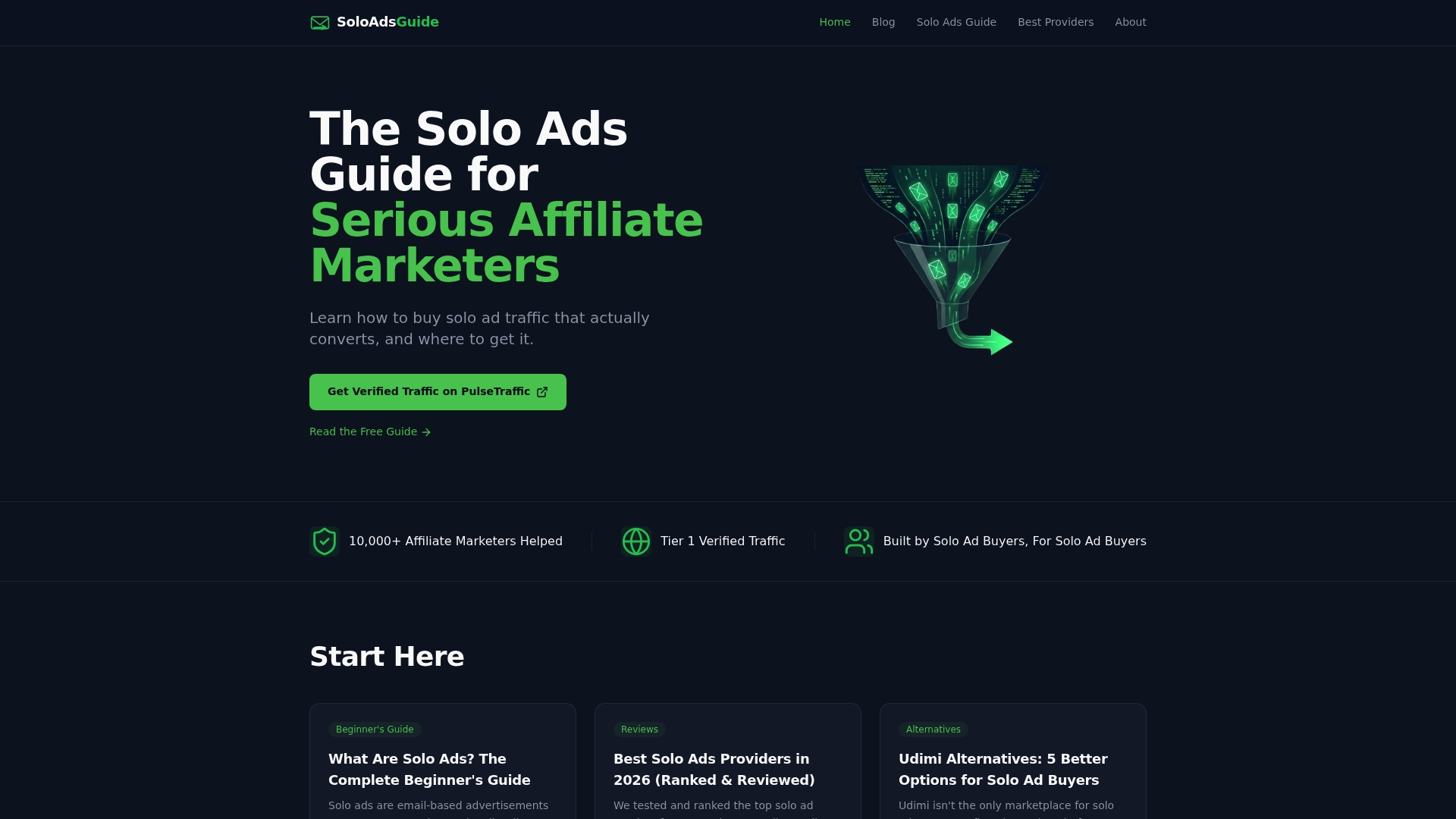
None of it is designed to push you toward a specific vendor. The entire point is putting the verification tools in your hands so you can judge any seller's claims for yourself, whether that's a country-targeting promise, an over-delivery guarantee, or a testimonial you can't independently confirm. If you're planning your first 100 to 200 click test, start at the Soloadsguide landing page and run your target vendor through the checklist before you send a single payment.
Sources
- Solo Ads Affiliate Marketing: Complete Buying & Converting
- Solo Ad Traffic - Solo Ad Monster | Solo Ad Traffic, Marketing Tools & Conversion Labs
Recommended
- High-Ticket Offer Solo Ad Strategies That Actually Work
- Solo Ads Budget Allocation: A Practical Guide for Affiliates
- Solo Ads Small Business Lead Generation Guide
- Solo Ads vs Paid Social Ads: 2026 Marketer's Guide
Want Verified Traffic Without the Guesswork?
PulseTraffic screens every seller, filters bot clicks in real time, and shows you verified buyer traffic labels before you spend a dollar.