
Ad copy is defined as the written text within a paid advertisement designed to persuade a specific audience to take a desired action. In marketing, this term covers everything from a three-word Google search ad to a 90-word Facebook post. Understanding what ad copy means in marketing is the foundation for any campaign that converts clicks into customers. The best advertising copy does not just describe a product. It moves people from passive scrollers to active buyers by combining a sharp hook, a credible promise, and a direct call to action.
What does ad copy mean in marketing, and why does it matter?
Ad copy is the most controllable variable in any paid campaign. Targeting algorithms and bidding strategies are largely automated, but the words you choose remain a human decision that directly shapes results. A well-crafted ad improves click-through rate (CTR), raises Quality Score on platforms like Google Ads, and lowers cost per click (CPC). That chain reaction means better copy produces more leads for less money.
The advertising copy meaning goes beyond clever phrasing. Copy must match the audience's awareness stage, fit the platform's format, and follow a proven sequence. Miss any one of those conditions and performance drops, regardless of how much budget you put behind the ad.

What are the key elements that make ad copy effective?
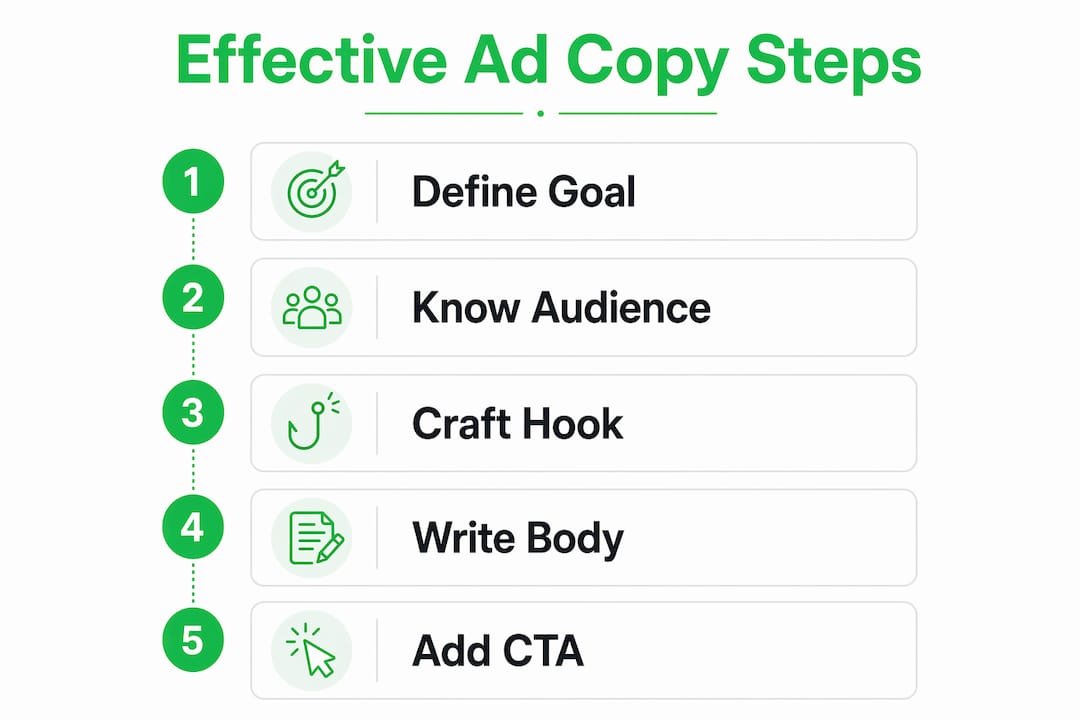
High-performing ad copy follows a strict, non-interchangeable sequence. Each element creates the condition for the next, and skipping one causes readers to drop off before reaching your call to action.
The four core elements are:
- The hook. The headline or opening line stops the scroll and earns attention. Headlines carry roughly 80% of total ad engagement. That figure means the rest of your copy is irrelevant if the first line fails.
- The value proposition. This is a specific, credible promise. "Lose 10 pounds in 30 days" outperforms "Get healthier" because it is concrete and measurable.
- Social proof. A testimonial, a user count, or a verified result reduces skepticism. Proof turns a claim into a fact in the reader's mind.
- The call to action (CTA). The CTA must be direct and matched to the reader's funnel stage. "Learn more" works for cold traffic. "Buy now" works for warm, product-aware audiences.
Platform constraints shape how you deploy these elements. Facebook truncates body text at 125 characters before showing a "See More" prompt. That means your most important claim must appear in the first two lines, not buried in the third paragraph.
Copy length also matters. Body copy of 40–90 words performs best on cold traffic. Each sentence past the third tends to reduce engagement because cold audiences have not yet committed attention to your message.
Pro Tip: Write your CTA before you write your headline. Knowing the exact action you want readers to take keeps every line of copy pointed in the same direction.
How does ad copy differ from other marketing content?
Ad copy and SEO content share the same alphabet but serve completely different goals. Ad copy targets immediate conversion within seconds of a reader seeing it. SEO content targets organic search ranking over weeks or months. Confusing the two leads to ads that read like blog posts and blog posts that read like sales pitches.
| Factor | Ad copy | SEO content |
|---|---|---|
| Primary goal | Immediate action | Long-term visibility |
| Length | 40–125 words typically | 1,000+ words typically |
| Tone | Urgent, direct | Informative, thorough |
| Traffic source | Paid media | Organic search |
| Success metric | CTR, CVR, CPC | Rankings, organic traffic |
Website copy sits between the two. It explains your brand in depth but does not carry the urgency of a paid ad. The smartest marketing programs align all three. Your ad copy sets a promise, your landing page fulfills it, and your SEO content builds the authority that makes the brand credible over time.
Aligning ad copy with SEO also protects your paid budget. When ad messaging matches the organic content a visitor has already seen, trust builds faster and conversion rates rise.
What strategies do experts use to write winning ad copy?
The most effective ad copy frameworks give you a repeatable structure so you are not starting from a blank page every time. Here are four approaches that professional copywriters rely on:
-
AIDA (Attention, Interest, Desire, Action). This classic framework moves the reader through four mental states. Grab attention with the hook, build interest with facts, create desire with the value proposition, and close with the CTA. AIDA works across formats from email subject lines to video scripts.
-
PAS (Problem, Agitate, Solution). Name the reader's problem, make them feel the cost of not solving it, then present your product as the answer. PAS is especially effective for cold traffic because it meets readers where they already are mentally.
-
Hook-to-belief matching. Successful hooks mirror the audience's internal conversation within 3–5 words. This is not about clever writing. It is about using the exact language your audience uses when they describe their own problem. Research forums, reviews, and social comments to find those words before you write a single line.
-
Awareness-stage targeting. Copy written for product-aware audiences fails when run against cold, unaware traffic. Map your copy to the five awareness stages: unaware, problem-aware, solution-aware, product-aware, and most-aware. Each stage needs a different hook and a different level of detail.
AI tools like ChatGPT can accelerate the brainstorming phase. Experts recommend using AI as a creative aid, not a replacement for strategic thinking or brand voice. AI generates volume. You provide the judgment about which angle matches your audience's beliefs. For a deeper look at how AI fits into this process, the guide on humanizing AI-generated text covers practical tactics for keeping copy on-brand.
Pro Tip: Before writing any ad, write a one-sentence description of your audience's current belief about their problem. Every line of copy should either confirm or gently challenge that belief.
How does ad copy impact campaign performance and cost efficiency?
Ad copy is the lever that controls your cost per lead. When copy is weak, you pay more for every click and convert fewer of those clicks into customers. When copy is strong, the platform rewards you with lower costs and higher reach.
The performance chain works like this:
- Better copy raises CTR. More people click when the message matches their need.
- Higher CTR improves Quality Score. Google Ads and similar platforms reward relevance with lower CPCs.
- Lower CPC stretches your budget. The same spend reaches more qualified people.
- Stronger messaging lifts conversion rate. Readers who click already believe the promise, so they convert at a higher rate.
Poor ad copy breaks this chain at the first link. A weak hook produces low CTR, which signals low relevance to the platform, which raises your CPC. You spend more to reach fewer people, and those people are less likely to convert. Tracking both CTR and conversion rate together reveals where the chain breaks. High CTR alone can be misleading if the landing page or offer does not match the copy's promise.
Ad copy also interacts with audience segmentation. Retargeting audiences are warmer and respond to proof-heavy copy. Cold audiences need a problem-focused hook first. Running the wrong copy against the wrong segment wastes budget even when the targeting itself is accurate. Ad frequency compounds this problem. When the same copy runs too long, engagement drops and costs rise. Understanding how ad frequency affects conversions helps you know when to refresh your messaging before performance declines.
Key Takeaways
Effective ad copy is the single most controllable factor in paid campaign performance, requiring a precise sequence of hook, value proposition, social proof, and CTA matched to the audience's awareness stage.
| Point | Details |
|---|---|
| Ad copy definition | Persuasive text in paid ads designed to drive a specific audience action immediately. |
| Sequence is non-negotiable | Hook, value proposition, social proof, and CTA must appear in order or conversion drops. |
| Platform constraints matter | Facebook truncates at 125 characters, so front-load your strongest claim every time. |
| Match awareness stage | Cold traffic needs a problem-focused hook; warm audiences respond to proof and offers. |
| Copy drives cost efficiency | Strong CTR raises Quality Score and lowers CPC, stretching every dollar of ad spend. |
Why clever writing is the wrong goal
Most marketers I work with arrive believing that better ad copy means more creative writing. That belief costs them money. The biggest misconception in advertising copy is that success comes from clever phrasing. It actually comes from mirroring the audience's language so precisely that readers feel the ad was written specifically for them.
I have reviewed campaigns where the copy was genuinely witty and the CTR was terrible. The hook was clever but it did not match what the audience was already thinking. Swap in plain, direct language that echoed the audience's own words, and CTR doubled within a week. No new creative direction. No new offer. Just language that fit.
The AI question is real and worth addressing directly. AI tools generate copy fast, and that speed is genuinely useful for testing multiple angles. But AI does not know your audience's specific beliefs, their frustrations, or the exact phrase that makes them stop scrolling. That knowledge comes from research, and research is still a human job. Use AI to produce drafts. Use your judgment to select the one that matches your audience's internal conversation. The guide on optimizing for AI-driven platforms offers useful context on how AI tools process and surface marketing content.
The trend I see accelerating is a split between automated copy generation and human strategic oversight. Platforms will write more ads automatically. The marketers who win will be the ones who know how to brief those systems with precise audience research, not the ones who let the algorithm guess.
— Phil
Solo ads and the ad copy advantage
Ad copy skills matter most when every word in your message has to carry weight. Solo ads are a direct example of that pressure. A solo ad is a single promotional email sent to a targeted list, with one offer and one call to action. There is no sidebar, no related content, and no second chance. The copy either converts or it does not.
Soloadsguide helps marketers apply these principles to real campaigns by connecting them with verified, tier-1 solo ad providers tested for high conversion rates. If you want to put strong ad copy in front of a warm, targeted audience without wasting budget on unverified lists, the best solo ads providers ranked and reviewed for 2026 is the right starting point. You can also learn the full process in the step-by-step guide on how to buy solo ads that actually convert.
FAQ
What is the definition of ad copy in marketing?
Ad copy is the written text in a paid advertisement designed to persuade a specific audience to take an immediate action. It includes the headline, body text, and call to action across formats like search ads, social ads, and email promotions.
How long should ad copy be?
Body copy of 40–90 words works best for cold traffic, with each additional sentence past the third reducing engagement. Platform limits like Facebook's 125-character truncation mean the most important claim must appear first.
What makes a good hook in ad copy?
A good hook mirrors the audience's existing belief or problem in 3–5 words, making readers feel the message was written for them. Clever writing is secondary to precise language matching.
How does ad copy affect cost per click?
Strong ad copy raises CTR, which improves Quality Score on platforms like Google Ads, which directly lowers CPC. Better copy means you pay less for each click while reaching more qualified people.
What is the difference between ad copy and SEO content?
Ad copy targets immediate conversion within seconds and runs on paid media. SEO content targets long-term organic search rankings and is measured by traffic and position over time, not by immediate clicks.
Recommended
- Solo Ads vs Paid Social Ads: 2026 Marketer's Guide
- What Is a Business Email Campaign? A 2026 Guide
- Solo Ads Blog, Tips, Guides & Reviews | SoloAdsGuide.com
- Solo Ad Marketplace Explained: Your 2026 Buying Guide
Want Verified Traffic Without the Guesswork?
PulseTraffic screens every seller, filters bot clicks in real time, and shows you verified buyer traffic labels before you spend a dollar.