

What conversion means in marketing
A conversion in marketing is the moment a visitor completes a specific action your campaign was designed to produce. That action could be a purchase, a form submission, a newsletter signup, or a demo request. Whatever the goal, conversion is the metric that tells you whether your marketing is actually working.
Conversion rate is the percentage of visitors who complete that action. It's the clearest signal of campaign effectiveness you have, and it connects your marketing spend directly to real business outcomes.
Common conversion actions include:
- Making a purchase
- Submitting a contact or lead form
- Signing up for a newsletter or email list
- Downloading a resource or lead magnet
- Requesting a product demo
- Starting a free trial
- Clicking a call-to-action button
What are common examples of conversions in marketing?
Conversions look different depending on your campaign type and business model. A purchase is the most obvious example, but most marketers track a wider range of actions.

Macro conversions are the primary goals of a campaign, typically tied directly to revenue. Examples include completing a checkout, booking a sales call, or submitting a paid subscription form.
Micro conversions are smaller steps that indicate a user is moving toward that main goal. These include:
- Clicking a product image
- Adding an item to a cart
- Watching a video past a certain point
- Signing up for a free webinar
Micro conversions matter because they reveal where users are in their decision process. If someone downloads your lead magnet but never books a call, that gap tells you exactly where your funnel needs work.
Here are numbered examples across common digital marketing scenarios:
- Email campaign: A subscriber clicks a link and completes a purchase.
- Paid search ad: A visitor clicks a Google Ad and fills out a contact form.
- Social media post: A follower clicks a link and downloads a free guide.
- Landing page: A visitor reads an offer and signs up for a free trial.
- Retargeting ad: A previous visitor returns and completes a checkout they abandoned.
For affiliate marketers running email traffic campaigns, the most tracked micro conversion is the opt-in, where a subscriber joins your list before any purchase happens.
How do you calculate conversion rate?
The conversion rate formula is straightforward:
(Total Conversions ÷ Total Visitors) × 100 = Conversion Rate %

If your landing page gets 500 visitors and 25 of them sign up, your conversion rate is 5%. For ecommerce, 3% is generally considered a good conversion rate, though that varies by industry and offer type.
Two ways to measure conversion rate:
- Visit-based: Counts every session, including repeat visits from the same user. This is the industry standard and works well for most campaigns.
- User-based: Counts unique users rather than visits, which gives a more accurate picture when customers typically visit multiple times before converting.
Marketers also distinguish between page-level and interaction-level conversion rates. Page-level rates measure how many visitors completed the goal from a given page. Interaction-level rates focus on users who engaged with a specific element, like a button or form, giving you clearer intent signals.
One important caution: there is no universal benchmark for a "good" conversion rate. Your best reference point is your own past performance, not a competitor's number pulled from a different industry with a different audience.
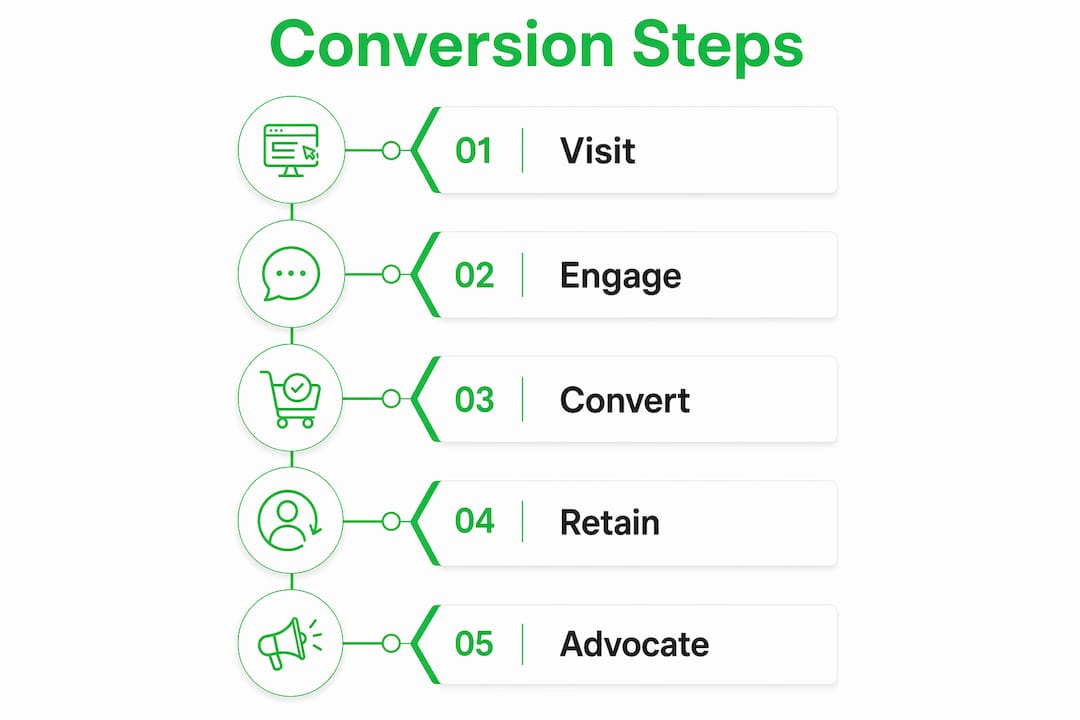
Why conversions matter in your marketing campaigns
Conversions are the link between marketing activity and business results. Without tracking them, you're spending money on traffic with no way to know what that traffic is actually doing.
When you focus on conversions, your marketing spend gets more efficient. You can identify which campaigns, channels, and messages produce real outcomes, then put more budget behind what works. If your store converts at 2% instead of 1%, your revenue doubles from the same traffic volume, with no increase in ad spend.
Key benefits of tracking and optimizing conversions:
- Better ROI visibility: You see exactly which campaigns generate revenue, not just clicks.
- Smarter budget allocation: Cut spend on low-converting traffic sources and reinvest in high-converting ones.
- Deeper customer insight: Conversion data reveals what offers, messages, and formats resonate with your audience.
- Faster campaign iteration: Real conversion data lets you test and improve quickly rather than guessing.
Converted traffic is the real asset. Raw visitor numbers tell you almost nothing on their own.
How to improve your conversion rates
Conversion marketing focuses on optimizing the full user journey, not just driving more traffic. The goal is to reduce friction at every step between a visitor arriving and completing your desired action.
Practical strategies that move the needle:
- Simplify your landing pages. Remove navigation links, competing offers, and anything that pulls attention away from the single goal. Post-click experiences are where conversions are won or lost, and a focused page outperforms a cluttered one every time.
- Write clear calls to action. Your CTA should tell visitors exactly what happens when they click. "Get My Free Guide" converts better than "Submit."
- Run A/B tests. Test one variable at a time: headline, button color, form length, or offer framing. Real data beats assumptions.
- Use personalized content. Match your message to the traffic source. A visitor from a solo ad campaign has different context than one from an organic search.
- Reduce form friction. Ask only for the information you actually need. Every extra field reduces completions.
Pro Tip: Reducing page load time by even 0.1 seconds can increase conversion rates by over 8%. Technical performance is not a secondary concern. It's one of the highest-leverage changes you can make before touching your copy or design.
For affiliate marketers, understanding why solo ads fail often comes down to the same issue: traffic arrives, but the post-click experience doesn't match the promise of the ad.
How do marketers track conversions?
Conversion tracking connects your marketing activity to specific outcomes. Without it, you can't calculate conversion rate, run meaningful A/B tests, or allocate budget with confidence.
Common tracking methods and tools:
- Google Analytics 4 (GA4): Tracks goal completions, form submissions, purchases, and custom events across your site. Free and widely used.
- Google Ads conversion tracking: Measures which ad clicks lead to purchases, signups, or other defined actions on your site.
- Meta Pixel: Tracks conversions from Facebook and Instagram ads, including purchases and lead form completions.
- UTM parameters: URL tags that identify which campaign, source, and medium drove a specific conversion. Works with any analytics platform.
- CRM integration: Tools like HubSpot or Salesforce connect marketing touchpoints to actual customer records, giving you a full view from first click to closed deal.
The method you choose depends on your traffic source and business model. Email marketers typically rely on UTM parameters combined with GA4. Paid advertisers lean on platform-native tracking like Google Ads or Meta Pixel for attribution.
How conversions fit into the marketing funnel
Every stage of the marketing funnel has its own conversion goal. Understanding where a conversion sits in the funnel tells you how to measure it and what to do next.
- Top of funnel (awareness): Conversions here are micro actions. A visitor reads a blog post and subscribes to your email list. The goal is capturing interest.
- Middle of funnel (consideration): The prospect downloads a guide, attends a webinar, or requests more information. These conversions signal intent and move the lead closer to a decision.
- Bottom of funnel (decision): The prospect makes a purchase, books a call, or signs a contract. This is the macro conversion most campaigns are ultimately built around.
Tracking conversions at each funnel stage lets you pinpoint exactly where leads drop off. If you have strong top-of-funnel opt-in rates but weak bottom-of-funnel purchases, the problem is in your nurture sequence or offer, not your traffic. That's a very different fix than if your opt-in rate is low from the start.
For marketers using affiliate traffic channels, aligning the right conversion goal to the right funnel stage is what separates campaigns that scale from ones that stall.
Key Takeaways
Conversion in marketing is the foundational metric connecting every campaign action to a measurable business result, and improving it requires optimizing the full user journey, not just driving more traffic.
| Point | Details |
|---|---|
| Conversion definition | A conversion is any action a visitor completes that aligns with your campaign goal, from a purchase to a form submission. |
| Conversion rate formula | Divide total conversions by total visitors, then multiply by 100 to get your conversion rate percentage. |
| Ecommerce benchmark | A 3% conversion rate is generally considered good for ecommerce, but your own past performance is the most useful benchmark. |
| Micro vs. macro conversions | Micro conversions (opt-ins, clicks) reveal funnel gaps; macro conversions (purchases, signups) measure campaign success. |
| Page speed impact | Reducing load time by 0.1 seconds can increase conversion rates by over 8%, making technical performance a high-priority lever. |
Recommended
- What Does Ad Copy Mean in Marketing? 2026 Guide
- Why Ad Frequency Affects Conversions: 2026 Guide
- How to Buy Solo Ads That Actually Convert (Step-by-Step)
- What Is a Business Email Campaign? A 2026 Guide
Want Verified Traffic Without the Guesswork?
PulseTraffic screens every seller, filters bot clicks in real time, and shows you verified buyer traffic labels before you spend a dollar.