

What is performance marketing, and how does it work?
Performance marketing is a results-driven advertising model where advertisers pay only when a specific, pre-defined action is completed. No impressions. No guesswork. Payment is triggered by a measurable outcome: a click, a lead form submission, a sale, or an app install.
This is the core principle that separates performance marketing from most traditional advertising. You define the action you want, agree on a price for that action, and pay only when it happens. The financial risk shifts from the advertiser to the publisher or partner carrying the campaign.
A few elements define every true performance marketing setup:
- Measurable outcomes: Every campaign targets a specific, trackable action rather than general visibility.
- Pre-agreed payment terms: Advertisers and partners agree on the cost per action before the campaign launches.
- Real-time tracking: Tools monitor every click, form fill, or purchase as it happens, allowing fast adjustments.
- KPI-driven evaluation: Metrics like Cost Per Acquisition (CPA), Click-Through Rate (CTR), and Return on Ad Spend (ROAS) determine whether a campaign is working.
The model gained traction alongside the rise of internet advertising, when it became technically possible to track exactly what a user did after seeing an ad. Today it covers paid search, social media ads, affiliate programs, native advertising, and retail media, all unified by one rule: pay for results, not potential.
How performance marketing differs from brand marketing and affiliate marketing
These three terms get mixed up constantly, and the confusion costs marketers real money. Understanding where each one starts and stops makes budget decisions much cleaner.

Performance marketing focuses on immediate, trackable conversions. Brand marketing focuses on awareness, reputation, and long-term emotional connection with an audience. Both are legitimate strategies, but they operate on completely different timelines and success metrics.
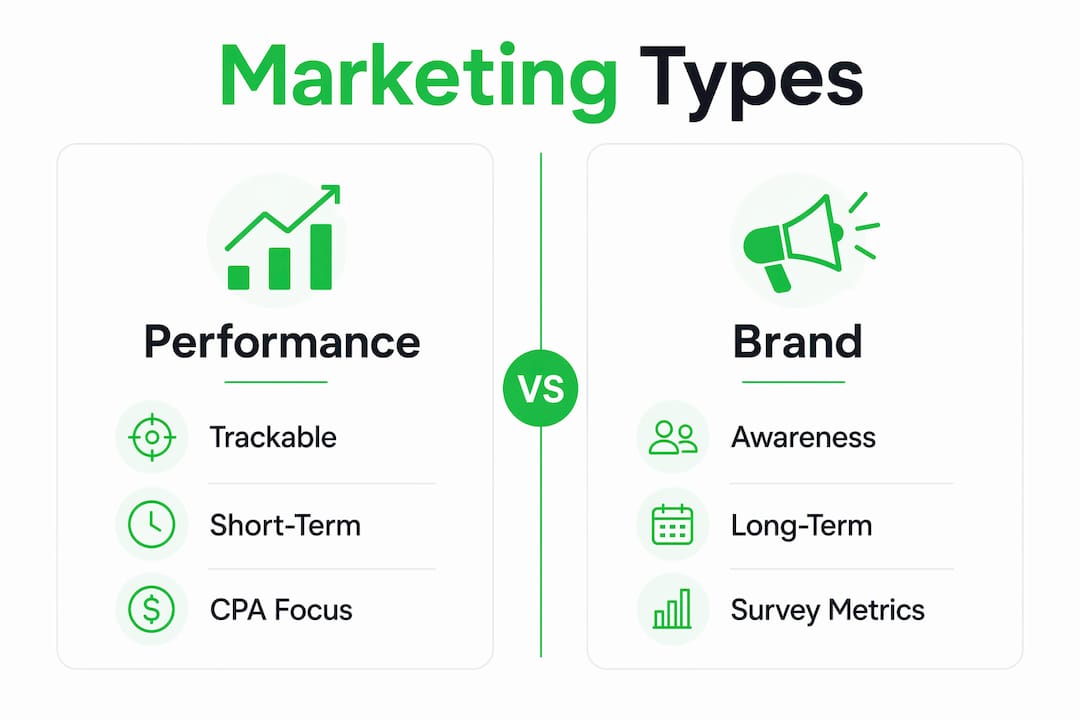
Brand marketing is measured in quarters or years, using tools like brand-tracking surveys, share-of-voice analysis, and sentiment studies. Performance marketing is measured in days or weeks, using CPA, ROAS, and CTR pulled from live dashboards. A company running a Super Bowl ad is doing brand marketing. A company paying only when someone clicks through to a product page is doing performance marketing.
Affiliate marketing is a subset of performance marketing, not a synonym for it. In an affiliate program, a third-party publisher or influencer promotes your product and earns a commission only when a conversion occurs. That payment-on-conversion structure makes it performance marketing. But performance marketing is broader: it also includes paid search, social media advertising, native ads, and programmatic display, none of which require an affiliate partner.
A quick comparison of the three:
- Brand marketing: Goal is awareness and reputation; success is measured by sentiment and reach; budget is defended through long-term narrative.
- Performance marketing: Goal is measurable conversion; success is measured by CPA, ROAS, and CTR; budget is justified by a direct return.
- Affiliate marketing: A performance marketing channel where third-party partners earn commissions on completed actions, typically sales or leads.
One common misconception worth clearing up: paying for impressions (CPM) without tying payment to any user action is traditional advertising, not performance marketing. True performance marketing requires billing models directly linked to conversion outcomes.
Types and channels of performance marketing
Performance marketing runs across several distinct channels, each with its own payment model and best-fit use case. Knowing which channel fits which goal is where strategy actually begins.
Affiliate marketing
Affiliates are third-party publishers, bloggers, or influencers who promote your product to their audience using a unique tracking link or code. You pay only when their audience converts. Commission structures vary: flat fee per sale, percentage of sale value, or a fixed cost per lead. This channel works especially well for e-commerce brands and subscription products with clear lifetime value.
Paid search (SEM)
Paid search places your ads at the top of Google or Bing results when users search for specific terms. The dominant payment model is pay-per-click (PPC): you pay only when someone clicks your ad. A florist bidding on "wedding bouquets near me" pays only when a searcher clicks through, not for every person who sees the ad. For high-intent searches, this channel delivers some of the most qualified traffic available.
Social media advertising
Platforms like Meta, TikTok, and LinkedIn let advertisers run campaigns optimized for specific actions: link clicks, lead form completions, purchases, or app installs. Payment can be structured as CPC, CPL, or CPA depending on the campaign objective. Social media advertising reaches users based on behavior and interest data, making it effective for both prospecting and retargeting.

Native advertising
Native ads match the look and feel of the content surrounding them, appearing as sponsored articles, recommended posts, or in-feed placements on news sites and content platforms. They typically run on a CPC or CPM basis, with performance measured by click-through rates and downstream conversions. Because they blend with editorial content, they tend to generate higher engagement than standard display ads.
Retail media
Retail media places ads directly within e-commerce platforms like Amazon or Walmart's marketplace. Advertisers pay for sponsored product placements that appear when shoppers search for relevant items. Payment is usually CPC, and the conversion data is exceptionally clean because the purchase happens on the same platform.
| Channel | Primary payment model | Best for |
|---|---|---|
| Affiliate marketing | CPA or revenue share | E-commerce, subscriptions |
| Paid search (SEM) | CPC (pay-per-click) | High-intent buyers |
| Social media ads | CPC, CPL, or CPA | Prospecting and retargeting |
| Native advertising | CPC or CPM | Content-driven awareness with conversion |
| Retail media | CPC | In-market shoppers |
Each of these channels shares one defining characteristic: you can attribute spend to a specific outcome. That attribution is what puts the "performance" in performance marketing.
How to measure the effectiveness of performance marketing
Measurement is where performance marketing earns its name. Without the right metrics, you are just running ads and hoping. With them, you can see exactly which campaigns are profitable and which are burning budget.
The five KPIs that matter most for a modern performance marketing setup are Hook Rate, CTR, CPA, MER, and CAC Payback Period. Each one answers a different question about campaign health.
- Hook Rate: The percentage of people who stop scrolling and engage with your ad in the first few seconds. A low hook rate means your creative is not stopping anyone, and no amount of targeting fixes that.
- Click-Through Rate (CTR): The ratio of clicks to impressions. CTR tells you whether your ad message is compelling enough to drive action after the initial stop.
- Cost Per Acquisition (CPA): The total cost to acquire one paying customer. This is the most direct measure of campaign profitability and the metric most advertisers optimize toward.
- Marketing Efficiency Ratio (MER): Total revenue divided by total ad spend across all channels. Since the iOS 14 privacy change in 2021 broke traditional attribution models, MER has become the go-to "north star" metric for understanding overall return on marketing spend without relying on user-level tracking data.
- CAC Payback Period: How many months it takes to recover the cost of acquiring a customer. Short payback periods indicate a healthy, scalable model; long ones signal a cash flow problem.
Key insight: MER works as a privacy-safe efficiency metric because it measures total business output against total spend, bypassing the need for individual user tracking that privacy regulations have restricted.
Weekly reviews of short-term metrics like CPA and CTR keep campaigns on track day to day. Quarterly reviews of longer-horizon metrics like CAC Payback Period reveal whether the overall acquisition model is sustainable.
Attribution remains the hardest problem in performance measurement. Market volatility has also caused fluctuations in CPM costs across platforms, which means cost-per-outcome metrics can shift even when campaign quality stays constant. Tracking these changes weekly, rather than monthly, gives you the fastest signal that something needs adjusting.
Pro Tip: Set up a simple weekly dashboard that tracks CPA and CTR side by side. When CPA rises but CTR holds steady, the problem is usually your landing page or offer, not the ad itself. When both drop together, look at your creative first.
Key benefits of using performance marketing
The case for performance marketing comes down to one practical reality: you only spend money when something measurable happens. That structure changes how budgets work and how risk is distributed.
- Higher ROI: Every dollar is tied to a specific outcome, so waste is structurally limited. You are not funding reach that never converts.
- Low financial risk: The pay-for-performance model means publishers and partners carry the exposure. If a campaign underperforms, your spend stays low automatically.
- Real-time tracking: Metrics like CTR, CPA, and ROAS update continuously, so you can pause underperforming ads or shift budget to winners within hours, not weeks.
- Scalability: When a campaign hits its target CPA, you can increase budget with confidence. The economics are proven before you scale.
- Flexibility: Campaigns can be adjusted mid-flight. Change the creative, shift the audience, or swap the channel without scrapping the whole effort.
- Accountability: Every partner, publisher, or affiliate is paid based on what they actually deliver. There is no payment for effort or reach alone.
- Budget efficiency: Because payment is tied to outcomes, even modest budgets can generate meaningful results when directed at the right channel and audience.
For affiliate marketers and solo ad buyers in particular, this accountability structure is what makes performance marketing worth learning. When you understand which actions you are paying for and how to track them, you stop guessing and start making decisions based on data. Resources like solo ad performance benchmarks can help you calibrate what good looks like across key metrics before you commit budget.
Common examples of performance marketing in real-world practice
Performance marketing shows up across dozens of campaign types. The common thread is always the same: a defined action, a tracking mechanism, and payment tied to completion.
- Pay-per-click search ads: A software company bids on "project management tool" in Google Ads and pays only when a searcher clicks through to the pricing page. The goal is trial signups, tracked via a conversion pixel.
- Affiliate marketing campaigns: A fitness brand partners with health bloggers who share unique discount links. Each blogger earns a commission only when a reader completes a purchase using their link.
- Social media lead ads: A mortgage lender runs Meta lead ads where users submit their contact information without leaving the platform. The lender pays per completed lead form, not per impression.
- Native advertising placements: A financial services company places sponsored articles on news sites through a content distribution network. Payment is CPC, and the downstream goal is newsletter signups tracked by UTM parameters.
- App install promotions: A mobile game developer runs campaigns on ad networks paying only when a user installs the app. Cost Per Install (CPI) is the payment model, and the developer tracks which networks deliver users who actually play past day one.
- Retail media sponsored listings: A consumer goods brand pays for sponsored product placement on a major e-commerce platform, appearing at the top of search results for relevant queries. Payment is CPC, with ROAS tracked directly through the platform's reporting dashboard.
- Email solo ad campaigns: An affiliate marketer pays a list owner to send a dedicated email to their subscribers, with payment structured around clicks delivered to a squeeze page. Click tracking is essential here to verify delivery and measure opt-in rates accurately.
Each example above has a clear, trackable action at its center. That specificity is what separates these campaigns from general advertising spend.
How to build an effective performance marketing strategy
A performance marketing strategy is not a single campaign. It is a repeatable system built around clear goals, the right channels, and continuous measurement. Here is how to put one together that actually holds up.
- Set specific, measurable goals first. "Get more leads" is not a goal. "Achieve a CPA of $25 for email opt-ins within 60 days" is. Your goal determines which metric you optimize and how you evaluate success.
- Choose channels based on where your audience converts. Paid search works for high-intent buyers actively searching for a solution. Social media ads work for building demand among audiences who do not know you yet. Affiliate marketing works when you want partners to carry the promotional load. Match the channel to the conversion behavior, not to what is trendy.
- Build creative with conversion in mind. Your ad creative is not decoration. It is the first filter in your funnel. A strong hook stops the scroll; a clear value proposition drives the click; a specific call to action completes the conversion. Weak creative cannot be fixed by better targeting.
- Set up tracking before you spend a dollar. Install conversion pixels, configure UTM parameters, and test your tracking links before the campaign goes live. You cannot optimize what you cannot measure, and discovering a broken pixel after two weeks of spend is an expensive mistake.
- Allocate budget with room to test. Do not put your entire budget into one ad set or one channel. Reserve a portion for testing new creatives, audiences, or placements. The winning combinations rarely show up on the first try.
- Review metrics on a structured cadence. Short-term metrics like CPA and CTR need weekly attention. Broader indicators like CAC Payback Period and MER need quarterly review to reveal trends that weekly data obscures.
- Optimize continuously, not occasionally. Performance marketing rewards marketers who make frequent, data-backed adjustments. Pause ads with high CPA and low CTR. Scale ads that hit target CPA. Rotate creatives before fatigue sets in.
Pro Tip: In 2026, major advertising platforms prioritize creative volume in their machine learning systems. Spend more of your time producing and testing multiple creative variations than fine-tuning audience targeting settings. The algorithm rewards creative iteration, and digital ad best practices consistently reflect this shift.
For campaigns that include email traffic, segmentation plays a direct role in conversion rates. Sending the right message to the right segment of your list is a core optimization lever, and a structured approach to email segmentation can meaningfully lower your CPA over time.
Expert insights on key KPIs and current performance marketing trends
The performance marketing environment in 2026 looks different from what it was five years ago. Two forces reshaped it: privacy regulation and the rise of machine learning in ad platforms.
The iOS 14 update in 2021 was the turning point. It broke the user-level attribution stack that performance marketers had relied on for years. Pixel-based tracking became less reliable, last-click attribution models started producing misleading data, and MER emerged as the metric that could still give a clear picture of overall marketing efficiency without depending on individual user data. MER does not require perfect attribution. It simply divides total revenue by total ad spend and tells you whether the business is getting a return on its marketing investment as a whole.
The shift in platform algorithms is equally significant. Ad platforms now use machine learning systems that learn from creative performance signals rather than from detailed audience targeting parameters. This means the old approach of building tightly defined audience segments and running one or two ads against them is less effective than it used to be. The platforms need creative variety to find the combinations that convert. Marketers who produce more creative variations and test them systematically tend to outperform those who spend their time refining audience settings.
Current trends shaping performance marketing strategy:
- MER as the north star metric: Because it is privacy-safe and channel-agnostic, MER gives a reliable read on overall efficiency even when individual channel attribution is incomplete.
- Creative volume over targeting precision: Platform algorithms reward marketers who give them more creative signals to learn from. Testing multiple ad formats, hooks, and messages consistently outperforms narrow audience targeting.
- CPM volatility: Market volatility has caused meaningful fluctuations in CPM costs across platforms, which affects CPA even when campaign quality is unchanged. Monitoring cost metrics weekly helps catch these shifts early.
- Hook Rate as an early warning signal: Before CTR or CPA can tell you anything, hook rate tells you whether your creative is stopping people at all. Low hook rate is the earliest signal that creative needs to change.
- CAC Payback Period as a sustainability check: A campaign can hit its target CPA and still be unsustainable if customers churn before the acquisition cost is recovered. Tracking payback period quarterly keeps the long-term model honest.
For marketers comparing channel options, understanding how paid social compares to other performance channels in terms of cost structure and conversion behavior is a practical starting point for channel allocation decisions.
The five KPIs that survived the post-iOS 14 transition, Hook Rate, CTR, CPA, MER, and CAC Payback Period, are not arbitrary. Each one measures a different layer of campaign health, from creative effectiveness at the top to business sustainability at the bottom. Running all five together gives you a complete picture that no single metric can provide on its own.
Grow your results with Soloadsguide

Performance marketing works when every dollar is tied to a measurable outcome. Solo ads are one of the most direct performance channels available to affiliate marketers, and the difference between a profitable campaign and a wasted budget often comes down to the quality of the traffic source.
Soloadsguide specializes in exactly that. The platform provides verified, tier-1 solo ad vendors tested for real conversion rates, so you are not guessing which list owners actually deliver buyers. Whether you are just getting started or looking to scale a campaign that is already working, Soloadsguide gives you the vendor intelligence to make better decisions faster.
Check out the best solo ads providers ranked and reviewed for 2026, and find the traffic source that fits your offer and your budget.
Key Takeaways
Performance marketing delivers measurable ROI because payment is tied directly to specific actions like clicks, leads, or sales, making every dollar of ad spend accountable.
| Point | Details |
|---|---|
| Pay only for results | Advertisers pay when a defined action is completed, not for impressions or reach alone. |
| Five core KPIs | Hook Rate, CTR, CPA, MER, and CAC Payback Period together give a complete picture of campaign health. |
| MER as the north star | Since iOS 14 disrupted attribution, MER measures total revenue against total spend without user-level tracking. |
| Creative volume wins | Platform machine learning systems reward creative iteration over narrow audience targeting in 2026. |
| Weekly and quarterly reviews | CPA and CTR need weekly monitoring; CAC Payback Period needs quarterly review to track long-term sustainability. |
Recommended
- Solo Ads vs Paid Social Ads: 2026 Marketer's Guide
- Solo Ad Marketplace Explained: Your 2026 Buying Guide
- Email Segmentation in Campaigns: A 2026 Guide
- Email Traffic Profit Margin Benchmarks: 2026 Guide
Want Verified Traffic Without the Guesswork?
PulseTraffic screens every seller, filters bot clicks in real time, and shows you verified buyer traffic labels before you spend a dollar.