

Solo ads deliver better results than banner ads for affiliate marketers, and the gap is measurable. Where banner ads fight for attention on cluttered web pages, solo ads land as a dedicated email in a subscriber's inbox, with your offer as the only message. The result is higher opt-in rates, typically ranging from 30–50% for solo ads, substantially exceeding the low engagement banner ads generate. That difference comes down to targeting, exclusivity, and the way email audiences are conditioned to respond.
Here is why solo ads consistently outperform banner ads for affiliate marketers:
- Targeted traffic: You reach subscribers who already opted into a niche list relevant to your offer.
- No banner blindness: Email recipients read the message rather than scroll past a display unit.
- Predictable pricing: You pay a fixed cost per click, with no auction volatility.
- Faster results: Traffic can arrive within a couple of days of placing an order.
- Clean tracking: Click-level attribution is straightforward, making ROI calculation simple.
- No platform ban risk: You deal directly with a list owner, not an ad platform with compliance rules.
- List-building potential: Every opt-in can become a subscriber on your own list, a long-term asset.
Solo ads give affiliate marketers something banner ads rarely can: a focused, pre-qualified audience reading a single message with one call to action. That exclusivity is the core reason conversion rates are consistently higher.
What are solo ads, and how do they differ from banner ads?
A solo ad is a paid email advertisement sent by a list owner to their subscribers on your behalf. The entire email promotes your offer and nothing else. You are not sharing space with other advertisers, editorial content, or competing links. That exclusivity is what separates solo ads from virtually every other paid channel.
Banner ads work differently. They appear as display units embedded in web pages, competing for attention alongside articles, navigation menus, videos, and other ads. Users have become so accustomed to ignoring these units that researchers have documented the phenomenon as "banner blindness," the tendency for web visitors to tune out display advertising almost automatically.
Solo ads, by contrast, reach people through email lists built around specific niches. A list owner in the make-money-online (MMO) space, for example, has subscribers who opted in because they wanted information on earning online. When your offer lands in that inbox, it reaches an audience already interested in what you are selling. That is the targeting mechanism, and it is far more precise than placing a banner on a broadly trafficked website.
Core terms to know:
- Squeeze page: A landing page designed to capture an email address, usually in exchange for a free lead magnet.
- Opt-in rate: The percentage of visitors who submit their email on your squeeze page.
- Lead magnet: A free resource (checklist, video, ebook) offered to incentivize sign-ups.
- Tier-1 traffic: Clicks from high-value English-speaking countries, primarily the US, UK, Canada, Australia, and New Zealand.
- Click-through rate (CTR): The percentage of email recipients who click your link.
Pro Tip: Always confirm that a vendor's list is niche-specific before buying. A general "internet marketing" list and a focused "affiliate marketing for beginners" list can produce very different opt-in rates, even at the same price per click.
How solo ads work step by step
Running a solo ad campaign is straightforward compared to setting up paid social or search ads. There is no pixel to install, no learning phase, and no ad creative to produce beyond an email and a landing page.
-
Find a vendor whose list matches your niche. Look for sellers who specialize in your market, whether that is MMO, crypto, health, or personal development. Check reviews, ask for recent traffic statistics, and confirm the geographic breakdown of their list.
-
Agree on the order details. Negotiate the number of clicks, the price per click, and the delivery window. Most vendors price clicks within a moderate range for quality tier-1 traffic. Confirm that the vendor uses unique click tracking to filter out duplicate visits from the same IP address.
-
Prepare your squeeze page and email copy. Send the vendor your tracking link and your ad copy. Some vendors write the email themselves; others send exactly what you provide. Either way, the email goes out under the list owner's sender name, which carries trust with their subscribers.
-
The vendor sends the email. Their subscribers receive a dedicated message promoting your offer. No other ads, no competing content. Just your link.
-
Traffic arrives at your squeeze page. Most orders deliver within 24–48 hours. You can monitor clicks in real time using a tracking tool like ClickMagick or a similar link tracker.
-
Measure your opt-in rate and follow up. Track how many visitors opt in, what your cost per lead is, and whether those leads convert further down your funnel. Your follow-up email sequence does the heavy lifting from this point.
-
Evaluate and scale. If a vendor delivers strong opt-in rates and conversions, order again. If results are weak, test a different vendor before assuming the problem is your offer.
Pro Tip: Test at least three to five vendors before drawing conclusions about your funnel's performance. A single underperforming list tells you about that list, not about solo ads as a channel. Testing multiple vendors is the standard practice for scaling successfully.
How solo ad pricing compares to banner ad costs
Solo ads use two main payment models, and both offer more predictability than the auction-based systems that govern most banner ad placements.

Pay-per-click (PPC): You pay a fixed rate for each unique click delivered to your link. The price is agreed upon before the campaign runs. There is no bidding, no rising CPM, and no surprise invoice at the end of the month.
Flat fee per mailing: Some vendors charge a fixed amount to mail their entire list, regardless of how many clicks result. This model is less common but can be cost-effective when the list is large and engaged.
Banner ads, by contrast, typically use cost-per-thousand-impressions (CPM) pricing on programmatic networks, where costs fluctuate based on real-time auctions. A Black Friday bidding war or a sudden surge in advertiser demand can spike your CPM overnight. Solo ads use fixed per-click pricing, negotiated directly with the list owner, which removes that volatility entirely.
| Factor | Solo Ads | Banner Ads (Display Networks) |
|---|---|---|
| Pricing model | Fixed cost per click | CPM auction (variable) |
| Price predictability | High — agreed upfront | Low — fluctuates with demand |
| Minimum spend | Often accessible with a lower starting budget | Varies; often higher on premium networks |
| Audience targeting | Niche email list | Demographic and contextual signals |
| Competition for placement | None (direct negotiation) | Auction-based, competitive |
| Setup time | Same day | Hours to days, depending on platform |
| Account ban risk | None | Low to moderate |
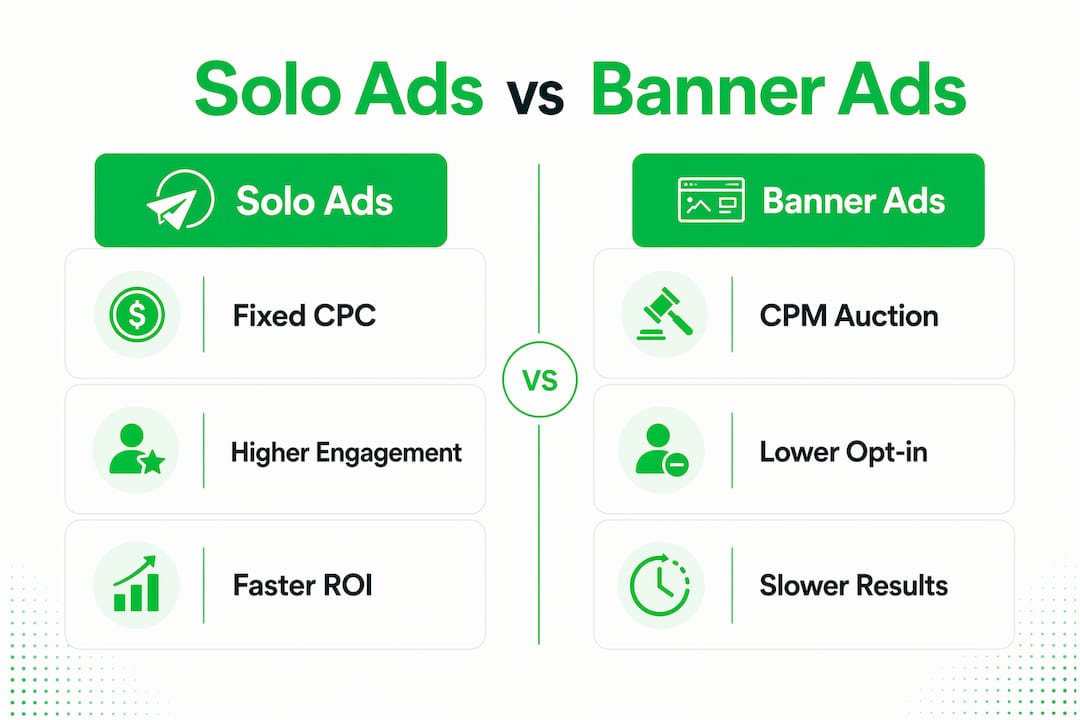
The fixed-rate model also makes budget planning straightforward. The fixed-rate model means you know your total spend before the campaign starts, aiding budget control. That kind of cost control is difficult to achieve with CPM-based display buying, where your actual spend depends on how many impressions the algorithm decides to serve.
Key benefits of solo ads versus banner ads
The performance gap between solo ads and banner ads is not a matter of opinion. It comes from structural differences in how each channel reaches its audience.

Targeting through list segmentation. Banner ad networks target by demographics, browsing behavior, or contextual keywords. Solo ad vendors target by the specific niche their list was built around. A subscriber on a crypto investing list opted in because they wanted crypto content. That intent signal is far stronger than a cookie-based demographic match.
Higher engagement and opt-in rates. Solo ads often see 30–50% opt-in rates on well-matched squeeze pages, while banner ads primarily generate brand awareness with much lower engagement. Email recipients read messages; banner viewers scroll past them.
Bypassing banner blindness. Display advertising suffers from a well-documented problem: users learn to ignore ad units, especially in familiar positions like the top of a page or the right sidebar. Solo ads arrive in the inbox as a personal message, which sidesteps this issue entirely.
Faster traffic and quicker ROI. Most solo ad orders deliver within a couple of days. Compare that to SEO, which takes months, or to paid social platforms that require days of learning phase before the algorithm stabilizes your costs.
No ad fatigue or account bans. Solo ads bypass platform account bans common in paid social and search advertising, because you are paying a person to send an email rather than running on a platform with compliance rules. Affiliate offers in MMO, crypto, and weight loss get flagged constantly on Facebook and Google. Solo ads have no such gatekeeping.
Lower cost per conversion in affiliate niches. Industry data indicates that solo ads may achieve lower cost per conversions than some Facebook ad campaigns in affiliate contexts. Worst-case scenarios exist too, which is why vendor selection matters so much.
Risks, challenges, and how to evaluate vendors
Solo ads are not risk-free. The biggest variable is vendor quality, and the market is decentralized enough that bad actors exist alongside excellent list owners.
Vendor quality varies widely. Poor results often stem from bad list selection rather than solo ads failing as a channel. A vendor with a stale, over-mailed list will send you clicks that never convert, regardless of how good your squeeze page is.
Bot traffic is a real threat. Some vendors inflate click counts with automated traffic. Bots can open emails and click links, making engagement metrics look healthy while producing zero real opt-ins or sales. Quality vendors use tracking systems that filter duplicate and bot clicks, so you only pay for genuine unique visitors.
List freshness matters. A list that was built two years ago and mailed daily since then has subscriber fatigue. The same subscribers have seen hundreds of offers and are far less likely to respond to yours. Ask vendors how recently their list was built and how frequently they mail.
Red flags to watch for:
- Vendors who guarantee unusually high opt-in rates without knowing your offer or squeeze page.
- No verifiable reviews or testimonials from recent buyers.
- Refusal to share traffic statistics or geographic breakdowns.
- Prices significantly below the market rate of $0.30–$0.70 per click for tier-1 traffic.
- No unique click filtering mentioned in their delivery terms.
Best practices for vetting vendors:
- Read recent buyer reviews on independent forums and communities.
- Start with a small test order of 100–200 clicks before committing to a larger spend.
- Use a tracking link to verify click volume, geographic split, and delivery timing independently.
- Check whether the vendor's niche aligns specifically with your offer, not just broadly.
- Ask for a sample of recent buyer results or testimonials.
For a thorough evaluation process, Soloadsguide publishes an advanced vendor vetting checklist that covers every checkpoint affiliate marketers should run through before placing an order.
Key performance metrics and calculating ROI for solo ads
Tracking solo ad campaigns is simpler than tracking banner or paid social campaigns because click-level attribution is clean and direct. There is no algorithm dispersing your clicks across audiences, no iOS privacy degradation, and no multi-touch attribution model to untangle.
Metrics to track on every campaign:
- Opt-in rate: Percentage of click visitors who submit their email. A healthy rate for a well-matched offer is 30–45%.
- Cost per lead (CPL): Total spend divided by the number of opt-ins. This is your primary efficiency metric.
- Click-through rate (CTR): Percentage of email recipients who clicked your link. Useful for evaluating the vendor's list engagement.
- Conversion rate: Percentage of opt-ins who complete a desired action, such as purchasing a product or signing up for a webinar.
- Cost per acquisition (CPA): Total spend divided by the number of paying customers.
ROI calculation:
ROI = ((Revenue from campaign minus Campaign cost) divided by Campaign cost) multiplied by 100
Example campaign data:
| Metric | Value |
|---|---|
| Clicks purchased | 500 |
| Cost per click | — |
| Total spend | — |
| Opt-in rate | 30–50% |
| Opt-ins generated depends on campaign specifics and list quality. | |
| Cost per lead varies with campaign parameters and traffic quality. | |
| Conversion rates vary widely depending on offer and audience quality. | |
| Sales generated depends on conversion rates and campaign performance. | |
| Revenue per sale depends on affiliate offer specifics. | |
| Estimated revenue depends on sales volume and commission rates. |
Banner ad campaigns complicate this calculation because CPM-based buying makes it harder to isolate exactly which impressions drove which conversions. With solo ads, every click is tracked through your own link, so the data is yours from the start.
Crafting effective solo ad copy
The email copy you provide to a vendor, or that the vendor writes on your behalf, determines whether subscribers click or ignore your message. Strong solo ad copy is focused, short, and built around a single action.
What makes solo ad copy work:
- A subject line that creates curiosity or urgency. The subject line is the only thing standing between your email and the delete button. Keep it under 50 characters, avoid spam trigger words, and make the reader want to know more.
- A short, direct body message. Three to five sentences is usually enough. State the problem, hint at the solution, and tell the reader exactly what to do next.
- One clear call to action. Every link in the email should point to the same destination. Multiple links to different pages dilute focus and reduce clicks.
- Personalization where possible. Using the subscriber's first name in the subject line or opening line can lift open rates, though this depends on the vendor's email platform.
- No overloaded copy. Long emails with multiple offers, bullet-heavy formatting, and excessive claims perform worse than concise, conversational messages.
Copywriting tips for higher conversions:
- Lead with the benefit, not the feature. "Get 50 leads this week" beats "Our system has advanced targeting."
- Write like you are talking to one person, not a list of thousands.
- Use a P.S. line. Many readers skip to the postscript, so put a second version of your call to action there.
- Match the tone of the list owner's usual emails. If their list is used to casual, conversational messages, a formal corporate tone will feel out of place.
- Test two subject line variants across different vendor orders to identify which framing drives higher open rates.
Pro Tip: Never send the same email copy to every vendor. Tailor the subject line and opening sentence to reflect the specific niche of each list. A crypto list and an affiliate marketing list have different vocabularies and pain points, and your copy should reflect that.
Industry insights: solo ads deliver superior conversions and build long-term assets
The case for solo ads goes beyond a single campaign's opt-in rate. Experienced affiliate marketers treat solo ads as a business-building tool, not just a traffic source. Every subscriber who opts in through a solo ad campaign can become a permanent asset on your own email list, one you can market to repeatedly without paying for traffic again.
Niche-specific email targeting consistently produces better conversions than broad banner ad placements, particularly in high-engagement niches like MMO, crypto, affiliate marketing, and product launches. These audiences are conditioned to respond to email offers. They expect promotions, they click links, and they have higher lifetime values than cold display traffic.
The exclusivity of a solo ad email is a structural advantage that banner ads cannot replicate. When a subscriber opens a solo ad, your offer has their full attention. There is no competing ad unit, no editorial content pulling focus, and no navigation menu to distract them. That focused environment is why engagement rates are consistently higher.
Solo ads also eliminate the platform algorithm risks that make paid social advertising unpredictable in affiliate niches. Platform bans are not a risk when you are buying clicks through a list owner rather than running on Facebook or Google. For marketers promoting offers in MMO, crypto, or weight loss, where income claims and before-and-after creative get flagged constantly, that freedom is a practical advantage with real budget implications.
The opt-in rate comparison tells the clearest story. Solo ads achieve significantly higher opt-in rates, typically 30–50% on well-matched squeeze pages, compared to the low engagement banner ads generate. For affiliate marketers whose primary goal is building an email list, that gap translates directly into a lower cost per subscriber and a faster path to a monetizable asset.
Common misconceptions about solo ads vs. banner ads
Several myths circulate about both channels, and they lead marketers to make poor budget decisions. Here is what the evidence actually shows.
Myth 1: Solo ads are a scam. This one persists because some vendors do deliver poor-quality traffic. But the channel itself is not the problem. A bad vendor with a bot-filled list will waste your money. A vetted vendor with a fresh, niche-relevant list can deliver opt-in rates that no banner campaign can match. The issue is vendor selection, not the format.
Myth 2: Banner ads reach more people, so they must be better. Reach without relevance produces low conversion rates. A banner served to a million general web visitors generates fewer qualified leads than a solo ad sent to ten thousand subscribers who opted into a list specifically about your niche. Volume is not the same as quality.
Myth 3: Solo ads only work for MMO offers. MMO and crypto are the most common niches because email audiences in those spaces are highly responsive. But solo ads also perform well in health and wellness, personal development, and digital product launches, provided the vendor's list is genuinely focused on that niche.
Myth 4: Banner ads are easier to track. The opposite is true. CPM-based display campaigns spread impressions across networks, devices, and placements, making clean attribution difficult. iOS privacy changes have further degraded conversion tracking on paid social platforms. Solo ads use a single tracking link you control, so attribution is direct and complete.
Myth 5: Solo ads are too expensive for beginners. You can test a solo ad campaign with as little as $50–$100. That is a lower barrier than most paid social platforms, which typically require $500 or more to gather statistically meaningful data. The questions to ask before buying are simple, and the setup takes a single day.
Myth 6: One failed campaign proves solo ads do not work. Two marketers can mail the same list and get completely different results, depending on their squeeze page, their offer, and their follow-up sequence. A single underperforming campaign is data, not a verdict. Testing across three to five vendors before drawing conclusions is the standard approach for any marketer who wants reliable results.
Find verified solo ad vendors through Soloadsguide
Knowing why solo ads outperform banner ads is only half the equation. The other half is finding vendors whose lists actually deliver. Soloadsguide maintains a curated, ranked list of top solo ad providers verified for tier-1 traffic and tested for conversion performance. Every provider on the list has been evaluated so you can skip the trial-and-error phase and put your budget to work faster.
Key Takeaways
Solo ads consistently outperform banner ads for affiliate marketers because they deliver targeted, engaged email traffic with predictable costs and clean attribution, producing opt-in rates of 30–50% versus the low engagement banner ads typically generate.
| Point | Details |
|---|---|
| Opt-in rate advantage | Solo ads achieve 30–50% opt-in rates; banner ads generate far lower engagement on the same offers. |
| Cost predictability | Solo ads use fixed per-click pricing negotiated directly with vendors, eliminating auction-based cost spikes. |
| No platform ban risk | Solo ads bypass ad platform compliance rules entirely, making them reliable for affiliate niches like MMO and crypto. |
| Vendor selection is critical | Poor results usually trace back to bad list selection, not the solo ad format itself. |
| Long-term list building | Every opt-in from a solo ad campaign can become a subscriber on your own list, compounding ROI over time. |
Recommended
- Are Solo Ads Worth It for Affiliate Marketers in 2026?
- Are Solo Ads Still Worth It in 2026? Honest Assessment
- Do Solo Ads Work for Affiliate Marketers in 2026?
- Solo Ads vs Paid Social Ads: 2026 Marketer's Guide
Want Verified Traffic Without the Guesswork?
PulseTraffic screens every seller, filters bot clicks in real time, and shows you verified buyer traffic labels before you spend a dollar.