

Subpar vendor performance is defined as the failure of an advertising partner to deliver traffic, targeting, or campaign management that converts at a profitable rate. This failure is the leading cause of wasted ad spend across paid media channels. The average Google Ads account wastes $1,127.54 monthly, which represents more than one-third of a typical $3,127 median budget. That figure is not an anomaly. It reflects a systemic problem rooted in poor vendor selection, misaligned incentives, and structural inefficiencies that most marketers never see on a dashboard. Understanding why subpar vendors waste ad budget is the first step toward protecting your ROI.
Why subpar vendors waste ad budget through poor audience targeting
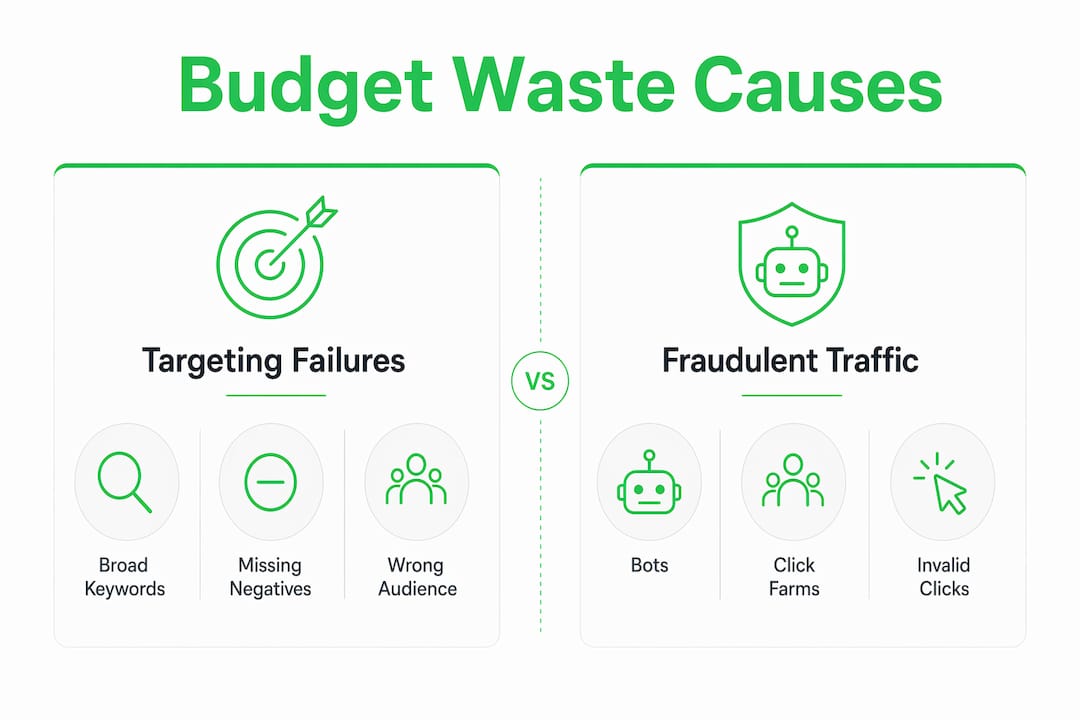
Audience targeting failure is the most common and costly mechanism of budget waste. A vendor who runs broad match keywords without audience layering sends your ads to users who will never buy from you. Broad match and missing negative keywords account for 32% of wasted Google Ads spend in B2B SaaS accounts. That means nearly one-third of your budget disappears before a qualified prospect even sees your offer.
The practical damage shows up fast. A software company running a campaign for "project management tools" on broad match will attract clicks from students searching for free homework planners and job seekers looking for task apps. Each click costs real money. None of those visitors convert. The vendor reports strong click volume, and the marketer assumes the campaign is working.

Accounts lacking negative keyword discipline accumulate irrelevant impressions and high click counts with low conversion rates. This is the classic vanity metric trap. A vendor optimizing for clicks rather than conversions will always look busy while your budget bleeds out.
Signs your vendor has a targeting problem:
- Click-through rate is high but conversion rate is below 2%
- Search term reports show irrelevant queries eating budget
- No negative keyword list has been updated in the past 30 days
- Audience exclusions are absent from campaign settings
- Cost per lead keeps rising while lead quality drops
Pro Tip: Pull your search term report weekly and flag any query that generated more than three clicks without a conversion. Add those terms as negative keywords immediately. A good vendor does this automatically.
Understanding how ad frequency affects conversions also matters here. Overexposure to the wrong audience wastes impressions and trains the algorithm to serve your ads to low-intent users.
What is the real cost of invalid and fraudulent traffic?
Invalid traffic is any ad click or impression generated by bots, click farms, or fraudulent publishers rather than real potential customers. In 2025, invalid traffic cost advertisers $63 billion globally, based on analysis of 2.7 billion clicks. That number reflects 8.51% of all paid traffic being invalid. For every $100 you spend, roughly $8.51 goes to clicks that will never produce a customer.
Platform choice matters more than most marketers realize. TikTok shows the highest invalid traffic rate among major platforms at 24.2%, followed by LinkedIn at 19.88% and X at 12.79%. A vendor placing your budget on high-fraud platforms without disclosing these rates is making a costly vendor mistake on your behalf.
Fraudulent activity takes several forms:
- Bot clicks: Automated scripts click your ads to drain your budget, often run by competitors or fraudulent publishers earning per-click revenue.
- Click farms: Low-paid workers in bulk-click operations generate fake engagement that inflates vendor performance reports.
- Domain spoofing: A vendor buys cheap inventory on low-quality sites while reporting placements on premium domains.
- Ad stacking: Multiple ads are layered in a single placement so only the top ad is visible, but all ads register an impression.
Detecting invalid traffic requires more than trusting your vendor's report. Use third-party tools to cross-reference click data against session behavior. If clicks spike without a corresponding rise in time-on-site or page depth, fraud is the likely cause. Soloadsguide addresses this directly by vetting solo ad vendors for click fraud risks before recommending them to marketers.
How does the programmatic supply chain drain your ad budget?
Programmatic advertising runs through a chain of intermediaries: demand-side platforms (DSPs), supply-side platforms (SSPs), data brokers, and ad exchanges. Each layer takes a cut before your ad reaches a real person. Advertisers lose 30%–50% of each ad dollar to these "tech tax" fees before a single impression is served. That means a $10,000 monthly budget may deliver only $5,000–$7,000 in actual media value.
This structure is not inherently corrupt, but it becomes a problem when vendors use it to obscure where your money goes. A vendor who cannot provide a clear media cost breakdown is almost certainly hiding margin inside the supply chain. The result is that you pay premium rates for inventory that costs the vendor a fraction of what you are charged.
| Budget layer | Typical share of spend |
|---|---|
| Actual media (impressions served) | 50%–70% |
| DSP and SSP fees | 15%–25% |
| Data and targeting fees | 5%–15% |
| Agency or vendor margin | 10%–20% |
The numbers above show why two vendors charging the same rate can deliver very different results. One passes most of the budget to media. The other pockets margin at every layer. An advertising ROI calculator can help you model the real return after fees, giving you a clearer picture of what your budget actually buys.
Pro Tip: Ask any programmatic vendor for a "cost transparency report" that separates media spend from fees. If they refuse or cannot provide one, treat that as a red flag and request a direct IO (insertion order) with a publisher instead.
Why does choosing the cheapest vendor cost more over time?
The cheapest advertising vendor is rarely the least expensive option when you account for total cost of ownership (TCO). Low-cost suppliers carry hidden costs including high defect rates, campaign downtime, and rework that inflate the real price of the relationship. A vendor charging 30% less than the market rate often delivers results that require 50% more budget to fix.
Marketing leaders consistently underestimate vendor switching costs, including the time spent onboarding a new partner, rebuilding campaign history, and re-establishing audience data. These costs make the decision to go cheap even more expensive in hindsight.
Watch for these warning signs when evaluating low-cost vendors:
- No case studies or verifiable conversion data from past clients
- Pricing that seems too far below market rate without a clear explanation
- Vague reporting that shows impressions and clicks but no conversion attribution
- No dedicated account manager or defined point of contact
- Contracts that lock you in for six months or more with no performance guarantees
Cheap solo ad pricing is a common trap in email traffic buying. A vendor selling clicks at $0.20 each when the verified market rate is $0.40–$0.60 is almost certainly delivering bot traffic, recycled lists, or unengaged subscribers. The low price is the warning sign, not the selling point.
How should you monitor vendor performance to protect your budget?
Continuous monitoring is the only reliable defense against poor vendor performance. A vendor who knows you review data weekly behaves differently than one who reports monthly to a client who never checks the numbers. Defined ownership and audit routines minimize the financial damage when vendor failures occur. Without clear roles, incidents escalate before anyone acts.
A practical vendor audit framework looks like this:
- Set conversion tracking before the campaign launches. No vendor should run a single dollar of your budget without confirmed conversion tracking in place.
- Review search term reports weekly. Flag non-converting queries and add negative keywords within 48 hours of identifying them.
- Audit placement reports monthly. Identify low-quality domains and exclude them from your targeting.
- Request a cost breakdown quarterly. Separate media spend from fees to verify your budget is reaching real audiences.
- Benchmark performance against industry standards. Effective ad management keeps waste under 10%–15%. If your vendor's waste rate exceeds that, it is time for a direct conversation.
- Assign one internal owner for each vendor relationship. That person reviews reports, escalates issues, and holds the vendor accountable on a defined schedule.
Pro Tip: Build a simple vendor scorecard with five metrics: cost per conversion, conversion rate, invalid traffic rate, budget utilization, and response time to issues. Score each vendor monthly. A vendor who drops below your threshold two months in a row gets a performance review, not a contract renewal.
Evaluating online advertising options for small and midsize businesses also helps you understand which channels carry the highest vendor risk so you can allocate budget accordingly.
Key Takeaways
Subpar vendors waste ad budgets through targeting failures, invalid traffic, opaque fee structures, and hidden costs that compound over time.
| Point | Details |
|---|---|
| Targeting failures drive waste | Broad match keywords and missing negative keywords account for 32% of B2B Google Ads waste. |
| Invalid traffic is a $63B problem | 8.51% of paid traffic is invalid globally, with TikTok showing the highest platform rate at 24.2%. |
| Tech tax eats 30%–50% of budget | Programmatic intermediaries consume up to half your spend before your ad reaches a real person. |
| Cheap vendors cost more long-term | Low-cost suppliers carry hidden defect and rework costs that inflate total cost of ownership. |
| Audits protect your budget | Weekly search term reviews, monthly placement audits, and defined vendor ownership reduce waste below 15%. |
What I've learned from watching marketers trust the wrong vendors
The most damaging vendor mistakes I have seen share one trait: the marketer trusted the vendor's own reporting. A vendor who controls both the campaign and the performance data has every incentive to show you numbers that justify their fee. Clicks are easy to manufacture. Conversions are not.
The marketers who protect their budgets best treat every vendor relationship as a partnership that requires verification, not faith. They pull raw data from their own analytics tools, cross-reference it against vendor reports, and ask hard questions when the numbers do not align. That habit alone catches most of the waste before it compounds.
The other pattern I have noticed is that marketers underestimate how long it takes to recover from a bad vendor. You do not just lose the budget you spent. You lose the campaign history, the audience data, and the time it takes to rebuild. Choosing a verified vendor from the start is not a premium. It is the cheaper option when you account for everything a bad vendor costs you.
— Phil
How Soloadsguide helps you avoid costly vendor mistakes
Wasted ad spend almost always traces back to a vendor who was never properly vetted. Soloadsguide was built specifically to solve that problem for affiliate marketers and business owners running solo ad campaigns.

Every vendor listed on Soloadsguide has been tested for tier-1 traffic quality, opt-in rates, and conversion performance. Users report a 40% reduction in cost per lead after switching from unverified vendors to Soloadsguide-recommended sources. The platform removes the guesswork from vendor selection by publishing verified performance data alongside each provider listing. Check the best solo ads providers for 2026 to find vendors who deliver real traffic at a cost that makes sense for your budget.
FAQ
Why do subpar vendors waste ad budget so consistently?
Subpar vendors optimize for volume metrics like clicks and impressions rather than conversions, which hides waste in reports while your budget erodes. Studies show that effective management keeps waste under 10%–15%, while poor vendors routinely exceed that threshold.
What percentage of ad spend is typically wasted?
B2B SaaS businesses lose an average of 36.1% of their Google Ads budget to waste, with some accounts losing over 50% on non-converting traffic.
How can I tell if my vendor is sending fraudulent traffic?
Cross-reference click data against session behavior in your own analytics. If clicks rise sharply without a matching increase in time-on-site or goal completions, invalid traffic is the likely cause. You can also review how to avoid solo ad scams for a practical checklist of fraud indicators.
What is the ad tech tax and how does it affect my budget?
The ad tech tax refers to fees taken by DSPs, SSPs, and data brokers in the programmatic supply chain. Advertisers lose 30%–50% of each ad dollar to these intermediaries before an impression is served to a real user.
How often should I audit my vendor's performance?
Review search term reports weekly, placement reports monthly, and request a full cost breakdown quarterly. Clear ownership roles and regular audits are the most reliable way to catch vendor failures before they cause serious financial damage.
Recommended
- How to Avoid Solo Ad Scams: 2026 Buyer's Guide
- Are Solo Ads Still Worth It in 2026? Honest Assessment
- Why Beginners Lose Money on Solo Ads (Real Reasons)
- Solo Ads Blog, Tips, Guides & Reviews | SoloAdsGuide.com
Want Verified Traffic Without the Guesswork?
PulseTraffic screens every seller, filters bot clicks in real time, and shows you verified buyer traffic labels before you spend a dollar.