
Solo ads are worth testing if you already have a proven ecommerce or affiliate funnel and a way to independently track every click. If you don't have both, skip them for now. A solo ad is a dedicated email a list owner sends to their subscribers promoting only your offer, with no other advertisers sharing the send. That single fact drives almost everything else in this guide: how much you pay, what can go wrong, and how you verify what you actually got.
TL;DR:
- Solo ad costs vary widely based on niche, list reputation, and targeted quality, making price alone an unreliable measure of value.
- Independent tracking is essential to verify genuine traffic, with special attention to IP clustering and session duration to detect bots or fake clicks.
- Starting with a small test of 300 to 500 clicks, tracked independently, helps assess opt-in and conversion rates before scaling a campaign.
- Solo ads are most effective for proven funnels, high-commission offers, and list-building campaigns, not for untested landing pages or low-margin offers.
- Always vet vendors using a detailed checklist and negotiate refund or overdelivery terms before purchasing to avoid scams or low-quality traffic.
Table of Contents
- What Is an Ecommerce Solo Ad and How Does It Work?
- Who Should (and Shouldn't) Buy Solo Ads
- Solo Ad Scams and Red Flags to Watch For
- How to Buy and Test Solo Ads Without Getting Burned
- What Solo Ads Actually Cost and How to Run the Math
- Verifying Solo Ad Traffic Is Real
- Buyer Credentials and the Vendor Vetting Framework
- What Successful Ecommerce Solo Ad Campaigns Actually Look Like
- Writing Solo Ad Copy That Works for Ecommerce Offers
- Fitting Solo Ads Into Your Ecommerce Sales Funnel
- Legal and Compliance Rules for Solo Ad Traffic
- A Skeptical Take on Solo Ads Worth Remembering
- Get the Checklist Before Your Next Solo Ad Buy
- Sources
- FAQ
What Is an Ecommerce Solo Ad and How Does It Work?
A solo ad is different from a newsletter sponsorship. In a sponsorship, your ad sits alongside someone else's content and other advertisers. In a solo ad, the entire email is about your offer and nothing else. The list owner (the "vendor") sends it to their subscribers, and you pay for the traffic that results.
For ecommerce advertising strategies, solo ads function as a rented audience. You're not building a list. You're borrowing someone else's, one send at a time, which is exactly why independent tracking matters more here than in almost any other paid channel.
Pricing generally follows one of three models:
- Cost-per-click (CPC): the most common structure, where you pay a set rate per verified click, typically negotiated as a block (say, 200 or 500 clicks).
- Pay-per-open: rarer, and harder to verify independently, since open tracking depends on the vendor's own reporting.
- Flat packages: a fixed price for a promised click count, sometimes bundled with a "top-tier" or "premium" list tier at a higher rate.
Delivery also varies. Some vendors write the email copy themselves using their knowledge of what their list responds to. Others require you to supply the subject line and body copy, which gives you more control but assumes you know that list's preferences. Some sends drop the reader straight onto your landing page; others route through a bridge page first, which can lift opt-ins but adds a step vendors sometimes use to inflate perceived quality.
Before you pay anything, get the click count, delivery window, geo targeting, and overdelivery policy in writing. Verbal promises about "quality traffic" mean nothing without a contract term attached to them.
Who Should (and Shouldn't) Buy Solo Ads
Solo ads suit a narrow set of use cases well. They're a poor fit for almost everything else.
Good fits:
- Affiliate and information-product marketers with commissions high enough to absorb testing costs
- Product launches that need a fast burst of traffic within a fixed promotional window
- List-building campaigns where the goal is opt-ins, not a first-touch sale
Poor fits:
- Landing pages that haven't converted on any other traffic source yet
- Offers with commissions under $10 to $15, where a handful of unqualified clicks erases any margin
- Businesses with no follow-up email sequence ready to nurture the leads that opt in
If you're unproven, start small: a single test buy of 100 to 200 clicks from one vendor, tracked independently, before you commit to anything larger. Scale only after a test batch clears your cost-per-lead threshold on a second, unrelated list, not just the first one.
Solo Ad Scams and Red Flags to Watch For
The solo ads industry has a real quality problem, and it shows up in a handful of repeatable patterns. Knowing them in advance saves you from learning them with your own money.
The most common issues, according to industry breakdowns of solo ad risk, include:
- Scraped or purchased lists dressed up as organic subscribers, which produce clicks but almost no opt-ins or sales.
- Bot traffic, often visible as clicks arriving in unnatural bursts, all from a narrow IP range, with near-identical timestamps.
- Exhausted lists that have been resold and promoted to death, where subscribers have stopped opening anything.
- Fake or padded click reports that don't match what an independent tracker actually recorded.
Red flags on the seller side are just as telling. Walk away from any vendor who guarantees sales (no one can guarantee a stranger buys anything), who refuses to let you run your own tracking link, or who can't tell you basic facts about their list, like its niche origin, typical geo mix, or approximate open rate.
Pro Tip: Ask for a small sample send, 50 to 100 clicks, before committing to a full package. A vendor confident in their list will agree without hesitation; one who stalls or adds conditions is telling you something.
The remedy for all four issues is the same: insist on tracker reconciliation against the vendor's own report, and get refund or overdelivery terms in writing before you pay; for broader campaign insights, consider comparing solo ad ROI with other acquisition channels like those at Founder Campaigns — PeerFounder. A vendor who won't commit to replacing bad clicks isn't worth testing.
How to Buy and Test Solo Ads Without Getting Burned
Buying a solo ad well is a process, not a transaction. Skip a step here and you're gambling instead of testing.
Before you buy anything:
- Confirm your landing page already converts on some traffic source, even a small one
- Have your follow-up email sequence built and live, not "coming soon"
- Set up independent tracking so you're not relying solely on the vendor's numbers
That last point deserves its own framework, which is exactly why Soloadsguide built a 21-question vendor vetting checklist. A handful of the questions that matter most before you send a payment:
- Where did your list originate, and how do new subscribers opt in?
- What's your average open rate, click rate, and opt-in rate across recent campaigns?
- Can you break down your list by geography?
- What bot-filtering or click-fraud detection do you use?
- What's your refund or overdelivery policy if I don't receive the agreed click count?
- Will you allow me to use my own tracking link?
A vendor who answers all six clearly and specifically is a different category from one who deflects into vague reassurances.
Once you've vetted a seller, set up tracking before the send goes live. Create a unique link through a third-party tracker like ClickMagick or Improvely, enable session recording on your landing page if your tools support it, and record your baseline conversion metrics so you have something to compare against.
Independent click tracking and reconciling tracker logs with vendor reports is the single most reliable way to catch fake or low-quality traffic before you scale a campaign.
For the test itself, buy a small starter package of roughly 300 to 500 clicks. Compare your tracker's log against the vendor's delivery report line by line. Then watch opt-in rate and downstream conversion over a 14 to 30 day window, since ecommerce and affiliate sales rarely close on the first touch. Only after that window closes, and the numbers hold up on a second, unrelated list, should you consider scaling the budget.
What Solo Ads Actually Cost and How to Run the Math
Solo ad pricing swings widely based on list niche, seller reputation, and how "targeted" the list claims to be. Niche-specific lists (biz-op, weight loss, forex) typically command higher CPCs than generic "make money" lists, and vendors with a track record of clean traffic charge a premium over unknown sellers.
The metrics that matter go well beyond raw cost per click. Cost per click alone tells you almost nothing about whether a campaign was worth running; opt-in rate, conversion rate, and earnings per click are what determine profitability.
Run the math with two scenarios before you buy:
| Metric | Best-case scenario | Worst-case scenario |
|---|---|---|
| Clicks purchased | a moderate number | a moderate number |
| Opt-in rate | a good opt-in rate | a low opt-in rate |
| Leads generated | a high lead count | a lower lead count |
| Conversion rate on leads | a typical conversion rate | a very low conversion rate |
| Buyers generated | several buyers | fewer buyers |
The gap between those two rows is the entire reason vetting matters more than price shopping. A cheap click that produces a 10% opt-in rate is more expensive, in real terms, than a pricier click that converts at 35%. Set a maximum acceptable cost-per-lead before you buy, and treat any test that blows past it as a signal to stop, not a reason to double down.
Verifying Solo Ad Traffic Is Real
A tracker only helps if you actually read what it's telling you. Set up a link through a dedicated platform, not just your ecommerce store's built-in analytics, and check three things in the log: unique click count, IP address clustering, and session duration.
- Unique clicks should roughly match what the vendor promised, within a reasonable margin.
- IP clusters with identical or near-identical timestamps and durations are a strong bot signal.
- Session duration near zero across a large share of clicks suggests traffic that never actually engaged with your page.
Reconciling your tracker against the vendor's own report is where most disputes get resolved. If the vendor's report shows 500 clicks delivered but your tracker only logged 340 unique visits, that gap needs an explanation, not a shrug.
Real engagement leaves a different fingerprint than fabricated traffic. Opt-ins, email opens on your follow-up sequence, and longer time-on-page all correlate with genuine buyers, while a flood of clicks with zero opt-ins and no opens usually means the list, or the traffic, wasn't what you paid for.
Pro Tip: Screenshot your tracker's dashboard the moment a campaign ends, before requesting anything from the vendor. It's your documented baseline if a refund or resend conversation becomes necessary.
When the numbers don't reconcile, ask for a re-send or a partial refund, and bring your tracker data as evidence. A vendor who stands behind their list will make it right without an argument.
Buyer Credentials and the Vendor Vetting Framework
This guide is written by Philip Coble, who has spent 11 years on both sides of the solo ads business, as a vendor selling traffic and a buyer testing it. That dual view is why Soloadsguide's 21-question vendor vetting framework exists: it turns vague vendor claims into specific, checkable answers before money changes hands.
Use the framework as a conversation script, not a form to fill out silently. Ask the questions directly, and pay attention to how a vendor answers as much as what they say.
What Successful Ecommerce Solo Ad Campaigns Actually Look Like
Successful ecommerce campaigns share a pattern: they never treat the solo ad as the sale itself. The click buys a lead, not a customer. A store selling a physical product typically routes solo ad traffic to a lead-capture page offering a discount code or a free guide related to the product category, rather than straight to a product page.
That distinction matters because solo ad subscribers are cold traffic meeting your brand for the first time. Ecommerce stores that treat the click as a direct-to-checkout event tend to see poor results, since impulse purchases from a stranger's list are rare. Stores that capture the email first, then nurture with two or three follow-up messages before ever mentioning price, see meaningfully better opt-in-to-sale ratios.
Info-product and affiliate campaigns following the ecommerce model tend to succeed the same way: a bridge page qualifies interest, a lead magnet captures the email, and a short automated sequence does the actual selling over several days. The solo ad's only job is to get a relevant stranger to raise their hand.
The common failure mode runs the opposite direction: a vendor promising "buyer lists" that convert instantly on the first email. Buyer intent from a rented list doesn't transfer cleanly between niches, and any promise that it does is a claim worth testing small before believing.
Writing Solo Ad Copy That Works for Ecommerce Offers
Solo ad copy for an ecommerce offer needs to do one job well: earn a click from someone who has never heard of your brand and isn't in buying mode yet.
Keep the email short. Most high-performing solo ads run under 150 words, with one clear benefit statement and one call to action, since list subscribers are scanning, not reading closely. Lead with the outcome your product delivers, not its features. "Cut your morning routine to five minutes" earns more clicks than a paragraph describing ingredients.
Match the offer to the list's existing interest rather than trying to convert a cold niche. A skincare solo ad sent to a general "make money online" list will underperform badly compared to the same ad sent to a beauty or wellness list, regardless of how good the copy is.
Give the subscriber a reason to click right now: a limited-time discount, a free sample offer, or a giveaway entry tends to outperform a generic "check out our store" pitch. And always disclose that it's a promotional email if the vendor's platform requires it. Subscribers on solo ad lists expect promotional content; hiding that fact doesn't help conversion and can violate the list's own terms.
Fitting Solo Ads Into Your Ecommerce Sales Funnel
Solo ads work best as a top-of-funnel acquisition channel, not a standalone sales tool. The click lands on a lead-capture page, the subscriber opts in for an incentive, and everything after that point runs through your owned email sequence and retargeting, not the solo ad itself.
A typical structure looks like this: solo ad click, bridge or opt-in page, an immediate thank-you page with a soft offer, then a three-to-seven email nurture sequence that introduces your brand, addresses objections, and eventually asks for the sale. Some stores add a retargeting pixel on the opt-in page so paid social or display ads can follow up with the same visitor across other channels.
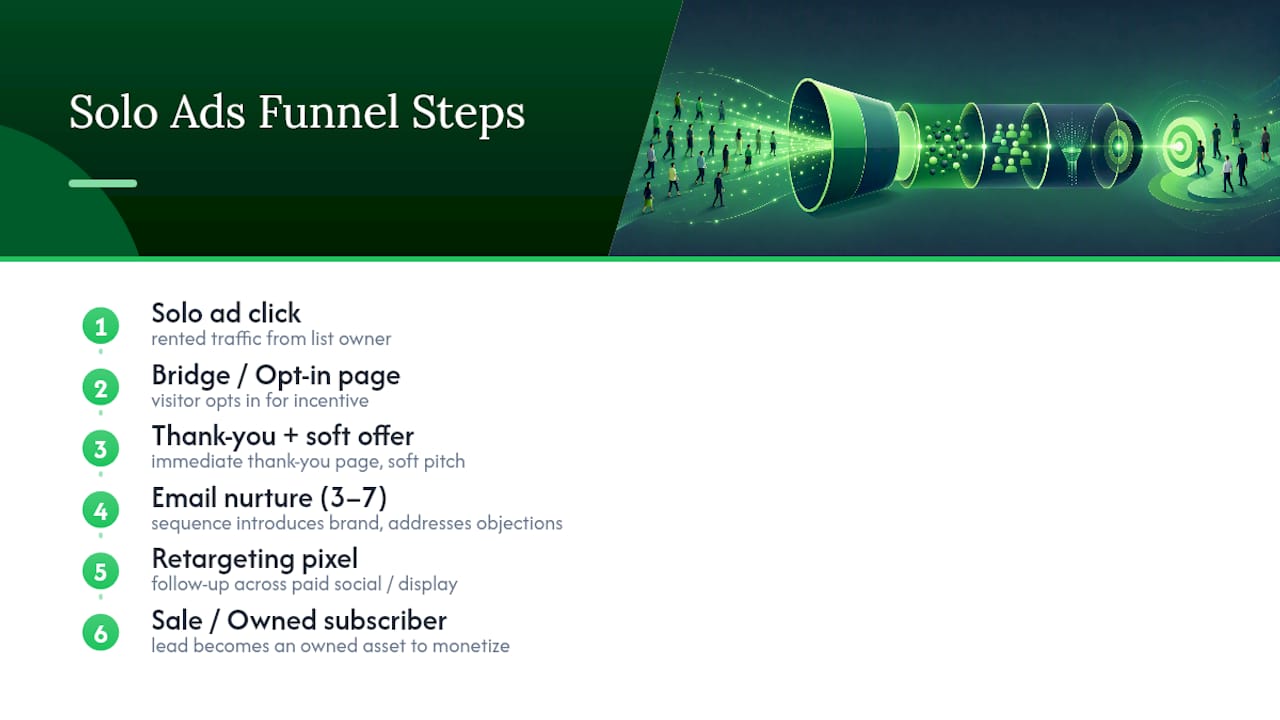
This structure matters because it turns rented traffic into an owned asset. Once someone opts in, you're no longer paying the list owner for access. You've captured a lead you can email for as long as they stay subscribed, which is the entire economic case for buying solo ads over one-off ad clicks that disappear the moment the campaign ends. Treat the solo ad budget as a customer acquisition cost, not an ad spend, and measure it against lifetime value rather than a single transaction.
Legal and Compliance Rules for Solo Ad Traffic
Every email your solo ad funnel sends, including the follow-up sequence you build after the opt-in, falls under the CAN-SPAM Act if you're marketing to US-based subscribers. That means a visible unsubscribe link, accurate sender information, and no deceptive subject lines in anything you send after the initial opt-in.
The vendor's original solo ad email is the vendor's compliance responsibility, since they own that list and that send. Your responsibility starts the moment someone opts in on your page and becomes your subscriber. From that point forward, your privacy policy, your data handling, and your unsubscribe process all need to meet the same standards as any other email list you build.
If you sell to buyers in the European Union, GDPR consent requirements apply to how you collect and store that new subscriber's data, even if the original solo ad traffic came from a US-based list. A single opt-in checkbox with clear language about what the subscriber is signing up for covers most of this requirement, but silence on data usage does not.
Never buy a list, only rent traffic through a solo ad send. Purchasing or scraping email addresses to build your own list is a different practice entirely, carries real legal exposure, and has nothing to do with legitimate solo ad buying.
A Skeptical Take on Solo Ads Worth Remembering
Most of the damage solo ad buyers do to themselves happens because they scale before they verify. A campaign that looks promising after 50 clicks can fall apart at 500, and a list that converted well last quarter can be exhausted today. The discipline that actually protects your budget isn't finding the "best" vendor. It's refusing to trust any vendor's numbers until your own tracker agrees with them.
Quit a bad test early and without hesitation. If your tracker shows a large gap from the vendor's report, or opt-ins stall well below what a comparable list should produce, that's your answer. Don't wait for a "bigger sample" to change the verdict. Run the vetting questions before every purchase, not just the first one, and let independent tracking data, not seller reputation alone, decide whether you scale.
— Philip Coble
Get the Checklist Before Your Next Solo Ad Buy
Soloadsguide is the alternative to buying blind on seller promises: instead of guessing whether a vendor's open rates and click reports are accurate, you get a checklist built from 11 years of watching both sides of this industry. The site's downloadable resources turn everything covered here into a workflow you can run in the next 48 hours.
The package includes the full 21-question vendor vetting checklist, a step-by-step tracking setup guide covering ClickMagick and Improvely configuration, and a sample test plan you can copy for your first campaign. Pull the checklist, run it against any vendor you're considering before you send payment, and set up your tracking link before the campaign goes live, not after. If a vendor's answers don't hold up against the checklist, you'll know before you've spent a dollar. Head to Soloadsguide to grab the downloads and start your first vetted test this week.
Sources
- What Are Solo Ads? And Are They Right For Your Business? — GetResponse
- What Are Email Solo Ads? How They Work & How to Use ... — EmailVendorSelection
- Are Solo Ads Worth It for Affiliate Marketers in 2026? — Market Spur
FAQ
How Much Do Solo Ads Cost?
Solo ad pricing is typically quoted per click, with niche-specific and higher-reputation lists commanding a premium over generic lists. Exact rates vary by vendor and niche, so run the cost-per-lead math on any quote before buying rather than judging price alone.
Are Solo Ads Worth It for Ecommerce and Affiliate Marketers?
Solo ads can be worth it if you already have a proven landing page, a follow-up email sequence ready to go, and independent tracking in place before you buy. Without those three pieces, a solo ad test is far more likely to waste money than produce usable data.
What's a Good Test Budget for a First Solo Ad Campaign?
A starter test of roughly 300 to 500 clicks from one vendor gives you enough data to judge opt-in rate and early conversion without overexposing your budget. Evaluate results over a 14 to 30 day window before deciding whether to repeat the buy or scale.
How Do I Verify Solo Ad Traffic Is Real and Not Bots?
Run every campaign through an independent tracker and compare unique click counts, IP clustering, and session duration against the vendor's own report. Large click clusters from narrow IP ranges with near-zero session duration are the clearest sign of bot or low-quality traffic.
What Is a Solo Ad, in Plain Terms?
A solo ad is a dedicated email a list owner sends entirely on behalf of one advertiser, promoting only that advertiser's offer to their subscriber list. It's essentially renting someone else's audience for a single, focused promotion rather than sharing space with other advertisers the way a sponsorship does.
Recommended
- Solo Ad Buyers: 21 Questions to Vet Fake Conversions
- Affiliate Fraud Solo Ads: A Buyer's Verification Checklist
- Solo Ad Buyers: 50–200 Click Test and 21 Questions to Verify Leads
- Solo Ad Click Logs: A Buyer's Guide to Verifying Traffic
Want Verified Traffic Without the Guesswork?
PulseTraffic screens every seller, filters bot clicks in real time, and shows you verified buyer traffic labels before you spend a dollar.