
No single vendor claim proves fake proof solo ads exist. Screenshots, testimonials, and "guaranteed" opt-in rates are marketing, not evidence. The only real proof comes from independent tracking and a small test order you control.
Before you message any vendor, run this checklist:
- Ask for tracking parity: your link running alongside theirs.
- Get niche and list-sourcing details in writing, not vague reassurances.
- Request recent, timestamped tracker screenshots, not cropped dashboard images.
- Start with a small test order (around 100 clicks) using an AI creative-testing platform like Popjam before committing real budget.
- Confirm the opt-in guarantee terms in writing before you pay.
Pro Tip: Before you send a dollar, ask for two things: your tracking link and their tracking link running side by side. If a vendor hesitates on that one request, you have your answer.
Key Takeaways
Verifying solo ad traffic requires independent tracking parity, a small test order, and written answers to the 21-Question Vendor Vetting Framework before any large purchase.
| Point | Details |
|---|---|
| Demand tracking parity | Insist on running your own tracker alongside the vendor's for every order. |
| Test small first | Start with roughly 100 clicks before committing to a larger budget. |
| Watch the geo and timing math | Impossible CPC-to-geo ratios and unnatural click bursts signal fake traffic. |
| Get guarantees in writing | A guarantee with impossible conditions attached isn't a real guarantee. |
| Use Soloadsguide's framework | Soloadsguide's 21-Question Vendor Vetting Framework gives buyers a written checklist to vet vendors before paying. |
Table of Contents
- How Fake or Low-Value Solo Ads Get Created
- The 21-Question Vendor Vetting Framework
- How Do You Verify Traffic Delivery With Your Own Tracker?
- What's the Right Way to Test a Vendor Before Scaling?
- What Red Flags Should Make You Refuse to Pay?
- Vendor Email Template and Five Questions to Ask First
- What to Do If You Suspect You Were Scammed
- Is Buying Solo Ads Legal, and What Crosses the Line?
- What I've Learned After Years of Watching This Industry
- Get the Full Vendor Vetting Framework From Soloadsguide
- Frequently Asked Questions
- Sources
How Fake or Low-Value Solo Ads Get Created
Traffic sellers have a handful of tricks that make weak clicks look premium. Bot and click-farm traffic mimics human behavior just enough to pass a casual glance. Incentivized clicks come from people paid pennies to opt in, so they never buy anything downstream. Recycled or overmailed lists get resold to buyer after buyer until the same subscribers are burned out on every offer in the niche.
Opt-in rate is the most misleading number in the industry. A high opt-in rate measures headline curiosity, not buyer intent. A vendor advertising a 40%+ opt-in guarantee is describing how many people clicked a subject line, not how many will ever pull out a credit card.
A campaign showing 60% of clicks from Tier-1 countries but a $0.12 average cost-per-click is a red flag on its face. Tier-1 solo ad traffic rarely runs that cheap, and when the math doesn't add up, the traffic usually isn't what it claims to be.
Watch for geo splits that don't match the promised targeting, and click timestamps that arrive in suspicious bursts rather than a natural spread throughout the day.
The 21-Question Vendor Vetting Framework
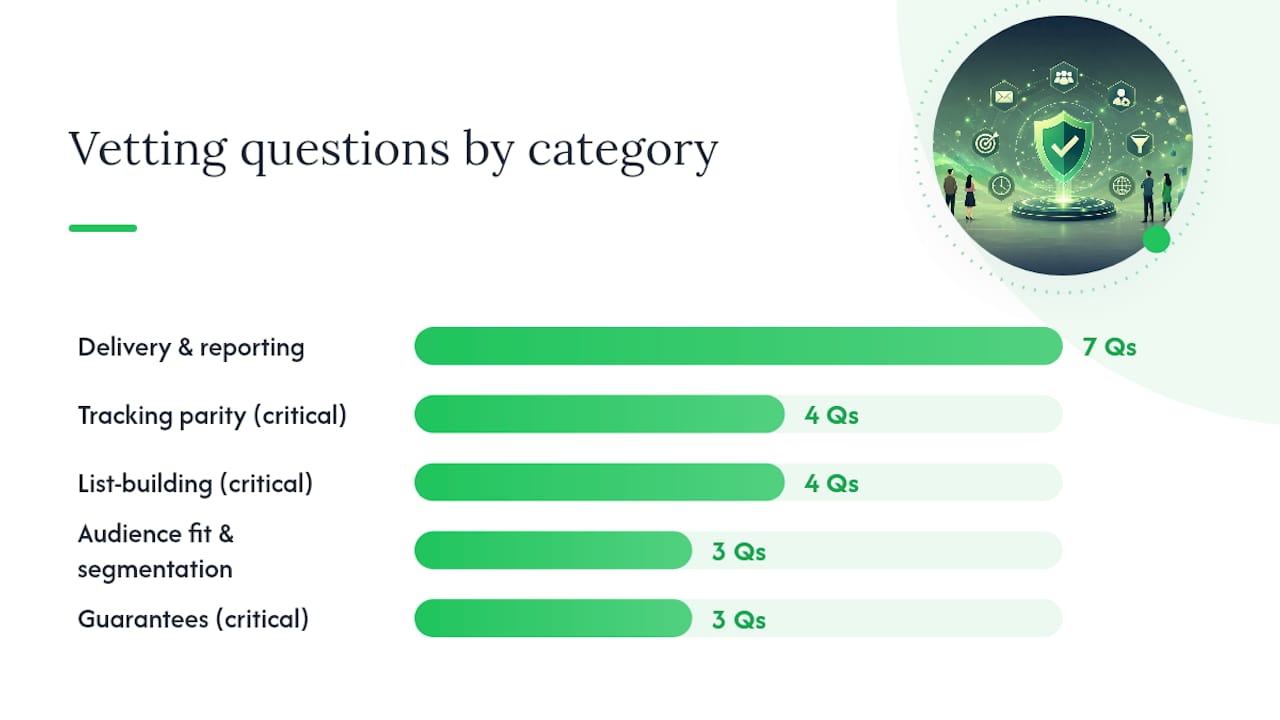
Soloadsguide built this framework around one idea: a legitimate vendor answers direct questions without flinching. Run through these five categories before you ever click "pay."
Transparency and tracking
- Will you run my tracking link alongside yours for the entire order?
- Can you share tracker screenshots from a campaign delivered in the last 30 days?
- Do you provide daily click logs during delivery, not just a final total?
- Will you disclose geo breakdowns by percentage before I order?
List quality and sourcing
- How was this list built, and is it double opt-in?
- How often do you add fresh subscribers to keep the list responsive?
- What niche or offer types has this list historically responded to?
- Can you share an approximate list size and average age of subscribers?
Audience fit and segmentation
- Can you segment by sub-niche (health, wealth, biz-op) if I need it?
- What percentage of your list has bought a similar offer before?
- Do you exclude subscribers who've already seen my exact offer?
Guarantees and dispute policy
- What's your written opt-in guarantee, and what voids it?
- Do you offer a make-good or refund if delivery falls short?
- What happens if my tracker and yours don't match?
Delivery mechanics and reporting
- What's your typical delivery window for a full order?
- Can I split delivery across multiple days?
- Do you use redirects, and can I audit them?
- What reporting do I get at the end of the campaign?
- Can I speak with you directly if something looks off mid-campaign?
- Do you write custom copy, or do I supply it?
- What's your policy if I want to test small before scaling?
You can find a fuller walkthrough with examples in Soloadsguide's expanded 21-question guide.
Pro Tip: If a vendor balks at just three of these, tracking parity, list-building method, and the guarantee terms, stop the conversation. Those three questions expose more fraud than the other eighteen combined.
How Do You Verify Traffic Delivery With Your Own Tracker?
Never rely on a seller's dashboard alone. Set up independent tracking before you place any order.
- Create a tracking link in a platform like ClickMagick or Voluum.
- Send that link to the vendor and ask them to run it alongside their own.
- Compare click counts hourly during delivery, not just at the end.
- Export the raw click log (CSV) once delivery completes.
Both ClickMagick and Voluum report unique IP addresses, time-of-day distribution, and geo location per click. Those three data points expose most fake traffic instantly. Real human traffic arrives in a natural spread across hours, not in unnatural bursts of hundreds of clicks in a single minute.
During and after delivery, check:
- Do click counts on your tracker match what the vendor reported?
- Does the geo breakdown match what was promised at purchase?
- Is the time-of-day spread natural, or does it look automated?
- Did opt-ins land in your autoresponder with valid, working email addresses?
If you're setting up a dashboard for the first time, Soloadsguide's analytics dashboard setup guide walks through configuring ClickMagick and Voluum specifically for solo ad verification.
What's the Right Way to Test a Vendor Before Scaling?
Start small. A 100-click order is a reasonable first test, cheap enough to absorb as a loss and large enough to produce a real signal.
Watch these windows and metrics:
- 48 to 72 hours: lead delivery should complete and opt-ins should land in your autoresponder.
- 7 to 14 days: initial conversions or replies should start showing up, depending on your funnel's follow-up sequence.
- Cost per subscriber (CPS): divide total spend by opt-ins collected.
- Sales or replies per 100 clicks: your clearest pass/fail signal.
A 100-click test that produces 25 to 40 opt-ins and at least one real reply or conversion is worth scaling to a larger order. A test that produces bounced emails, zero engagement, or a lopsided geo split that doesn't match the invoice is a fail, no matter how good the vendor's screenshots looked beforehand.
- Pass: opt-ins land in the promised range, replies or sales appear, tracker matches vendor report.
- Fail: high bounce rate, no engagement, tracker and vendor numbers diverge by more than a few percentage points.
What Red Flags Should Make You Refuse to Pay?
Certain signals should end the conversation immediately, before money changes hands.
- Refusing to run your tracking link alongside theirs.
- A geo split that doesn't match what was promised at checkout.
- Testimonials phrased identically across multiple review sites.
- Tier-1 CPC promises around $0.30 or lower, which is not realistic for genuine Tier-1 traffic.
- No written guarantee, or a guarantee with impossible conditions attached.
- Pressure to skip a test order and commit to a large buy immediately.
A refund guarantee that requires proof no reasonable buyer could produce isn't a guarantee. It's a marketing line designed to sound safe while protecting the seller from ever having to pay out.
Fabricated proof tends to repeat itself. If the exact same testimonial phrasing shows up on three different vendor pages, that's not a coincidence. Soloadsguide's breakdown of proven vendor testimonials shows what real client evidence looks like next to recycled copy.
Vendor Email Template and Five Questions to Ask First
Send this before paying anything:
"Hi [Name], before I place an order I'd like to run my own tracking link alongside yours for parity. Could you also share a recent tracker screenshot, details on how your list was built, and your opt-in guarantee terms in writing?"
Five non-negotiable questions to get answered in writing:
- Will you run my tracker alongside yours?
- Can I see a screenshot from a campaign delivered this month?
- How was your list built, and is it double opt-in?
- What's your guarantee, and what voids it?
- Can I start with a small test order?
Keep the tone matter-of-fact, not accusatory. Legitimate vendors answer these routinely; experienced sellers already expect them.
What to Do If You Suspect You Were Scammed
Act fast and document everything before contacting anyone.
- Preserve your tracker logs and export the raw click CSV immediately.
- Screenshot the vendor's claims and delivery reports, with timestamps visible.
- Save the full conversation thread, including any guarantee language.
- Compare your tracker's numbers against the vendor's report side by side.
- Open a payment dispute or chargeback with this evidence attached.
Gather everything before contacting your payment processor: tracker CSV, screenshots, conversation transcript, and the original order confirmation. Escalate to a chargeback once the vendor stops responding or refuses to address the discrepancy, and do it within your payment processor's dispute window, which is typically 60 to 120 days depending on the platform.
Is Buying Solo Ads Legal, and What Crosses the Line?
Buying solo ad traffic is a legal transaction in the United States. You're paying someone to email their list on your behalf, no different in principle from renting a mailing list. But legality doesn't mean every practice is ethical or compliant with platform rules.
The biggest gray area is consent. If a list wasn't built through genuine double opt-in, subscribers on it never agreed to receive third-party offers, and mailing them can violate the CAN-SPAM Act's requirements around consent and unsubscribe mechanisms. Buyers should ask vendors directly how a list was built and request evidence of the sign-up process, not just take their word for it.
Autoresponder and CRM platforms also have their own policies. Many prohibit importing purchased or "rented" traffic lists directly, and violating those terms can get your account suspended, regardless of whether the traffic itself was legally sourced. Always send solo ad clicks to a squeeze page you own, capture the opt-in yourself, and only then add that contact to your own list under your own consent record.
The ethical line is simple: you're responsible for what happens to a subscriber's data after you receive it, even if you didn't build the list. Vendors who won't discuss consent and sourcing openly are handing you legal risk along with the traffic.
What I've Learned After Years of Watching This Industry
The 21-question framework isn't paranoia. It's basic due diligence in an industry where reputation is easy to fake and tracking parity is the one thing a scammer can't fabricate convincingly. A vendor's willingness to run your tracker alongside theirs tells you more in five minutes than a week of reading testimonials.
Treat every first order as paid education, not a bet on profit. Use the framework as risk control, not a formality.
Get the Full Vendor Vetting Framework From Soloadsguide
Soloadsguide's edge isn't another list of "proven" vendors. It's the 21-Question Vendor Vetting Framework itself, the exact questions and answer standards that expose a fake or under-delivering seller before you've spent a dollar.
The framework works best as a live document: copy it into a note, run it during your next vendor conversation, and score the answers against what this article covers. If a seller passes, place a small test order first, around 100 clicks, and verify the results with your own tracker before committing to anything larger. Soloadsguide also breaks down what to ask before buying if you want the extended version with more vendor-response examples. Start there, run one small test, and only scale once your tracker and the vendor's numbers actually agree.
Frequently Asked Questions
Can a solo ad vendor actually prove their traffic is fake proof?
No vendor can prove traffic is fake proof through claims alone. The only real proof comes from letting you run independent tracking alongside theirs and matching results on a small test order first.
What's a reasonable opt-in rate to expect from legitimate solo ad traffic?
Rates vary by niche and list quality, and vendors advertising 40%+ opt-in rates exist, but a high opt-in rate alone doesn't guarantee buyer intent or sales.
How many clicks should I buy for a first test?
Around 100 clicks is a common starting point, enough to spot delivery problems without risking significant budget on an unverified vendor.
What should I do if my tracker numbers don't match the vendor's report?
Export your click logs, screenshot the discrepancy with timestamps, and raise it with the vendor in writing before requesting a refund or opening a payment dispute.
Is it illegal to buy solo ads?
Buying solo ads is legal, but mailing a list that wasn't built through genuine consent, or importing purchased traffic into a CRM that prohibits it, can create legal and platform-policy risk.
Sources
- Ihsan Solo Ads | Premium Tier-1 Email Traffic with 40%+ Opt-In Rates
- Phil Solo Ads | Premium Buyer Traffic That Converts
- What Are Email Solo Ads? How They Work & How to Use Them
- Solo Ads for Network Marketing: How to Buy Traffic Without Getting Burned - Work With David Wood
Recommended
- How to Vet Solo Ad Sellers (Before You Spend a Dollar)
- Proven Vendor Testimonials for Solo Ad Buyers (2026)
- How to Avoid Solo Ad Scams: 2026 Buyer's Guide
- Why Beginners Lose Money on Solo Ads (Real Reasons)
Want Verified Traffic Without the Guesswork?
PulseTraffic screens every seller, filters bot clicks in real time, and shows you verified buyer traffic labels before you spend a dollar.