

The fastest way to stop low-quality solo-ad traffic is a multi-layer filtering stack, not IP blocking alone. IP reputation checks, browser fingerprinting, and session-entropy scoring together catch what IP-only rules miss: residential proxies, rotating IPs, and carrier NAT ranges that make a fraudulent click look identical to a real one.
Before you spend another dollar, do these four things
- Require the vendor to send you the exact broadcast copy before sending, not after.
- Demand tracking links with unique-click deduplication built in, not raw click counts.
- Run a small paid sample and score it with a fingerprint check, not just an IP lookup.
- Set a pass/fail threshold before you look at results (start with a proxy-flag rate below a moderate level and a session-entropy score in the "normal" band for your tracker) and hold yourself to it.
Key Takeaways
Reliable solo-ad traffic filtering depends on combining IP reputation, fingerprinting, and session-entropy scoring, since IP-only blocking now fails against proxies and shared IP ranges.
| Point | Details |
|---|---|
| Layer your defenses | Combine IP reputation, fingerprinting, entropy scoring, and click dedupe instead of relying on IP blocks alone. |
| Test before scaling | Run a sample buy of 100 to 150 unique clicks minimum and hold it open 48 to 72 hours before judging results. |
| Track revenue, not clicks | Downstream conversion and revenue per click matter more than raw click volume when judging vendor quality. |
| Vet vendors directly | Request broadcast copy, unique-click tracking, and sample sends before committing to a full buy. |
| Use Soloadsguide's framework | Soloadsguide's 21-question vetting checklist and testing spreadsheet give affiliates a ready-made verification process. |
Table of Contents
- Why IP Filtering for Solo Ads Alone Doesn't Work Anymore
- Building a Practical Multi-Layer Detection Stack
- Testing a Solo Ad Before You Scale the Buy
- Tools That Belong in Your Verification Pipeline
- A Compressed Vendor Vetting Checklist
- Frequently Asked Questions
- Sources
Why IP Filtering for Solo Ads Alone Doesn't Work Anymore
IP-only blocking assumes one IP equals one identity. That assumption broke years ago. Residential proxy networks route traffic through real home internet connections, so a "clean" residential IP can still be feeding you bot clicks. Carrier-grade NAT means thousands of legitimate mobile users share one public IP, which means blocking that IP kills real prospects along with fake ones. Add shared hosting, CDNs, and rotating proxy pools that swap addresses every few requests, and a blocklist becomes a guessing game.
IP reputation scoring, which flags an address based on blacklist history and known proxy or data-center origin, is a useful first filter. But it produces both false positives (blocking a legitimate mobile carrier IP shared by hundreds of real users) and false negatives (missing a proxy farm that rotates fresh, unflagged IPs every session).
Picture two scenarios side by side: 40 clicks from one T-Mobile IP address in an hour, versus 40 clicks from 40 different IPs across four countries in the same hour, all landing on your page for the same number of seconds. The first looks suspicious by IP-only logic but is probably real. The second looks distributed and clean, but the identical timing pattern is the actual red flag.
Building a Practical Multi-Layer Detection Stack
Effective IP address filtering works best as a stack, where each layer catches what the one before it missed.
- IP reputation and proxy flags. Call an IP reputation API on every click and flag results tagged as data-center origin, known VPN exit node, or recent blacklist activity. Treat this as a screening layer, not a verdict.
- Browser and device fingerprinting. Tools like FingerprintJS capture screen resolution, installed fonts, canvas rendering, and browser configuration to build a device signature. Run it as pre-landing JavaScript with a server-side fallback for users who block scripts.
- Session-entropy and behavior scoring. Genuine visitors show variation: different scroll speeds, pause lengths, mouse movement. Low entropy, meaning nearly identical timing and interaction patterns across "different" sessions, is a strong bot signal.
- Unique-click deduplication. Correlate fingerprint and cookie data so the same visitor can't be billed as five separate clicks, a common way vendors inflate delivery numbers.
- Post-click engagement and conversion scoring. Track time on page, opt-in rate, and downstream revenue per click, not just the click itself. Vendors like NinjaClick build this kind of engagement scoring specifically to catch sessions that look human but never actually engage.
Run inline JavaScript fingerprint checks for speed and layer in server-side proxy detection for anything that slips past the browser layer. Keep the JavaScript light. A heavy fingerprint script that slows your landing page will cost you more in bounce rate than it saves in fraud detection.
Pro Tip: Score traffic first and hard-block only at high-confidence thresholds. A visitor flagged by one layer but clean on three others is probably real. Reserve outright blocking for sessions that fail multiple independent checks at once.
Testing a Solo Ad Before You Scale the Buy
A sample buy without a testing protocol is just a smaller way to lose money. Here's the sequence:
- Tag every link with a unique tracking parameter tied to that specific vendor and send date.
- Buy a small sample first. Solo ad list sizes vary, but a batch too small to generate enough unique clicks won't give you a reliable entropy or conversion signal.
- Split the sample: run filtered tracking (fingerprint plus IP reputation) against a control set with IP-only filtering, so you can see the gap directly.
- Hold the test open for at least 48 to 72 hours to capture delayed engagement, not just the first-hour click spike.
- Compare results against pre-set thresholds before deciding to scale.
Track these metrics, not just raw clicks:
- Conversion rate on your opt-in or offer page.
- Downstream revenue or lifetime value per click, since click fraud distorts attribution far more than it distorts raw click counts.
- Session-entropy score distribution across the sample.
- Proxy or VPN flag rate as a percentage of total clicks.
- Repeat-visitor ratio and bounce pattern within the first 30 seconds.
A simple decision rule: scale the buy only when conversion rate and entropy scores both clear your threshold in two consecutive tests, not one. One good sample can be luck. Two in a row is a pattern.
Tools That Belong in Your Verification Pipeline
You don't need to build this from scratch. A handful of tool categories cover the whole stack:
- Tracking platforms such as Voluum or ClicksDealer for server-side tracking and unique-click dedupe, so vendor-reported numbers can be checked against your own logs.
- IP reputation and proxy detection from providers like IPQualityScore or MaxMind, which flag data-center origin, known VPN ranges, and blacklist history on every click.
- Fingerprinting libraries like FingerprintJS, deployed as lightweight pre-landing scripts that don't slow the page or trip aggressive ad blockers.
- Bot detection and entropy scoring through services like Cloudflare Bot Management, useful once volume justifies enterprise-grade filtering.
Proxy-detection specialists focused on ad verification can also flag rotating-proxy ranges specifically built to simulate distributed, "organic looking" click patterns.
A Compressed Vendor Vetting Checklist
Before you send money to any solo ad vendor, ask these questions directly:
- Can you send me the exact broadcast copy before you mail my offer?
- Do you use unique-click tracking with deduplication, or do you report raw clicks?
- Will you run a paid sample first so I can verify quality before a full buy?
- What's your refund policy if verified metrics (not raw clicks) fall below agreed thresholds?
- Can you describe how your list is segmented and sourced?
Walk away if a vendor refuses to share the broadcast, guarantees a raw click count with no dedupe language, gives vague answers about list sourcing, or produces sample traffic with a high proxy and VPN flag rate. Guaranteed-click language is one of the oldest tricks in the industry, and it usually means the vendor is optimizing for clicks instead of quality.
- Request sample send times so you can cross-check them against your own click logs.
- Subscribe to the vendor's list directly to see what actually lands in an inbox.
- Compare vendor-provided reports against your own independent tracking data line by line.
Philip Coble built Soloadsguide's 21-question vetting framework after years of watching affiliate marketers get burned by vendors who look legitimate on the surface. The approach stays skeptical by default: verify first, trust later.
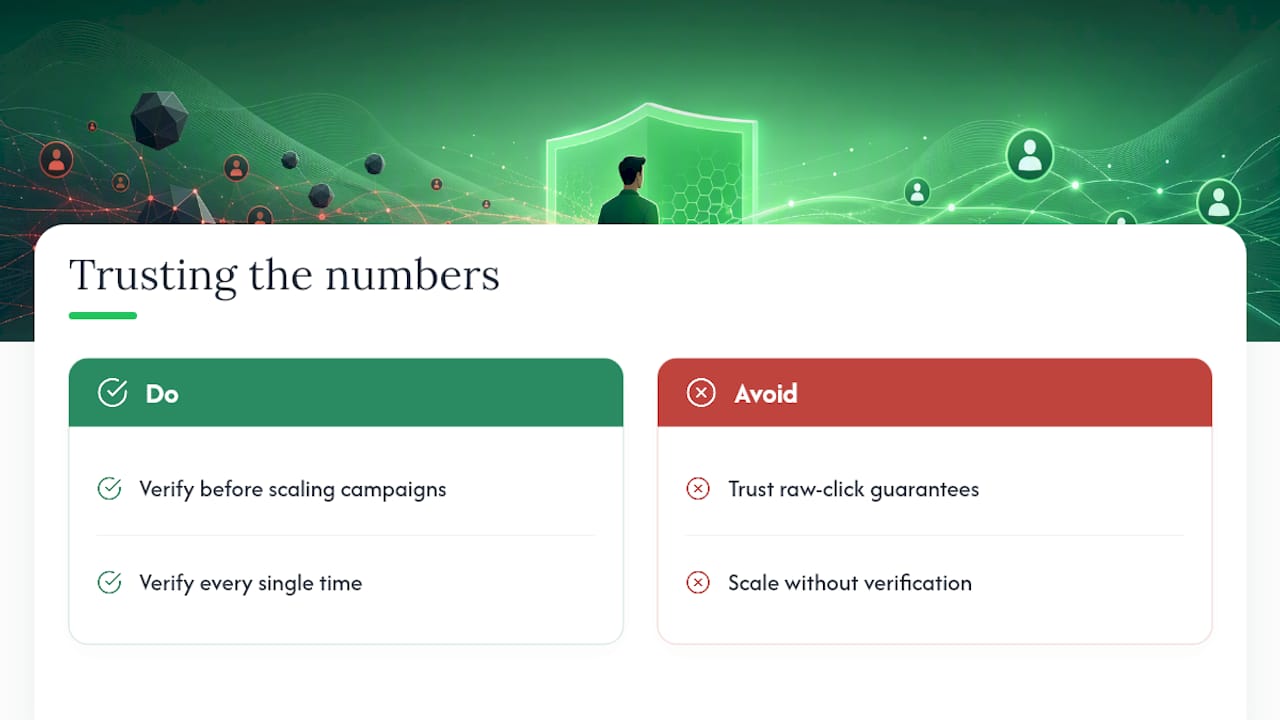
A Publisher's Note on Trusting the Numbers
Bad traffic taught this industry its hardest lessons the expensive way. After 11 years watching vendors game raw-click guarantees, the only defense that has held up is verifying before you scale, every single time.
Where to Get the Full Vetting Framework and Testing Template
Everything covered here, the layered detection stack, the sample-testing protocol, the vendor questions, comes from a longer, downloadable resource built for affiliates who want the full methodology in one place.

The full version includes the complete 21-question vendor-vetting framework, a sample-testing spreadsheet you can copy for your own buys, and suggested API calls for IP reputation and fingerprint checks so you're not starting from a blank page. It's built for marketers who are done trusting vendor-reported numbers at face value and ready to verify traffic before it costs them a full campaign budget. Run the sample-test protocol on your next buy before committing to a full send, and check the full resource hub at Soloadsguide to pull the checklist and start applying it today.
Frequently Asked Questions
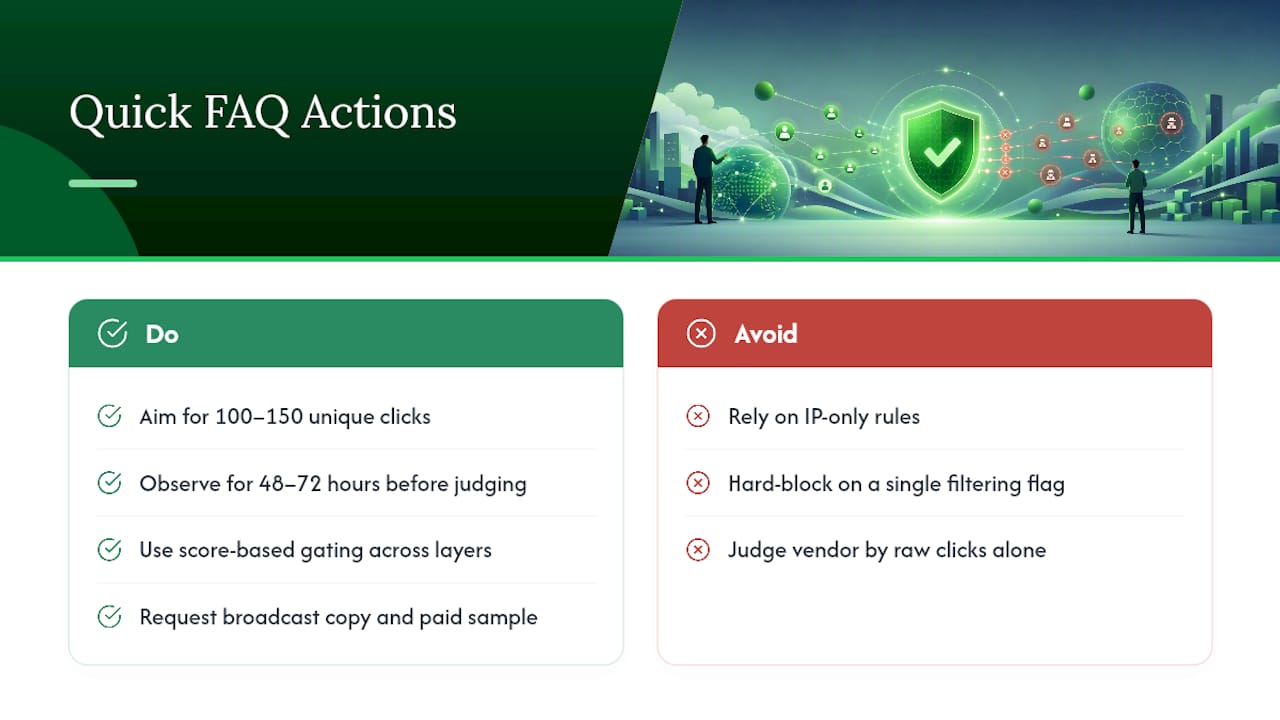
Does IP filtering alone stop solo-ad click fraud? No. IP-only rules miss residential proxies, carrier-grade NAT ranges, and rotating proxy pools, all of which make fraudulent clicks look like unique legitimate ones.
What's the minimum sample size for testing a solo ad vendor? Aim for at least 100 to 150 unique clicks and a 48 to 72 hour observation window before judging conversion rate and entropy scores.
What is session-entropy scoring? It measures variation in visitor behavior, like scroll speed and time on page, across sessions. Low entropy, meaning nearly identical patterns repeated across "different" visitors, signals bot activity.
Should I hard-block traffic that fails one filtering layer? Not usually. Score-based gating across multiple layers works better than hard-blocking on a single flag, since one imperfect signal can wrongly exclude real visitors.
What should I ask a solo ad vendor before buying? Request the exact broadcast copy, confirm they use unique-click tracking with deduplication, ask for a paid sample first, and clarify their refund policy tied to verified metrics rather than raw clicks.
Sources
Start with IP reputation basics to understand how proxy and blacklist flags are scored. For click-fraud fundamentals and duplicate-click risks, review the solo ad buyer guide and Soloadsguide's own click fraud prevention guide. For tracking setup, how to track solo ads walks through server-side tracking and fingerprint correlation. For proxy-detection specifics, see ad verification proxy use cases, and for engagement scoring, visitor identification methods cover behavioral signals worth adding to your stack.
- Solo Ads: 7 Powerful Secrets to Avoid Losing Money in 2025
- WATCH OUT - Guaranteed Clicks Solo Ads | Warrior Forum - The #1 Digital Marketing Forum & Marketplace
Recommended
- Solo Ad Click Fraud Prevention Guide for 2026
- How to Track Solo Ad Traffic (Catch Low-Quality Clicks)
- What Does Click Fraud Mean in Digital Ads? (2026 Guide)
- Why Your Solo Ads Are Failing (2026 Fixes That Scale)
Want Verified Traffic Without the Guesswork?
PulseTraffic screens every seller, filters bot clicks in real time, and shows you verified buyer traffic labels before you spend a dollar.