Run your first solo ad as a test order of 100 to 300 clicks, not a full-scale buy. That size gives you enough data to judge traffic quality without risking real money on an unproven vendor. Track three things from the moment delivery starts: clicks verified by your own tracker (not the vendor's word), opt-ins on your landing page, and any first-touch sales or micro-conversions.
Here's what to do the moment you decide to test a vendor:
- Set your test size at 100–300 clicks. Fewer than 100 makes the data too noisy to trust.
- Confirm your tracking link and landing page are live and working before you send the vendor a single dollar.
- Place the order, then give delivery 48 to 72 hours before you draw any conclusions.
That's the whole framework in miniature. The rest of this guide walks through why those numbers matter, how to prepare before you buy, and how to read the results once traffic starts arriving.
Key Takeaways
A test order of 100 to 300 tracked clicks, verified against your own tracker rather than vendor reports, is the only reliable way to judge solo ad traffic before scaling a budget.
| Point | Details |
|---|---|
| Start small | Order 100–300 clicks split across two or three vendors before committing a larger budget. |
| Track everything independently | Use a third-party tracker to log clicks, opt-ins, and conversions instead of trusting vendor dashboards. |
| Know your benchmarks | Expect a low single-digit CTR on the send and a moderate opt-in rate for a well-matched offer. |
| Vet before you pay | Run vendors through a structured checklist covering tracking support, refund terms, and sample reports. |
| Use the right resource | Soloadsguide's 21-question vendor vetting checklist and test-order spreadsheet help structure this process before you buy. |
Table of Contents
- What Is a Test Order Solo Ads Buyer Should Start With?
- Why Solo Ads Work for Affiliate Marketers and Online Businesses
- How to Prepare Before You Order
- How Do You Place and Confirm a Verifiable Test Order?
- How Many Clicks Should You Buy and What Should You Budget?
- What Metrics Prove a Test Order Actually Worked?
- How Do You Vet a Solo Ad Vendor Before You Buy?
- Where Should You Buy a Solo Ad Test Order?
- Common Mistakes That Waste a Test Order Budget
- What Should You Do After Your Test Order Delivers?
- Author Perspective: Treat Every First Order as a Probe
- Get the Vendor Vetting Checklist Before You Spend Another Dollar
- Frequently Asked Questions
- Sources
What Is a Test Order Solo Ads Buyer Should Start With?
A solo ad is a paid email broadcast: you pay a list owner to send an email promoting your offer to their subscribers, and you pay per click or per package. The term "test order" simply means you're buying a small batch of that traffic first, before committing a larger budget, so you can judge whether the list actually converts.
The mechanics are straightforward. A solo ad vendor writes or uses your email copy, sends it to their list, and recipients who click land on your tracked link. From there, your tracker logs the click, and the visitor continues to your landing page or bridge page. That's the entire chain: send, click, land, convert (or not).
- Per-click pricing: you pay a fixed rate for each verified click, typically ranging from $0.30 to $0.70 for quality tier-1 traffic.
- Per-package pricing: you buy a set number of clicks (100, 200, 500) for a flat price, common on marketplaces.
- Delivery guarantees: most vendors promise to deliver the full click count within a stated window, sometimes with overdelivery, if they fall short.
Understanding solo ads versus running your own email campaigns matters here too. A solo ad rents someone else's audience for one send. It's not list building in the traditional sense. You're paying for a single shot at their subscribers, which is exactly why a small test order makes sense before you scale.
Why Solo Ads Work for Affiliate Marketers and Online Businesses
Speed is the primary draw. If you need traffic today, a solo ad can start delivering clicks within 24 hours, faster than most paid ad platforms that require approval, algorithm learning periods, or content review.
Simplicity is the second reason marketers gravitate toward solo ads. There's no ad account to build, no creative approval process, and no bidding war against competitors for the same keywords.
Solo ads fit best in a few specific scenarios:
- Launching a time-limited promotion where you need buyers or leads fast.
- Testing whether a CPA offer converts on cold email traffic before investing in other channels.
- Building a first-party list quickly when you don't yet have organic traffic.
The tradeoff is that solo ad traffic is colder than a search visitor actively looking for your product. That's precisely why the test order matters. You're not just checking if clicks arrive. You're checking if the audience actually resembles your target buyer, a question you can only answer with tracking data.
How to Prepare Before You Order
Skipping preparation is the fastest way to waste a test budget. Before you contact a single vendor, get your own systems in order so the data you collect is actually trustworthy.
Set up tracking first. Use a third-party tracker like ClickMagick or Improvely, and generate a unique tracking link with sub-IDs for each vendor you test. Confirm the tracker supports postback URLs or pixel tracking if your offer requires conversion attribution. Never send raw affiliate links directly, since you'll have no way to independently verify what actually happened.
Build a single-purpose landing page. Your squeeze or bridge page should have one offer, one headline, one call to action, and nothing else competing for attention. Load speed and mobile-first design measurably improve opt-in rates on cold traffic, since most solo ad clicks come from mobile email apps.
Lock down your offer and creative. Pick one offer and one subject line variation for the test. Testing multiple variables at once with only 100–300 clicks makes the results impossible to interpret.
- Capture leads on your own domain, never a vendor-hosted page, so you own the list regardless of how the test performs.
- Decide in advance whether the vendor writes the email copy or you supply your own swipe.
- Reserve roughly 20% of your test budget for tracking tools and page setup if you don't already have them running.
Pro Tip: Build your tracking link and landing page a full day before you contact any vendor. Vendors that see you're organized and already tracking tend to take the order more seriously, and you'll never be scrambling to set up infrastructure while clicks are already arriving.
How Do You Place and Confirm a Verifiable Test Order?
Placing a test order the right way takes five steps, and skipping any one of them is how buyers end up with data they can't trust.
- Choose three vetted vendors and split your budget. Reserve 100 clicks with each, or split $200–$300 across all three. This gives you a comparison baseline instead of judging a single seller in isolation.
- Confirm deliverables in writing. Get the minimum click count, target geography (tier-1 countries: US, UK, Canada, Australia), and confirmation that your tracker link is compatible with their sending system.
- Provide your tracked link and landing page, and settle whether the vendor uses their own email copy or the swipe you supply. This decision affects both deliverability and how the traffic performs on your page.
- Specify the delivery window and overdelivery policy. Ask for click timestamps or a delivery report once the send completes. Vendors who balk at this request are telling you something important.
- Monitor the send live in your tracker. Log opt-ins and any micro-conversions as they happen, and export the raw delivery data before you close the ticket, in case you need it for a dispute later.
Before you pay anyone, send a short round of vendor questions. A pre-buy checklist should cover:
- What niche is your list built around, and how recently was it built?
- Can you support third-party tracking links without modification?
- What's your refund or replacement policy if clicks don't deliver?
- Can you provide a sample delivery report from a recent buyer?
If a dispute arises, your checklist is simple: compare the vendor's delivery report against your own tracker logs, flag any timestamp gaps or click clustering, and screenshot everything before you escalate. Most reputable vendors resolve legitimate shortfalls without argument. The ones that don't are exactly the ones you shouldn't reorder from.
How Many Clicks Should You Buy and What Should You Budget?
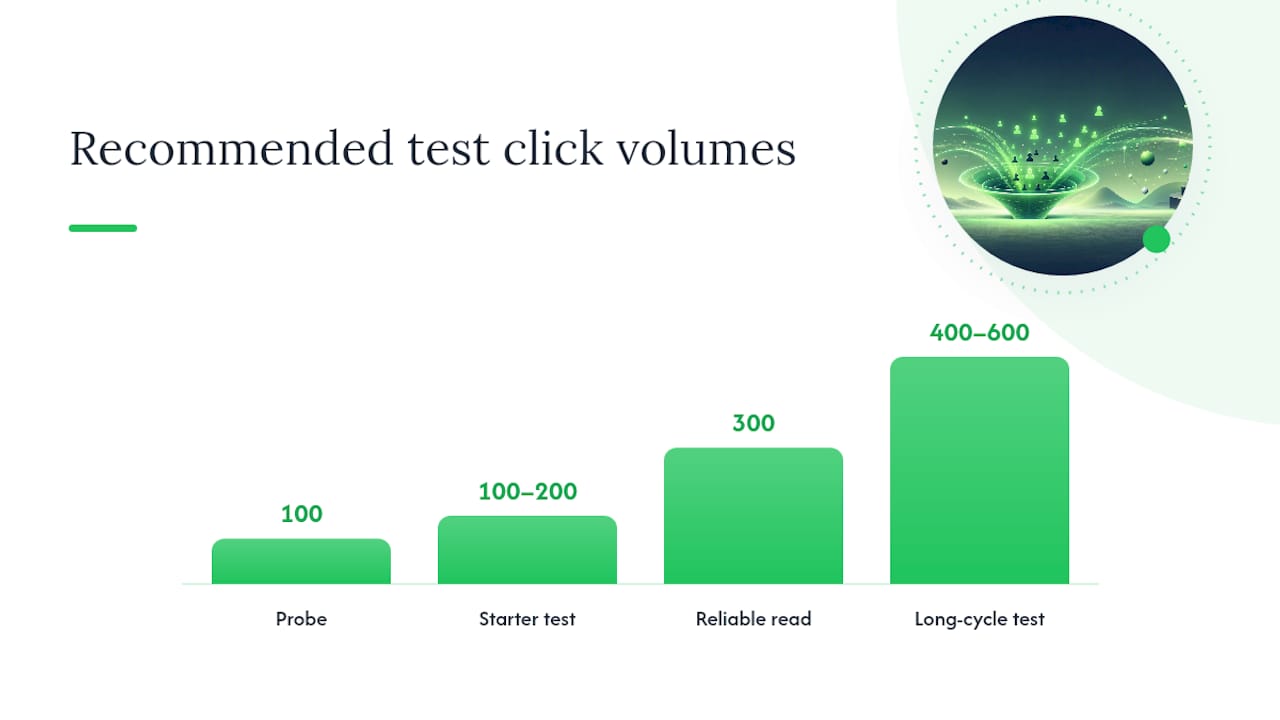
A 100-click order is a probe. It tells you whether a list is wildly off-target or fraudulent, but it's too small to draw firm conclusions about conversion rate. A 300-click order gives you a meaningfully more reliable read, since starting with 100–200 clicks and scaling from there is the standard recommendation among experienced buyers. If your offer has a long sales cycle or a low-single-digit conversion rate, consider pushing to 400–600 clicks before making a scale-or-stop decision.
Budget planning follows directly from click volume. Standard tier-1 traffic typically runs $0.30 to $0.70 per click, so a starter budget of $200–$300 covers a meaningful test across two or three vendors when split evenly.
Some vendors advertise steep discount test packages, like 100 clicks for a flat $27 fee marketed as a risk-free trial. Treat these the same as any other order: verify the clicks with your own tracker rather than assuming a low price means low risk.
Delivery speed varies by package size and vendor practice:
- Most sends begin within 24–72 hours of order confirmation.
- Full delivery of a 100–300 click order typically completes in 1–4 days.
- Very fast, same-day full delivery can indicate broader, less-targeted segments.
- Slower, more staggered delivery often signals manual targeting and can correlate with higher engagement.
Neither speed extreme is automatically good or bad. It's a data point to weigh alongside your actual conversion numbers, not a red flag on its own.
What Metrics Prove a Test Order Actually Worked?
Four numbers tell you almost everything about whether a solo ad test succeeded: tracked clicks, opt-in rate, raw conversions, and earnings per click (EPC) where you can measure it.
Verification is where most buyers cut corners, and it's exactly where you shouldn't. Download the vendor's delivery CSV, cross-check the timestamps against your own tracker's logs, and watch for click clustering, dozens of clicks landing within the same few seconds, which often signals bot traffic or click fraud rather than real subscribers.
| Metric | What to check | Realistic benchmark |
|---|---|---|
| Click-through rate | Vendor's reported CTR vs. your tracker's logged clicks | 2–5% CTR on the email send itself |
| Opt-in rate | Percentage of tracked clicks that convert to leads on your page | 15–40% for a well-matched offer |
| Conversions | Sales or CPA actions attributed to the send | Varies by offer; even one confirmed sale is a meaningful signal at this volume |
| Cost per lead (CPL) | Total spend divided by verified opt-ins | Compare against your offer's break-even CPL |
To calculate CPL, divide your total test spend by the number of verified opt-ins. If you spent $210 on 300 clicks and generated 60 opt-ins, your CPL is $3.50. Compare that against what your offer can actually afford to pay per lead, and you have a clean go/no-go signal without guessing.
How Do You Vet a Solo Ad Vendor Before You Buy?
Soloadsguide built a 21-question vendor vetting framework specifically because vendor claims and vendor reality are frequently two different things. The full checklist covers audience niche and freshness, recent buyer reviews, tracking compatibility, refund policy, overdelivery terms, sample delivery reports, and how tightly the list is segmented. Running through even a condensed version before you pay protects your test budget more than any other single step.
Watch for these red flags, in roughly the order they should worry you:
- A vendor refuses to support third-party tracking links or insists you use their tracking only.
- The vendor demands you send traffic to their hosted capture page instead of your own domain.
- Refund or replacement terms are vague, verbal, or buried behind conditions that never seem to be met.
- Opt-in or sales claims sound too good relative to industry norms, especially anything promising guaranteed sales.
- The vendor refuses to provide a raw delivery export or sample report from a previous buyer.
Some vendors do offer genuine buyer protections. Guarantees like free replacement clicks until you hit a minimum opt-in threshold, or transparent delivery tracking through a named third-party tool, are worth factoring into your decision. But a guarantee is only as good as the paperwork behind it, so get the terms in writing before you send payment.
Pro Tip: Score each vendor on a simple scale as you go through your questions: a clean "yes" with documentation, a vague answer, or a refusal. Two or more vague answers or refusals out of your first five questions is a strong signal to move to the next vendor on your list.

Where Should You Buy a Solo Ad Test Order?
Marketplaces and direct sellers solve different problems. A marketplace adds a layer of buyer protection and standardized reporting, which matters most when you have no track record with a seller yet. Direct sellers can offer tighter targeting and better long-term pricing, but only after you've confirmed the relationship is trustworthy.
| Provider | Cost model | Min. test size | Tracking support | Refund/replacement policy | Niche segmentation |
|---|---|---|---|---|---|
| Udimi | Per-click, standardized packages | Typically 100 clicks | Built-in platform tracking plus third-party support | Marketplace-backed dispute process | Buyer-searchable niche filters |
| TrafficForMe | Package-based pricing | Varies by package tier | Third-party tracker compatible | Vendor-dependent, package terms vary | Pre-vetted list segments by package |
| Direct sellers / list owners | Negotiated per-click or flat fee | Negotiable, often 100+ | Depends entirely on individual vendor | Negotiated directly, no marketplace backstop | Often the most granular once vetted |
Udimi's structure gives first-time buyers a built-in review system and standardized checkout, which is why it's a reasonable starting point if you've never bought solo ads before. TrafficForMe's package-style pricing suits buyers who'd rather choose from curated list segments than negotiate one-on-one. Direct sellers become valuable once you've already run a test that passed, since a validated relationship lets you negotiate custom sends and pricing that a marketplace can't offer.
The practical sequence: run your first one or two test orders through a marketplace, where the vetting infrastructure absorbs some of your risk, and reserve direct sellers for lists you've already proven convert. For a fuller side-by-side of established sellers, the best solo ad providers roundup breaks down more options by niche fit.
Common Mistakes That Waste a Test Order Budget
Most failed solo ad tests trace back to one of four avoidable errors, and each has a straightforward fix.
- Buying too few clicks. Under 100 clicks produces data too thin to act on. Fix: run 100–300 clicks, split across two or three vendors rather than concentrated with one.
- Sending to a vendor-hosted or unoptimized capture page. This costs you list ownership and usually tanks opt-in rates. Fix: build a single-offer squeeze page on your own domain before you place the order.
- Trusting vendor reports without cross-checking your own tracker. A vendor's self-reported numbers are a starting point, not proof. Fix: insist on raw delivery CSVs and match timestamps against your tracker logs line by line.
- Scaling before proving a sale. Doubling a budget on unverified traffic just doubles the risk. Fix: require at least one confirmed sale, or a CPA ratio that pencils out, before you commit to a bigger order.
Every one of these mistakes is cheap to avoid and expensive to repeat. A vendor's refusal to provide delivery data or their pattern of vague answers is usually visible before you ever place a second order, if you're looking for it.
What Should You Do After Your Test Order Delivers?
Once delivery completes, run through a short analysis checklist before deciding anything. Verify your tracker's click count against the vendor's report, calculate your opt-in rate, work out your cost per lead and short-term ROI, and check lead quality signals like email reply rates or click-through on your follow-up sequence.
A few thresholds make the scale-or-stop decision less of a guessing game:
- If opt-in rate and CPL both land within your target range, reorder from the same vendor at 2x to 3x the original volume, not more.
- If opt-ins are strong but sales are absent, the traffic may be fine and the offer or follow-up sequence is the problem. Fix the funnel before buying more clicks.
- If both opt-ins and engagement are weak, and the vendor's delivery data doesn't match your tracker, stop buying from that vendor and move to the next one on your list.
A single successful test order proves a vendor deserves a bigger budget. It doesn't prove your entire funnel is finished.
Author Perspective: Treat Every First Order as a Probe
Most of the disappointment people feel with solo ads doesn't come from bad traffic. It comes from treating a 100 or 300 click test as if it were supposed to be a marketing outcome instead of a diagnostic tool. It's a probe. Its only job is to tell you whether a list and your funnel work together, nothing more.
The traffic matters less than what happens after the click. Two buyers can run the exact same 200 click order from the same vendor and get wildly different results, because the funnel and follow-up sequence, not the send itself, usually decides the outcome. If your landing page is weak or your follow-up emails don't exist, no vendor's list will fix that for you.
Independent verification isn't optional caution. It's the entire point of running a small test before a large one. Trust your tracker, not the vendor's dashboard.
Get the Vendor Vetting Checklist Before You Spend Another Dollar
Soloadsguide built the 21-question vendor vetting framework so you don't have to reconstruct it from scratch every time you consider a new list owner. It's the same screening process outlined throughout this guide, condensed into a document you can run through in minutes.
The download includes the full vetting checklist alongside a test-order tracking spreadsheet, built to log clicks, opt-ins, and conversions against each vendor you test, so you're comparing sellers on real numbers instead of memory. It shortens the setup work covered in the preparation section above to something you can fill out before your first email even goes out.
If you're about to place a test order, grab the vendor vetting checklist before you contact a single seller. It takes less time to run through than a single vendor's sales pitch, and it puts the verification burden back where it belongs, on documented answers instead of trust.
Frequently Asked Questions
How many clicks should my first test order solo ads purchase include?
Start with 100 to 300 clicks. Fewer than 100 rarely gives you enough data to judge a list fairly, while 300 gives a more reliable read on opt-in rate and conversion behavior without overcommitting budget.
How long does a solo ad test order take to deliver?
Most vendors begin delivery within 24 to 72 hours of confirming your order, with full delivery of a 100–300 click test typically completing within 1 to 4 days depending on package size and targeting.
What's a good opt-in rate to expect from a solo ad test?
Anything meaningfully below that range is worth investigating before you reorder from the same vendor.
Should I use Udimi, TrafficForMe, or a direct seller for my first test?
Marketplaces like Udimi or TrafficForMe are the safer starting point for a first test, since they offer built-in tracking support and dispute processes. Move to direct sellers once you've verified a list converts and want to negotiate custom terms.
What should I do if a vendor's delivery report doesn't match my tracker?
Export both reports and compare timestamps line by line. A small discrepancy may be normal tracking lag, but consistent mismatches or unexplained click clusters are grounds to request a replacement or refund under the vendor's stated policy.
Sources
The benchmarks and processes in this guide draw on established solo ad buying guidance and landing page research, alongside Soloadsguide's own vendor vetting framework.
- How to Use Solo Ads for CPA Marketing | RevBoost™
- What Are Solo Ads? And Are They Right For Your Business?
- Crazyegg
- Solo Ads for Network Marketing: How to Buy Traffic Without Getting Burned - Work With David Wood
Recommended
- How to Buy Solo Ads That Actually Convert (Step-by-Step)
- Solo Ads Budget Allocation: A Practical Guide for Affiliates
- High-Ticket Offer Solo Ad Strategies That Actually Work
- Why Your Solo Ads Are Failing (2026 Fixes That Scale)
Want Verified Traffic Without the Guesswork?
PulseTraffic screens every seller, filters bot clicks in real time, and shows you verified buyer traffic labels before you spend a dollar.