

Vendor arbitrage in solo ads means buying email clicks from a list owner at one price and reselling that traffic, or the leads it produces, at a markup. The tactic works only when you protect your contribution margin and confirm the traffic is real, not recycled or bot-driven. Before spending real money, run a small, tracked test order against a vetting checklist. That single step separates profitable arbitrage from an expensive lesson.
TL;DR:
- Most vendor arbitrage relies on a strict margin discipline, accounting for marketplace fees, payment processing, refunds, and replacement costs that often erode apparent profits.
- A small, tracked test order with raw delivery logs and a unique tracking link is essential to verify traffic quality before scaling arbitrage efforts.
- Vendor vetting should include direct questions about list origins, replacement policies, delivery schedule, and proof of repeat buyers to avoid dishonest sellers.
- Traffic verification depends on analyzing timing patterns, IP clustering, and geography to identify bots, recycled leads, or invalid clicks.
- Compliance with CAN-SPAM laws is mandatory, requiring accurate sender info, clear ad identification, a working opt-out, and contractual liability sharing with vendors.
Table of Contents
- What Vendor Arbitrage Solo Ads Actually Involves
- How Do You Vet a Solo Ad Vendor Before Buying?
- What Does Solo Ad Arbitrage Actually Cost You?
- How Do You Verify a Vendor's Traffic Is Real?
- What Compliance Rules Apply to Solo Ad Resellers?
- What's the Right Way to Test Before Scaling?
- What Red Flags Mean You Should Walk Away?
- Why Trust This Guide
- What This Guide Gets Right That Most Advice Misses
- Get the Vetting Checklist and Tracking Templates
- Sources
- FAQ
What Vendor Arbitrage Solo Ads Actually Involves
A solo ad is a single email a list owner sends to their subscribers on your behalf, pointing to one offer with one call to action. Vendor arbitrage adds a layer: instead of buying clicks to promote your own offer, you buy clicks from a list owner and resell them, or the resulting leads, to another buyer at a higher price. You're the broker sitting between the traffic source and the end customer.
The workflow generally runs in four steps:
- Source the clicks. You buy a fixed-click package or ongoing allocation from a list owner or marketplace, negotiating price per click and delivery timeline.
- Resell or deliver. You either point that traffic at your own funnel and sell the leads, or you resell click packages directly to other marketers who need list-building traffic.
- Track everything. Every click gets a unique link so you know exactly what the vendor delivered versus what you promised your buyer.
- Replace or refund. When traffic underperforms or fails quality checks, you invoke replacement terms with the original vendor before those losses land on you.
Payment models shape how risk moves through that chain. Pay-per-click deals put the risk on you if conversion rates disappoint, since you're paying regardless of quality. Guaranteed click packs shift some risk back to the vendor, since they owe you a fixed volume. Replacement terms decide who eats the cost of bad clicks: a vendor with no written replacement policy is quietly keeping all the upside and handing you all the downside. This basic merchant structure, buying fixed click packages and reselling at a markup, is well documented in practical arbitrage guides, and it only works when margin accounting stays disciplined.
How Do You Vet a Solo Ad Vendor Before Buying?
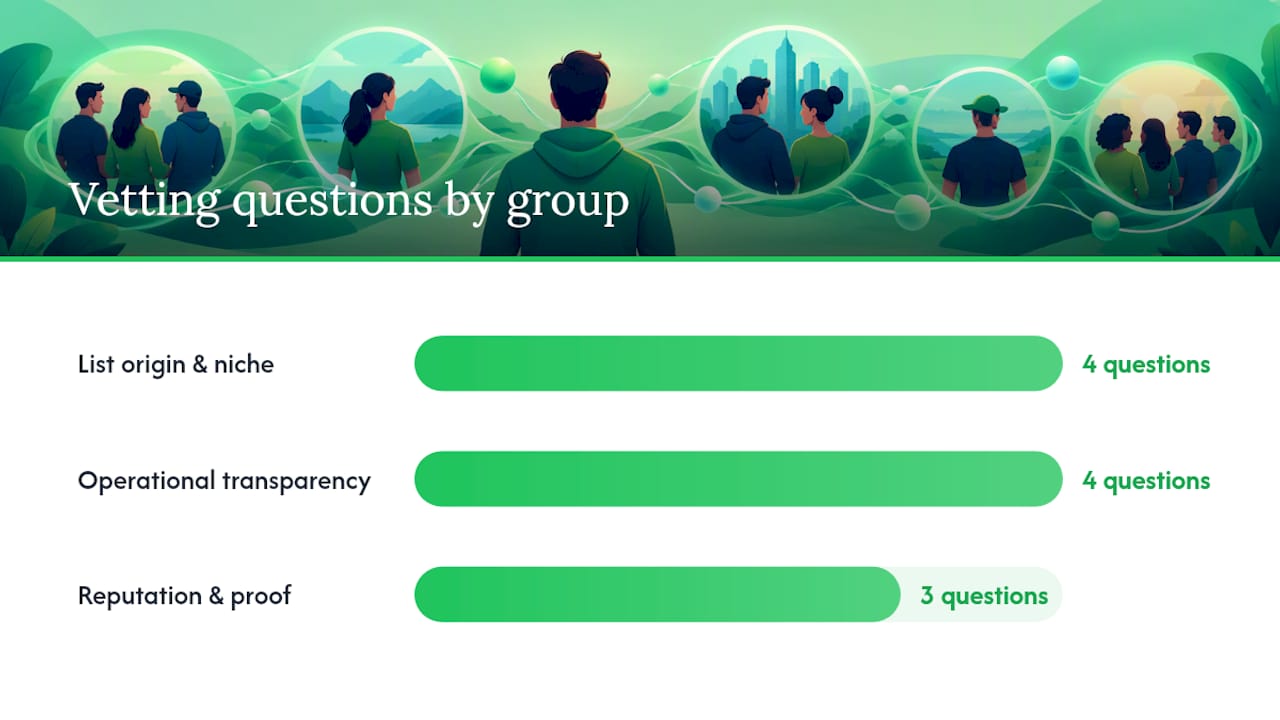
A 21-question vendor vetting framework exists because most sellers won't volunteer the answers that actually matter. Here's a condensed version you can run through on a single vendor call, organized into three groups.
List origin and niche fit. Ask directly:
- How was this list built, through paid ads, co-registration, or organic opt-ins?
- What percentage of subscribers came from sources outside your primary funnel?
- What offers have converted well on this list in the last 90 days?
- Can you name the niche categories this list responds to, beyond "make money" or "biz-op"?
Operational transparency. This is where vendors either prove themselves or start dodging:
- What's your replacement policy for unopened or bounced clicks?
- What's your typical delivery schedule, and can you commit to a start date in writing?
- Can you break down the device and geography split for this traffic?
- Will you provide a sample of raw delivery logs before I pay in full?
Reputation and proof. Screenshots of income claims are close to worthless; ask for the following instead, since good sellers are judged by repeat buyers and verifiable delivery logs, not marketing copy:
- Can I contact two or three repeat buyers directly?
- How long have you sold to the same core group of buyers?
- What's your average opt-in rate across your last 10 orders, and can you show the tracking that produced it?
Red-flag answers show up fast. If a vendor won't name a replacement policy, dodges the raw-log request, or answers "everyone converts great on my list" without specifics, walk away. Vague enthusiasm is not proof.
Pro Tip: Ask every vendor the same replacement-policy question in the same words. Vendors who improvise a different answer each time you ask are usually improvising the policy itself.
What Does Solo Ad Arbitrage Actually Cost You?
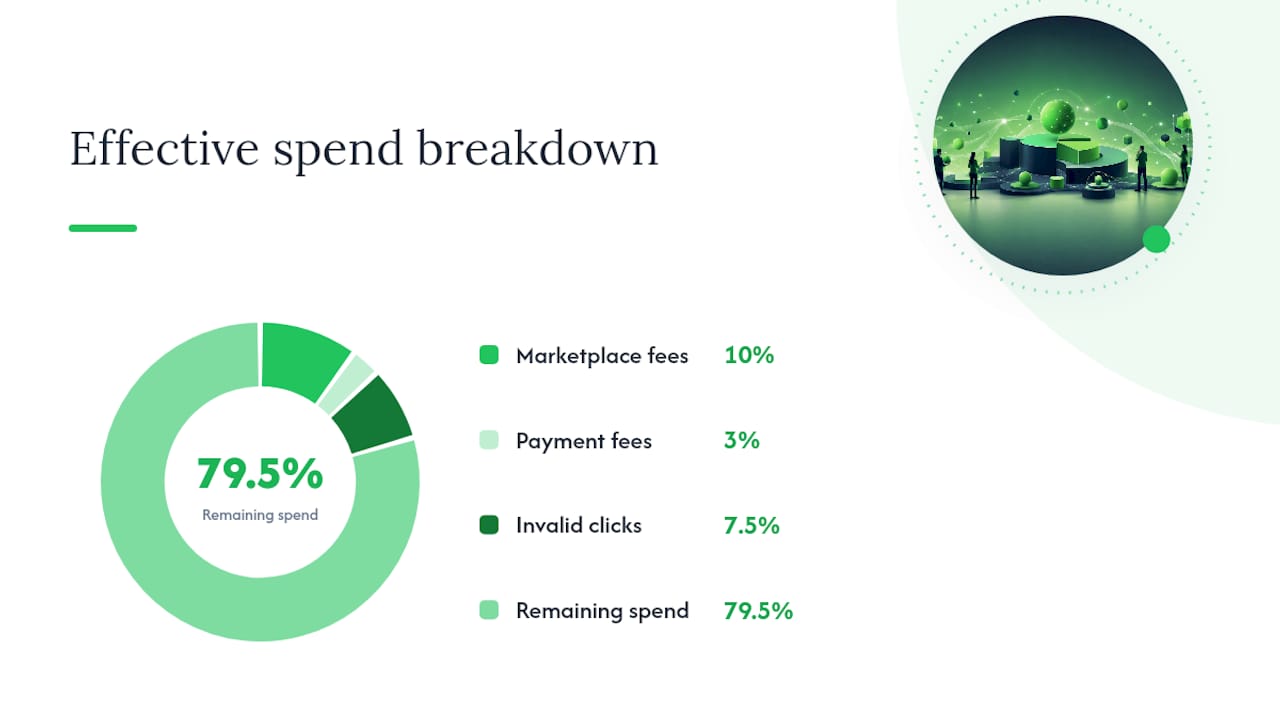
Gross markup, the difference between what you paid per click and what you charged, looks appealing until you subtract everything else eating into it. Contribution margin, what's actually left after every variable cost tied to that order, is the number that determines whether arbitrage is worth doing.
Cost items that reduce your real margin include:
- The base click price you negotiated with the vendor
- Marketplace or platform fees, if you sourced traffic through a solo ad marketplace
- Payment processing fees on both the buy side and the sell side
- Refunds and replacement clicks you have to absorb before the vendor honors their policy
- Customer support time spent resolving buyer complaints about lead quality
Here's a simplified illustration. Say you buy 200 clicks at $0.45 each, a $90 outlay, and resell that traffic bundle for $150. Your gross markup looks like $60. But marketplace fees might take 10%, payment processing another 3%, and if 15 of those 200 clicks bounce or get flagged as invalid, you're either eating that cost or waiting on a slow replacement cycle. Your real contribution margin could land closer to $25 to $35, not $60.
A low nominal cost per click can hide exclusions that only surface after delivery, which is why you calculate effective cost per valid click after fees and replacements, never the sticker price. Reserve planning matters here too: set aside a meaningful buffer of expected receipts on early orders to cover delayed marketplace payouts, disputed replacements, and chargebacks until a vendor's reputation is proven over multiple orders.
How Do You Verify a Vendor's Traffic Is Real?
Tracking is the difference between trusting a vendor's word and having proof. Set up a unique landing page or tracking link for every vendor you test, never a shared link across multiple sources, so you can attribute every click to its origin with certainty.
Collect these data points from the moment traffic starts flowing:
- Click timestamps, so you can see whether clicks arrive in a natural, spread-out pattern or in suspicious bursts
- IP address and device signals, flagging repeated IPs or datacenter ranges instead of residential ones
- Total click count against what was promised, checked in real time, not after the order closes
- Opt-in rate and cost per lead, the two numbers that tell you whether this traffic converts at all
- Device and geography mix, confirmed against what the vendor claimed before you paid
Three verification techniques catch most bad traffic before it costs you real money. IP clustering flags when dozens of "unique" clicks trace back to the same narrow IP range. Time-to-click distribution analysis catches bot traffic, since real humans click at irregular intervals while automated systems often fire in tight, mechanical windows. Asking directly for raw delivery logs and testing everything through unique links remains the most reliable way to separate genuine list traffic from bot or recycled clicks. Pair that with a guide to IP filtering so you know what patterns to flag before you've paid for a second order.
What Compliance Rules Apply to Solo Ad Resellers?
Commercial email triggers CAN-SPAM obligations the moment it promotes a product or service, and arbitrage brokers are not exempt just because they didn't write the list themselves. Anyone whose product or service is advertised in a message can be treated as a sender, and the FTC's rule makes the "from" line decisive in determining who counts as the sender when multiple marketers are involved in one campaign.
Minimum requirements every solo ad campaign needs, per FTC guidance:
- Accurate, non-misleading header information
- A subject line that doesn't deceive about the message's content
- Clear identification of the message as an advertisement, when applicable
- A valid physical postal address included in the email
- A working opt-out mechanism that's honored promptly
Paying an affiliate or list owner doesn't remove your liability. The FTC has made clear that using paid intermediaries can create inducement liability for the advertiser. Practically, that means naming a designated sender in contract language, requiring vendors to honor opt-outs immediately, and building in terms that transfer compliance obligations wherever legally possible. Read a full breakdown in this compliance guide for affiliates.
What's the Right Way to Test Before Scaling?
Start small enough that a bad vendor costs you a lesson, not a quarter's budget. A modest first order, sized to what you can afford to lose completely, gives you real data without exposing your cash flow to an unproven source.
- Place a small proof order. Keep it tracked with a unique link from click one.
- Measure opt-in rate and cost per lead against your baseline for that niche. If the numbers land within your target range, that's your signal to consider a repeat order.
- Watch the early conversion window. Leads that engage within the first 24 to 48 hours tend to be the most reliable indicator of list quality, according to practical testing approaches marketers use before committing larger budgets.
- Scale in increments, not leaps. Double an order only after two consistent results, never after one good one.
- Set a stop rule in advance. If opt-in rate or cost per lead drops below your threshold on a repeat order, stop buying from that vendor immediately rather than hoping the next batch improves.
What Red Flags Mean You Should Walk Away?
Certain patterns show up again and again in bad solo ad deals. Clicks that arrive in unnatural, machine-like bursts instead of a spread-out pattern usually mean bot traffic, not real subscribers. Leads that have clearly been recycled across multiple buyers, evident when the same names and emails show up in unrelated campaigns, are a dead giveaway. Screenshots of income or conversion numbers with no underlying data to verify them are not proof of anything.
Vendor behavior tells you just as much as the traffic itself:
- No written replacement policy, or a vague one that changes when you ask for specifics
- Evasive or contradictory answers to the same vetting question asked twice
- Pressure to buy immediately, especially "limited slots" framing on a recurring list
Before paying anyone, demand sample delivery logs, written refund and replacement terms, and the option to run a smaller test order first. A vendor who refuses all three isn't worth the risk.
Why Trust This Guide
The author has spent many years working inside the solo ads industry as a vendor, which means the vetting process is seen from both sides of the transaction. The 21-question vetting framework in this guide is based on experience, taking a skeptical stance that assumes most sellers overpromise until proven otherwise.
The buyer who asks for raw delivery logs before paying is the buyer who rarely gets burned twice by the same vendor.
The framework, along with deeper guides on tracking and traffic verification, exists to give affiliate marketers a repeatable process instead of a gut feeling.
What This Guide Gets Right That Most Advice Misses
Most solo ads content treats vendor selection as a trust exercise: find someone with good reviews, send money, hope for the best. That's backwards. The vetting process this guide lays out only works if you assume the vendor is overstating quality until they prove otherwise with logs, replacement terms, and a small test order they're willing to honor.
The conventional advice oversells gross markup and undersells contribution margin. Arbitrage math that ignores marketplace fees, payment processing, and replacement costs will always look more profitable on paper than it performs in practice. That gap is where most first-time brokers lose money, not on the traffic itself, but on cost items nobody warned them to subtract.
If you take one thing from this guide, prioritize tracking before price. A cheap click with no verification is not a deal. It's an unmeasured liability. Vet first, track everything from click one, test small, and let the numbers, not the vendor's pitch, decide whether you scale.
— Philip Coble
Get the Vetting Checklist and Tracking Templates
Running through 21 vetting questions from memory on a live vendor call is hard. Soloadsguide's landing page gives you the full checklist, tracking link templates, and deeper guides on click verification in a format you can actually use before your next order, not after you've already paid for one.

The page walks through the same framework referenced throughout this guide: how to score a vendor's answers, what a legitimate replacement policy looks like in writing, and how to size a first test order without exposing your whole budget to an unproven source. If you're about to place your first arbitrage order, or your fifth, start at the Soloadsguide checklist and resource hub and run your next vendor call against it before you send a single payment.
Sources
The legal foundation for solo ad compliance comes directly from the FTC's CAN-SPAM compliance guide and its rule on sender definitions, both essential reading for anyone reselling list traffic. Practical vendor-vetting guidance drew on seller evaluation best practices and arbitrage mechanics, while margin and pricing guidance referenced email marketing compliance tips covering effective cost calculation.
- Definitions and Implementation Under the CAN-SPAM Act - 16 CFR Part 316 - R411008
- Best practices for email marketing: Practical tips for CAN-SPAM Act compliance | Lewis Rice
- Solo Ads Seller Guide 2026 and How to Spot Good Traffic Quality | MKAUthority
- How to Start Doing Solo Ads Arbitrage - Teachingbiz
FAQ
Is Vendor Arbitrage Solo Ads Legal?
Yes, buying and reselling solo ad traffic is a legal business model, but the commercial email involved must meet CAN-SPAM requirements including accurate headers, ad identification, and a working opt-out. Brokers and affiliates can share liability with the original sender, so contract terms matter.
How Much Should My First Solo Ad Test Order Cost?
Keep your first order small enough to absorb as a complete loss if the vendor underperforms, since the goal is verified data, not volume. Track opt-in rate and cost per lead on that order before considering any repeat purchase.
What's the Difference Between Gross Markup and Contribution Margin in Arbitrage?
Gross markup is simply the difference between your buy price and resale price per click. Contribution margin subtracts marketplace fees, payment processing, refunds, and replacement costs, which is why it's the more reliable number for deciding whether an order was actually profitable.
How Do I Know If a Solo Ad Vendor Is Sending Bot Traffic?
Check for unnatural click timing patterns, repeated IP addresses clustering from the same narrow range, and unusually fast time-to-click distribution across a batch. Requesting raw delivery logs and testing with a unique tracking link per vendor remains the most reliable way to catch this before you pay for a second order.
Where Can I Find a Full Vendor Vetting Checklist?
Soloadsguide's 21-question vendor vetting framework, available through its resource hub, breaks the questions into list origin, operational transparency, and reputation categories. It's built specifically to help buyers verify claims instead of trusting them.
Recommended
- Protect Your Budget: 21 Question Solo Ad Red Flags for Buyers
- How to Vet Solo Ad Sellers (Before You Spend a Dollar)
- How to Avoid Solo Ad Scams: 2026 Buyer's Guide
- Fake Proof Solo Ads: How to Verify Before You Buy
Want Verified Traffic Without the Guesswork?
PulseTraffic screens every seller, filters bot clicks in real time, and shows you verified buyer traffic labels before you spend a dollar.