
Solo ads are defined as paid email promotions where you pay a list owner to send your offer to their subscribers as a standalone email with one call to action. Why solo ads confuse new marketers comes down to a single core problem: most beginners treat them as a traffic shortcut rather than a testing tool that depends on funnel quality, list relevance, and email follow-up. The mechanics look simple on the surface. You pay for clicks, someone sends an email, and traffic arrives. But lack of a proven funnel is the primary reason that traffic fails to convert, and most beginners never see that coming.
Why solo ads confuse new marketers: the mechanics explained
Solo ads operate on a pay-per-click model. You agree on a number of clicks with a vendor, they send an email to their list, and you receive visitors to your landing page. The confusion starts the moment you realize that clicks do not equal sales.
The traffic arriving from a solo ad is cold. These subscribers do not know you, have not searched for your offer, and have no existing relationship with your brand. That means your squeeze page and email follow-up sequence carry almost all of the conversion weight. Without them, even a perfectly targeted click goes nowhere.

Traffic quality varies widely among solo ad vendors. Some vendors maintain engaged, responsive lists built over years. Others use low-interest subscribers or inflate click counts with bot traffic. A CHEQ 2023 study found that roughly 40% of web traffic is bot traffic, and solo ad campaigns are not immune to that problem.
Understanding solo ads also means understanding what you are actually buying. You are renting access to someone else's audience for one email. That audience may or may not match your niche, and you have no control over how the email is written unless you provide the copy yourself.
Key components that determine solo ad results:
- Vendor list quality: Is the list built from real opt-ins in your niche?
- Your squeeze page: Does it capture emails before sending visitors anywhere else?
- Your email follow-up sequence: Do you have at least 5–7 follow-up emails ready?
- Your lead magnet: Is your free offer compelling enough to earn an opt-in?
- Tracking setup: Are you measuring opt-in rate, click-through rate, and conversions separately?
Pro Tip: Start with a small order of 100–200 clicks from a new vendor before committing to larger packages. This limits your risk and gives you real data on list quality.
What mistakes cause the most confusion for beginners?
New marketers often expect instant profits from solo ads, skipping the foundational skills that make campaigns work. That expectation is the single biggest source of frustration. Here are the most common mistakes, in order of how much damage they cause:
-
Sending traffic to a sales page instead of a squeeze page. Cold solo ad traffic rarely buys on the first visit. You need to capture the email address first, then sell through your follow-up sequence.
-
Running solo ads without a follow-up sequence. A single email after opt-in is not a sequence. Effective follow-up runs 7–14 days and builds trust before making a direct offer.
-
Ignoring tracking and analytics. If you do not track your opt-in rate, you cannot tell whether a poor result came from the vendor's list or your own landing page. Use a tracking tool to separate those variables. Soloadsguide covers how to track solo ad traffic in detail, including how to catch low-quality clicks before they drain your budget.
-
Relying on a single vendor. One vendor's list reflects one audience segment. Testing three to five vendors gives you a real picture of what works.
-
Paying below-market rates and expecting quality. High-quality solo ad traffic costs between $0.40 and $0.90 per click in the current market. Prices well below that range often signal bot traffic or disengaged lists.
-
Treating solo ads as a standalone strategy. Solo ads feed your list. Your list feeds your funnel. Your funnel generates revenue. Skipping any step breaks the chain.
Pro Tip: Build and test your funnel with free or low-cost traffic before spending on solo ads. Knowing your opt-in rate and email open rate in advance tells you exactly what to expect from paid traffic.
How do solo ads compare to other traffic sources?
Solo ads offer predictable costs and sidestep the compliance headaches that come with paid social platforms. That predictability attracts beginners who have had ad accounts suspended or who want to avoid the steep learning curve of social media advertising. But predictability does not mean guaranteed results.
The table below compares solo ads against paid social media ads across the factors that matter most to new marketers.
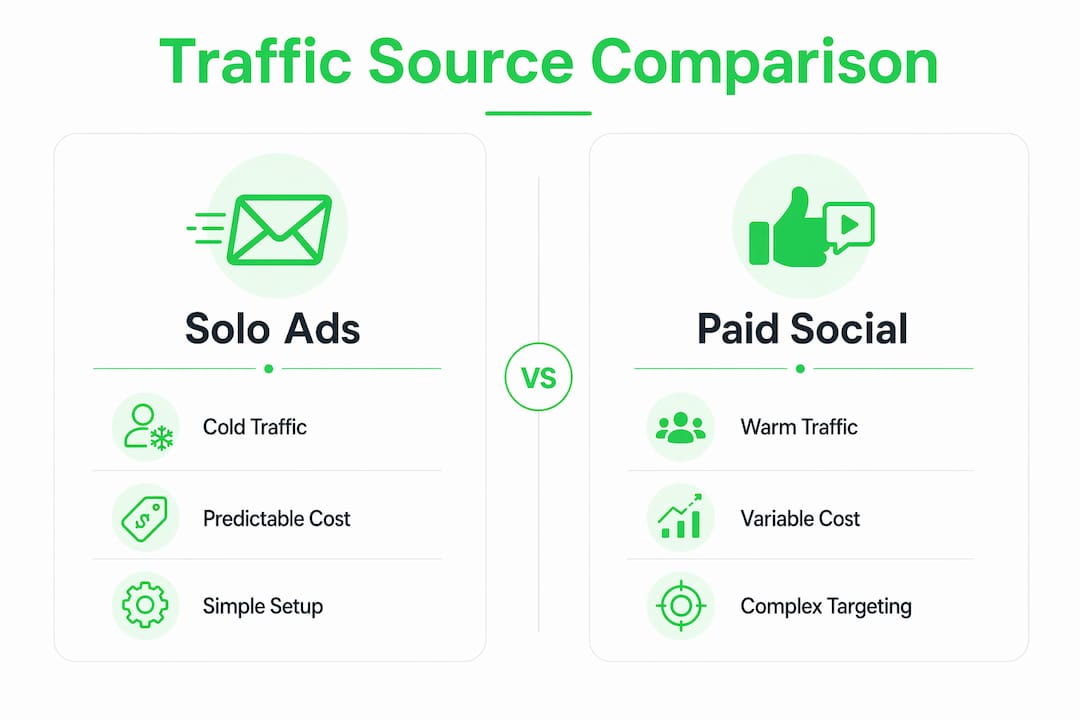
| Factor | Solo ads | Paid social media ads |
|---|---|---|
| Traffic temperature | Cold (no prior relationship) | Cold to warm (interest-based targeting) |
| Account ban risk | None | High, especially for affiliate offers |
| Setup complexity | Low | Moderate to high |
| Targeting precision | Low (niche-level only) | High (demographic, behavioral, interest) |
| Cost predictability | High (fixed cost per click) | Variable (auction-based) |
| Scalability | Limited | High |
| Traffic quality control | Low (vendor-dependent) | Moderate (platform-controlled) |
Solo ads attract marketers who want to avoid social platform bans, but this leads to a misconception that solo ads require no skill or strategy. That assumption increases beginner confusion significantly. For marketers exploring alternatives to paid ads entirely, resources on generating leads without paid ads can provide useful context on where solo ads fit in a broader traffic mix.
The core trade-off is this: solo ads give you speed and simplicity at the cost of targeting precision and scalability. They work best for list building in specific niches like online business, make-money-online, health, and personal development, where large email lists already exist.
Best practices to make solo ads work for you
Solo ads work best as part of a larger, long-term funnel strategy, not as a one-time traffic experiment. The marketers who get consistent results treat each campaign as a data-collection exercise, not a revenue event.
-
Build your squeeze page first. Your landing page should have one goal: capture an email address. Remove navigation links, sidebars, and anything that distracts from the opt-in form. A well-built affiliate funnel guide walks through the exact structure that converts cold solo ad traffic.
-
Write your email sequence before you buy traffic. You need at least five emails scheduled and ready before the first click arrives. Email one delivers your lead magnet. Emails two through five build trust and introduce your offer from different angles.
-
Set a realistic opt-in rate benchmark. A well-built squeeze page targeting a relevant solo ad list should achieve a 30%–50% opt-in rate. If you fall below 30%, the problem is usually your page, not the vendor. Check solo ads performance benchmarks to understand what good looks like across different niches.
-
Vet your vendors carefully. Real professionals are transparent with verified stats and reviews. Look for vendors who share their average opt-in rates, provide traffic source details, and have third-party testimonials. Soloadsguide maintains a vetted list of providers specifically tested for tier-1 traffic quality.
-
Track every variable separately. Use a click-tracking tool to monitor where traffic comes from, what device visitors use, and how long they stay on your page. Separating click quality from page performance is the only way to improve both.
-
Scale only what works. Once a vendor delivers a 35%+ opt-in rate and your email sequence generates at least one sale per 100 subscribers, increase your order size with that vendor. Do not scale campaigns that have not proven themselves on small budgets.
Key Takeaways
Solo ads succeed only when cold traffic meets a tested squeeze page, a ready email sequence, and a vendor with a verified, niche-relevant list.
| Point | Details |
|---|---|
| Clicks do not equal sales | Cold solo ad traffic requires a squeeze page and follow-up sequence to convert. |
| Vendor quality varies widely | Prices below $0.40 per click often signal bot traffic or disengaged subscribers. |
| Funnels come first | Build and test your funnel before spending on any paid traffic source. |
| Track every variable | Separate click quality from page performance to identify what actually needs fixing. |
| Test before scaling | Run 100–200 click tests with multiple vendors before committing to larger orders. |
What I've learned from watching beginners struggle with solo ads
The pattern repeats itself constantly. A new marketer hears that solo ads are simple, buys 500 clicks, sends them to a basic sales page, and gets zero sales. They conclude that solo ads do not work. What actually failed was the system around the traffic, not the traffic itself.
Solo ads are not a magic button. They require the same strategic thinking as any other paid traffic channel. The difference is that the feedback loop is faster and cheaper than social media ads, which makes them genuinely useful for beginners who want to test offers quickly without risking an ad account ban.
What I tell every beginner is this: treat your first three solo ad campaigns as tuition, not investment. You are paying to learn your opt-in rate, test your email copy, and understand how cold traffic behaves. If you enter with that mindset, the results will not disappoint you because you will be measuring the right things.
The marketers who stick with solo ads and eventually profit from them share one trait. They build their funnel skills and their email marketing skills at the same time they run campaigns. Solo ads without email marketing knowledge is like buying a car without knowing how to drive. The tool is fine. The operator needs more practice.
Check out the common reasons beginners lose money on solo ads if you want a frank breakdown of what goes wrong and why. It will save you real money.
— Phil
Trusted resources for new marketers starting with solo ads
Getting solo ads right from the start means working with vendors you can trust and having a clear picture of what good results look like.
Soloadsguide exists specifically to solve the vendor problem for new marketers. The platform maintains a regularly updated, ranked list of top solo ad providers tested for tier-1 traffic quality and verified opt-in rates. Every provider on the list has been evaluated for list engagement, traffic sourcing, and buyer transparency. Users of Soloadsguide have reported results including a 40% reduction in cost per lead by switching from unvetted vendors to those on the recommended list. If you are starting out, that list is the most practical first step you can take before spending a dollar on traffic.
FAQ
What is a solo ad, exactly?
A solo ad is a paid email promotion where you pay a list owner to send your offer to their subscribers as a standalone email. The email contains one call to action pointing to your landing page.
Why do solo ads confuse new marketers so often?
Most beginners expect solo ads to generate immediate sales, but solo ads require a tested funnel and email follow-up sequence to convert cold traffic into leads and buyers.
How much should I pay per click for solo ads?
Quality solo ad traffic costs between $0.40 and $0.90 per click. Prices below that range frequently indicate bot traffic or low-engagement subscriber lists.
What opt-in rate should I expect from a solo ad campaign?
A well-built squeeze page targeting a relevant solo ad list typically achieves a 30%–50% opt-in rate. Results below 30% usually point to a landing page problem, not a vendor problem.
Are solo ads better than paid social media ads for beginners?
Solo ads carry no account ban risk and have predictable costs, but they offer less targeting precision and lower scalability than paid social media ads. They work best for list building in specific niches as part of a broader funnel strategy.
Recommended
- Why Beginners Lose Money on Solo Ads (Real Reasons)
- Why Beginners Lose Money on Solo Ads (Real Reasons)
- Solo Ads Recurring Income Explained for Affiliate Marketers
- Are Solo Ads Worth It for Affiliate Marketers in 2026?
Want Verified Traffic Without the Guesswork?
PulseTraffic screens every seller, filters bot clicks in real time, and shows you verified buyer traffic labels before you spend a dollar.