
A recycled solo ad list is a batch of email subscribers who have already been mailed the same offer dozens of times, resold across multiple vendors, or padded with bot clicks to look bigger than it is. The single rule that protects you: never buy more than 100 to 200 clicks from a vendor until you've tracked the results yourself.
That test buy is cheap insurance. Vendor dashboards can show any number they want. Your own tracking link cannot lie about how many unique people actually opted in.
Before you place another order, do three things:
- Run a small test first. Buy a small number of clicks, no more, and treat it as paid education rather than a real campaign.
- Track with your own third-party tool. Never rely solely on the vendor's click counter. A tracker you control catches duplicate IPs, bot patterns, and inflated numbers.
- Send traffic to a page you own. Never let a vendor deliver clicks straight to an affiliate link. Capture the email first so the list becomes yours, win or lose.
Record your opt-in rate, reply rate, and sales per 100 clicks in a simple spreadsheet within 24 hours of the test ending. If the numbers fall below the benchmarks in this guide after a full 7 to 30 day tracking window, request a refund or replacement before you reorder.
Key Takeaways
Testing 100 to 200 clicks with your own tracker before scaling is the single most reliable way to catch a recycled solo ad list before it drains your budget.
| Point | Details |
|---|---|
| Test small first | Cap your first order at 100 to 200 clicks and treat it as paid education, not a launch campaign. |
| Track independently | Use a third-party tracker instead of vendor dashboards to catch bot clicks and duplicate IPs. |
| Send traffic to owned pages | Route every click to a squeeze page and email sequence you control, never the vendor's property. |
| Score vendors before paying | Apply a structured vetting framework and require verifiable answers on transparency and refund policy. |
| Follow Soloadsguide's vetting framework | Use the 21-question checklist to score vendors before committing beyond a test buy. |
Table of Contents
- What Is a Recycled Solo Ad List and Why It Hurts Your ROI
- What Red Flags Signal a Recycled or Low-Quality List?
- What Metrics Actually Prove Traffic Quality?
- How Do You Test a Vendor Before Scaling Up?
- What Should You Demand From Udimi, TrafficForMe, and ClicksDealer?
- What Does the 21-Question Vendor Vetting Framework Cover?
- What Do You Do If You Get Recycled Traffic?
- How Do You Reduce Your Reliance on Rented Lists?
- Why the 21-Question Framework Changes How You Buy Traffic
- Get the Full Vendor Vetting Checklist and Email Templates
- Frequently Asked Questions
- Sources
What Is a Recycled Solo Ad List and Why It Hurts Your ROI
A recycled list is any batch of subscribers that's been mailed too often, resold to multiple buyers without disclosure, or artificially inflated with clicks that don't come from real, interested humans. Some vendors run the same names through dozens of campaigns a month. Others buy cheap, low-intent traffic and funnel it through their own list to pad delivery numbers. Either way, you end up paying for clicks from people who've seen your kind of offer so many times they've stopped reading past the subject line.
Three consequences show up almost immediately when this happens:
- Conversion failure. Clicks arrive, but almost nobody opts in, because the audience has mentally tuned out solo ad offers entirely.
- List fatigue. Repeated exposure to similar pitches trains subscribers to ignore or delete without opening, a pattern Mailchimp documents as a measurable, predictable drop in engagement over time.
- Skewed metrics. Vendor dashboards report the click count they delivered, not whether those clicks were unique, human, or interested, which makes their reporting nearly useless for judging quality.
It's worth noting that "recycled" isn't always the full story; understanding the role of audience targeting in digital ads helps clarify when poor results come from mismatched audiences versus list quality. A well-maintained list can still underperform badly if your offer doesn't match the audience's interests. Post Affiliate Pro points out that offer-to-audience mismatch causes plenty of failures that get blamed on "bad traffic" when the real issue is targeting. That's exactly why the small test matters: it tells you whether the list is genuinely stale or whether your funnel needs work.
What Red Flags Signal a Recycled or Low-Quality List?
Some warning signs show up before you spend a dollar. Others only appear once traffic starts flowing. Learning to spot both saves you from repeat mistakes with the same vendor.
Before you buy, watch for vague or evasive answers to specific questions. A vendor who can't describe their list's niche beyond "make money online" or "health and fitness" probably doesn't segment their audience at all. Refusal to let you use your own tracking link is a harder stop; legitimate vendors expect it and build their business around proving delivery. Promises of guaranteed conversion rates or guaranteed sales are another warning. Nobody controls how a cold audience will respond to your specific offer, and any vendor claiming otherwise is selling a story, not traffic.
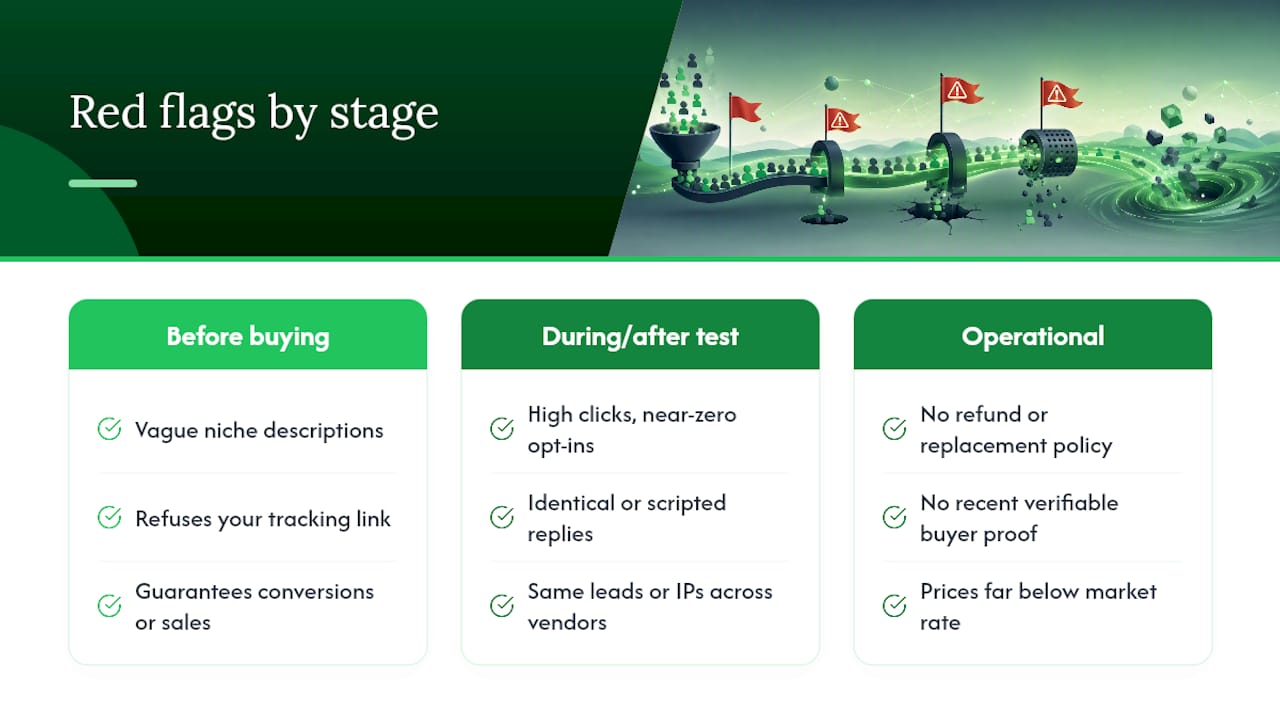
During and after the test, the numbers themselves tell the story. A high click count paired with a near-zero opt-in rate suggests the clicks weren't real people looking for what you offered. Identical or oddly worded email replies across a batch of "leads" often point to bots or a scripted response farm. If you run the same offer through two different vendors and start seeing the same names or IP addresses show up as leads from both, you've caught two sellers mailing the same recycled audience.
Operationally, a vendor with no refund or replacement policy for undelivered or clearly fraudulent clicks is telling you something about how they handle disputes before you ever have one. Unwillingness to share recent, verifiable buyer feedback, not screenshots of testimonials but actual recent transaction proof, is another signal worth weighing. And a price so far below market rate that it seems too good to be true almost always is; BizzOffers forum threads from buyers who've tested dozens of vendors consistently note that rock-bottom pricing correlates with rock-bottom quality.
The clearest tell isn't any single red flag. It's a pattern: a vendor who avoids specifics on niche, dodges tracking requests, and can't produce a recent satisfied buyer is very likely reselling the same tired list to whoever pays next.
What Metrics Actually Prove Traffic Quality?
Vendor-reported click counts tell you almost nothing on their own. What matters is what happens after the click, and that data lives in your tracker, not theirs.
Here's what to capture and roughly what to expect from a legitimate, well-targeted list during a first 100 to 200 click test:
| Metric | What it measures | Reasonable benchmark range |
|---|---|---|
| Unique clicks vs. delivered clicks | How many clicks came from distinct visitors, not repeat hits | Should closely match delivered count; large gaps suggest bot traffic |
| Click-to-opt-in rate | Percentage of visitors who join your list | About 15% on a solid landing page with matched niche |
| Email reply rate | Subscribers who respond to your welcome or follow-up emails | A handful of genuine replies per 100 opt-ins signals real humans |
| Sales per 100 clicks | Direct conversions from the test batch | Varies widely by offer and price point, but zero across multiple tests is a warning sign |
| Refund or replacement window | Time vendor allows to report problems | 24 hours or more is standard among reputable sellers |
Delivered clicks are the easiest number to fake and the least useful for judging anything. Your tracker's unique click count, session duration, and geographic consistency matter far more. Post Affiliate Pro recommends measuring results over a full 7 to 30 day window rather than judging a campaign on day one, since some opt-ins convert to sales weeks later.
A few extra data points worth logging every time:
- Time-of-day and time-zone patterns in your click logs, since a cluster of clicks at 3 a.m. local time for your target country deserves a second look.
- Bounce rate on your squeeze page, because unusually high bounces often mean the traffic wasn't genuinely interested in your niche to begin with.
- Repeat IP addresses within a single delivery, which point toward either bot activity or a very small underlying list being recirculated.
How Do You Test a Vendor Before Scaling Up?
Run this exact sequence on every new vendor, no exceptions, before you commit real budget.
- Set up your tracker first. Install a third-party tool such as ClickMagick or Voluum before you place any order, so every click from the vendor passes through your own logging system.
- Build a page you control. Create a squeeze or bridge page hosted on your own domain, never a page the vendor provides or controls.
- Load your follow-up sequence. Write a 5 to 7 email series before traffic arrives, since a funnel without follow-up emails wastes clicks that might have converted with a second or third touch.
- Order 100 to 200 clicks, no more. This is your paid education, not your launch campaign.
- Watch your tracker logs in real time. Look for unique visitor counts, geographic consistency, and session length that matches genuine browsing behavior rather than instant bounces.
- Record opt-ins and replies daily for 7 to 30 days. Delayed conversions are common, so don't judge the run on day one alone.
- Compare against your benchmarks. Decide before the test starts what opt-in rate and reply rate you'll accept, so you're not rationalizing weak numbers after the fact.
Community guidance from experienced buyers on forums like BizzOffers consistently backs this exact approach: start small, insist on tracker access, and favor Tier 1 traffic filtered to the US, UK, Canada, and Australia before expanding to broader targeting.
Your decision rules should be simple and written down in advance:
- If opt-in rate lands below roughly 15% and reply rate is near zero, request a refund or replacement and do not reorder.
- If opt-in rate clears 25% and you see a handful of genuine replies, place a second, slightly larger test order before scaling further.
- If sales appear within the 30-day window at a rate that covers your cost per click, you've likely found a vendor worth a repeat relationship.
Pro Tip: Keep a dedicated tracking campaign name for every new vendor. Mixing vendors under one tracking link makes it nearly impossible to tell which seller sent you the recycled traffic later.
What Should You Demand From Udimi, TrafficForMe, and ClicksDealer?
Solo ad marketplaces and individual vendor sites work differently, and each model comes with its own blind spots.
Udimi operates as a marketplace connecting buyers directly with individual sellers, complete with a rating and review system tied to each vendor's account. That review layer is genuinely useful, but treat star ratings as a starting filter, not a final verdict. Before buying, ask any Udimi seller for raw opt-in counts from a recent campaign in your niche, not just a screenshot of their overall rating. Confirm they'll let you paste in your own tracking link rather than one they generate.
TrafficForMe positions itself around curated, higher-quality traffic sourced from the vendor's own network rather than an open marketplace of third-party sellers. That centralized model can mean more consistent quality control, but it also means less transparency into where any single batch of clicks originated. Ask directly what niche segmentation options exist and request a sample delivery report from a campaign similar to yours before committing budget.
ClicksDealer functions more like a traffic brokerage, sourcing clicks from multiple channels and reselling them in packages. Because the traffic can be blended from several sources, ask specifically how they verify uniqueness across their supply and whether they can guarantee Tier 1 country targeting if that matters for your offer. Get their refund policy in writing before you order, since brokerage models sometimes have less direct control over the original traffic source than a solo vendor does.
Across all three, the same requests apply regardless of platform:
- Ask for raw opt-in numbers from a recent, comparable campaign, not cherry-picked testimonials.
- Request a sample tracking postback or screenshot showing delivery timestamps and unique click counts.
- Get the refund or replacement policy in writing before you pay, not after a problem shows up.
- Confirm niche targeting claims with a specific example of a past buyer in your vertical.
- Verify you can use your own tracking link rather than one supplied by the seller.
Buyer reviews matter, but read them skeptically. A glowing testimonial dated two years ago tells you nothing about a vendor's current list health. Favor recent feedback, and weigh forum discussions from buyers with no financial stake in the platform over reviews posted directly on the marketplace itself.
What Does the 21-Question Vendor Vetting Framework Cover?
A single red flag rarely tells you enough. Scoring a vendor across a structured set of questions gives you a clearer, more defensible buy or avoid decision than gut instinct alone.
Group your questions into five categories and ask them directly, either in chat or email, before you place an order:
- Transparency: Will you let me use my own tracking link? Can you show a recent delivery report with timestamps? Do you disclose your traffic source (owned list, network, or brokered)?
- Traffic quality: What's your typical click-to-opt-in rate for offers similar to mine? How do you handle bot or invalid click filtering? What countries make up your Tier 1 traffic mix?
- Delivery guarantees: What's your refund or replacement window? Do you guarantee unique clicks, or only total clicks delivered? How quickly do you deliver after purchase?
- Legal and compliance: Do subscribers on your list opt in under applicable anti-spam and privacy regulations? Can you confirm consent practices for the list you're sending to?
- Buyer history: Can you provide a reference from a recent buyer in my niche? How long have you operated this list? What's your policy if I find duplicate leads from another vendor?
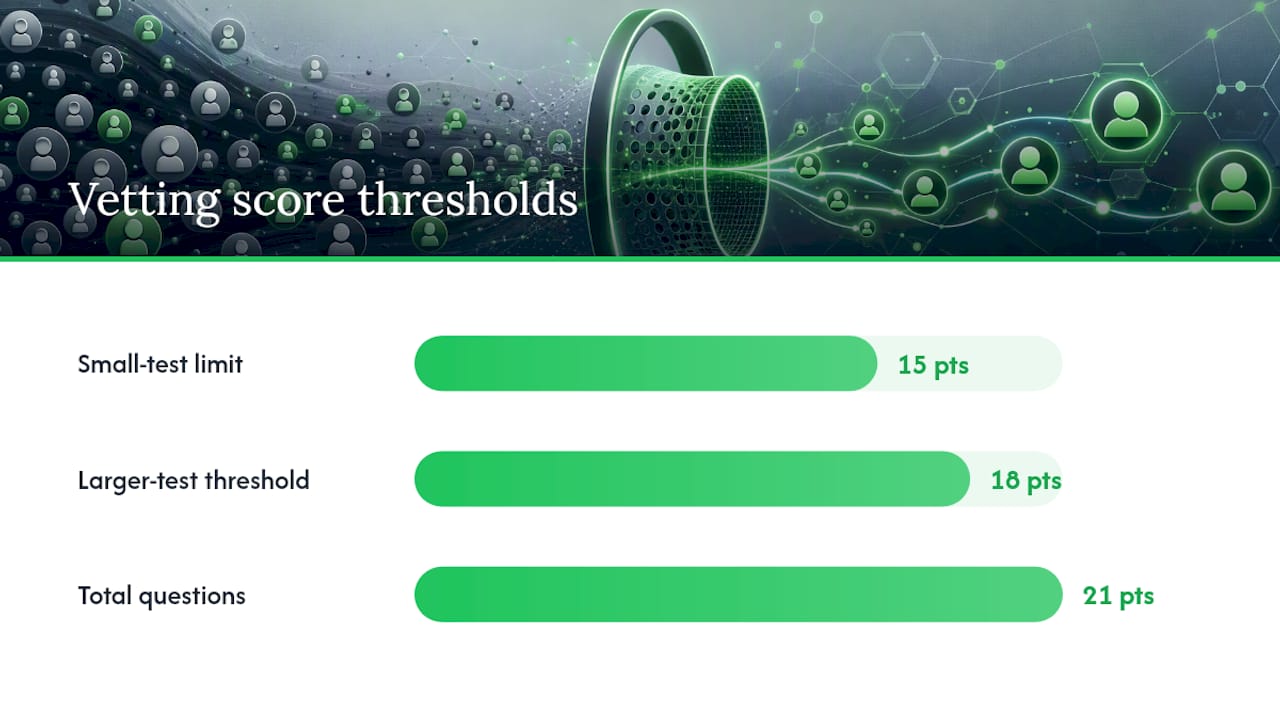
Score a yes on each question as one point. A vendor scoring below 15 out of 21 deserves a small test order at most, never a large one. A vendor clearing 18 or higher on direct, verifiable answers earns a slightly larger initial test, though still nowhere near your full budget on a first run.
Write the answers down as you get them. Memory fades, and a documented record lets you compare vendors side by side instead of relying on impressions days later. Soloadsguide hosts the full 21-question vetting checklist with space to log each vendor's answers directly.
Pro Tip: Ask all 21 questions in a single message rather than trickling them out over several days. A vendor's response time and thoroughness on that first message tells you almost as much as the answers themselves.
What Do You Do If You Get Recycled Traffic?
Discovering a bad run doesn't have to mean losing the money outright. Acting fast and documenting everything gives you real leverage.
- Pull your tracker logs immediately. Export unique click counts, timestamps, IP addresses, and session durations before anything gets deleted or overwritten.
- Export your opt-in timestamps. Compare the timing of opt-ins against the delivery window the vendor reported to spot inconsistencies.
- Cross-check leads against other vendors. If you've run parallel tests, compare email addresses and IPs across lists to catch overlap that proves recycling.
- Request a replacement or refund with evidence attached. Send the specific data points, not a vague complaint, and reference the refund window they quoted before you paid.
- Escalate through the marketplace if the vendor stalls. Most platforms have a dispute process for exactly this situation.
Vendors and marketplaces typically respond best to hard evidence rather than complaints framed emotionally. That means:
- Postback logs showing exact delivery times matched against your server records.
- A list of unique click IDs from your tracker, cross-referenced against what the vendor claims they delivered.
- Screenshots of duplicate or scripted-sounding email replies, if that's part of your evidence.
If the marketplace dispute process doesn't resolve things, and you paid through PayPal or a card processor, keep every piece of correspondence and tracking data. Payment providers generally require documented proof before they'll consider a chargeback, so the evidence trail you build during the dispute step does double duty here.
How Do You Reduce Your Reliance on Rented Lists?
Testing protects your budget on any single purchase, but the real long-term fix is owning more of your traffic instead of renting it every time.
- Build your own list from every solo ad purchase. Route every test through a squeeze page you control, so even a mediocre vendor run adds names to an asset you keep permanently.
- Split-test your lead magnet and headline. Small improvements in opt-in rate compound across every future traffic source, rented or organic.
- Migrate your best converters into a core nurture sequence. Subscribers who respond early deserve deeper, more consistent follow-up than a generic autoresponder provides.
- Run periodic re-engagement campaigns. A simple "still interested?" email to subscribers who've gone quiet for 60 or 90 days often revives a meaningful chunk of an otherwise cold segment, a tactic Mailchimp recommends specifically to counter the fatigue effect that recycled lists suffer from constantly.
Solo ads work best as a funnel-building tool, not your primary, permanent sales channel. Think of each purchase as a way to add qualified names to a list you'll own and nurture for months, rather than a one-time transaction you hope converts immediately. Marketers who treat rented traffic as the entire strategy stay exposed to every recycled list and price hike in the market. Those who treat it as one input into a growing owned asset build something that gets cheaper to monetize over time.
It's almost always cheaper than buying fresh cold traffic, and it targets people who've already shown some interest.
Why the 21-Question Framework Changes How You Buy Traffic
Most guidance on solo ads treats vendor selection as a matter of finding the right recommendation, as if one good tip solves the whole problem. That's backwards. The vendors worth buying from today aren't necessarily the ones worth buying from in six months, because lists age, get overmailed, and change hands. A framework you apply consistently protects you regardless of which specific names are trustworthy this quarter.
The 21-question checklist works because it forces a vendor to commit to specifics before any money changes hands. A seller who answers seventeen questions clearly and dodges four consistently is telling you exactly where their weak points are, whether they realize it or not. I've seen buyers skip this step because it feels slow when a vendor is pushing for a quick sale, and that's precisely the moment a recycled list operator counts on you not asking.
Treat your first order with any new vendor as tuition, not revenue generation. A small, disciplined test that comes back weak costs you far less than a large order placed on faith, and it teaches you something concrete about that specific list rather than a general impression you can't act on.
Get the Full Vendor Vetting Checklist and Email Templates
Running the 100 to 200 click test manually works, but having the exact questions, scoring sheet, and evidence log in front of you during a vendor conversation makes the whole process faster and harder to talk yourself out of.
Soloadsguide built the full 21-question vendor vetting framework as a downloadable resource, complete with sample email templates for requesting proof from a vendor and a simple evidence log template for tracking test results across multiple sellers. It's free to access, and nothing on the download page asks for information beyond an email address, so you can grab it, run your next test, and unsubscribe anytime if it's not useful to you. If you're about to place an order with a new vendor, or you've been burned once already and want a repeatable system instead of guesswork, download the vendor vetting checklist before your next purchase and score that vendor against all 21 questions before you pay.
Frequently Asked Questions
What exactly makes a solo ad list "recycled"?
A recycled list is one that's been mailed the same or similar offers repeatedly, resold across multiple buyers without disclosure, or padded with clicks that don't come from genuinely interested subscribers. The result is high delivered click counts paired with weak opt-in and conversion rates.
How many clicks should I buy for my first test with a new vendor?
Start with 100 to 200 clicks. That range is small enough to limit your exposure if the list turns out to be weak, but large enough to give you a meaningful read on opt-in rate and reply behavior within a 7 to 30 day tracking window.
Can vendor-reported click numbers be trusted at all?
Treat them as a starting point, not proof. Vendor dashboards report what they claim to have delivered, not whether those clicks came from unique, interested humans. Your own third-party tracker is the only reliable source for that distinction.
What's a reasonable opt-in rate to expect from a quality solo ad list?
Rates well below 15% across multiple tests from the same vendor point toward either a mismatched offer or a genuinely low-quality list.
Should I ever buy solo ads as my main, ongoing traffic source?
Solo ads work best as a funnel-building tool that feeds your own email list, not as a permanent primary sales channel. Marketers who rely entirely on rented traffic stay exposed to every recycled list and pricing shift in the market, while those who build an owned list from each purchase reduce that exposure over time.
Sources
The claims and benchmarks in this guide draw from tracking best practices and field-tested buyer guidance rather than vendor marketing copy. A few resources worth bookmarking as you build out your own testing process:
- Solo ads affiliate marketing - Post Affiliate Pro
- Boost Affiliate Sales Fast: Proven Solo Ads Strategy for Beginners | Affilorama
- Ad fatigue - Mailchimp
Whenever possible, favor primary evidence over secondhand claims. Your own tracker logs, exported opt-in timestamps, and raw email replies will always tell you more than a vendor's screenshot or a testimonial posted on their own sales page.
Recommended
- Why Solo Ads Reduce Customer Acquisition Costs
- Grow Your Email List With Solo Ads Quickly
- Why Beginners Lose Money on Solo Ads (Real Reasons)
- Solo Ads Recurring Income Explained for Affiliate Marketers
Want Verified Traffic Without the Guesswork?
PulseTraffic screens every seller, filters bot clicks in real time, and shows you verified buyer traffic labels before you spend a dollar.