

Yes, retargeting solo ad traffic works, but only when tracking, segmentation, and a follow-up sequence are already in place before you buy. Solo ad clicks are cold and short-lived, so the retargeting layer is what turns a one-time spike into repeat exposure and, eventually, sales.
Do this in the next two hours:
- Set unique sub-IDs for the order and install a click tracker so you can see what actually happened, not what the vendor claims happened.
- Confirm your squeeze page and thank-you page both exist and load fast enough to fire a pixel before the visitor bounces.
- Buy a 100-click probe order from one vendor, not five, so you can isolate results.
Pro Tip: Watch sales per 100 clicks first. If the list rarely buys, track replies to your follow-up emails instead. Either number tells you more than opt-in rate ever will.
Key Takeaways
Retargeting solo ad traffic converts reliably when tracking, audience segmentation, and a tested follow-up sequence are built before the first click arrives.
| Point | Details |
|---|---|
| Track before you buy | Set unique sub-IDs and a click tracker like ClickMagick, Voluum, or BeMob before spending on any vendor. |
| Watch sales per 100 clicks | Use this metric, or reply rate if sales are rare, as the primary signal for scaling a vendor. |
| Segment by intent | Separate clicked-only, opted-in, and thank-you page visitors, and exclude converters from prospecting ads. |
| Layer pixel and list retargeting | Start with a short 1 to 7 day pixel window, then add Customer Match or Custom Audiences for cross-device reach. |
| Vet vendors first | Apply Soloadsguide's 21-Question Vendor Vetting Framework and run a 100-click probe before committing real budget. |
Table of Contents
- How Solo Ad Traffic Behaves Differently From Other Paid Channels
- Prepare Your Funnel and Tracking Before Buying Solo Ad Traffic
- Segmenting Solo Ad Leads for Smarter Retargeting
- Setting Up Pixel-Based Retargeting on Facebook and Google
- List-Based Retargeting: Customer Match and Custom Audiences
- Ad Creative and Sequencing That Converts Solo Ad Leads
- Budgeting and KPIs for Solo Ad Retargeting Campaigns
- Vetting Vendors With a Repeatable Test Protocol
- Common Retargeting Mistakes and Quick Fixes
- Syncing Email Automation With Your Retargeting Audiences
- Frequency Capping and Ad Fatigue With Small Retargeting Audiences
- Expanding Reach With Lookalike Audiences
- Handling Objections and Sharpening Your Value Proposition in Retargeting Ads
- Building Sequential Retargeting Funnels That Nurture in Stages
- A Failed Test That Taught Us to Trust the Numbers, Not the Pitch
- Get the Vetting Checklist Before Your Next Solo Ad Buy
- Frequently Asked Questions
- Sources
How Solo Ad Traffic Behaves Differently From Other Paid Channels
Solo ad traffic arrives cold, in one short burst, from a list you didn't build and can't fully audit. Most vendors send a single email blast, so you get a spike of clicks in a narrow window instead of the steady trickle you'd see from Google Ads or Facebook Ads. Many lists skew toward specific niches like make-money-online or health, which means your offer either matches that list closely or converts poorly no matter how good your funnel is.
Opt-in rate and buyer rate are not the same metric, and treating them as interchangeable is one of the most common mistakes affiliate marketers make with solo ads.
- A high opt-in rate can still produce zero sales if the list is full of freebie seekers.
- Watch for click bursts that all land within seconds of each other, which often signals bot or incentivized traffic.
- Odd geo or device splits (all mobile, all one country you didn't target) are a warning sign worth logging before you retarget anyone.
Prepare Your Funnel and Tracking Before Buying Solo Ad Traffic
Buying traffic before your funnel is ready wastes the spend and the retargeting opportunity that comes with it. Solo ads deliver fast leads but no lasting revenue without a conversion system already built to capture and follow up on them.
- Build a fast-loading squeeze page and a distinct thank-you page, since the thank-you page is where your pixel fires and your highest-intent audience gets tagged.
- Assign a unique sub-ID to every vendor and every order, then install a click tracker like ClickMagick, Voluum, or BeMob and enable postback tracking wherever the vendor allows it.
- Write a baseline five-email follow-up sequence before you spend a dollar, and check your landing page's message match against the vendor's promotional email.
Pro Tip: Log reply rates from that five-email sequence separately from your sales numbers. Replies tell you if the list is engaged even before anyone buys, which matters when you're deciding whether to retarget or walk away.
Segmenting Solo Ad Leads for Smarter Retargeting
Not every click deserves the same ad spend, and treating your entire traffic source as one audience is how budgets disappear fast. Break leads into behavior tiers: clicked-only, viewed the landing page, opted in, reached the thank-you page, and purchased. Each tier represents a different level of intent, and your retargeting budget should reflect that.
- Tag visitors using URL parameters, dataLayer events on your site, or list tags inside your email service provider so every segment is identifiable later.
- Exclude converters from prospecting-style retargeting ads immediately. Showing a sales pitch to someone who already bought wastes impressions and can hurt the relationship.
- Isolate thank-you page visitors into their own audience. Segmenting by engagement depth reduces wasted spend because that group already showed the highest intent on your list.
Setting Up Pixel-Based Retargeting on Facebook and Google
Pixel-based retargeting is the fastest way to re-engage a solo ad spike, since the pixel population happens automatically once traffic starts flowing.
- Place the pixel on every page in the funnel, landing page, thank-you page, and any offer or upsell page, then test that it fires correctly before you spend a dollar on ads.
- Use Meta's Events Manager test tool or Google Tag Assistant to confirm the pixel is registering visits in real time, not just installed on the page.
- Set a short initial audience window, one to seven days, since solo ad traffic arrives as a single spike rather than a steady stream, and a 30 or 60 day window dilutes your ad spend across people who already forgot the offer.
- Layer additional windows (14 days, 30 days) only after the first short window shows a real signal.
Standard remarketing shows the same generic ad to anyone who visited. Dynamic remarketing personalizes the ad creative to the exact offer or product a visitor viewed, and Google Ads documents the full setup process using a data feed inside campaign settings.
Pro Tip: Don't skip the pixel test step. A pixel that's installed but misfiring is the single most common reason retargeting campaigns show zero audience growth after a solo ad buy.
List-Based Retargeting: Customer Match and Custom Audiences
Pixel data disappears the moment a visitor switches devices or clears cookies, but an email address doesn't. List-based retargeting solves that gap by uploading your captured leads directly into an ad platform.
- Export your opt-in list and upload it as a hashed file into Facebook Custom Audiences or Google Customer Match, both of which require the email to be hashed before upload for privacy compliance.
- Choose list-based targeting over pixel-based when you expect leads to browse on mobile and buy on desktop, since a hashed email match follows the person, not the device.
- Keep a minimal compliance checklist: confirm the list was collected with consent, remove unsubscribes before every upload, and refresh the audience regularly so it doesn't include stale or bounced addresses.
Ad Creative and Sequencing That Converts Solo Ad Leads
Message match is the difference between a retargeting ad that feels familiar and one that feels like spam. If the vendor's email promised a free guide, your retargeting ad should reference that same guide, not pivot to an unrelated pitch.
- Sequence your ads to mirror your email cadence: value lead first (a tip or resource), then social proof (testimonials or results), then urgency or a specific offer tied to your final email.
- Run quick creative tests even on small audiences: split one headline against another, test a strong CTA against a soft one, and compare a static image against a short video.
- Keep each test isolated to one variable at a time, or you won't know which change actually moved the funnel conversion rate.
Budgeting and KPIs for Solo Ad Retargeting Campaigns
Sales per 100 clicks is the number that matters most, and it's the metric practitioner guidance consistently points to when testing a new solo ad vendor. If sales are rare in your niche, track reply rate to your follow-up sequence as the next best signal.
- Test with a probe order plus a small retargeting budget before committing real money to either.
- Scale spend only from confirmed profit, never from opt-in rate alone, since a full inbox of freebie seekers can look great on paper and convert to nothing.
- Cap ad frequency early. Small retargeting audiences burn out fast if the same three people see your ad twenty times in a week.
- Use conversion-focused bidding cautiously on small audiences, and avoid setting an aggressive ROAS target before you have enough data to support it.
Vetting Vendors With a Repeatable Test Protocol
A 100-click probe order is the cheapest insurance policy in this business, and running it the same way every time is what makes the results comparable across vendors.
- Buy exactly 100 clicks from one vendor and send them to your squeeze page, tagged with a unique sub-ID.
- Record click timing (bursts vs. a steady trickle), device and geo splits, opt-in rate, email replies, and sales.
- Compare that data against the vendor's own claims about list niche, delivery window, and past buyer conversions.
Soloadsguide built its 21-Question Vendor Vetting Framework around exactly this kind of test, covering tracking permissions, list niche disclosure, delivery windows, and refund or replacement policies before you spend beyond a probe order.
Refusal to allow tracking, click patterns that arrive in a matter of seconds, and vague or dodged answers about list niche and buyer history are the clearest signs a vendor won't hold up past the first order.
Pro Tip: If a vendor won't let you use your own tracking link, that's the whole conversation. Walk away before you spend a dollar more.
Common Retargeting Mistakes and Quick Fixes
Most retargeting failures trace back to a handful of repeat mistakes, and most of them are fixable in under an hour.
- Missing tracking: audit your pixel and click tracker before assuming the campaign underperformed.
- Poor message match: compare your ad copy against the original vendor email and your landing page headline.
- Retargeting every click instead of segmenting: add exclusions for converters and isolate high-intent visitors.
- Skipping the follow-up sequence: a retargeting ad with no email cadence behind it is fighting alone.
- No test log: keep a simple spreadsheet comparing vendors, sub-IDs, and sales-per-100-clicks so you're not relying on memory when deciding who to reorder from.
Syncing Email Automation With Your Retargeting Audiences
Your email list and your ad audiences should talk to each other, but most affiliate marketers run them as two separate systems that never sync. That gap wastes the segmentation work you already did during opt-in.
Most email service providers now support a direct or semi-direct connection to Facebook Custom Audiences, either through a native integration or a middle step using a tool like Zapier. The practical version looks like this: every time someone opts in from your solo ad squeeze page, they get tagged in your ESP with the source and date. That same tag can trigger an export, sometimes daily, sometimes weekly, into a Custom Audience inside Facebook Ads or a Customer Match list inside Google Ads.
The advantage over pixel-only retargeting is durability. A pixel-based audience decays as cookies expire or people switch devices. An email-synced audience holds steady until the person unsubscribes or the address bounces. That matters most for buyers, the smallest and most valuable segment in your funnel, since you want to keep reaching them with upsells or a second offer weeks after the original solo ad exposure, long after any pixel window would have closed.
Set the sync frequency to match how fast your list grows. A vendor sending you 300 clicks a day needs a daily sync, while a slower trickle can run weekly without losing much responsiveness. Either way, the sync should exclude anyone tagged as "purchased" so you're not showing a cold-list buyer the same offer they already paid for.
Frequency Capping and Ad Fatigue With Small Retargeting Audiences
Solo ad traffic produces small, concentrated audiences, and small audiences burn out fast. Showing the same ad fifteen times in a week to a pool of 300 people isn't persistence, it's the reason your click-through rate collapses by week two.
Set a frequency cap at the campaign level inside Facebook Ads Manager or Google Ads, typically capping impressions per user at two to three per day and reviewing the frequency metric weekly rather than daily. If frequency climbs past four or five per week while click-through rate drops, that's ad fatigue setting in, and it happens faster with solo ad audiences than with broader prospecting campaigns simply because the pool is smaller.
Rotate creative on a schedule tied to audience size rather than a fixed calendar date. A 200 person audience might need fresh creative every five to seven days, while a 2,000 person list-based audience can run the same ad for two or three weeks before fatigue sets in. Build three to four creative variations before you launch so you're not scrambling to produce new ads mid-campaign when performance dips.
Ad fatigue shows up as rising cost per click and falling engagement well before it shows up in sales numbers, so treat frequency as a leading indicator, not a lagging one. Pull the ad or swap creative the moment frequency crosses your threshold rather than waiting for the sales-per-100-clicks number to confirm it.
Expanding Reach With Lookalike Audiences
Retargeting alone caps your ceiling at the size of your original solo ad traffic, which for most probe orders is a few hundred people. Lookalike audiences solve that ceiling by asking the ad platform to find new people who resemble your best existing segment.
The seed audience matters more than the lookalike percentage you choose. A lookalike built from your buyer list will consistently outperform one built from your full opt-in list, because the platform is matching against people who paid, not people who just filled out a form out of curiosity. If your buyer list is too small to build a reliable lookalike, usually under 100 people, use your thank-you page visitors as the next best seed since that group already showed the highest intent short of purchasing.
Start with a 1% lookalike audience for the tightest resemblance to your seed group, and only expand to 2% or 3% once you've confirmed the tighter audience converts. A broader lookalike reaches more people but drifts further from what actually worked in your original solo ad traffic, which defeats the purpose of building it from real buyer behavior in the first place.
Run lookalike campaigns as a separate budget line from your direct retargeting spend so you can compare performance cleanly. If the lookalike audience produces a similar sales-per-100-clicks figure to your retargeted segment, it's worth scaling. If it lags significantly, the seed audience likely needs to be refined before you put more money behind it.
Handling Objections and Sharpening Your Value Proposition in Retargeting Ads
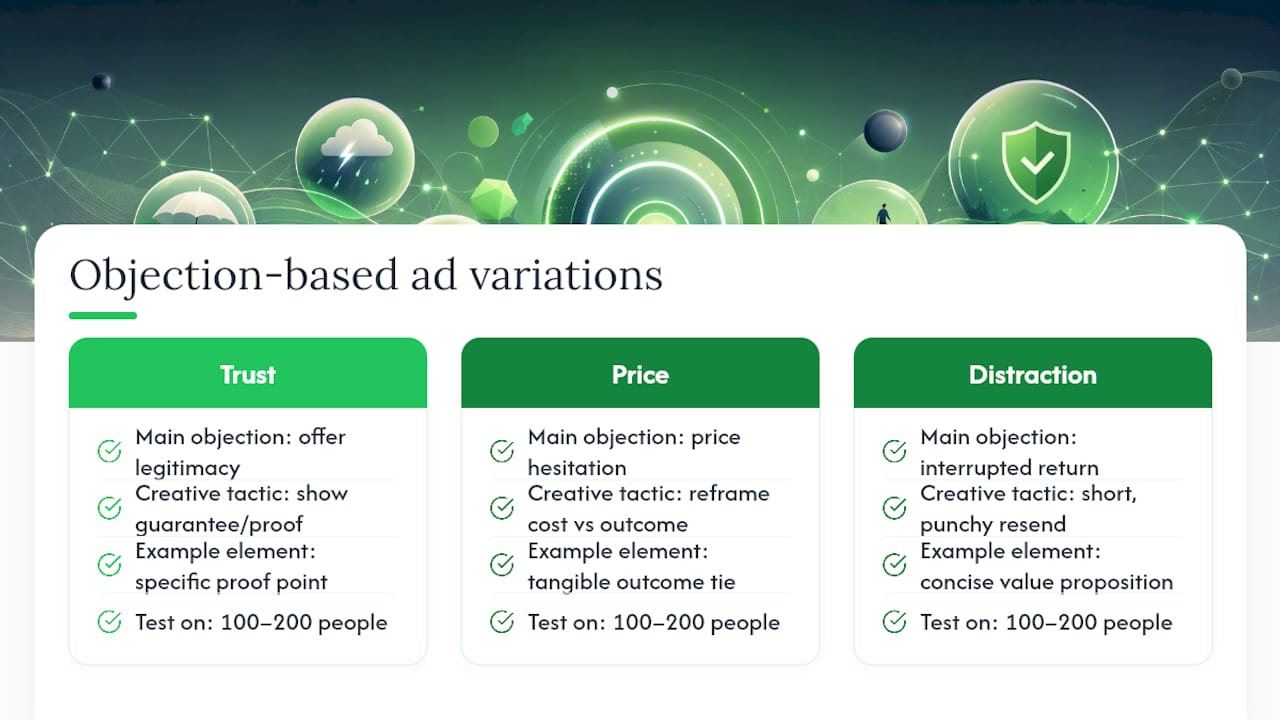
A retargeting ad has one job the original solo ad email didn't: answer the objection that stopped someone from converting the first time. Someone who clicked but didn't opt in had a reason, and your retargeting creative should address that reason directly instead of just repeating the original pitch louder.
Common objections in this traffic type include skepticism about the offer's legitimacy, price hesitation, and simple distraction (they clicked, got interrupted, and never came back). Build separate ad variations for each. A trust-focused ad might reference a guarantee or specific proof point. A price-focused ad might reframe the cost against a tangible outcome. A distraction-focused ad might simply resend the original value proposition in a shorter, punchier format, since that segment already showed interest and just needs a nudge back.
Refine your value proposition by testing specificity against vagueness. "Learn how to grow your list" is weaker than a specific number or outcome tied to the exact lead magnet promised on your squeeze page. Since message match between the vendor email and your landing page is already a known conversion factor, your retargeting ad should extend that same specific language rather than introducing a new angle that breaks the thread.
Test objection-handling creative against your control ad on the smallest viable audience first, generally 100 to 200 people, before rolling it out wider. The winning variation usually reveals which objection was actually holding your funnel back, which is often more useful than the sale itself.
Building Sequential Retargeting Funnels That Nurture in Stages
A single retargeting ad asks someone to make one decision immediately. A sequential funnel breaks that decision into smaller steps, which tends to work better with cold solo ad traffic that hasn't built any trust with you yet.
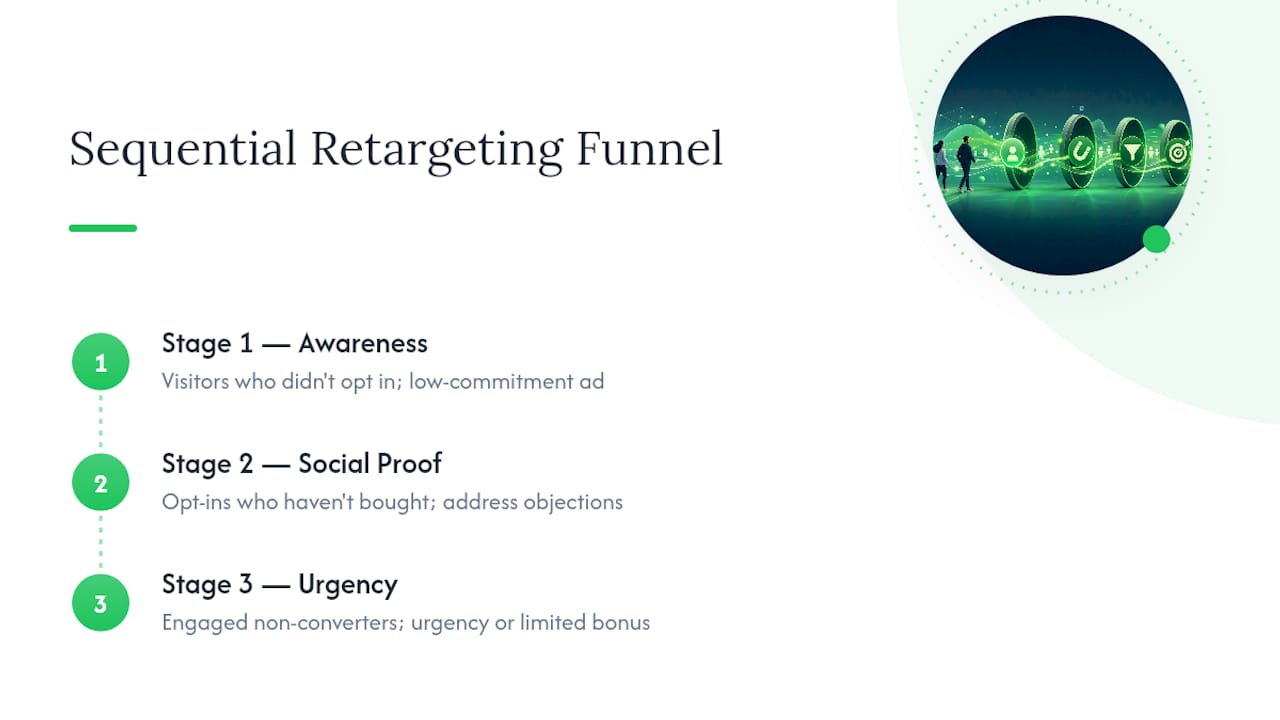
Structure it in three stages. Stage one targets everyone who visited your landing page but didn't opt in, showing a low-commitment ad that reinforces the original lead magnet's value. Stage two targets people who did opt in but haven't purchased, shifting the message toward social proof and addressing the objections most common at that stage. Stage three targets people who engaged with stage two ads but still haven't converted, introducing urgency or a limited-time bonus tied to your final email in the follow-up sequence.
Each stage should exclude anyone who advanced to the next one, so your stage-one messaging never reaches someone who already opted in. This is the same exclusion logic used in basic segmentation, just applied across a longer timeline instead of a single audience.
Space the stages to match your email cadence rather than running them all simultaneously. If your follow-up sequence sends emails on days one, three, five, seven, and ten, align your ad stages to roughly the same windows so the ad and the email reinforce each other instead of competing for attention on different days.
A Failed Test That Taught Us to Trust the Numbers, Not the Pitch
One 100 click probe order looked promising for the first ten minutes. Then the click log showed every single click landing within a three minute window from one device type. No opt-ins, no replies, zero sales per 100 clicks.
That test cost far less than a full-size order would have. It's why we treat every small buy as paid education first, and why sales per 100 clicks stays the number that actually decides whether a vendor earns a second order.
Get the Vetting Checklist Before Your Next Solo Ad Buy
The fastest way to protect a retargeting budget is to stop bad traffic before it ever reaches your pixel. Soloadsguide's downloadable 21-Question Vendor Vetting Framework walks through the exact questions to ask a vendor about tracking permissions, list niche, and delivery patterns before you send a single dollar.
The checklist maps directly onto the steps in this guide: the tracking setup walkthroughs match the sub-ID and click tracker section above, and the test templates give you a structured way to log your 100 click probe results instead of relying on memory or a vendor's word. It's a paid-education tool in the truest sense. The few dollars it costs to vet a vendor properly is nothing compared to what a burned solo ad order costs once you've already built the retargeting campaign around it. Visit Soloadsguide's guide to buying solo ads that convert to grab the checklist and start your next vendor test with a real framework instead of a guess.
Frequently Asked Questions
How long should a retargeting audience window stay open after a solo ad campaign? Start with one to seven days since solo ad traffic arrives as a single spike rather than a steady stream. Layer a longer window, such as 14 or 30 days, only after your initial short window shows a real conversion signal.
What's the minimum budget needed to test retargeting on solo ad traffic? There's no fixed number, but the practical approach is a small probe order (around 100 clicks) plus a modest retargeting budget layered on top, scaled only once sales per 100 clicks confirms the traffic converts.
Can I retarget solo ad traffic without an email list? Pixel-based retargeting works without an email list since it tracks website visitors directly. List-based retargeting through Customer Match or Custom Audiences requires captured emails, which is why the squeeze page step matters even if your goal is primarily paid retargeting.
How do I know if a solo ad vendor is worth reordering from? Run a 100-click probe, track sales per 100 clicks or reply rate, and compare the delivery pattern against the vendor's claims about list niche and buyer history. Consistent, spread-out clicks with real opt-ins and at least some sales are the signal to scale.
Should I retarget everyone who clicked, or only people who opted in? Segment instead of blanket retargeting. Exclude converters, prioritize thank-you page visitors as your highest-intent audience, and treat clicked-only visitors as a lower-priority, lower-budget segment.
Sources
- Dynamic remarketing for websites and apps - Google Ads Help
- Solo Ads for Network Marketing: How to Buy Traffic Without Getting Burned - Work With David Wood
- How to Use Solo Ads for CPA Marketing | RevBoost™
- The Ultimate Guide To Solo Ads: What are Solo Ads and How Should You Use Them?
Recommended
- Solo Ad Spend vs Conversion Tracking: ROI Rules
- High-Converting Solo Ad Niches: Shortlist + Test Plan
- Optimize Your Solo Ad Sales Funnel Conversion in 2026
Want Verified Traffic Without the Guesswork?
PulseTraffic screens every seller, filters bot clicks in real time, and shows you verified buyer traffic labels before you spend a dollar.