

Solo ad sellers offer six main types of guarantees: click-delivery (unique human clicks), replacement or re-delivery, over-delivery/bonus clicks, refund/money-back, marketplace escrow/buyer protection, and deliverability or open-rate assurances. For affiliate marketers buying traffic to build a list or test an offer, the guarantees that matter most are click-delivery with documented verification and time-bound remedies. A solo ad traffic guarantee defines measurable delivery — unique, human clicks within an agreed timeframe — and specifies remedies such as re-delivery, credits, or refunds, while excluding conversions or sales from coverage.
Here is a quick reference of the six guarantee categories:
- Click-delivery guarantee — a set number of unique, human clicks within a defined window
- Replacement/re-delivery guarantee — shortfalls are made up with additional sends
- Over-delivery/bonus clicks — vendor promises extra clicks above the purchased amount
- Refund/money-back guarantee — cash returned if delivery falls short
- Marketplace escrow/buyer protection — a neutral platform holds funds until obligations are met
- Deliverability/open-rate assurance — vendor claims a minimum inbox placement or open rate
Pro Tip: No guarantee covers conversions or sales. If a vendor promises opt-in rates or commissions, treat it as a red flag, not a feature.
Key Takeaways
Click-delivery guarantees with documented verification and time-bound remedies are the only solo ad promises that give affiliate marketers real, enforceable buyer protection.
| Point | Details |
|---|---|
| Prioritize click-delivery guarantees | Unique human clicks with a stated delivery window and written remedy are the most verifiable promise a vendor can make. |
| Require third-party tracking | Set up ClickMagick before paying; vendors who refuse tracker links are telling you the guarantee is unenforceable. |
| Test small before scaling | Buy 100–200 clicks first, verify unique counts and opt-in rate, then scale only if results meet your baseline. |
| Guarantees cover delivery, not conversions | No legitimate solo ad guarantee covers opt-ins, sales, or commissions; those outcomes depend on your funnel. |
| Use Soloadsguide's vetting framework | The 21-Question Vendor Vetting Checklist gives you a structured process to confirm guarantee terms before every purchase. |
Table of Contents
- What the main types of solo ad guarantees actually promise
- How guarantees work in practice and what the fine print actually says
- How to vet a vendor's guarantee before you spend a dollar
- Which guarantees are worth paying more for
- Sample guarantee wordings and questions to ask before buying
- The guarantee is only as good as your ability to prove the shortfall
- Soloadsguide's vetting checklist puts this into practice
- Sources
What the main types of solo ad guarantees actually promise
Understanding each guarantee type means reading past the marketing language to the actual obligation. Here is what each one covers and where the limits are.
Click-delivery guarantee
The most common promise in the industry: you buy 500 clicks, you get 500 unique, human clicks within a stated timeframe (often 3–7 days). "Unique" means one count per IP address or device. "Human" means bot-filtered. The vendor's definition of both terms is where disputes start. Ask specifically how uniqueness is measured and whether the vendor uses a bot-filtering service.
Pros: Directly measurable with a third-party tracker. Clear pass/fail outcome. Cons: "Human" is self-reported unless you verify with your own tracker. Delivery window can be vague if not stated in writing.
Replacement/re-delivery guarantee
If the vendor delivers fewer clicks than purchased, they send additional traffic to make up the shortfall. No cash changes hands. This is the most common remedy offered in lieu of a refund.
Pros: Low friction for the vendor to honor. You still get the traffic you paid for. Cons: Replacement traffic may come from a lower-quality segment. There is usually a dispute window (often 48–72 hours after delivery) you must act within.
Over-delivery/bonus clicks
An over-delivery guarantee that vendors sometimes offer means the vendor promises at least 10% more clicks than purchased — buy 1,000, receive at least 1,100 — and typically limits that promise to unique, human-verified clicks rather than repeat or bot activity. Some vendors offer this as a standard practice, while others advertise it as a selling point.
Pros: Gives you a buffer if a small percentage of clicks are filtered out by your tracker. Cons: Over-delivery does not compensate for poor list quality. Bonus clicks from a low-engagement list add volume, not value.
Refund/money-back guarantee
Cash returned if delivery falls short. Less common than replacement guarantees because vendors prefer to keep revenue and make up the difference with more traffic. When a refund is offered, it is almost always partial (covering only undelivered clicks) and subject to a short claim window.
Pros: Strongest financial protection for the buyer. Cons: Refund eligibility typically requires documented proof from a third-party tracker. Vendors may dispute your tracker's data if it conflicts with their own logs.
Marketplace escrow/buyer protection
Platforms like Udimi hold payment in escrow until the vendor delivers. If delivery falls short, the marketplace mediates. This is the closest thing to neutral dispute resolution the solo ad industry offers. Marketplace buyer-protection and written, time-bound replacement/refund policies materially improve buyer protection because they provide neutral dispute resolution and hold funds until obligations are met.
Pros: Funds are protected before delivery. Dispute process is handled by a third party. Cons: Marketplace fees apply. Vendor selection is limited to listed sellers.
Deliverability/open-rate assurance
Some vendors claim a minimum inbox placement rate or open rate. These are the hardest guarantees to verify independently. Inbox placement depends on the recipient's email provider, the sender's domain reputation, and content factors outside the vendor's control.
Pros: Signals the vendor cares about list hygiene. Cons: Nearly impossible to audit without access to the vendor's sending infrastructure. Treat these as marketing claims unless the vendor provides third-party deliverability reports.
The table below contrasts the six guarantee categories across the dimensions that matter most to buyers.
| Guarantee type | What's measured | Common remedy | Verifiable by buyer? | Typical exclusions |
|---|---|---|---|---|
| Click-delivery | Unique human clicks | Re-delivery or refund | Yes, with third-party tracker | Conversions, sales, opt-ins |
| Replacement/re-delivery | Click shortfall | Additional sends | Yes, with tracker | Quality of replacement traffic |
| Over-delivery/bonus | Clicks above purchased amount | None needed if met | Yes, with tracker | Bot/duplicate clicks |
| Refund/money-back | Click shortfall | Cash refund | Yes, with documented proof | Partial delivery scenarios |
| Marketplace escrow | Delivery vs. payment release | Mediated refund or re-send | Yes, via platform | Platform fee, listed vendors only |
| Deliverability/open-rate | Inbox rate or open rate | Rarely specified | Rarely | All conversion metrics |
How guarantees work in practice and what the fine print actually says
A guarantee is only as strong as the artifacts that prove it. Delivery, measurement method, dispute window, and remedy type must all be defined in writing before you send payment. Solo ads require agreement on price, creative, and tracking in advance; verification depends on buyer-supplied trackers and vendor reporting to reconcile sends and clicks.
Typical operational elements to confirm before buying:
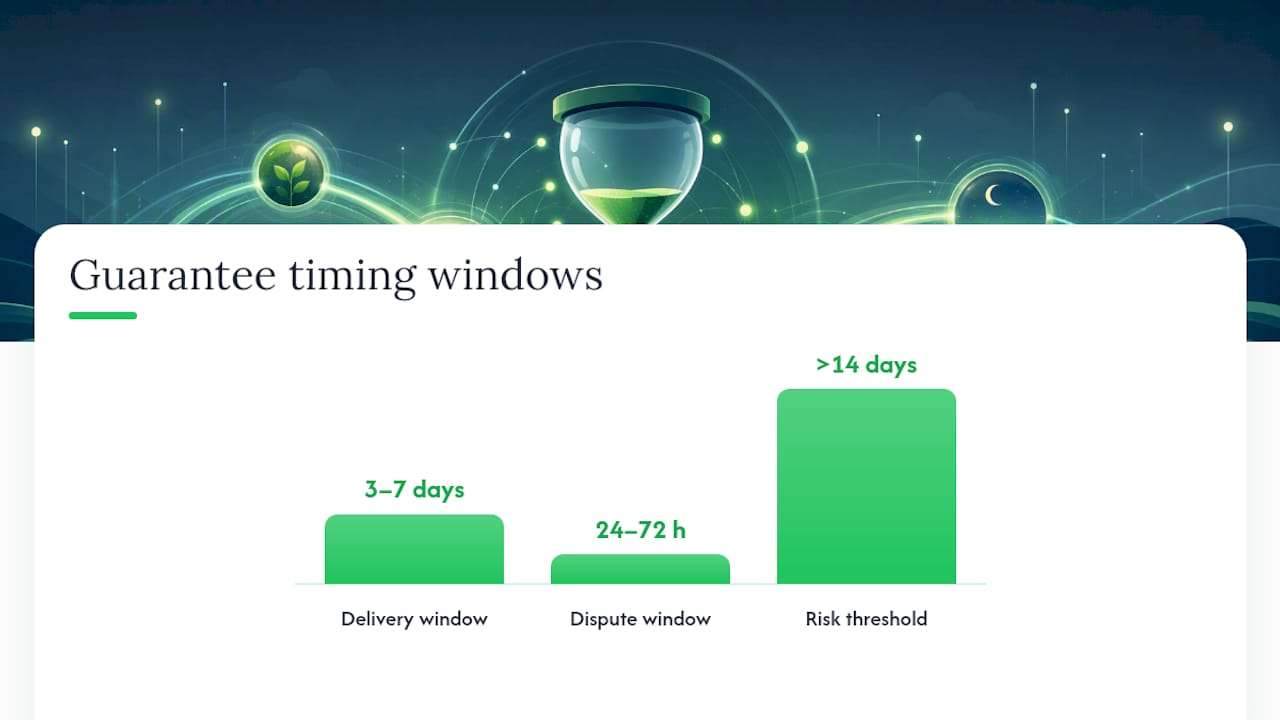
- Delivery window: How many days from payment to completion? Three to seven days is standard; anything over 14 days without a milestone check-in is a risk.
- Unique-click definition: Does the vendor count by IP, by device, or by a cookie? IP-based counting is most common and easiest to reconcile with ClickMagick or similar tools.
- Dispute window: Most vendors allow disputes within 24–72 hours of delivery completion. Miss that window and you forfeit your remedy.
- Measurement method: Vendor-side tracking vs. buyer-side tracking. Discrepancies of 5–10% are normal; larger gaps require explanation.
- Remedy type: Re-delivery, credit, or cash refund — and under what conditions each applies.
Evidence vendors should supply to honor a claim:
- Raw click logs with timestamps
- Unique click IDs for each recorded visit
- IP address summaries (to cross-reference with your tracker)
- Third-party tracker report links (if the vendor supports them)
- Send confirmation showing list segment and send time
Vendor-provided tracking proof — click logs, unique click IDs, timestamps — speeds dispute resolution when vendors publish a clear claim process.
Watch for contract language that narrows your rights. Phrases like "delivery is considered complete upon send" remove the vendor's obligation to prove clicks were received. "Opt-in rate is not guaranteed" is standard and acceptable. "No refunds after 24 hours" is aggressive but common. "Results may vary" with no defined remedy is not a guarantee at all.
Guarantees universally exclude conversions and sales. A vendor who promises a specific opt-in rate is making a claim they cannot control, since your landing page, offer, and follow-up sequence determine that outcome. Solo ads are worth testing only when buyers have a proven offer, a tested landing page, an email follow-up sequence, and independent tracking; otherwise paid clicks rarely translate into profit.
How to vet a vendor's guarantee before you spend a dollar
A vetted guarantee is only as strong as the verification artifacts behind it. The promise on a vendor's sales page means nothing if they cannot produce click logs, support your tracker, or define a dispute process in writing.
Soloadsguide's 21-Question Vendor Vetting Framework groups the questions you need to ask into four themes. Here is a summary:
Tracking and evidence (questions 1–6)
- Do you support third-party tracking links (e.g., ClickMagick)?
- Will you provide raw click logs with timestamps after delivery?
- How do you define a "unique" click?
- What bot-filtering method do you use?
- Can I see a sample report from a recent campaign?
- What is your average discrepancy rate with buyer trackers?
List quality and targeting (questions 7–12) 7. What niche or interest categories does your list cover? 8. How was your list built (opt-in, co-reg, purchased)? 9. How often do you mail your list? 10. What is the average age of subscribers on your list? 11. Do you segment by buyer vs. freebie-seeker? 12. What countries does your traffic come from?
Terms and remedies (questions 13–17) 13. What is your delivery window? 14. What is your dispute window? 15. What remedy do you offer for shortfalls — re-delivery, credit, or refund? 16. Is your guarantee in writing (terms and conditions page or email)? 17. What evidence do I need to provide to claim a remedy?
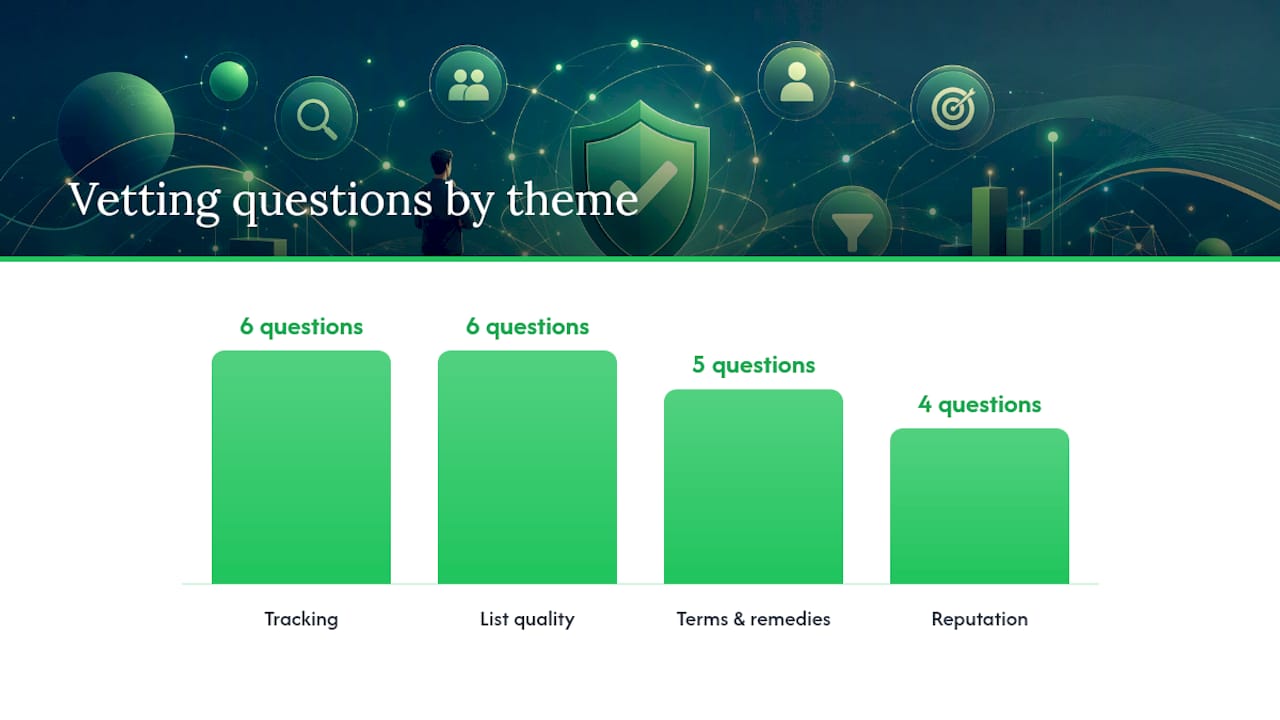
Reputation and payment protection (questions 18–21) 18. Do you sell through a marketplace with escrow, or direct? 19. Can you provide references or verifiable buyer reviews? 20. How long have you been selling solo ads? 21. Do you accept payment through a platform with buyer protection?
Tracking verification steps with ClickMagick:
- Create a tracking link in ClickMagick before you send payment.
- Give the vendor your ClickMagick link as the destination URL.
- After delivery, compare your ClickMagick unique-click count with the vendor's reported count.
- Check the IP log in ClickMagick for geographic distribution and bot scores.
- Flag any discrepancy above 10% and request the vendor's raw click log for reconciliation.
Red flags to watch for:
- Vendor refuses to accept a third-party tracking link
- No written terms defining delivery window or dispute process
- Guarantee promises opt-in rates, sales, or commissions
- Price is significantly below market rate (often a sign of bot traffic)
- Vendor cannot produce a sample click report from a past campaign
- Dispute window is under 24 hours
Reputable vendors publish delivery guarantees and will refund undelivered clicks; avoid sellers who refuse to provide tracker links or detailed reporting.
Small-sample test plan before committing to a large buy:
- Purchase 100–200 clicks as a test order.
- Require your ClickMagick link as the destination.
- After delivery, check unique clicks, geographic distribution, and bot scores.
- Measure your opt-in rate on the squeeze page.
- Request the vendor's click log and reconcile with your tracker data.
- Only scale if unique clicks match within 10% and opt-in rate meets your baseline.
Pro Tip: Ask the vendor to send to a small segment first (50 clicks) before completing the full order. A vendor confident in their list quality will agree. One who refuses is telling you something.
Which guarantees are worth paying more for
Prefer verifiable click-delivery guarantees with clear remedies and documented dispute windows for any testing campaign. Everything else is secondary.
When a stronger guarantee justifies a higher price:
- You are running a high-ticket funnel where a bad traffic batch costs you real money. See high-ticket offer strategies for how guarantee terms shift at this level.
- You are building a list from scratch and need clean, opt-in-ready traffic.
- You are testing a new landing page and need reliable click volume to get a statistically meaningful sample.
- You are buying Tier 1 traffic (US, UK, Canada, Australia) where pricing is higher and list quality expectations are proportionally higher.
Pricing tradeoffs:
- Over-delivery guarantees (10% bonus clicks) rarely add meaningful cost. They are a standard competitive feature, not a premium.
- Marketplace escrow adds platform fees but provides neutral dispute resolution. For first-time buys or new vendors, the fee is worth it.
- Refund guarantees are worth more than replacement guarantees when you are on a tight testing budget. Cash back lets you reallocate; replacement traffic from a vendor who already underdelivered may not perform better.
- Deliverability/open-rate assurances rarely justify a price premium because they are nearly impossible to verify independently.
Negotiation tips:
- Ask for a written confirmation of delivery window and remedy type via email before paying.
- Request a tracker link requirement be added to the order terms.
- For orders over 500 clicks, ask for a milestone update at the halfway point.
- Use a marketplace with escrow for any vendor you have not bought from before. Check how to vet solo ad sellers for a step-by-step process.
- If a vendor only offers replacement (not refund), ask what segment the replacement traffic comes from and whether it is the same list.
For a detailed breakdown of when solo ads make financial sense at all, the solo ad cost per lead guide covers the math behind guarantee premiums and testing budgets.
Sample guarantee wordings and questions to ask before buying
Having the right language ready before you contact a vendor saves time and filters out sellers who cannot meet basic standards.
Three sample guarantee wordings:
Short form: "Vendor guarantees delivery of [X] unique, human clicks within [Y] days. Shortfalls will be remedied by re-delivery within [Z] days of a written claim submitted within 48 hours of delivery completion."
Medium form: "Vendor guarantees [X] unique clicks, defined as one click per IP address, bot-filtered using [method], delivered within [Y] days of campaign launch. Buyer must supply a third-party tracking link.
Explicit SLA form: Delivery is confirmed by vendor click log and buyer's ClickMagick report. Buyer must submit a claim with tracker screenshots within 48 hours of the stated delivery deadline."
Five questions to send a vendor before buying:
- "Do you accept a ClickMagick tracking link as the destination URL for this order?"
- "What is your delivery window, and what is the dispute window if delivery falls short?"
- "Can you provide a sample click report from a recent campaign in a similar niche?"
- "What percentage of your list is Tier 1 (US, UK, Canada, Australia)?"
- "If delivery falls short, do you offer re-delivery, a credit, or a cash refund?"
For a full pre-purchase question list, the questions before buying solo ads guide covers additional targeting and list-quality questions worth asking.
Short contract clause template:
Evidence checklist if a dispute becomes necessary:
- Screenshot of your ClickMagick unique-click count with timestamps
- Screenshot of vendor's reported click count (from their dashboard or email)
- IP log export from your tracker showing geographic distribution
- Copy of the original order confirmation with stated quantity and delivery window
- Written record of your claim submission (email or platform message with timestamp)
The guarantee is only as good as your ability to prove the shortfall
Most affiliate marketers focus on the promise. The experienced ones focus on the proof. After 11 years as a solo ad vendor, Philip Coble's consistent observation is that buyers who get burned are rarely victims of outright fraud. They are buyers who paid without a tracker link, accepted verbal delivery confirmations, and missed the dispute window because they did not know it existed.
The guarantee types covered here are real and enforceable — but only when you have the artifacts to back a claim. A refund guarantee with no tracker requirement is a marketing statement. A replacement guarantee with a 24-hour dispute window you did not know about is worthless after day two. The single most useful habit you can build is this: before you send payment, get the delivery window, the dispute window, and the remedy type in writing. Everything else in this article is secondary to that one step.
Soloadsguide's vetting checklist puts this into practice
Knowing the types of solo ad guarantees is step one. Applying that knowledge before every purchase is where most buyers skip ahead and pay for it later.
Soloadsguide's 21-Question Vendor Vetting Checklist operationalizes everything covered in this article. It gives you a ready-to-use question list grouped by tracking, list quality, terms, and payment protection — so you are not improvising when a vendor's sales page looks convincing. The checklist also includes a sample clause template you can paste into any order confirmation, a step-by-step small-sample test plan, and tracking configuration notes for ClickMagick.
Buyers who work through the checklist before purchasing spend less time in disputes and make faster decisions about which vendors to scale with. You can access the checklist and the full solo ad vendor vetting guide at Soloadsguide, along with the scam-avoidance guide that covers the red flags this article introduced.
Sources
Third-party tracking tools:
- Get high-quality traffic: the solo ad guarantee explained
- Are Solo Ads Worth It for Affiliate Marketers in 2026? Costs, Risks and Realistic Returns - Market Spur
- What Are Email Solo Ads? How They Work & How to Use Them
- Solo Ads: 7 Powerful Secrets to Avoid Losing Money in 2025
Marketplace buyer protection:
Soloadsguide resources:
Recommended
- Solo Ads Affiliate Commissions Explained for Marketers
- The Solo Ads Guide for Affiliate Marketers
- Solo Ad Click Tracking Explained for Affiliate Marketers
- Why Small Businesses Need Email Traffic: A Vetting-First Guide
Want Verified Traffic Without the Guesswork?
PulseTraffic screens every seller, filters bot clicks in real time, and shows you verified buyer traffic labels before you spend a dollar.