Coaching solo ads can work, but only if you fix your funnel first and refuse to buy from any vendor who won't allow independent tracking. That's the whole verdict. Everything else in solo ad buying is downstream of those two conditions.
Before you spend a dollar, build a single-field squeeze page (email address only, nothing else) and install an independent tracker like ClickMagick so you control the data instead of relying on a vendor's word. Then treat your first purchase as paid research, not a launch.
- Fix the funnel first: one headline, one field, one call to action
- Install independent tracking before any vendor sends a single click
- Buy small on the first order and judge the vendor on real numbers, not promises
- Expect to learn more than you earn on your first two or three buys
Key Takeaways
Coaching solo ads succeed when buyers fix their funnel before spending and insist on independent tracking instead of trusting vendor-reported numbers.
| Point | Details |
|---|---|
| Fix the funnel first | Build a single-field squeeze page before contacting any solo ad vendor. |
| Track independently | Install a tool like ClickMagick before the send, never rely only on vendor reports. |
| Test small, scale slow | Start with 100 to 300 clicks and change one variable per order. |
| Vet before you pay | Ask about Tier-1 percentage, funnel review, and written guarantees upfront. |
| Verify with the vetting framework | Soloadsguide's 21-Question Vendor Vetting Framework and funnel review help confirm a vendor's claims before you spend. |
Table of Contents
- What Coaching Solo Ads Actually Are and How They Work
- How to Prepare, Buy, and Monetize Solo Ad Traffic Step by Step
- Vendor Vetting and the Red Flags That Should End the Conversation
- The Email and Landing Page Blueprint That Turns Clicks Into Clients
- Tracking the Metrics That Tell You Whether a Vendor Is Worth Repeating
- Testing and Scaling Without Blowing Your Budget
- Seven Common Mistakes That Waste Solo Ad Budgets
- Applying the SoloAdsGuide Vetting Framework in Practice
- Staying on the Right Side of Spam Laws and Permission Marketing
- Lead Generation Methods That Work Alongside Solo Ads
- Writing Email Swipes That Actually Convert Solo Ad Clicks
- Why Verification Beats Hype Every Time
- Get Hands-On Help Vetting Your Next Solo Ad Vendor
- Sources
What Coaching Solo Ads Actually Are and How They Work
A solo ad is a paid, dedicated email that a list owner sends to their subscribers on your behalf, promoting your offer and nothing else. You're renting someone else's attention for one message, one link, one call to action. Pricing runs by unique click, not impressions or opens, which makes solo ads unusual among traffic sources: you know exactly what you paid for the moment the campaign closes.
Expect cost-per-click benchmarks between $0.30 and $1.00 depending on the traffic tier. Tier-1 traffic (subscribers based in the US, UK, Canada, Australia, and New Zealand) sits at the top of that range because it converts better and carries higher average buyer value.
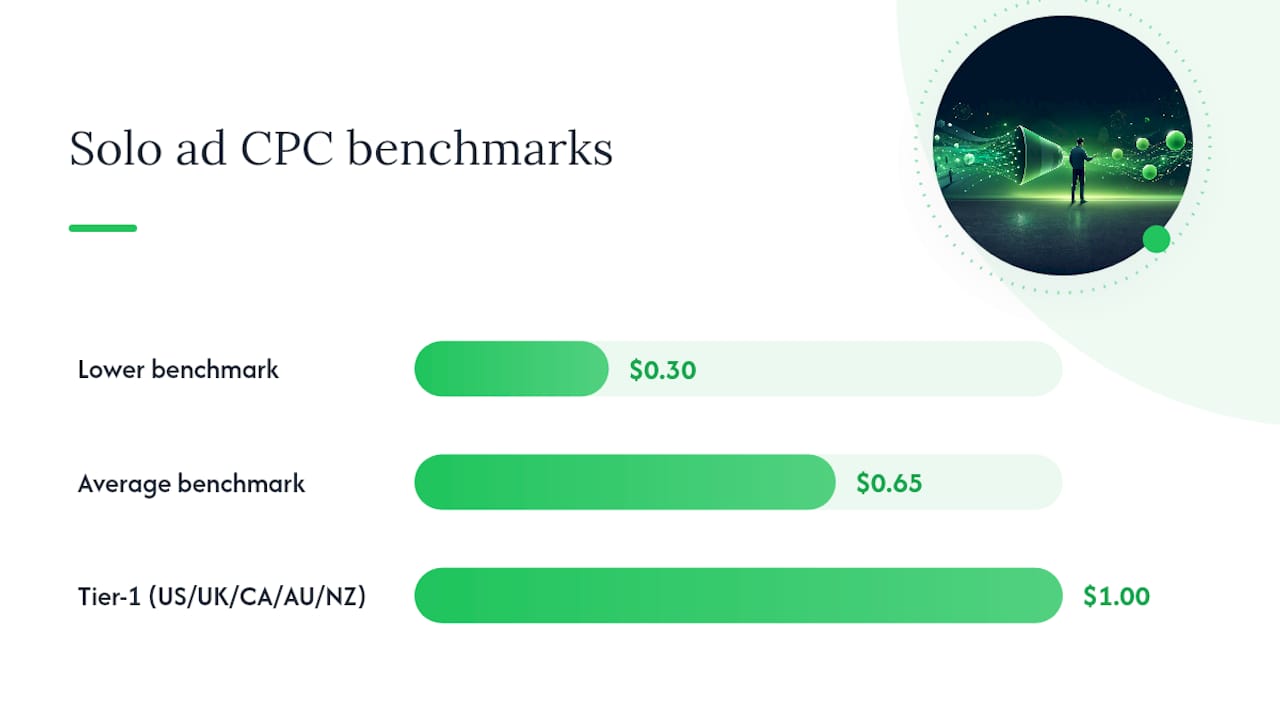
Statistic Callout: Tier-1 traffic commands premium pricing because these five countries produce the bulk of verified buyer conversions in solo ad marketing, and vendors price accordingly.
For coaching offers, the fit depends on what happens after the click. A lead magnet built around a specific outcome, followed by a tripwire offer under $50, tends to perform well because coaching audiences are used to paying for guidance in small increments before committing to bigger programs. High lifetime value offsets a modest opt-in rate. Where solo ads fail coaches is when the offer requires deep trust before any purchase, like a $5,000 mastermind pitched cold with no tripwire in between.
One underappreciated trade-off: solo ads are platform-agnostic. No algorithm can ban your account or throttle your reach overnight, unlike paid social. That stability comes at the cost of scale. You're limited by how many quality vendors exist in your niche, not by an ad platform's inventory.
- Billed per unique click, not impressions
- Tier-1 traffic costs more but converts at a higher rate
- Immune to platform bans, but limited by vendor supply
How to Prepare, Buy, and Monetize Solo Ad Traffic Step by Step
Solo ad campaigns follow a predictable sequence, and skipping steps is where most budgets get wasted. Here's the order that actually protects your money.
- Build your landing page first. A single-field squeeze page with one headline, one benefit statement, and one email field. No navigation, no distractions.
- Confirm your lead magnet solves one specific problem. Vague coaching lead magnets ("Free Guide to Success") convert worse than specific ones ("The 3-Email Script That Books Discovery Calls").
- Install independent tracking before contacting any vendor. A tool like ClickMagick lets you see click timing, geography, and duplicate patterns the vendor cannot control.
- Confirm your opt-in flow is CAN-SPAM compliant, including a visible unsubscribe link and honest sender information on every follow-up email.
- Run your vetting script before you pay. Ask about Tier-1 percentage, funnel review process, and written guarantees.
- Negotiate a smaller first order (100 to 300 clicks) instead of accepting whatever package size the vendor pushes.
- Monitor the live click log during the send. Watch for geo mismatches, timestamp clustering, or repeat IPs, which often signal bot traffic.
- Confirm overdelivery or guarantee terms are honored once the order closes; a 30% opt-in guarantee is common among reputable vendors.
- Launch your follow-up sequence immediately so new subscribers hit your inbox while the offer is fresh in their mind.
- Log your results (clicks, opt-ins, sales) in a simple spreadsheet before you ever consider reordering from the same vendor.
Pro Tip: Screenshot your tracker's live dashboard during the send, not just the final report. Vendors sometimes "adjust" final numbers after the fact, but a live screenshot with a timestamp is evidence you control.
The step most buyers skip is step 3. Trusting a vendor's self-reported numbers without your own tracker is how buyers end up paying for clicks that never happened.
Vendor Vetting and the Red Flags That Should End the Conversation
Vetting a solo ad vendor isn't complicated, but it requires asking direct questions and refusing vague answers. The core of Soloadsguide's 21-Question Vendor Vetting Framework centers on a handful of questions that matter more than the rest:
- What percentage of your list is Tier-1 traffic, and can you prove it?
- Will you allow me to use my own independent tracker, like ClickMagick, for this order?
- Do you offer a written opt-in guarantee, and what happens if I fall short?
- Can you review my funnel before the send and flag anything that looks weak?
- Can you provide named buyer proof, not just screenshots with usernames blurred out?
A quality vendor treats a funnel review as a standard part of the service. A vendor who refuses to even glance at your squeeze page before sending traffic usually has no stake in whether you will succeed.
Reviews matter, but only the specific kind. Third-party platforms like Trustpilot can reveal patterns across dozens of buyers that a vendor's own testimonial page will never show you, especially repeated complaints about delayed delivery or low-quality clicks.
Ask for logs, not screenshots. A vendor with nothing to hide will show you the raw click data from their own tracking system alongside your independent tracker's report, side by side, without hesitation.
Three red flags should end the conversation immediately: refusal to allow independent tracking, vague or shifting explanations of "Tier-1 percentage," and prices so far below market rate that no legitimate list owner could profit from the sale.
The Email and Landing Page Blueprint That Turns Clicks Into Clients
Everything after the click depends on two assets: the email swipe the vendor sends and the page it points to. Get either one wrong and the traffic quality won't matter.
- Keep the email between 150 and 300 words. Solo ad subscribers skim. A short, punchy email with one call to action outperforms a long sales letter almost every time.
- Write subject lines that combine curiosity and benefit. Something like "The email script that filled my calendar" beats a generic "Free coaching guide" every time.
- Give the reader exactly one next step. One link, repeated once or twice, never a menu of options.
- Build the squeeze page around a single headline, one email field, and one button. Nothing above the fold should compete for attention.
- Prioritize page speed and mobile display. Most solo ad clicks arrive on phones, and a slow-loading page kills opt-ins before the reader ever sees your offer. Partner resources like this guide to landing page structure cover the mechanics of pages built for paid traffic specifically.
Pro Tip: If your core offer costs more than $500, insert a bridge page between the opt-in and the sales page instead of sending cold solo ad traffic straight to a high-ticket pitch. The bridge page warms up trust in thirty seconds instead of asking for it instantly.
A bridge page works best when the core offer requires more trust than a cold click can provide. Sending solo ad traffic straight to a low-ticket tripwire, on the other hand, usually performs fine without one.

Tracking the Metrics That Tell You Whether a Vendor Is Worth Repeating
Five numbers determine whether a solo ad campaign was worth the money: clicks delivered, opt-in rate, cost per lead (CPL), sales per opt-in, and earnings per click (EPC). Each one answers a different question, and skipping any of them leaves you guessing.
Opt-in rate tells you if your squeeze page is doing its job. CPL tells you what each new subscriber actually cost once you divide total spend by total opt-ins. EPC, calculated as total revenue divided by total clicks, is the number that ultimately decides whether to reorder from a vendor.
| Metric | What It Tells You |
|---|---|
| Opt-in rate | Percentage of clicks that became email subscribers |
| Sales per opt-in | Percentage of subscribers who purchased the tripwire or core offer |
| Earnings per click (EPC) | Total revenue divided by total clicks delivered |
Statistic Callout: Cost per click typically runs $0.30 to $1.00 for solo ad traffic, so a 300-click test costing $90 to $300 should be budgeted as a data-gathering expense, not a guaranteed profit run.
A quick worked example: 300 clicks at $0.60 each costs $180. That single test wouldn't be profitable on its own, but it tells you whether the funnel and vendor combination deserve a second, larger order.
Testing and Scaling Without Blowing Your Budget
Scaling a solo ad campaign works the same way scaling any paid channel does: prove it small before you bet big.
- Start with 100 to 300 clicks as your first probe. The goal isn't profit yet, it's data: opt-in rate, early sales, and delivery quality.
- Change only one variable per test. Swap the subject line, or the landing page headline, or the tripwire price, but never all three in the same order.
- Double your spend only after two consecutive profitable or break-even orders from the same vendor, not after one lucky run.
- Add a second vendor once your first one is proven, so a single list owner's traffic quality or list fatigue doesn't sink your whole pipeline.
- Log every result (spend, opt-ins, sales, EPC) in one spreadsheet so patterns across vendors become visible over time.
This single-variable discipline matters because solo ad results swing widely between sends, even from the same vendor. Treating each order as one controlled test, rather than a verdict on your entire offer, keeps you from abandoning a good funnel after one bad batch of clicks or scaling a lucky fluke into a real loss.
Seven Common Mistakes That Waste Solo Ad Budgets
Most solo ad losses trace back to a short list of repeated errors, and every one of them is fixable before your next order.
- Buying a large package on the first order. Fix: cap your first buy at 100 to 300 clicks regardless of the discount offered for volume.
- Skipping independent tracking. Fix: install a tracker before you ever contact a vendor.
- Sending traffic that doesn't match your list's niche. Fix: ask vendors directly what topics their subscribers originally opted in for.
- Pointing traffic at a homepage instead of a dedicated squeeze page. Fix: build a single-purpose landing page for every campaign.
- Chasing the cheapest click price available. Fix: compare EPC, not CPC, across vendors.
- Never testing subject lines. Fix: request two swipe variations and split the order.
- Reordering from a vendor before reviewing your own logged data. Fix: check your spreadsheet before you check your inbox for the next upsell.
Applying the SoloAdsGuide Vetting Framework in Practice
The full 21-Question Vendor Vetting Framework covers everything from list age to refund terms, but a handful of questions carry most of the weight. Ask about Tier-1 percentage, request a funnel review before the send, and require written guarantee terms in the same message where you agree to pay.
Set up independent tracking through a tool like ClickMagick before contacting any vendor, then request the vendor's own delivery logs after the send so you can compare both data sets side by side. A mismatch between your tracker and the vendor's report is itself useful information.
- Ask for Tier-1 percentage and how it's verified
- Request a funnel review before agreeing to a package size
- Require written guarantee terms, not verbal promises
- Ask for named buyer proof, not anonymized screenshots
- Compare your independent log against the vendor's delivery report
The strongest evidence a vendor can offer isn't a testimonial page. It's raw tracking data that matches what your own independent tracker recorded, sent without you having to ask twice.
Staying on the Right Side of Spam Laws and Permission Marketing
Solo ad traffic is opt-in by definition: the subscriber joined the list owner's email program voluntarily, so the first message they receive from your campaign is not unsolicited email. But your obligations don't end there. Once someone opts into your list through a solo ad, you become responsible for how you communicate with them going forward.
Under CAN-SPAM Act requirements in the United States, every follow-up email needs a working unsubscribe link, accurate sender information, and a subject line that doesn't misrepresent the message's content. These aren't optional extras. Violating them exposes you to real regulatory risk, not just poor deliverability.
Permission marketing means treating that opt-in as a privilege, not a green light to email daily with unrelated pitches. Subscribers who joined for a coaching lead magnet expect coaching-related content, not a rotating cast of unrelated affiliate offers. Burn that trust and your unsubscribe rate climbs, your sender reputation drops, and future solo ad opt-ins convert worse because the traffic quality never had a chance to prove itself.
Vendors bear some responsibility too. A reputable solo ad seller maintains their list with regular engagement, removes unresponsive subscribers, and doesn't recycle the same names across dozens of unrelated buyers in a single week. Ask about list hygiene practices during vetting, not after you've already paid.
Lead Generation Methods That Work Alongside Solo Ads
Solo ads work best as one channel in a broader lead generation approach, not the only source of new subscribers. Relying on a single traffic type, rented or otherwise, leaves you exposed if that channel's quality shifts or a favorite vendor's list ages out.
Content marketing through a blog or YouTube channel builds an audience that trusts you before they ever see an offer, though it takes months to produce meaningful volume. Guest appearances on podcasts in your coaching niche can generate highly qualified leads because the podcast host's endorsement carries weight a cold solo ad click never will.
Paid social platforms and search ads offer more targeting control than solo ads but come with account-ban risk and steeper learning curves for new advertisers, a trade-off worth weighing against solo ads' platform-agnostic stability, as covered in this comparison of traffic channels.
Joint venture webinars with other coaches let you borrow an established audience's trust in exchange for revenue share, similar in spirit to a solo ad but with a live, interactive component that often converts at a higher rate. Referral programs that reward existing clients for sending new leads round out a diversified approach, since a personal recommendation from a paying client converts better than almost any paid channel.
The pattern across all of these: solo ads deliver speed, while these alternatives build compounding trust over time. A strong email list foundation makes every one of these channels perform better together.
Writing Email Swipes That Actually Convert Solo Ad Clicks
The swipe email is the single highest-leverage asset in a solo ad campaign because it determines whether a curious subscriber becomes a click, and it's also the piece buyers spend the least time perfecting.

Open with a hook that raises a specific question the reader wants answered, not a generic greeting. "Why does my opt-in rate keep dropping?" pulls harder than "Hey there, hope you're doing well." Keep the body between 150 and 300 words: enough to build interest, not enough to lose the skimmer's attention. Every sentence should point toward the single link, never toward multiple competing calls to action.
Write in first person and address a specific pain point your coaching offer solves, rather than describing features of your program. Subscribers respond to "stop losing clients to no-shows" faster than they respond to "learn my client retention system." Use short paragraphs, sometimes a single line, because solo ad subscribers read on mobile screens in spare moments between other tasks.
Test two swipe variations against each other whenever a vendor allows a split, changing only the subject line or opening hook between versions. A dedicated cost-per-lead optimization approach treats swipe copy as a variable worth testing just as rigorously as the landing page itself. The swipe that gets the most clicks isn't always the one that produces the most sales, so track both numbers, not just the click-through rate the vendor reports back to you.
Why Verification Beats Hype Every Time
Most solo ad content online sells excitement: fast traffic, easy list building, instant results. None of that matches what actually determines whether a coaching offer succeeds with rented traffic. What determines it is boring by comparison: a working funnel, an independent tracker, and a buyer willing to treat the first few orders as tuition rather than a shortcut.
The industry rewards skepticism because the incentives are misaligned by default. A vendor gets paid whether your funnel converts or not, so their promises mean less than their willingness to let you verify results independently. Every guarantee, every review, every claim should be checked against a tracker you control before you reorder.
Coaches and affiliates who succeed with this traffic type aren't the ones who found a secret vendor. They're the ones who fixed their funnel before spending, logged every result honestly, and walked away from any seller unwilling to prove their numbers. That discipline, more than any single tactic in this guide, is what separates a repeatable system from an expensive lesson.
— Philip Coble
Get Hands-On Help Vetting Your Next Solo Ad Vendor
Reading a checklist is one thing. Applying it under pressure, when a vendor is pushing you toward a bigger package or a "limited time" discount, is another. That's the gap Soloadsguide exists to close: a verification-first resource built by someone who has sold solo ad traffic for over a decade and knows exactly which vendor answers should raise a flag.
The 21-Question Vendor Vetting Framework walks you through the exact questions to ask before you pay, covering Tier-1 percentage, tracking compatibility, guarantee terms, and named buyer proof. It's not a shortcut to results and it doesn't promise income. It's a way to stop guessing whether a vendor is telling you the truth before your money leaves your account.
If you're staring at a squeeze page you're not sure will convert, or a vendor pitch that sounds too good to check out, start there. Run your next vendor through the framework at Soloadsguide before you send a single payment.
Sources
Recommended
- Solo Ads for Coaching: How to Buy, Test, and Scale Right
- High-Ticket Offer Solo Ad Strategies That Actually Work
- High-Converting Solo Ad Niches: Shortlist + Test Plan
- Solo Ads Small Business Lead Generation Guide
Want Verified Traffic Without the Guesswork?
PulseTraffic screens every seller, filters bot clicks in real time, and shows you verified buyer traffic labels before you spend a dollar.